Fiji athletes
pp. 27-28 · Read in the full issue
warned: don't be too optimistic
With April s—the day of the
Fiji National Championships—
fixed as the final opportunity for Fiji’s athletes to prove them selves worthy of selection for the South Pacific Games, the preced ing weeks have seen some pretty intense competition at Buckhurst Park.
Early in March, the Fiji Amateur Athletics Association issued a list of objectives for potential Games par ticipants.
It said that in selecting a team, the association would choose athletes who had shown, by consistent per formance, ability to win at least a bronze medal at Port Moresby. The only exception would be in the case of young athletes showing exceptional promise.
Anticipating a sharp rise in levels of performances at the Games, the FAAA has raised its requirements above those set for the Noumea Games in 1966.
Usaia Sotutu, Fiji’s most-publicised athlete this season, continued to set new records during track and field events leading up to the National Championships. By mid-March he held all the Fiji national records, from the 800 to the 10,000 metres.
He had also returned a record breaking 9 mins 31 secs for the 3,000 metre steeplechase, slicing 20 seconds from his previous national record.
At the Noumea Games, Sotutu won the steeplechase with a time of 9 mins 59.2 secs.
Performances lower
While Sotutu’s continuing success this season has built up much opti mism regarding his chances at Port Moresby, a cautionary note came from athletics coach, Mike Joyce.
In a letter to the Fiji Times, which has given the athlete a great deal of publicity, Mr. Joyce said he wanted to sound a “note of warning”.
“I’d like to point out that Sotutu is certain not to have things all his own way in Port Moresby,” he said.
“Sotutu deserves credit for three years of steady build up since the 1966 Games. But he is not a super man and he is the first to admit that he has a long way to go before he can reach international standard.”
Mr. Joyce said Fiji’s athletes had
set high standards for field events and sprints may years ago and it was only recently that the very poor middle and long distance standards had risen to a respectable level.
Generally, Fiji’s athletics perform ances were lower now than at a similar period before the Second South Pacific Games.
“In the men’s middle and long distance events we can be no more than cautiously optimistic at this stage,” said Mr. Joyce.
He added that nearly all Fiji’s athletes would have to train a lot harder if they were even to maintain the position achieved in track and field events at Noumea.
It was generally agreed among athletics observers that while the effects of Mr. Joyce’s letter was slightly dampening, its message was timely.
Fiji Rugby
The question of whether Fiji should send a Rugby team to the South Pacific Games was still un decided in March. At the annual meeting of the Fiji Rugby Union on March 21, Mr. Graham Eden was said to have suggested that Fiji would gain nothing in experience and little in “kudos” by playing at the Games.
It would be a costly business to send a team to Port Moresby—and judging by the standard of Rugby played at the Noumea Games, it seemed that even the Suva junior rep. team would not have much difficulty
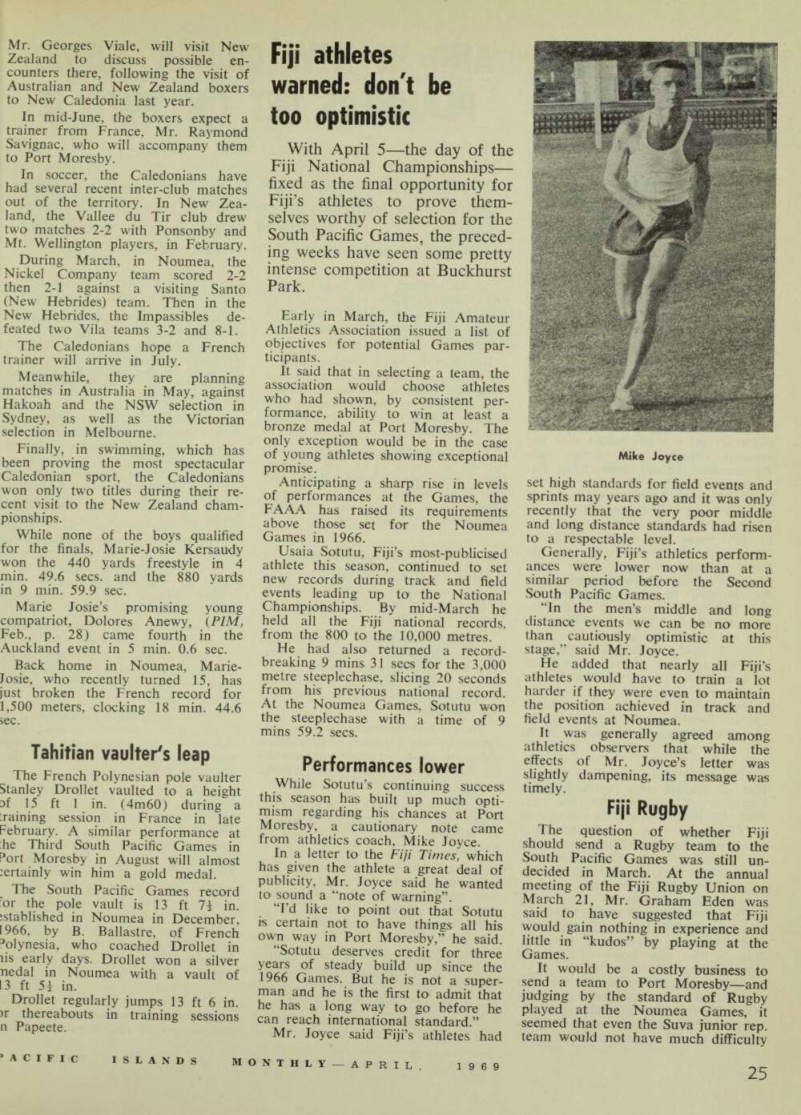
Mike Joyce
in beating teams from other terri tories, FRU secretary, Mr. Derek Robin son, argued that Fiji had a moral obligation if nothing else to play at the Games, and the president, Sir Maurice Scott, said since Fiji liked to call itself a leader in the South Pacific, it should show this in sport.
Mr. Eden’s suggestion was put to the vote and it was decided that the executive should look further into the question before committing Fiji to Games Rugby, Sir Maurice Scott warned that if the Fiji team was to do well against Wales in June, it would have to be in the finest and fittest condition.
“Otherwise the Welsh will take the pants off us,” he said.
After having played magnificently for the first 10 minutes against the All Blacks last year, it had soon become obvious that the Fiji team was not wholly fit, he added.
Sir Maurice described Fiji’s visit to England next year as the “tour of tours” as far as the Fiji Rugby Union was concerned.
He revealed that from May 10 to 25 the New Zealand Rugby coach, Mr. Ken Cunningham, would be in Fiji to coach in various parts of Viti Levu.
The FRU executive has decided that all players who represented the President’s XV against the New Zea land All Blacks would be recognised as Fiji reps. This would also apply to all who were stand-by reserves for Fiji matches since the commence ment of the international substitution rule. It would include the test re serves against Tonga.
The New Zealand Colts XV team has been invited to tour Fiji in 1971 and Australia has agreed to play Fiji on the way home from New Zealand in 1972.
At the annual meeting. Sir Maurice Scott, who has been president of the FRU for the past 22 years, was re elected. He was also made a life member for his services to Fiji Rugby.