The Practical Planter
pp. 147-157 · Read in the full issue
Artificial Insemination For
Improving Livestock
Throughout the world artificial insemination (AI) has been used widely in the breeding of dairy cattle. A recent estimate states that about 58 million dairy cows are bred artificially each year. More than 46 million ewes are artificially inseminated annually—4o million of them in the USSR or satellite states. Relatively few females of other domesticated species are bred by AI (about 900,000 sows, 56,000 goats, 125,000 mares, 4 million turkey hens, and 600,000 fowls).
The magnitude of the AI project for any species in any area results from the interaction of biolo gical and economic factors.
In considering the use of AI to im prove livestock productivity, it must e understood that— (a) progeny reduced by AI are no better than tie natural progeny from a normal lating of the same parent animals, nd (b) the breeding females them slves are not improved by being rtificially inseminated.
Artificial insemination does, how ver, allow the more widespread use f a selected male. His semen can e diluted and many females can be srved using the sparmatozoa which 'ould normally be deposited in the enital tract of a single female.
In addition, in some species the iluted semen can be preserved (by hilling, deep-freezing, or by chemical leans) so that samples of semen can e held viable until the females nom lated come into season. This gives me for the transport of the samples, ccasionally over very long distances, nd also permits a delay so that the isemination can be performed at le most fertile period of the female ycle.
After collection, spermatozoa are iable (and hence fertile) for only a jw hours but, for example, the iccial technique of deep freezing of ull semen can extend its fertile life ian for years. However, unless con itions for the preparation and storage f deep-frozen semen are rigidly con olled this advantage will, in practice, e difficult to achieve in the field.
This article is taken from South acific Commission Technical Paper Jo. 155, “Artificial Insemination of ivestock in the South Pacific”, by C. A. Martin.
Since AI allows very heavy selec tion of sires (as fewer males are needed), much must be known of the genetics, or breeding quality, of the sires retained. Further, a character istic such as milk production can be measured only in the female, and then only after she has matured and reproduced. If young dairy bulls are to be selected on the rational basis of milk production, then they must be evaluated on the results of such progeny testing.
Every AI organisation concerned with dairy cattle has its scheme for ranking the merits of young bulls, and for the subsequent widespread use of the bulls so proven. Indeed, survival of the AI organisations de pends on their ability to prove that the bulls at an AI centre have a breeding value higher than any in dividual farmer or group of farmers could select by natural mating.
Commonly, 6,000 to 9,000 cows will be bred per bull annually in well-developed AI centres.
Benefits in Islands
Thus AI is an expensive (or even unnecessary) technique in animal pro duction, unless one can be sure that it will be used correctly in a scheme soundly based on the principles of population genetics. Continuity of effort and policy in the identification and raising of breeding stock is essential for success.
Initially, animal breeding projects in the South Pacific Commission region could benefit from the use of AI for one or more of the following reasons:
© Samples of semen from selected or proven animals can be imported from other regions without the risks of either death or disease involved in the shipment of animals and their subsequent acclimatisation. o A few top-grade sires of locally adapted strains can be used in an AI scheme, (a) to distribute to the farm ing community the qualities of a male who has performed well at a State, co-operative, or other central animal research farm, or (b) to select the best of a group of young males. • Where small groups of breeding females exist, geographically isolated from other flocks or herds, inbreed ing can be avoided in those areas by arranging artificial insemination for them. This overcomes the problems of maintenance and dis posal of males in isolated island or highland areas. • AI can be valuable in disease control, since (a) the introduction of exotic diseases can be minimised as donor animals in established AI centres are kept under quarantine con ditions, and (b) diseases existing locally, particu’arly those transmitted venereally, can be controlled.
One of the most efficient schemes for use of AI is first to breed a limited number of females with the imported batches of semen from several sires having the traits of productivity which are desired in a particular area.
The young so produced are studied intensively (e.g., growth, economy of food conversion, and milk yield) and are inter-bred to give further generations of cross-breds from which
males are selected for use in the general livestock population.
Such a proposal pre-supposes the existence of research stations on Svhich to start this work; it must be mphasised that AI is only a tech aique which if correctly handled vill accelerate the improvement of m animal population, and is not m end in itself. ’
The stations are necessary for the naintenance of livestock under known •onditions. On them the initial AI irogrammes can be kept under close lurveillance- staff can become ex ierienced in this and other livestock jroduction techniques, and can train >thers for the later phases, when nany animals in commercial herds ire to be inseminated.
M Lori r U a
iViarKGCI Cnan96
In many circumstances the need or AI beyond the importation phase s slight; much more can be achieved n improving local stock by releas tig selected young males to approved armers. Once again the need for the tations arises for the feeding and aising of this young stock for dis ribution.
The use of AI can result in marked hanges in the genetic structure of n animal population in a short time, Tierefore it is wise to have a central lan to regulate its use. There is the isk that an inadequately proven sire dll be widely used and will be detri icntal to the progress of the pro set.
Alternatively, a popular sire may e used too widely and his daughters lated back to him if he is held too Dng at the AI centre. Again, it is
recognised that too high a proportion Q f E uro p ean strains in either crossbred cattle or pigs in the tropics can outweigh the initial advantage of the introduction of new genes for high productivity.
By us mg AI the sire does not have to survive in a stressful climate, whereas his offspring do, and an acute problem arises when an animal which has a hi 8 h potential for production is unfit for survival in the commercial environment.
For these reasons records must be kept of all importations of exotic strains and their use, so that changes in animal type and productivity can be appraised at a district or national level.
The livestock industry must be given direction on what strains have been introduced or have been developed locally, what further crossbreeding appears desirable, what opportunities exist for inter-strain crosses, and what are the risks of inbreeding.
Policy on the application of AI will vary from region to region, according to land utilisation, whether animal production is a major or secondary activity, and according to the s P e cies of domesticated animal involved.
The productive life-span of the species, its generation length (period from conception of the animal to the age at which it can reproduce), and the heritability of the various desirable characteristics related to productivity will determine whether AI is undertaken or whether controlled natural breeding projects are to be organised, Furthermore, a system involving both AI and natural breeding could well be the most effective plan. The following notes add detail on these interrelationships in the species most
likely to be used in the South Pacific, Pigs: As chilled or deep-frozen semen is not yet in general use, there are limitations on the transport of pig semen samples. However, enough js known to permit the use of AI for the initial introduction of a new strain. As litter size is large, the duration of pregnancy short, and the young animals mature rapidly (puberty at five to six months), much can be learnt in a short time about the breeding quality of boars and sows.
Numbers of first-and second-genera tion cross-bred animals can be bred up rapidly with natural mating, and carcase appraisals can be made of a proportion of each litter as an aid to the final selection of young stock for breeding.
The decision either to organise an AI project or to distribute young selected boars to the farming corn munity must be made after consider ing practical factors in the light of the desired rate of improvement in the pig population, Mayimum name mdAimum ycniib Maximum gains should be made by using semen from a highly selected boar in an AI scheme, but, in practice, at least in the initial stages of a project, the distribution of boars of a somewhat lower level of merit could be a cheaper and more efficient method of introducing new strains into local piggeries.
A choice on which plan to follow can be made only by studying both local needs and the stage of educa tion and efficiency in livestock pro duction of the farming community.
Horses: Few mares are bred by AI, possibly because no really satis factory method of deep freezing or otherwise preserving stallion sperm-
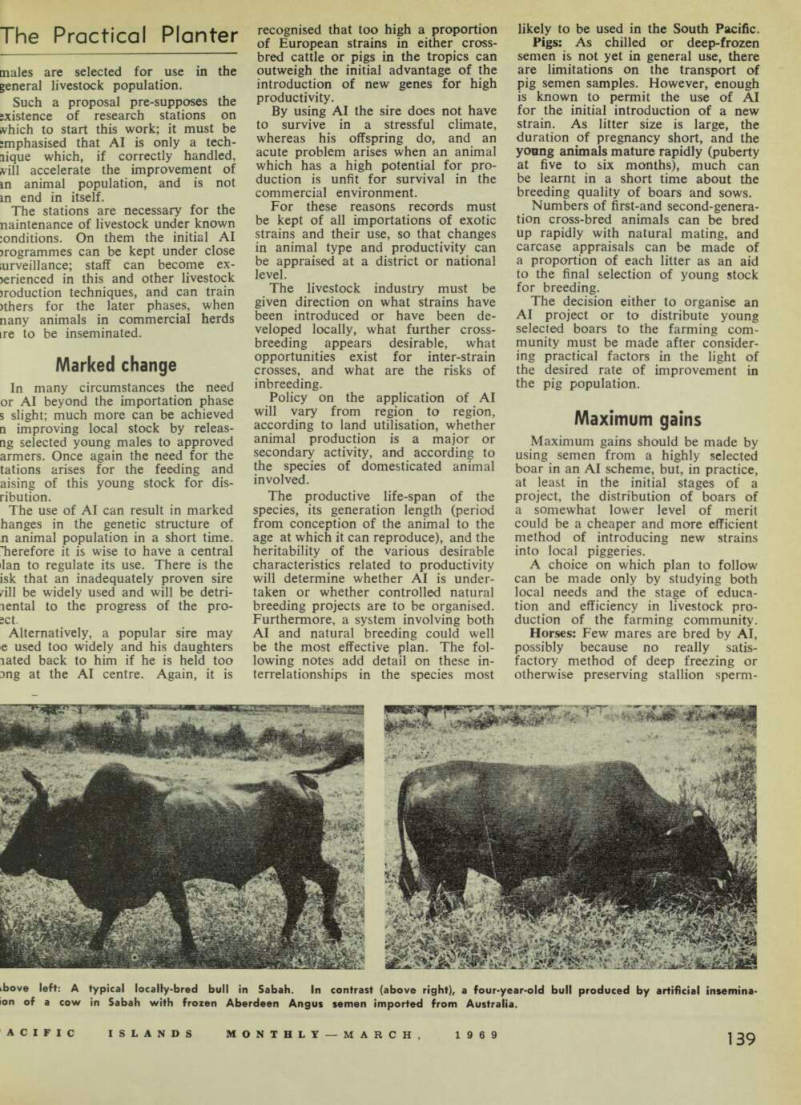
Above left: A typical locally-bred bull in Sabah. In contrast (above right), a four-year-old bull produced by artificial insemina tion of a cow in Sabah with frozen Aberdeen Angus semen imported from Australia.
tozoa has been developed. As horses ire usually kept in small numbers or riding or draught work and their working life is relatively long, except n studs, there is no pressure for requent, say annual, foaling.
Hence, where the need for horses 5 not great, a small number of mares nay be widely distributed, with few ir no suitable stallions in the region.
If semen from highly-bred stallions /ere available in deep-frozen form nd ready for the intermittent de land, the advantages would be con iderable.
In practice it has been found that tallions from temperate regions sually acclimatise well in the tropics : given reasonable feeding, housing, nd grooming. Thus, syndicates in vested in horse breeding are com lonly formed for the purchase, trans ort, and care of a stallion to stand t stud.
Until much more research has been ompleted on the AI of horses this ► the most satisfactory arrangement.
Sheep and goats: There has been ruch research on the AI of sheep nd goats. A substantial amount of fork has been completed on the □ntrol of the oestrous cycle of the we so that large numbers of them an be treated to ovulate simultane usly.
Great aid
This is a very great aid in the rganisation of an AI programme, ut, unfortunately, the experiments n preserving semen have not been s successful.
When these problems are solved, J will become a very important xhnique in the introduction of xotic strains and the selection of oung rams. Generally, those tech iques of AI which are satisfactory i sheep, goats or pigs are similar a those which are satisfactory in attle.
Cattle: AI is a particularly valuable id in breeding projects with dairy attle, though of lesser importance i breeding beef cattle.
Much is known about progeny jsting and the selection of bulls diich transmit characteristics which :ad to improved milk production, he widespread availability of deep rozen bull semen makes the importa on of samples from proven bulls uite easy.
There are many instances of the se of semen after months or even ears of storage and after many lousands of miles’ transport. Inter ational shipments of deep-frozen
semen are usually sent by air in lightweight packs, using solid carbon dioxide or liquid nitrogen as the refrigerant.
For cattle the generation length is long, single births are usual, and the individual commercial value of the animal is high. Raising even one generation of calves is a long-term and expensive project, so that once sires of above-average merit have been identified they should be used as widely as possible.
As there are usually insufficient selected bulls available for distribution among the farmers, best use should be made of those that are known to transmit desirable features to their progeny.
AI projects can take various forms, These are determined by local conditions, size of the herds of cattle in the district, distances to be travelled from the bull centre to the cows, and many other factors, all of which must be surveyed before a particular programme of herd improvement can be started.
Before embarking on an AI programme, the farmer should ensure the following: • Fencing must be adequate so that livestock cannot stray. Where
animals are housed, e.g., in pigsties, attention must be paid to all of the usual requirements of shade, water, cleaning, and drainage. 9 The breeding stock must be adequately fed. In many areas there would be greater immediate benefits from the better nutrition of the animals than from breed improve ment. Once nutritional problems are minimal, then improvements in animal type are warranted to give an even higher productivity. • Every animal must be perman ently identified by brand, tatoo, or ear tag. Accurate identification of livestock is critical for the success of any research project, and is par ticularly important in the practical operation of an AI service. Records of the breeding history of every animal must be kept, o Normally, the animals cannot be inseminated at any time con venient to the operator. Inseminations can only be fertile when performed within a range of hours equivalent to that period in which the female will allow the male to mate with her.
A high rate of fertility following AI requires precision in observation of the onset and duration of oestrus, Full control of the breeding cycles
Figure 1 —Diagram shows the arrangement of the reproductive tract, urinary bladder, and rectum of a cow. Arrow B indicates the course of the insemination pipette through the vagina to the neck of the uterus. Arrow A indicates the approximate position of the gloved hand of the technician when he locates the cervix of the cow and guides the insemination pipette into the opening.
pf any species of livestock has not been achieved, though many ad vances have been made with hormone treatment.
However, if oestrus and ovulation vere accurately controlled to permit groups of females to come into reason synchronously, then the daily pbservations of behaviour could be emitted, and all the females in a Seated group could be inseminated an the one day, thus creating an im portant advance in efficiency for AI projects. • Trained technicians must be available to perform the insemina tions. • Diseases must be adequately controlled. Emphasis should be placed mi routine prophylactic measures -ather than therapeutic use of drugs after a disease condition is evident.
Such routine matters as vaccinations, lipping to kill ticks, and dosing with anthelmintics to remove worms and lukes, are vital.
It becomes very wasteful of time, effort, and money if animals of im proved strains either die or become unthrifty because standard control Measures are ignored. Additionally, jome exotic crossbreds may prove to pe particularly susceptible to local parasites and, accordingly, special care must be taken with these animals >o that they at least can be bred in the hope that a better disease resistance can be selected in some pf their progeny.
Since AI is likely to be most useful in cattle breeding in the Islands, the rest of this article is concerned with the insemination of bull semen.
Quiet handling
There is no need to give bulls lavish attention in diet or housing.
Skilful, quiet handling is necessary if the bull is to be safely and easily trained as a semen donor. It is critically important to see that the bulls are disease-free when they enter the AI centre, and that conditions at the centre are essentially those of quarantine from the general animal population.
Cows are usually inseminated late in the day on which oestrus occurs, or if oestrous behaviour is first observed late in the day, then those cows are inseminated early the following morning.
The importance of correct timing to an AI project cannot be over emphasised. In many areas the lack of skill of the observer or the poor display of oestrus by particular
strains of cows have meant that :orrect observations have been made Dnly after teaser (vasectomised and herefore sterile) bulls were intro luced into the herd.
Attention must be paid to these letails, which mean the difference be ween success, with high fertility ates, and failure, even though the emen, whether deep frozen or hilled, is being prepared and stored orrectly.
Insemination is performed by a rained technician, who locates the jenital tract of the cow by inserting gloved hand into its rectum and uses his hand to guide the end of the in emination tube deep into the tract so hat the sperm are injected either high nto the cervical canal or into th/ items (see Figure 1 for details).
This method is preferred to the ilder method of using a vaginal peculum, as there is a real risk of ransferring disease from cow to cow n the speculum itself; furthermore, dth the older method the site of de osition of the semen dose cannot ccurately be determined.
Careful training
Disposable plastic gloves and in sminating tubes are available; they re cheap and effective and are de troyed after a single use on a cow.
Careful training (an initial three weeks f intensive training is required) and onstant supervision of technicians is ecessary if fertility results are to be igh.
There is no difference in insemina on technique using either chilled or eep-frozen semen, except that the eep-frozen semen is thawed just be >re use, and the contents of the mpoule are sucked into the insem lation tube while still at a low tem erature. Chilled or deep-frozen imples are transported on to the irm in insulated containers, and it is sound general practice to take away om the laboratory only sufficient ;men to inseminate the cows known > be ready for breeding.
In general, chilled samples are not nproved by transport, and accidents -in which either chilled or deep ozen semen is allowed to warm and len cool again (which is very damag ig to fertility)—can occur, and may 9 undetected, with the damaged )erm being used on a later occasion.
The breeding history of every cow mst be readily available. Card 'stems, grouping cows into farm “rds, are simple to use, and similar
□formation of cows inseminated per jaculate must be recorded.
Fertility results are usually judged >n non-re turns to service; it is the iractice to allow two further free in eminations should there be no con eption at the first service. This icthod has the advantage that the armer is highly likely to report the •utcome of the first service if there > an option on more inseminations, nd therefore the centre’s fertility re ords for first services will be ccurate. Conversely, there must be ositive identification of individual ows, ohterwise there is a tempalation 3 nominate fresh cows as return ser ies for cows already pregnant.
Over 60 per cent.
Most well-run AI centres find that ver 60 per cent, of cows will con eive on the first service, but often lis is only achieved after much work n the above and other practical de iils. ummary: From the information outlined for cattle it can be seen that AI projects are much more complex than simply obtaining semen and inseminating females.
Artificial insemination does appear to offer the most satisfactory method of introducing new strains and testing young males for their breeding quality, and then using them widely in the general livestock population. lany modifications of basic tech niques can be made to suit local re quirements, and AI schemes will run successfully if judged by fertility results. however, the ultimate critical test of the use of artificial insemina tion is whether the quality of the livestock population has been im proved at a greater rate than by natural mating. Natural mating is easier and cheaper to organise. • Trials with a variety of maize ed in Taiwan are being conducted Fiji. The seed was imported by >uth Pacific Sugar Mills Ltd., from e Corn Research Centre of Taiwan hich works in close co-operation ith the Rockefeller Foundation of merica. It is a hybrid variety bred resist downy mildew disease which so attacks sugar cane.