Business and Development
pp. 127-130 · Read in the full issue
Carpenters: A bonus with a shipping surprise to boot
Few will quibble that February wasn’t W. R. Carpenter’s month. The many-faced Islands business leader and general in vestor declared a generous bonus share issue, indicated a best ever profit on the way for 1968-69, collected two significant British and Japanese shipping agencies in Australia and NG and ambitiously launched a $500,000-plus cargo forwarding tie-up from Australia to NG with a major Australian transporter.
It was cream cakes for share holders who have seen their 50 cent shares in W. R. Carpenter Holdings Ltd. climb from a low point of $l.Bl last year to $3.45 following the February announcement of a one for-five bonus share issue. Capital now shoots up from $l5 million to $lB million but directors are con fident last year’s 18 per cent, dividend will remain.
The Carpenter bonus closely follows an identical one-for-five bonus by its major competitor. Burns Philp and Co. Ltd. (PIM, Dec., 1968, p. 128) and this happy news was probably one reason for the shares in the third NG business leader. Steamships Trading Co. Ltd., to go to 96 cents in February—this company’s best for nearly two years.
But the glory was Carpenters. A bonus this year or another increased dividend came hardly as a surprise.
In fact, PlM’s finance roundsman says shareholders can expect further handouts—either by bonuses or increased dividends—in the next 24 months.
Finance for Carpenter’s two major NG projects—New Britain desiccated coconut and Highlands tea —has proved more than anticipated, but most of it has now been spent out of reserves. From now on production from both will steamroll and produce buyers’ cheques will flow to the com pany.
Carpenters have a particularly rosy future with their NG tea exports.
While they intend to sell much of the high-grade produce to Europe and North America, Australia will be a major buyer. As with NG rubber
exports, where Australian rubber manufacturers must buy all NG rubber at dear prices before buying elsewhere, Australian tea makers (especially Bushells) could find their hot little brewing hands handling all the NG tea available before they can even look at other overseas tea.
A guaranteed Australian market for NG tea, even with “jacked-up” prices, isn’t an impossibility.
Other details of the Carpenter an nouncements in February were: • From April 1 subsidiaries of Carpenter in Australia and NG will become agents for the British-owned Austasia Line Ltd., which operates between Australia and South-East Asia.
• From March 1, W. R. Carpenter and Co. Ltd. became general agents in NG for Mitsui OSK Lines Ltd., which currently operate a monthly sailing from Japan to NG and return, and a monthly sailing from Japan and Hong Kong to NG and NZ. • From late March there will be launched a 50-50 venture with Thomas Nationwide Transport Ltd. and Carpenters, which will offer a door-to-door freighting service between Sydney and Brisbane to Lae.
The Carpenter—TNT announce ment is the most significant. It links two huge companies on routes which exporters and shippers say are already over-catered for. Competition will be intensified.
The partners have formed two companies for their cargo forwarding venture. They are Papua New Guinea Through Transit Pty. Ltd. (registered in Moresby with a nominal capital of $500,000) and PNT (Australia) Pty. Ltd. (registered in Sydney with a nominal capital of $50,000).
"W.R.—big hand"
The boards of both companies naturally bristle with top executives of TNT and Carpenters, but it’s interesting to see Mr. W. R. Car penter, Carpenter’s deputy managing director, on the boards, rather than Mr. C. H. Carpenter, his managing director. “WR” took a big hand in answering some curly questions at a Sydney Press conference to an nounce the deal.
Also handling his share of curly ones at the conference was a white-haired, good-looking Mr. Ken Thomas, chairman of TNT, who was asked which established NG shipping companies would handle the venture’s freight (as the service is a forwarding service only and neither company has any shipping).
He said: “We have been approached by at least three shipping companies to carry our goods”. He wouldn’t name them.
PlM’s shipping roundsman says four companies could currently cater for the cargoes.
Of them, Karlander, South West Pacific and Burns Philp have all had preliminary “talks” with TNT- Carpenters. No agreements had been made up to late February. The other
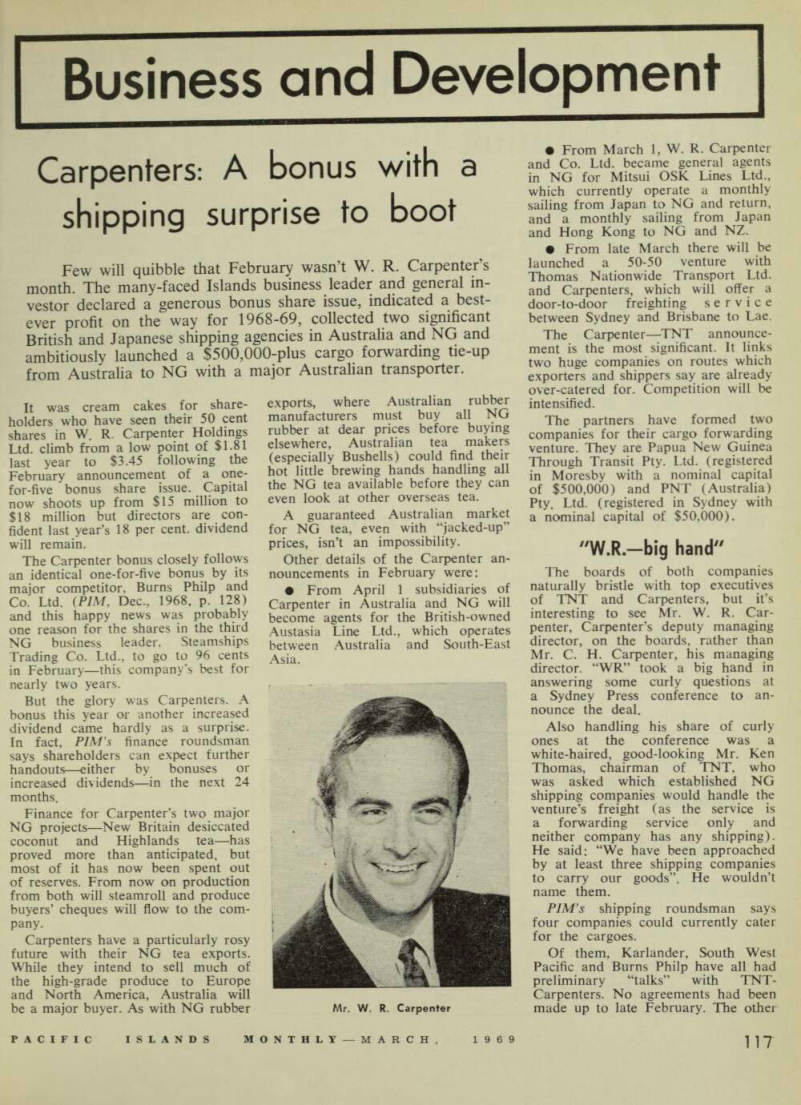
Mr. W. R. Carpenter
company, China Navigation, sees the venture as a direct threat to itself.
China Navigation’s attitude is—ships are full already, too many shippers operate—a sign that the TNT- Carpenter venture is not meeting with universal glee.
Shipping company attitude also was: “They would approach us, we wouldn’t approach them”.
Keith Holland Shipping, which operates a motor vessel from Queens land to Papuan ports and in which Mr. Thomas has personal interests, will not be connected in any way with the new venture, Mr. Thomas told PIM.
Mr. Thomas said TNT and Car penters could possibly buy or charter their own ships for the venture. But a question from PIM as to where these ships would be registered brought only half-hearted cries of “Panama, Timbucktoo” from a bevy of TNT and Carpenter executives.
Professional touch
Press conferences apart, this new venture looks good. It will be run by two highly-successful groups who could well put a more professional touch into Australian exporting operations to NG. That Lae and Highlands were selected as the area of operations adds more weight to the growing consensus that this area is the territory’s real go-ahead region.
The partners have taken up a “majority interest” in Kevin Seeto Customs Agency, Lae, which will fit in with operations. TNT will carry Australian cargo to Sydney, Brisbane or Melbourne in its own trucks and when it reaches Lae local contractors will carry the cargo around Lae or onto the Highlands.
Aims are to set up one charge to exporters for handling of their goods from their Australian factories to their NG customers.
Another single charge will be laid for NG producers for pick up from their factories or farms to the offices of their Australian buyers. Hopes are through transit handling to reduce losses from damage and pilfering.
Both companies are extremely con fident the venture will be a success within a very short time and indica tions are operations will extend to other territory ports and even other Pacific territories soon after. Back loading cargo problems out of NG could be overcome by the group— Carpenters have very ambitious pro duction targets for tea and desiccated coconut production.
s2m plan fa
boost 1 Fiji
Fiji’s Council of Chiefs in February accepted a report recommending the establishment of a Fijian Investment and Development Corporation, with an authorised capital of $2 million.
Among the methods suggested for financing the corporation were share participation by the Fijian public and by the Fijian Affairs Board, share investment or loan finance from the Fijian Development Fund Board and government assistance.
The fields envisaged for the cor poration included tourism, produce marketing, saw milling, real estate and residential development and building and heavy construction.
The corporation would not, the report said, perform economic miracles or become the panacea for all the economic ills of the Fijian people.
The report was prepared by a committee headed by Peni Naqasima, the Assistant Minister for Com munications, Works and Tourism, and presented to the Council of Chiefs by a member of the committee, Mosese Qionibaravi.
The corporation’s authorised share capital of $2 million was envisaged as being divided into 2 million $1 shares. It was suggested that no projects should be initiated until $500,000 of paid-up capital was available.
The committe pointed out that Fijian income derived from wages, salaries, agriculture and commercial ventures amounted to between $23 million and $27 million a year. This represented a substantial ready market for goods and services which now largely benefited non-Fiijans.
While it was suggested that a managing director be recruited from overseas for something like a five year term, it was agreed that one or two suitably qualified Fijians should be appointed to understudy him, with the view of finally taking over.
The Governor, Sir Robert Foster, said at the opening session of the Council of Chiefs that such a cor poration was likely to play a major role in the economic advancement of the Fijian people.
Discussing the system of land rating, Sir Robert said there was almost universal preference among the Fijian people for the new system, already adopted by the provinces of Tailevu, Kadavu and Ba.
Attempts were being made to secure the services of additional professional valuers to accelerate the speed with which Fijian land in the remaining 11 provinces could be valued.
Sir Robert said he was in the
process of appointing a committee to examine the provisions of the Agri cultural Landlord and Tenant Ordinance, with the intention of making it more workable in practice and more equitable in concept.
February's world
copra market report
Mr. lan McDonald, chairman of the PNG Copra Marketing Board, reported on February 24: Copra prices have fallen gradually from SAI9O to SAI7S, and it’s hard to say if the trend will continue or if prices will stay at present levels.
Much of the drift came from pressure to sell parcels which have recently arrived in Europe, Recent exports of copra and coco nut oil showed a slight increase, although overall 1968 tonnage was almost four per cent, less than in 1967. However, variations in quantity do not seem to be enough to affect the market, and it is more likely that buyers have taken temporary advan tage of afloat parcels to depress the market.
The price of copra in 1968 was ex tremely high at an average of about $2lO per ton (from a high of $255.76 in May to $174,20 in October), and unless there are outside influences affecting production and supply, it mightn’t be surprising to find copra prices levelling out at about $175 this year.
A-bomb protest
with a difference
A report that the American Atomic Energy Commission was to create a harbour in northern Western Aus tralia by setting off a thermo-nuclear explosion had repercussions in Tahiti early in February.
TTie repercussions were heard in the local Territorial Assembly, where the majority parties, led by Messrs.
Francis Sanford and John Teariki, have been bitterly critical over the past few years of France’s nuclear testing project in the Tuamotus, At an extraordinary session of the Assembly, Mr. Henri Bouvier, a prominent Sanford-Teariki man, pro posed that the French Government should protest to the Australian and American Governments over the pro jected explosion in Western Australia.
However, the chief results of this was to provoke an explosion of anger from members of the conservative minority parties, who have become rather bored by the majority’s fre
quent protests over the Tuamotu tests.
“When will you finish bringing politics into your debates?” Messrs.
Gaston Flosse and Frantz Vanizette asked the majority. “We have better things to do than to listen to you.
“After all, gentlemen, this affair is primarily of interest to the Aus tralians. Are they complaining? It doesn’t seem to us that they are. And is it certain that the explosion will take place?
“Look how many years they’ve been talking about blowing a second canal through Panama, and nothing has been done about it yet.
“Let’s stop wasting our time and get on to serious matters.”
When it was moved that a vote be taken on Mr. Bouvier’s proposal, the minority councillors walked out of the Assembly, leaving it without a quorum and forcing the president to suspend the sitting.
Next day, one of Papeete’s news papers likened Mr. Bouvier to a Castro-model Don Quixote tilting at imaginary windmills; and there seemed to be a general feeling that members of the Sanford - Teariki coalition could overplay their hands in protesting about the dangers of radio-activity. Still, in view of the Australian and NZ attitude to the French Pacific explosions last year, it was probably poetic justice.
Bank for Hawaii?
In a move viewed locally as “reasonable”, the Bank of Hawaii has offered to take over the com mercial section of the Bank of Ame rican Samoa, Pago Pago. If success ful, Hawaii would collect deposits of about SUSS million and capture a business making an annual profit of about $U5250,000.
The Pago bank would become basically a development bank and no longer accept deposits. The Hawaiian arrival would make Bank of American Samoa cheques negotiable in the US (they aren’t at present) and also presumably make far more funds available for local loans, such as hotel projects.
Second bank for
New Caledonia
The Banque Nationale de Paris re cently opened a branch in Noumea at the corner of the Avenue de la Victoire and the Rue de Vemheil.
The coming of the BNP means that New Caledonia now has two banks, and that the monopoly of the Banque de I’lndo-Chine has been broken. The Banque de ITndo-Chine
has been established in New Cale donia since 1878.
New Caledonia’s banking situation is now similar to Tahiti’s, where a new bank, the Banque de Tahiti, was recently founded with substantial American backing and the monopoly of the Banque de Flndo-Chine has been broken after many years ( PIM , Dec., 1968, p. 129).
BP's on (■he
move in Suva
After over 20 years of “thinking about it”, Burns Philp and Co. Ltd. has opened an office of its subsidiary.
Burns Philp Trustee Company Ltd., in Suva. It’s all part of the new and aggresive approach of the Big Firm under the chairmanship of Mr.
David Burns.
BP’s first thought of whacking its trustee group into the Pacific Islands back in 1946 but under the con servative knuckles of the late Mr.
Joseph Mitchell nothing was done.
However, last year the Fiji Development Bank asked BP’s to act as trustee for its debenture stock.
To comply, the Big Firm had to set up its trustee company in the colony.
Therefore, in December, special legislation went through the Fiji Government to allow the company into Fiji.
Then, when BP lodged 550,000odd as sureties in Fiji Government Loans, the road was cleared early this year for trustee operations.
Another oil strike
in Gulf of Papua
A further off-shore gas-oil strike by Phillips Australian Oil Company in the Gulf of Papua in February closely followed pressure in Aus tralia for NG equity participation in any exploitation of oil discovered off NG’s coast.
Present government legislation doesn’t cover ownership or control of off-shore resources in NG and it’s likely a similar deal to the 20 per cent, option equity the NG Administration has in the Bougain ville copper project would be sought.
To date the NG Administration could only expect a 10 per cent., royalty payout on oil exports.
Meanwhile, Phillips, at its Pasca A-2 off-shore well 50 miles off the Papuan coast and 162 miles north west of Port Moresby, found “sub stantial amounts” of gas and liquid hydrocarbons about 7,000 ft down.
The daily rate of condensate was up to 1,375 barrels.
Record sugar tonnage
crushed at Lautoka
The Lautoka sugar mill closed dur ing the first week in February after crushing the biggest tonnage of cane yet milled in Fiji.
Manager of the mill, Mr. J. M.
Aitken, estimated the crush to be about 1,390,000 tons. He said the previous record was in 1967 season, when his mill crushed 1,129,000 tons.
The 1969 crushing season at Lautoka is expected to begin towards the end of April.
South Pacific Sugar Mills Ltd. is building Fiji’s largest molasses tank, to be completed and commissioned for the 1969 sugar crushing season, at the Lautoka waterfront.
It has its own pump house, with electrical installations capable of pumping molasses to carrying vessels at the rate of 200 gallons an hour.
The 1,600,000-gallon tank was de signed by the company’s engineers,
Japanese in
Pacific partnership
Assisting in raising finance for Bougainville’s copper project could be one of the first jobs of Partner ship Pacific Ltd., a company recently formed by three banks—the Bank of New South Wales, Bank of Tokyo and Bank of America—to organise finance for, and invest in, natural resources in Australia and its nearby regions.
Mr. Masao Tsuyama, manager of the Bank of Tokyo’s international in vestment section, said that if approached, PPL “might assist” in raising finance for Bougainville. He added that Japanese manufacturers opening up in Australia could be helped also —a point which would mean these makers’ exports could find their way to places like NG or Fiji.
Fiji nearer self
sufficiency in rice
Fiji’s rice industry took another step closer to self-sufficiency in February with the news that more than SUSI million is to be spent on a pre-investment survey for a rise-growing drainage and irrigation scheme in the Rewa area.
The United Nations Special Fund has agreed to contribute 5U5654,500 —following an application made to it by the Fiji Government in 1967
and the Fiji Government will pro vide $U5466,755.
Experts in drainage and irrigation engineering, a hydrologist and agri cultural and flood control engineers will be provided by the UN’s Food and Agricultural Organisation, and equipment will also be provided for agricultural, engineering and hydro logical work.
It is intended that fellowships will be awarded to enable local counter part staff to receive overseas training in irrigation and drainage.
Part of Fiji’s contribution will be the construction of a 250-acre pilot scheme. It will be used to test engineering designs and layout and to conduct trials and experiments in the agronomic and economic aspects of irrigated farming, using rice as the principal crop.
Oil firms given
go ahead by Tonga
Shell, British Petroleum and the French firm Aquitane have won Tongan approval to check out oil seepages in the kingdom following many applications by experienced— and inexperienced—oil corporations to do the job.
The three successful companies were announced in February by King Taufa’ahau who said many of the companies who had applied to look for Tonga’s oil did not have “inter national experience”.
Other applicants could be termed “wild catters,” the king said.
Investigations by the three companies were expected to start later this year.