Pacific Shipping
pp. 107-113 · Read in the full issue
Captain Savoie has landed his biggest fish yet
After 24 years of buying, selling and operating ships in the Pacific Islands, French master Emile Savoie pulled off his biggest coup in February when he bought the 3,786-ton passenger-freighter Malekula in Sydney from Bums Philp and Company Ltd.
The price he paid BP’s for its 17year-old ship was not made public, but Captain Savoie told PlM’s ship ping roundsman that it was less than the £Stg. 100,000 offer BP’s had re ceived from Asian buyers. The Asian sale was earlier disallowed by the Australian Government.
Captain Savoie said that the Male kula will replace the 1,334-ton Jacques Del Mar II on the three-weekly cargo-passenger service from Sydney to Lord Howe Island, Norfolk Island and Noumea. The Jacques Del Mar II will be sold.
So far three offers have been made for this ship, and Captain Savoie in late February anticipated a quick sale, either to Australian or Islands buyers.
New Caledonian crew
Captain Savoie will use a crew of 25 New Caledonians to operate the Malekula, whereas BP’s used a crew of 54 Australians. He will install an automatic pilot and introduce other forms of automation.
He said that he had bought a far bigger ship than the Jacques Del Mar II because he anticipates increased business between Australia and New Caledonia now that more nickel operators are moving into New Cale donia.
Malekula’s sale means BP’s has re duced its fleet to four ships—Brae side, Tulagi, Montoro and Moresby.
However the company needs more cargo space to NG and it will enter into a joint arrangement with a NG shipper later this year for another vessel.
Malekula’s appearance under French flags could mean an even tougher time for Lord Howe’s cargo handlers. She’s a big ship and a stop
at the island for a meagre 80 tons or so of cargo is hardly worthwhile.
In Captain Savoie’s words, future calls here “would be an even bigger nuisance than before”.
Captain Savoie’s new ship—to be renamed the Jacques Del Mar ll —left Sydney in late February on her first regular run, with her owner as master.
Based in Noumea these days, Cap tain Savoie went to sea in 1928 (he was 16) as an apprentice in the Destremau, a 5,000-ton freighter carrying timber in and out of New Caledonia, Tahiti and Fiji. Soon after, he joined the Messageries Mari times ship Pierre Loti, a 6,000-tonner
trading from China to Noumea and Sydney.
In 1935 he was made chief mate on the Neo Hebrides, a 1,000-tonner working between Sydney and Noumea. It was on this ship that, in 1939, he gained his master’s cer tificate.
Met John Kennedy
During World War II he was master of the Polynesian and a pilot for the American Navy in Melanesia.
On Santo in 1944 he met and made friends with a young American PT boat officer called John Kennedy.
From 1945 on he has been buying
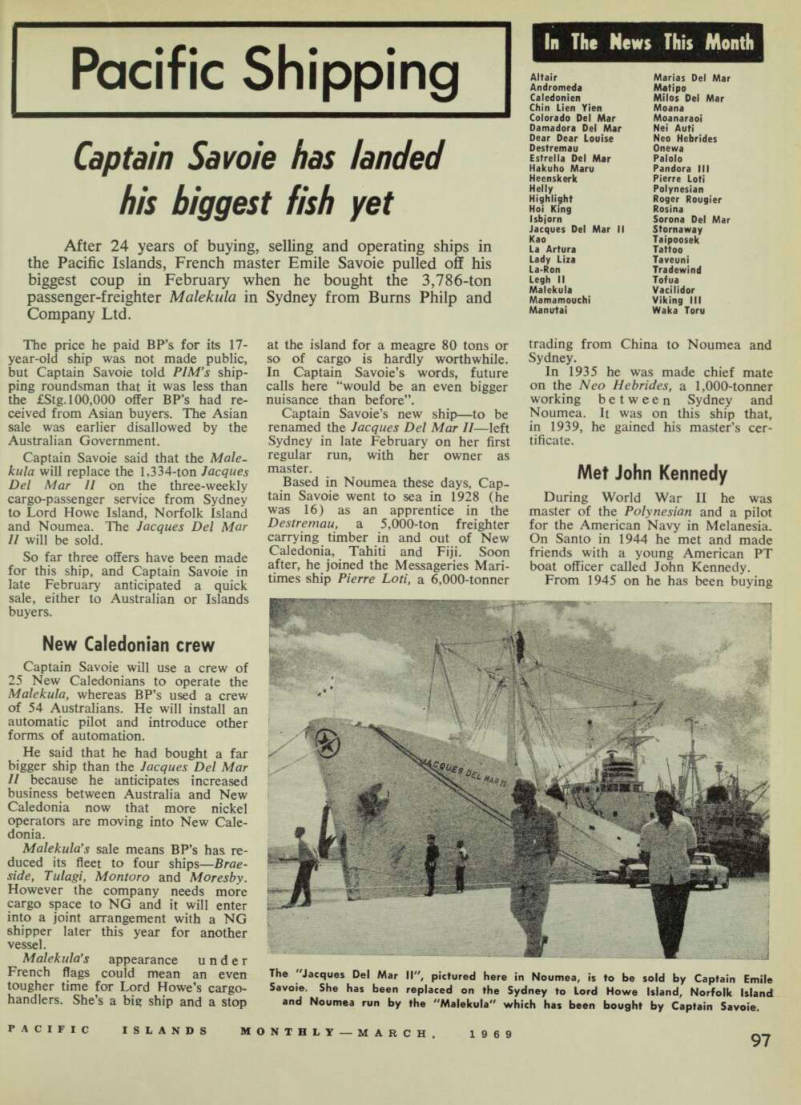
The "Jacques Del Mar II", pictured here In Noumea, is to be sold by Captain Emile Savoie. She has been replaced on the Sydney to Lord Howe Island, Norfolk Island and Noumea run by the "Malekula" which has been bought by Captain Savoie.
and selling ships the way some people buy and sell cars. The list includes three named Colorado Del Mar, three named Marias Del Mar, two Jacques Del Mar, the Estrella Del Mar, two named Sorona Del Mar, two Milos Del Mar, the Altair, Damadora Del Mar and now the Malekula. Most ships were freighters of the 100-ton to 1,200-ton range.
In this period there has been only one other similar South Sea dealer in ships—the irrepressible Athol Rusden of the New Hebrides.
In 1955 Captain Savoie formed a company, Societe Maritimes Cale donienne, to operate his Sydney- Noumea service in opposition to a Messageries Maritimes service with the Polynesian. Captain Savoie now holds about half the shares in this company.
A descendant of one of New Cale donia’s pioneer French families, Captain Savoie married Margarethe Porcheron of Noumea in 1942 and the couple now have a teenage son, Jacques.
PIM asked the 57-year-old busi nessman why he spent so much of his days at sea. His answer: “My father didn’t want me to be a sailor but I wouldn’t listen to him and I went away to sea. I wanted to see countries, I was born on an island and I liked ships. What else do you need?”
British Firm Wins Si.Bm.
Vila Wharf Contract
George Dew and Co. Ltd., con structor of Tonga’s STI million Nukualofa wharf, has now landed a $1.83 million contract to build a 700 ft deepwater wharf at Vila, New Hebrides.
The British firm, whose tender for the Vila wharf was the cheapest re ceived by the condominium govern
ment, bettered nine other tenders from British, Australian and French firms.
Losers included Taylor Woodrow International Ltd. (Britain) and Compagnie Francaise d’Enterprises who offered a joint tender and were among the favourites.
Other tenders were Societe de Grands Travaux de I’Est, Societe Dumez, Enterprises Courbot, Kier Ltd. (British) and Australian companics Hornibrook Constructions Pty.
Ltd., John Holland (Constructions)
Pty. Ltd., Citra Australia and Gam mon Australia Pty. Ltd., which has Malayan interests and experience in Fiji.
Dew’s bid was successful because of its work in Tonga, its low tender and its statements that as much New Hebridean labour would be used as possible.
The company will start work in June and it hopes to complete the wharf in 2J years. Vila’s wharf will cater for big liners up to the P and O Arcadia’s size and it will be able to berth two freighters of the size of the Caledonien and Polynesia at the same time.
The New Hebrides Condominium Government will pay for the much awaited wharf out of condominium funds and loans raised in London and Paris. The government was pleased to receive 10 tenders for the wharf. Tenderers’ estimations of the cost of the wharf varied widely, as did their projections of the time it would take to build it.
Advisors to the government on construction of the wharf were Wilton and Bell Dobbie and Partners, who have had wide experience in Pacific Islands wharfs, causeways and airfields.
Vila doesn’t have any deepwater wharf. Overseas vessels stand off the
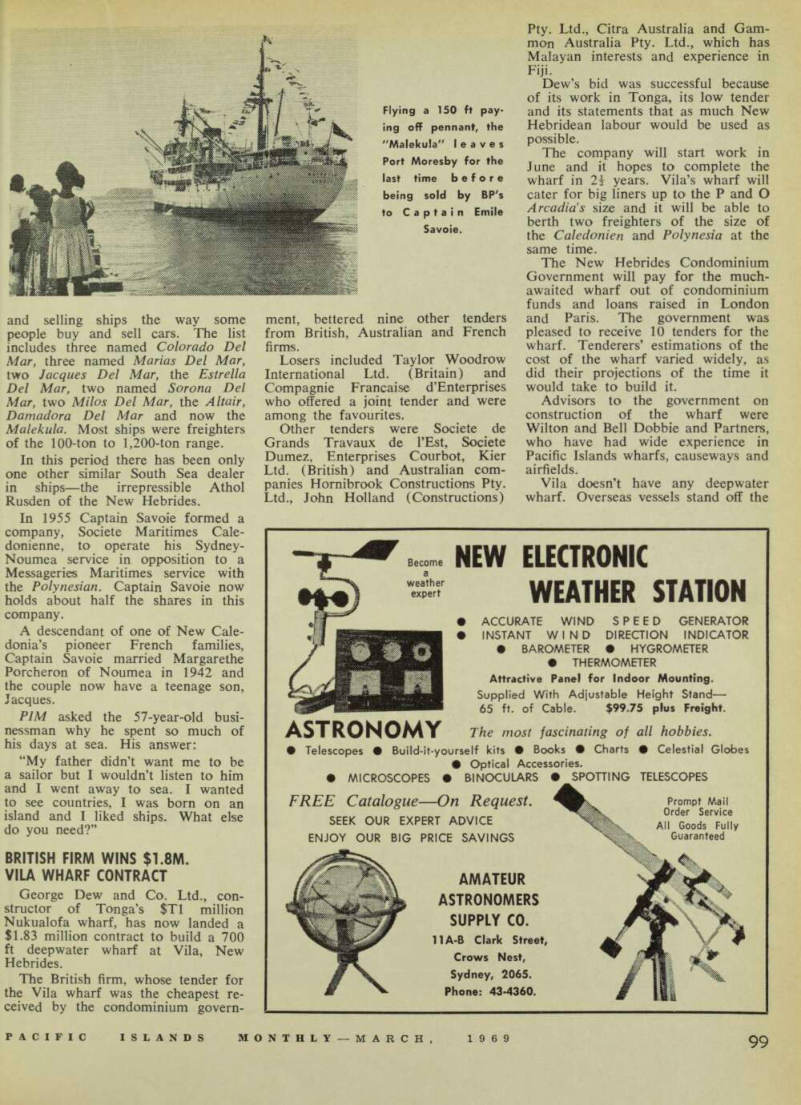
Flying a 150 ft pay ing off pennant, the "Malekula" leaves Port Moresby for the last time before being sold by BP's to Captain Emile Savoie.
town and offload cargo by lighters.
Its new wharf will be on the sheltered south side of Vila Bay and will be served by a new mile-and-a-half road from the town.
Santo has had a deepwater wharf for many years.
No Increase In South
Pacific Radioactivity
Last year’s nuclear tests in French Polynesia have not resulted in any increase in the radioactivity of waters west of the Cook Islands. This is the finding of 29 top Japanese scientists aboard the SUS 4 million 3,000-ton research vessel Hakuho Maru.
Late last year the Hakuho Maru made a sweep from the Marshalls, some 30 degrees to the north of the Equator, to a point 70 degrees south of the Equator (well past the south ern tip of NZ). The ship made a course past the Phoenix Islands, the Tokelaus, the Samoas, Niue and Tonga, and scientists took samples of sea water en-route.
Owned by the Tokyo University’s Ocean Research Institute, the trip had cost the institute over $250,000.
Director of the expedition, Pro fessor J. Horibe, told PIM that in addition to examining seawater, the scientists had also made a close examination of the South Pacific sea bed, particularly in deep areas. He said that information gained would be valuable for fish farming projects in the Pacific Islands.
He pointed out that Japan had to look ahead for her huge food wants of the future. The Pacific Islands were an “ideal area” for farming the sea.
And why, PIM asked, were Japan and Russia doing so much oceano graphic research in the Pacific Islands while the two major powers in the area—the US and Britain— were doing so little?
He didn’t know, he said, but added: “I think my country sees a bigger future in food supples from the sea than others.”
"Roger Rougier" For N.
Hebrides Timber Trade
A timber freighter Roger Rougier is expected in Vila in April from France. Built for Societe Timber Carrier Corporation, which is de veloping timber reserves on the south New Hebridean island of Erromanga, the ship will be used for carrying timber from Erromanga to storage depots on Efate, the condominium’s administrative centre.
Roger Rougier has been specially built for carrying timber and her hull is designed to handle loading on Erromanga’s beaches.
"Nei Auti": The Ferry That
Goes Off And On
The early February news that Nei Auti, the GEIC’s new ferry which runs between two major centres on Tarawa Betio and Bairiki had broken down again made many residents of the two centres wring their hands.
Before the much-publicised Nei Auti arrived for service last year, services were maintained by smaller and slower launches. A single trip never took less than 40 minutes and often longer.
In contrast, Nei Auti, standing high out of the water, “screamed” across Tarawa Lagoon in 25 minutes. So instead of running an hourly service the colony decided to run a half hourly service.
But then the ferry’s intricate petrol fuelling system started to give trouble. Nei Auti was pulled out of service for a couple of days in December to “rectify things”. For Tarawa residents it was back to the 40-minute-plus trips.
Although things were rectified it wasn’t long before things again went wrong, and the Nei Auti has been off and on ever since.
The people responsible for the services the men in Betio’s Marine Department such as Captain Willie Schutz—have copped many a head ache on account of the Nei Auti.
Among other things they have had to have spare parts for their super ferry flown in from Fiji.
A PIM man in Tarawa recently found that the most popular solution to the GEIC’s ferry crises was to pur chase another fast ferry so that when one ferry was taking a sickie, her sister could do the honours.
However, Administration attitude is to hang on with the one ferry. The Admin, boys point out that the cause way is on the way and soon ferries won’t be needed.
Two New Tourist-Fishing
Vessels For Lord Howe
Lord Howe is getting two new 36 ft tourist-fishing boats. Mr. Roy Wilson, owner of the Leanda Lei guesthouse and the island member on the island’s board, will have finished building his wooden vessel Viking 111 by June. It will be skippered by islander Gower Wilson, 29, on special fishermen’s cruises around the island.
Mr. Clive Wilson, bicycle operator, petrol agent and local contractor for servicing the island’s flying boats, is having a $25,000 aluminium boat