Yesterday
p. 99 · Read in the full issue
Bothersome Falcon Island, Tonga, was on the way down.
The island, which has bobbed up and down since its discovery in the late 18th century (the bobbing is caused by underwater volcanic eruptions), was reported nine fathoms below the sur face of the Pacific in March, 1949. This followed a 1946 report which had said the island was at a depth of five fathoms. It was all pretty disconcerting for poor old Tonga, which annexes the island each time it breaks water. In the late 1800’s Falcon came up in a big way—a strip of barren land a mile and a quarter long and 153 ft high appeared.
Other items in PIM for March, 1949, included: French Polynesia’s Governor Pierre Maestracci was to take up a new post in France and be replaced in Tahiti by Mr. Armand Anziani, a Sub-Director of Economic Affairs in the Ministry of French Overseas Pos sessions.
From Canberra on March 15 came the official announcement that Port Moresby was to be the permanent administrative headquarters of Papua- New Guinea. It cancelled a 1941 plan recommending Lae as NG”s capital (and Port Moresby as Papua’s).
An author, Professor J. W. Coul ter, created a storm when he said, “Fiji might do better if it were a land of teeming Indian hamlets and farms.” The Fiji Times blasted Mr.
Coulter; the Pacific Review said Pro fessor Coulter was “‘talking sense”; and the Oceania Daily News chipped in and supported the Fiji Times, alleging that the Pacific Review was a “Communist organ”.
Under construction for the Union Steam Ship Company was a 6,000ton passenger cargo vessel. The aim was to use the ship, the Tofua, with the other company ship the Matua, on the NZ-Fiji-Samoa-Niue- Cooks service.
Two small tuna ships Hawaiian Tuna and Marlin had arrived in Tahiti waters to try to start a tuna fishing industry in French Polynesia.
First jobs were to conduct a trial run and then gain a fishing permit.
Tonga’s Queen Salote arrived in NZ on an official visit. She travelled on the Union Steam Ship Company vessel Matua and was accompanied by Vavau’s Governor A. Ulukalala, a lady-in-waiting and two attendants.
A Japanese plan to re-settle 40,000,000 Japanese in New Guinea
was being mooted. American re ports said it would be an effort to solve Japan’s over-population, and Japanese Government pressure was being put on the US to support the plan.
Building progress was envisaged at Luganville, Santo, following the open ing of Harris’ Cinema and a new Barrau store. Talk was that “big business” was to build a new hotel (a “sort of country road-house”) and other stores in this important centre of the New Hebrides.
Mrs. Helena Marie Hides, one of Papua’s pioneer women and mother of the territory’s famous explorer, Jack Hides, died at her Sydney home on March 6.
A prayer was doing the rounds in NG. It went: “Oh Lord, grant that this day we may come to no decision, neither run into any kind of respon sibility; but that all our doings may be ordered to establish new depart ments, for ever and ever Amen.”
An ADO, Gus G. O’Donnell, had returned from a patrol of the Ufim and Umi River region of New Guinea. He had been out since January to investigate a report that natives had been killed by other natives armed with Japanese rifles.
During the patrol O’Donnell and his party climbed to the moss-forest region which lies between 7,500 and 8,000 ft in the Finesterre Ranges.
One arrest was made by O’Donnell but no Japanese weapons were found.
However, it was still believed that some of the natives in the region had rifles and further patrols were planned.
After three years’ tenure of office as New Zealand’s latest Adminis trator and first High Commissioner
in Western Samoa, Col. F. W.
Voelcker had left Apia in February for the US where he was to spend a lengthy holiday before becoming one of New Zealand’s delegates to the South Pacific Commission. The newly-appointed High Commissioner was Mr. J, R. Powles who was due to arrive in Apia with his wife in March.
In Fiji, a Press Bill was passed which allowed the Governor in Coun cil to order a correction to be printed following the publication in any news paper of a story he considered false or distorted. Naturally enough the bill caused quite a stir. The Oceania Daily News spoke of “secret police”.
The Fiji Times, however, was quite calm about the measure, pointing out that the bill merely set out in black and white a right which had long been granted to all governments, in stitutions and individuals by reputable British newspapers.
The first Papuans to be brought to Australia by the External Terri tories’ Administration Miria Gav era, Boe Kapena and John Tam had been inspecting Queensland co operative organisations in February.
TLe three Papuans were co-operative inspectors with the New Guinea Administration, and their duties were to help run the 82-odd village co operatives which then existed in the territory.
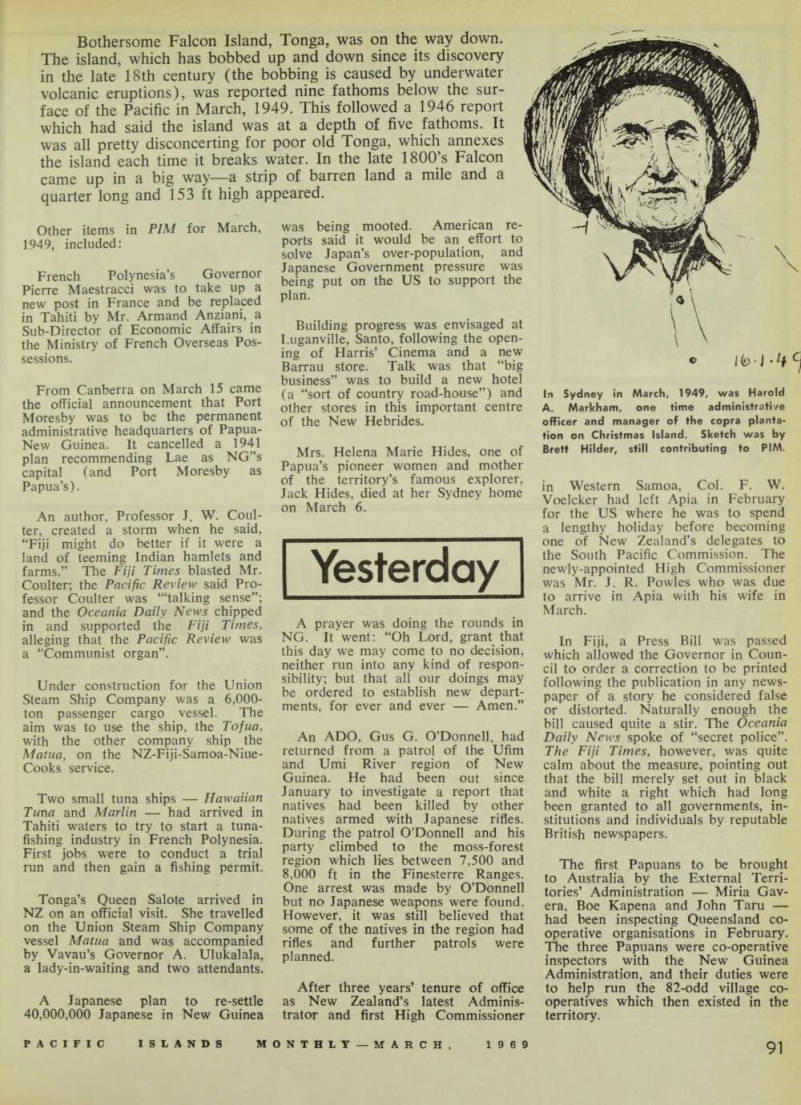
In Sydney in March, 1949, was Harold A. Markham, one time administrative officer and manager of the copra planta tion on Christmas Island. Sketch was by Brett Hilder, still contributing to PIM.