Magazine Section
pp. 89-97 · Read in the full issue
Vivid new light on the wild Pacific of Louis Becke's day
By Robert Lang Don
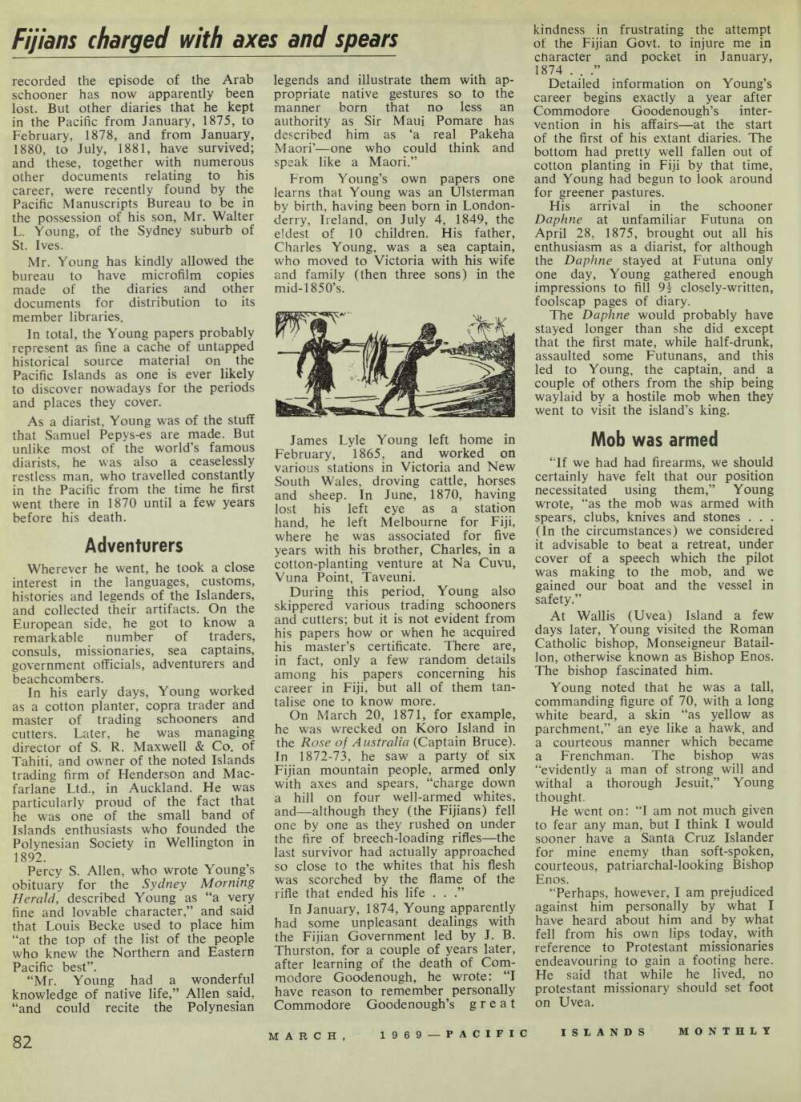
In December, 1928, barely eight months before he died at Warren, New South Wales, an old, white-haired man, with a droopy, walrus moustache, wrote down the story of an extraordinary adventure that had once befallen him in the far off Caroline Islands. The writer was James Lyle Young, a veteran of nearly 60 years of close association with the Pacific, whose story was written for the edification of his sister Harriet, of Buckinghamshire, England.
The story harked back to the days of Young’s vigorous youth when he had sailed trading schooners in Micronesia for a German firm, A.
Capelle & Co., of Jaluit.
“I see by my diary for 1878,”
Young wrote, “‘that an episode happened a few days after I wrote you from Gouap (Yap) Island in March (of that year).
“While bound to the eastward in the schooner Tutuila, I met with a schooner out of Mozambique owned by a Mohammedan Arab, who was on board. He was an aged man. His captain, also an Arab, had lost his way, not being a navigator.
“Two Portuguese half-breeds, whom he had shipped in the Malay Archipelago, had terrorized the captain and crew.
“The owner sold me the cargo, consisting of beche-de-mer, shark fins, ivory nuts and sea-swallow nests, etc., etc., for 2,000 silver dollars, which I paid him, on condition that I took his schooner to a port in the Malay Archipelago.
“So the Tutuila continued on to the eastward and I ran on to the south-west. A few days passed and land was in sight. I was sitting in the cabin on deck aft at 6 a.m. talking to the Arab owner when I heard a commotion on deck. I ran out and
met one Portuguese with blood all over him (but not his own; it was from the captain whom he had absolutely disembowelled with one slash of a knife).
“I had a heavy colt’s revolver in the pocket of a pajama suit. I had no time to get it out, he was too close, with the knife menacing me.
So I shot through the pocket and hit him just below the ribs. He was dead before he struck the deck.
“The second Portuguese jumped on top of the cabin and rushed towards
The Pacific Manuscripts Bureau was established in 1968 as part of the Research School of Pacific Studies, Australian National University , Canberra.
Its purpose is to locate un published documents of value concerning the Pacific Islands and to obtain copies of them on microfilm for four world libraries specialising in Pacific research.
The four libraries are the National Libraries of Australia and New Zealand; the Mitchell Library, Sydney; and the Library of the University of Hawaii, Honolulu. Robert Langdon is executive officer of the bureau.
me. I got the pistol free, but had to shoot him twice, once in the chest and once in the throat. He died in a few minutes.
“We threw these two overboard without ceremony, and the captain with a little more observance, and all was peace aboard that little schooner!
“The owner landed at the port agreed; he was quite willing even anxious, to hold his tongue as to the happenings on board, as he was a half-smuggler, half-pirate, and of all things avoided attracting the attention of officials of any descrip tion. I secured a passage to Manila and thence to the eastward.
Saved his life
“The Arab gave me five hundred dollars, for he knew that I had saved his life, and commended me to Allah . . .”
Young eventually returned to his employment with A. Capelle & Co., of Jaluit; and as was his custom at that stage of his career, he continued keeeping a detailed diary of all that he saw and did as he knocked about Miclronesia in Capelle’s trading schooners.
It is a matter for great regret that the original diary in which Young
James Lyle Young, photographed in San Francisco in 1909 at the age of 60.
Fijians charged with axes and spears
recorded the episode of the Arab schooner has now apparently been lost. But other diaries that he kept in the Pacific from January, 1875, to February, 1878, and from January, 1880, to July, 1881, have survived; and these, together with numerous other documents relating to his career, were recently found by the Pacific Manuscripts Bureau to be in the possession of his son, Mr. Walter L. Young, of the Sydney suburb of St. Ives.
Mr. Young has kindly allowed the bureau to have microfilm copies made of the diaries and other documents for distribution to its member libraries.
In total, the Young papers probably represent as fine a cache of untapped historical source material on the Pacific Islands as one is ever likely to discover nowadays for the periods and places they cover.
As a diarist, Young was of the stuff that Samuel Pepys-es are made. But unlike most of the world’s famous diarists, he was also a ceaselessly restless man, who travelled constantly in the Pacific from the time he first went there in 1870 until a few years before his death.
Adventurers
Wherever he went, he took a close interest in the languages, customs, histories and legends of the Islanders, and collected their artifacts. On the European side, he got to know a remarkable number of traders, consuls, missionaries, sea captains, government officials, adventurers and beachcombers.
In his early days, Young worked as a cotton planter, copra trader and master of trading schooners and cutters. Later, he was managing director of S. R. Maxwell & Co. of Tahiti, and owner of the noted Islands trading firm of Henderson and Mac farlane Ltd., in Auckland. He was particularly proud of the fact that he was one of the small band of Islands enthusiasts who founded the Polynesian Society in Wellington in 1892.
Percy S. Allen, who wrote Young’s obituary for the Sydney Morning Herald, described Young as “a very fine and lovable character,” and said that Louis Becke used to place him “at the top of the list of the people who knew the Northern and Eastern Pacific best”.
“Mr. Young had a wonderful knowledge of native life,” Allen said, “and could recite the Polynesian
legends and illustrate them with ap propriate native gestures so to the manner born that no less an authority as Sir Maui Pomare has described him as ‘a real Pakeha Maori’—one who could think and speak like a Maori.”
From Young’s own papers one learns that Young was an Ulsterman by birth, having been born in London derry, Ireland, on July 4, 1849, the eldest of 10 children. His father, Charles Young, was a sea captain, who moved to Victoria with his wife and family (then three sons) in the mid-1850’s.
James Lyle Young left home in February, 1865, and worked on various stations in Victoria and New South Wales, droving cattle, horses and sheep. In June, 1870, having lost his left eye as a station hand, he left Melbourne for Fiji, where he was associated for five years with his brother, Charles, in a cotton-planting venture at Na Cuvu, Vuna Point, Taveuni.
During this period, Young also skippered various trading schooners and cutters; but it is not evident from his papers how or when he acquired his master’s certificate. There are, in fact, only a few random details among his papers concerning his career in Fiji, but all of them tan talise one to know more.
On March 20, 1871, for example, he was wrecked on Koro Island in the Rose of Australia (Captain Bruce).
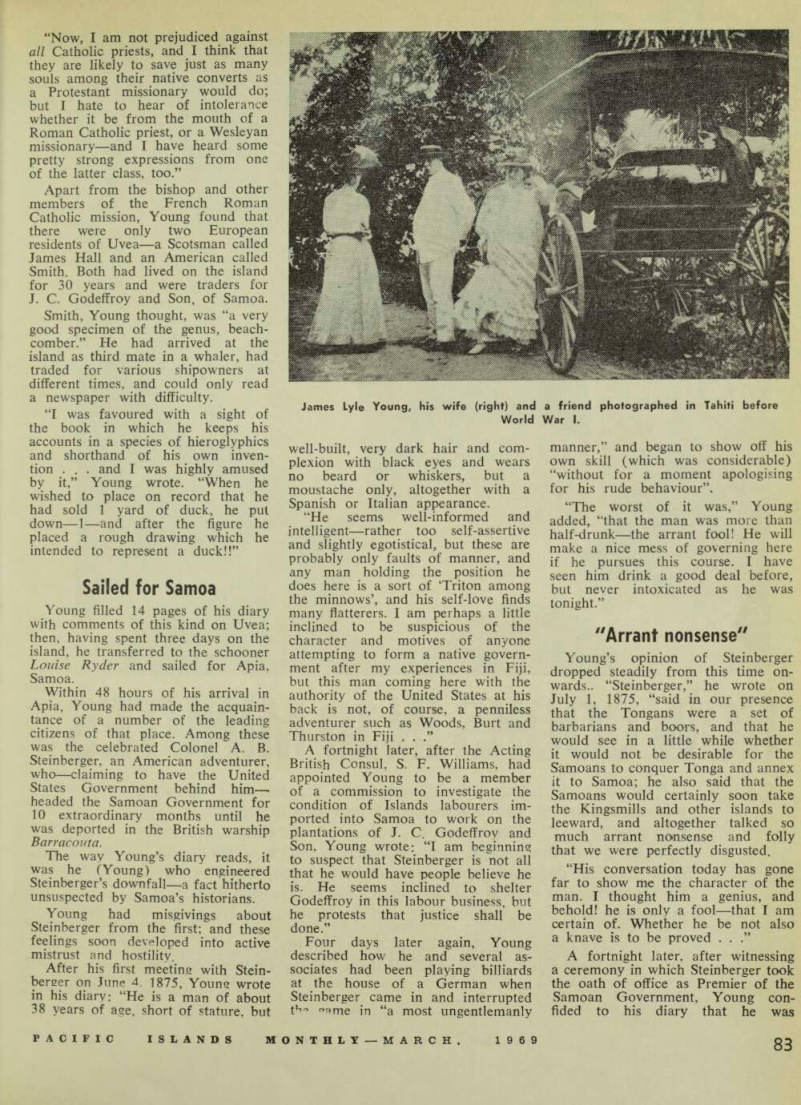
In 1872-73, he saw a party of six Fijian mountain people, armed only with axes and spears, “charge down a hill on four well-armed whites, and—although they (the Fijians) fell one by one as they rushed on under the fire of breech-loading rifles —the last survivor had actually approached so close to the whites that his flesh was scorched by the flame of the rifle that ended his life . . .”
In January, 1874, Young apparently had some unpleasant dealings with the Fijian Government led by J. B.
Thurston, for a couple of years later, after learning of the death of Com modore Goodenough, he wrote: “I have reason to remember personally Commodore Goodenough’s great
kindness in frustrating the attempt of the Fijian Govt, to injure me in character and pocket in January, 1874 . .
Detailed information on Young’s career begins exactly a year after Commodore Goodenough’s inter vention in his affairs —at the start of the first of his extant diaries. The bottom had pretty well fallen out of cotton planting in Fiji by that time, and Young had begun to look around for greener pastures.
His arrival in the schooner Daphne at unfamiliar Futuna on April 28, 1875, brought out all his enthusiasm as a diarist, for although the Daphne stayed at Futuna only one day, Young gathered enough impressions to fill 9k closely-written, foolscap pages of diary.
The Daphne would probably have stayed longer than she did except that the first mate, while half-drunk, assaulted some Futunans, and this led to Young, the captain, and a couple of others from the ship being waylaid by a hostile mob when they went to visit the island’s king.
Mob was armed
“If we had had firearms, we should certainly have felt that our position necessitated using them,” Young wrote, “as the mob was armed with spears, clubs, knives and stones . . . (In the circumstances) we considered it advisable to beat a retreat, under cover of a speech which the pilot was making to the mob, and we gained our boat and the vessel in safety,”
At Wallis (Uvea) Island a few days later, Young visited the Roman Catholic bishop, Monseigneur Batail lon, otherwise known as Bishop Enos.
The bishop fascinated him.
Young noted that he was a tall, commanding figure of 70, with a long white beard, a skin “as yellow as parchment,” an eye like a hawk, and a courteous manner which became a Frenchman. The bishop was “evidently a man of strong will and withal a thorough Jesuit,” Young thought.
He went on: “I am not much given to fear any man, but I think I would sooner have a Santa Cruz Islander for mine enemy than soft-spoken, courteous, patriarchal-looking Bishop Enos.
“Perhaps, however, I am prejudiced against him personally by what I have heard about him and by what fell from his own lips today, with reference to Protestant missionaries endeavouring to gain a footing here.
He said that while he lived, no protestant missionary should set foot on Uvea.
“Now, I am not prejudiced against all Catholic priests, and I think that they are likely to save just as many souls among their native converts as a Protestant missionary would do; but I hate to hear of intolerance whether it be from the mouth of a Roman Catholic priest, or a Wesleyan missionary—and I have heard some pretty strong expressions from one of the latter class, too.”
Apart from the bishop and other members of the French Roman Catholic mission, Young found that there were only two European residents of Uvea —a Scotsman called James Hall and an American called Smith. Both had lived on the island for 30 years and were traders for J. C. Godeffroy and Son, of Samoa.
Smith, Young thought, was “a very good specimen of the genus, beach comber.” He had arrived at the island as third mate in a whaler, had traded for various shipowners at different times, and could only read a newspaper with difficulty.
“I was favoured with a sight of the book in which he keeps his accounts in a species of hieroglyphics and shorthand of his own inven tion . . . and I was highly amused by it,” Young wrote. “When he wished to place on record that he had sold 1 yard of duck, he put down—l—and after the figure he placed a rough drawing which he intended to represent a duck!!”
Sailed for Samoa
Young filled 14 pages of his diary with comments of this kind on Uvea; then, having spent three days on the island, he transferred to the schooner Louise Ryder and sailed for Apia, Samoa.
Within 48 hours of his arrival in Apia, Young had made the acquain tance of a number of the leading citizens of that place. Among these was the celebrated Colonel A. B.
Steinberger, an American adventurer, who—claiming to have the United States Government behind him—. headed the Samoan Government for 10 extraordinary months until he was deported in the British warship Barracouta.
The way Young’s diary reads, it was he (Young) who engineered Steinberger’s downfall—a fact hitherto unsuspected by Samoa’s historians.
Young had misgivings about Steinberger from the first; and these feelings soon developed into active mistrust and hostility.
After his first meeting with Stein berger on June 4. 1875, Young wrote in his diary: “He is a man of about 38 years of age, short of stature, but
well-built, very dark hair and com plexion with black eyes and wears no beard or whiskers, but a moustache only, altogether with a Spanish or Italian appearance.
“He seems well-informed and intelligent—rather too self-assertive and slightly egotistical, but these are probably only faults of manner, and any man holding the position he does here is a sort of ‘Triton among the minnows’, and his self-love finds many flatterers. I am perhaps a little inclined to be suspicious of the character and motives of anyone attempting to form a native govern ment after my experiences in Fiji, but this man coming here with the authority of the United States at his back is not, of course, a penniless adventurer such as Woods, Burt and Thurston in Fiji , . .”
A fortnight later, after the Acting British Consul, S. F. Williams, had appointed Young to be a member of a commission to investigate the condition of Islands labourers im ported into Samoa to work on the plantations of J. C. Godeffroy and Son, Young wrote: “I am beginning to suspect that Steinberger is not all that he would have people believe he is. He seems inclined to shelter Godeffroy in this labour business, but he protests that justice shall be done.”
Four days later again, Young described how he and several as sociates had been playing billiards at the house of a German when Steinberger came in and interrupted orq m e in “a most ungentlemanly
manner,” and began to show off his own skill (which was considerable) “without for a moment apologising for his rude behaviour”.
“The worst of it was,” Young added, “that the man was more than half-drunk—the arrant fool! He will make a nice mess of governing here if he pursues this course. I have seen him drink a good deal before, but never intoxicated as he was tonight.”
"Arrant nonsense"
Young’s opinion of Steinberger dropped steadily from this time on wards.. “Steinberger,” he wrote on July 1, 1875, “said in our presence that the Tongans were a set of barbarians and boors, and that he would see in a little while whether it would not be desirable for the Samoans to conquer Tonga and annex it to Samoa; he also said that the Samoans would certainly soon take the Kingsmills and other islands to leeward, and altogether talked so much arrant nonsense and folly that we were perfectly disgusted.
“His conversation today has gone far to show me the character of the man. I thought him a genius, and behold! he is only a fool—that I am certain of. Whether he be not also a knave is to be proved . . .”
A fortnight later, after witnessing a ceremony in which Steinberger took the oath of office as Premier of the Samoan Government, Young con fided to his diary that he was
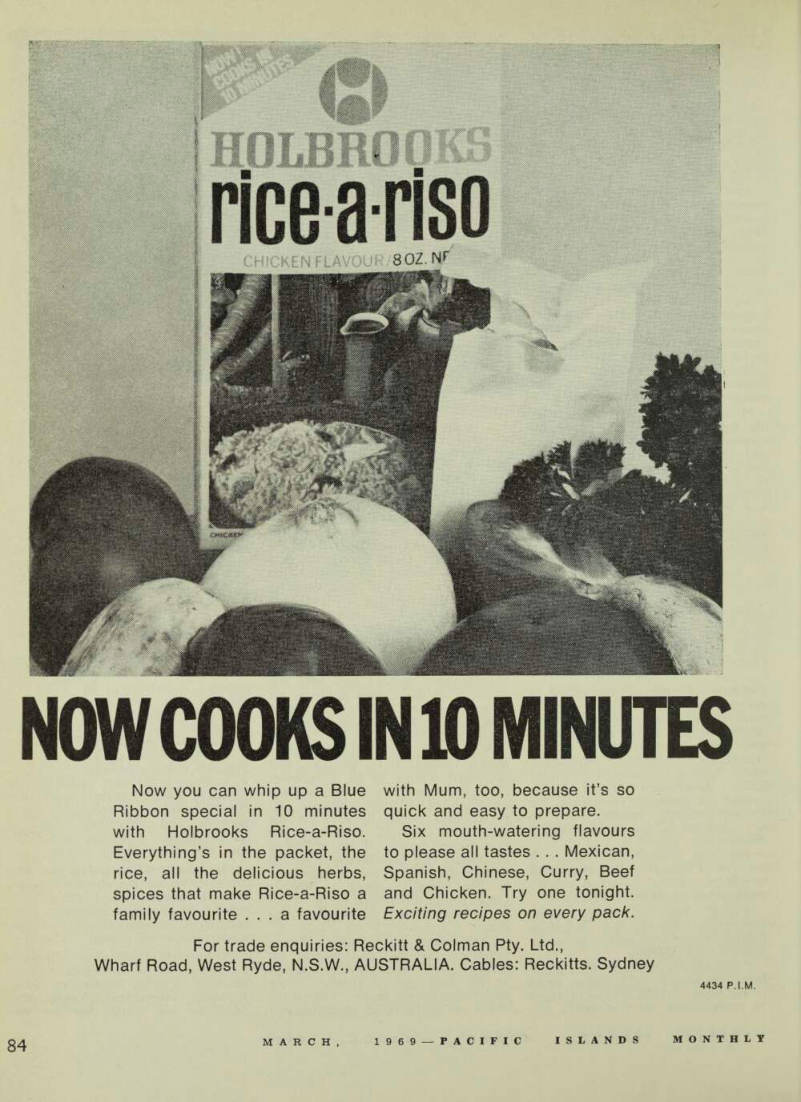
James Lyle Young, his wife (right) and a friend photographed in Tahiti before World War I.
Young influenced JV. Samoa's
“thoroughly convinced” that Stein berger was an imposter.
“If Steinberger is the agent of the United States here, as he represents himself to be, then he does not need, nor can he, take any oath to the Samoan people. My opinion is that he is simply an adventurer, and that he has no authority from the U.S.
Govt., whatever private influence he may have with U.S. Govt, officials...”
Although the Steinberger theme is a constantly recurring one in Young’s diary for 1875-76, there are numerous references to many other matters and vivid pen-pictures of dozens of the leading citizens of Samoa of the time.
Among the personalities whom Young met and described were J. M.
Coe, ex-US consul; his “good-look ing” daughter Emma, popularly known as the “Princess”; J. E. V.
Alvord, who, despite 23 years in the Islands, still retained the habits, manners and feelings of a gentleman; the drunken Major J. H. Latrobe, Steinberger’s aide-de-camp; Matthew Hunkin, long-time resident of Tutuila; the “enlightened” Rev.
George Pratt, of the London Mis sionary Society, who had compiled the Samoan Dictionary and was a good Hebrew and Greek scholar; the “intensely narrow-minded and bigoted” Rev. James Mathieson, of the Wesleyan Mission; Mrs. Hiram Bingham, “the beau-ideal of a mis sionary’s wife;” and Auguste Poppe, Godeffroy’s business manager, etc., etc.
Favourably impressed
Generally speaking, Young was favourably impressed by Samoa’s Europeans; and when he returned to Fiji with a large cargo of copra after “a very pleasant three months” in Samoa, he had to admit that even Steinberger had always treated him “with the greatest amount of courtesy of which he is capable”. This, how ever, did not alter his opinion of him.
When Sir Arthur Gordon, Fii’s Governor, asked Young to call on him at Nasova, a couple of weeks after his return from Samoa, Young repeated his view that Steinberger was an imposter and that he had no authority to act in Samoa as an agent for the United States Government.
“He (the Governor) semed much struck by what I told him about the manner in which the Samoan Govt, was being carried on,” Young wrote, and added that the Governor had
asked him for a copy of his notes on his investigations into Godeffroy’s imported labourers —which he sub sequently supplied.
A few days after this interview, Young chartered a schooner, the Pio Nono, to go on a trading voyage to Niuafo’ou and Samoa. But before he left Fiji on this voyage on October 23, 1875, he chanced to meet Captain C. E. Stevens, of HMS Barracouta, “and had a long talk with him about Samoa”. This meeting may well have helped to determine the course of Samoa’s history, for soon after Young returned to Samoa, Captain Stevens, in the Barracouta, turned up, also— with dire consequences for Stein berger.
The events moved swiftly from the moment that HMS Barracouta arrived on December 12, 1875, until Stein berger was arrested two months later by the US Consul, S. S. Forster, and imprisoned at his request on board the Barracouta.
But the arrest of Steinberger did not bring an end to the turmoil that plagued Samoa at that time, for an episode occurred on the morning of March 13, 1876, which, in Young’s opinion, made “all that has been done here up to this time” seem “as nothing” by comparison.
March 13 was the day on which Malietoa Laupepa, the Samoan king, arranged to go to Mulinuu, a narrow horn of land at the western end of
Apia harbour, to read an address to the Samoan people aimed at ending their various differences. Negotiations for the holding of this ceremony (in which Young again played a leading role) were conducted in great secrecy, for fear that a group of Samoans op posed to the king would get wind of it and “begin the old Samoan war of parties” with an armoury of cannon and small arms that Stein berger had given them.
In accordance with the arrangements for the ceremony, Captain Stevens and a couple of officers of the Barracouta, with the British Consul, Malietoa, several Samoan chiefs and Young, set off for Mulinuu from Apia at 8.45 a.m. on the appointed day.
At Matafele, the party was joined by the American consul, a guard of honor of 40 to 45 sailors and marines from the Barracouta, and 10 or 12 European residents who were curious to know what was going on.
The party reached the proposed site of the ceremony—a church—at 9.30 a.m. and found the place deserted. But soon afterwards, some Samoans, armed with rifles and cartridge belts, ran out of a nearby house and began posting themselves across the road to cut off the party’s retreat to Apia.
Shots exchanged
In a matter of moments, shots were being exchanged between the armed Samoans on the road and the Barracouta's guard of honour—the Samoans being backed by a large body of men who had been lying hidden in the thick bush. Seven or eight members of the guard of honor fell wounded in less than a minute.
This caused the Europeans who were there out of curiosity to beat a hasty retreat along the beach; while the king and the two consuls got into a boat from the Barracouta and began taking in the wounded guardsmen.
A few minutes later, as the boat was being pulled out to the Barracouta, the Samoans opened fire on it with a cannon, wounding one of the oars men in the leg. Meanwhile, Young, who had a revolver, was fired on by a Samoan with a breech-loading carbine as he was skirting a fence of Steinberger’s old house, which ran down into the sea.
“As he (the Samoan) was only about 15 yards from me,” Young wrote in his diary that nieht, “I thought it was all up if the fellow’s hand was steady. But I instantly fired at him with my revolver, and although from the necessary quickness of my action I did not hit him, there is no
Expected attack never came
doubt that I spoilt his aim, as he missed me.
“He was pretty smart though, for immediately after firing, he jerked out the old cartridge and prepared to load again. Seeing that if I allowed him to do so, I should probably get hit, as he might mend his aim next time, 1 ran up to the fence, he sidling away from me, with two or three cartridges in his hand endeav ouring all the while to reload. But his hand was too shaky, and to his bad nerves I probably owe my life, or at any rate my escape from a wound.
“On reaching the fence, I put my hand over it and took an aim at him and hit him in the jaw. He dropped his rifle, and putting his hand to his face, scrambled out towards the road.
Just at that moment, as I was running round the end of the fence to give him his quietus, a bluejacket ap peared round the end of a house close to the native, and immediately shot him through the body . .
Narrow escapes
Young had several other narrow escapes from death or injury in the next few hours as the battle raged on between the Samoans and the Barracouta’s men. So it is probably not surprising that when, at the end of it, he wrote up his diary for the day, he began by saying: “Today, the ides of March, will be as famous in Samoan history as the same date in that of Rome, We have been making history today with a vengeance. . . . The last twelve hours have made a red mark for ever on these beautiful islands, and the worst of it is that this is probably only the beginning of a bitter con flict in which no one can tell who may gain his passport to the land from which no traveller returns . . .”
Young recorded that one European was killed and 10 were wounded in the Mulinuu affray, compared with eight Samoan dead and 25-30 wounded. He recorded also that after the affray was over, preparations were immediately made at the British Consulate to resist an attack that the Samoans were expected to make on it. However, no attack was ever made, and a fortnight later the situation had become sufficiently quiet for Captain Stevens to withdraw the guns and men that he had provided for the consulate’s defence.
With the excitement over. Young apparently devoted himself to earning
a living again, But his diary for the next two months is tantalisingly brief.
On May 10, 1876, he recorded that Godeffroys had asked him to go as agent to the Solomon Islands and New Britain to “report on the resources of those islands,” but he said he had given “no decisive answer as I wish to await the Commodore’s arrival.” There is no subsequent mention of Godeffroy’s offer, but on May 18, 1876, Young recorded baldly that he had “arranged with Mr. Thos. Farrell to go with him to Marshall’s Group, etc.”
It appears from Young’s subsequent diary that he and several other Europeans had been engaged to open trading stations for Farrell at various islands in the Marshall Group. They sailed from Apia in the brig Vision on May 25, 1876—Young receiving on his departure “a most cordial letter” of thanks from the British Consul, S. F. Williams, for the “advice and assistance” he had given him during the previous few months.
However, Young recorded, some what mysteriously, that he had more reason to thank Williams, as his association with him had enabled him to prosecute “a labour of love” —viz, the breaking of Steinberger’s power.
Young’s voyage in the Vision again brought out his enthusiasm as a diarist, his diary being filled with long descriptions of the various islands he called at Butaritari.
Mille, Majuro, Arno, Jaluit, Kili and Namorik—before he and an assistant, Frank Sherlock, were finally landed on Ebon Atoll with £BOO worth of trade goods to set up a trade store.
Even wilder
Young worked for Farrell at Ebon, with occasional trips to other atolls in the Marshalls, for a year and a half. Life in those parts as that time was even wilder than it was in Fiji and Samoa, but Young entered into it with gusto, and his vivid diary ac count of it is undoubtedly of unique value for the light it throws on mis sionaries, beachcombers, fellow traders and native wars.
Young finally left Farrell’s employ after Farrell, having become insolvent, had left him on Ebon for eight months without new supplies of trade goods or food.
“I have been anxiously expecting arrival of Agnes Donald or other
vessel of Mr. Farrell’s from Mejoro for this past month,” Young wrote in his diary on October 11, 1877. “I am out of all sorts of provisions save flour, and have been living on bread and tea, without sugar—there being no food to be obtained here or from vessels which have called. I fear that some accident has happened to Farrell on his way from Auckland.”
Meanwhile, Young suffered severely from diarrhoea and dysentery, but he kept himself occupied by com piling a grammar of the Ebonese language—the first, as far as he knew, that had ever been attempted.
Young left Ebon on November 19, 1877, and went to Majuro. There, the two German traders, A. Capelle & Co., and Hernsheim & Co., promptly offered him jobs. After some demur, Young went off to Yap as Capelle’s “business manager” —and it is at that point that the second of his three extant diaries ends.
Swamped
There is a gap of two years before one can pick up the day-by-day threads of his life again from his third diary. However, four extant letters which Young wrote to his sister Alice from Yap, Jaluit, Guam and Ponape during this period, together with a couple of stories that he wrote up in his later years from now vanished diaries help to fill in that gap.
One of the most exciting incidents of his life at this time was that of the Arab schooner, already referred to. Another occurred at Nukuoro Atoll in the Carolines on November 18, 1879, when a boat in which he was taking bagged copra to a waiting schooner was swamped in the tide rip at the entrance to the atoll, and Young spent the period from dusk till dawn floating in the sea outside the reef with only an 18 ft ash oar to support him.
Young’s diary for 1880-81 is seldom as detailed as the earlier ones, but even so it contains a great deal of information that is probably not to be found elsewhere. Young was still working for Capelle at that time, but had transferred his head quarters to Guam and was travelling extensively.
Guam, then, as it had been for more than three centuries, was a Spanish colony, and capital of Spain’s settlements in the Marianas.
Most of the trade, however, was in the hands of enterprising Germans such as Hernsheim and Capelle. In Young’s view, Guam was still “semi-
Peaceful Guam
civilized”, but even so, it was quite an improvement on some of the island outposts he had lived in.
“It is strange to see the people going every morning to mass at 4 a.m. in wet or dry weather, and yet to see them fighting cocks all afternoon and losing all their money in gambling,” he said in a letter to his sister Alice that has survived. “Never theless, there is probably less crime in Guam than in any island of the same population in the Pacific, ay, or even in the world; theft is very rare, no murder has been com mitted for 50 years except by con victs from Manila, drunkenness is also very rare, although everyone drinks wine when they can afford it.
“The worst feature about the people is their want of ambition and their willingness to live and die as their fathers did before them ...” Young added prophetically: “The march of progress has not yet reached this out of the way place, but when it does then the Spaniard must let go these islands also.”
Despite his strictures, Young ap pears to have enjoyed himself in Guam, even taking to dancing with the Spanish senoritas. He also took a keen interest in Spain’s past in the Marianas. “I am now translating a short history of these islands, written by a Spanish offcial from Govern ment records,” he wrote on one occasion.
Young’s Marianas history, like his Ebonese grammar, does not seem to have survived passage of time.
According to Percy Allen’s obituary in the Sydney Morning Herald, Young left the Marianas in October, 1881, to take a cargo of islands produce to San Francisco for Andrew Craw ford and Co., a shipowner and trader of that city. His health was then in poor shape after 11 years in the Pacific without a break, and he took a job with Crawford and Co. as ac countant and ship’s husband.
Six months later, according to a statement by Young himself, he sailed for Tahiti in the schooner Greyhound to become manager of Crawford’s trading store there, spend ing a month en route inspecting out stations of the company in the Marquesas.
The Eastern Pacific fascinated Young and kept him busy for the rest of his life. In 1884 he married a Tahiti-born Englishwoman, Mary Stringer, in Tahiti. They had four children, two of whom died at birth.
Of the other two, both sons, one was killed at Gallipoli. The other is Walter Young, now 79.