gripes are keen-edged
pp. 53-57 · Read in the full issue

PIM's Reader Survey They love us (mostly) hut their gripes are keen-edged
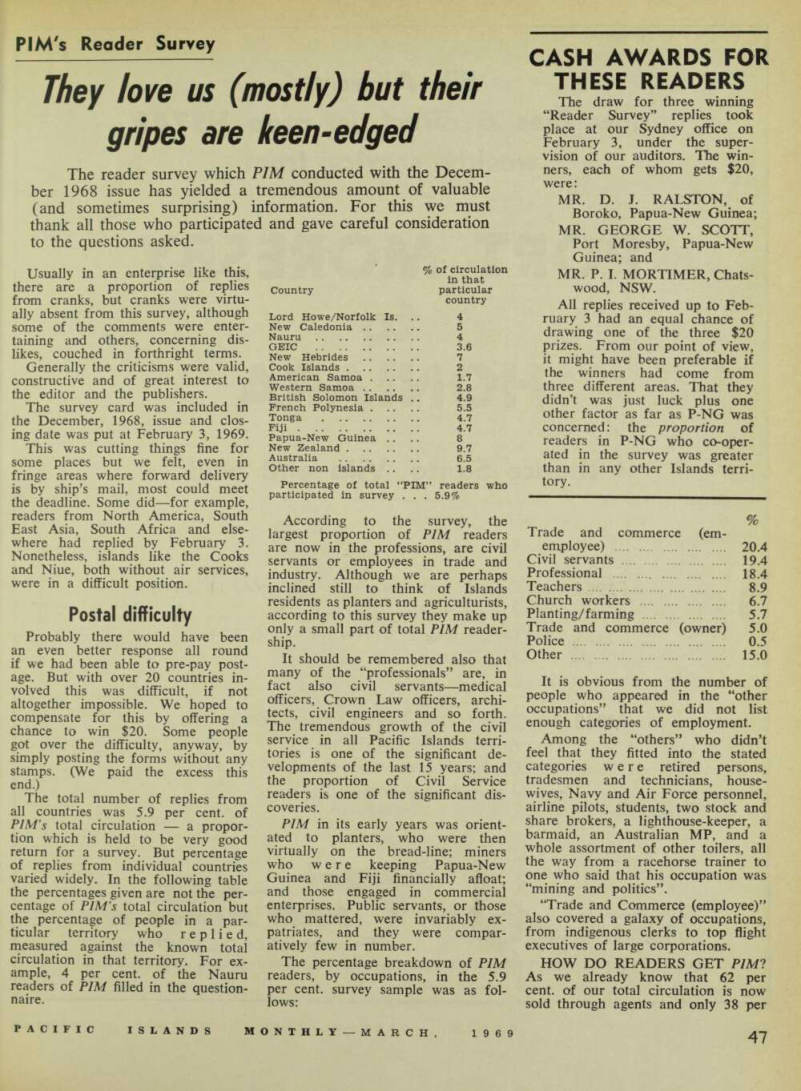
The reader survey which PIM conducted with the Decem ber 1968 issue has yielded a tremendous amount of valuable (and sometimes surprising) information. For this we must thank all those who participated and gave careful consideration to the questions asked.
Usually in an enteiprise like this, there are a proportion of replies from cranks, but cranks were virtu ally absent from this survey, although some of the comments were enter taining and others, concerning dis likes, couched in forthright terms.
Generally the criticisms were valid, constructive and of great interest to the editor and the publishers.
The survey card was included in the December, 1968, issue and clos ing date was put at February 3, 1969.
This was cutting things fine for some places but we felt, even in fringe areas where forward delivery is by ship’s mail, most could meet the deadline. Some did—for example, readers from North America, South East Asia, South Africa and else where had replied by February 3.
Nonetheless, islands like the Cooks and Niue, both without air services, were in a difficult position.
Postal difficulty
Probably there would have been an even better response all round if we had been able to pre-pay post age. But with over 20 countries in volved this was difficult, if not altogether impossible. We hoped to compensate for this by offering a chance to win $2O. Some people got over the difficulty, anyway, by simply posting the forms without any stamps. (We paid the excess this end.) The total number of replies from all countries was 5.9 per cent, of PI M’s total circulation a propor tion which is held to be very good return for a survey. But percentage of replies from individual countries varied widely. In the following table the percentages given are not the per centage of PlM’s total circulation but the percentage of people in a par ticular territory who replied, measured against the known total circulation in that territory. For ex ample, 4 per cent, of the Nauru readers of PIM filled in the question naire.
According to the survey, the largest proportion of PIM readers are now in the professions, are civil servants or employees in trade and industry. Although we are perhaps inclined still to think of Islands residents as planters and agriculturists, according to this survey they make up only a small part of total PIM reader ship.
It should be remembered also that many of the “professionals” are, in fact also civil servants—medical officers, Crown Law officers, archi tects, civil engineers and so forth.
The tremendous growth of the civil service in all Pacific Islands terri tories is one of the significant de velopments of the last 15 years; and the proportion of Civil Service readers is one of the significant dis coveries.
PIM in its early years was orient ated to planters, who were then virtually on the bread-line; miners who were keeping Papua-New Guinea and Fiji financially afloat; and those engaged in commercial enterprises. Public servants, or those who mattered, were invariably ex patriates, and they were compar atively few in number.
The percentage breakdown of PIM readers, by occupations, in the 5.9 per cent, survey sample was as fol lows:
It is obvious from the number of people who appeared in the “other occupations” that we did not list enough categories of employment.
Among the “others” who didn’t feel that they fitted into the stated categories were retired persons, tradesmen and technicians, house wives, Navy and Air Force personnel, airline pilots, students, two stock and share brokers, a lighthouse-keeper, a barmaid, an Australian MP, and a whole assortment of other toilers, all the way from a racehorse trainer to one who said that his occupation was “mining and politics”.
“Trade and Commerce (employee)” also covered a galaxy of occupations, from indigenous clerks to top flight executives of large corporations.
How Do Readers Get Pim?
As we already know that 62 per cent, of our total circulation is now sold through agents and only 38 per
Country % of circulation in that particular Lord Howe/Norfolk Is, country 4 New Caledonia .. 5 Nauru 4
Geic
3.6 New Hebrides 7 Cook Islands 2 American Samoa . 1.7 Western Samoa .. 2.8 British Solomon Islands 4.9 French Polynesia . 5.5 Tonga 4.7 Fiji 4.7 Papua-New Guinea .. 8 New Zealand 9.7 Australia 6.5 Other non islands .. 1.8 Percentage of total “ PIM” readers who participated in survey , . . . 5.9%
% Trade and commerce (ememployee) 20.4 Civil servants 19.4 Professional 18.4 Teachers 8.9 Church workers 6.7
Planting/farming
5.7 Trade and commerce (owner) 5.0 Police 0.5 Other 15.0
Background news stories t
cent, through direct subscriptions, the answers to this question told us nothing except that direct subscribers are more likely to participate in reader surveys than others.
According to the sample, 57 pei cent, of those who replied had a pre-paid subscription; 43 per cent, from newsagent or shop and less than 1 per cent, got the magazine passed on from a friend.
What Do They Like Best
IN PIMI Ten categories were offered for choice. Readers could tick just one box or they could mark one to 10, in order of preference.
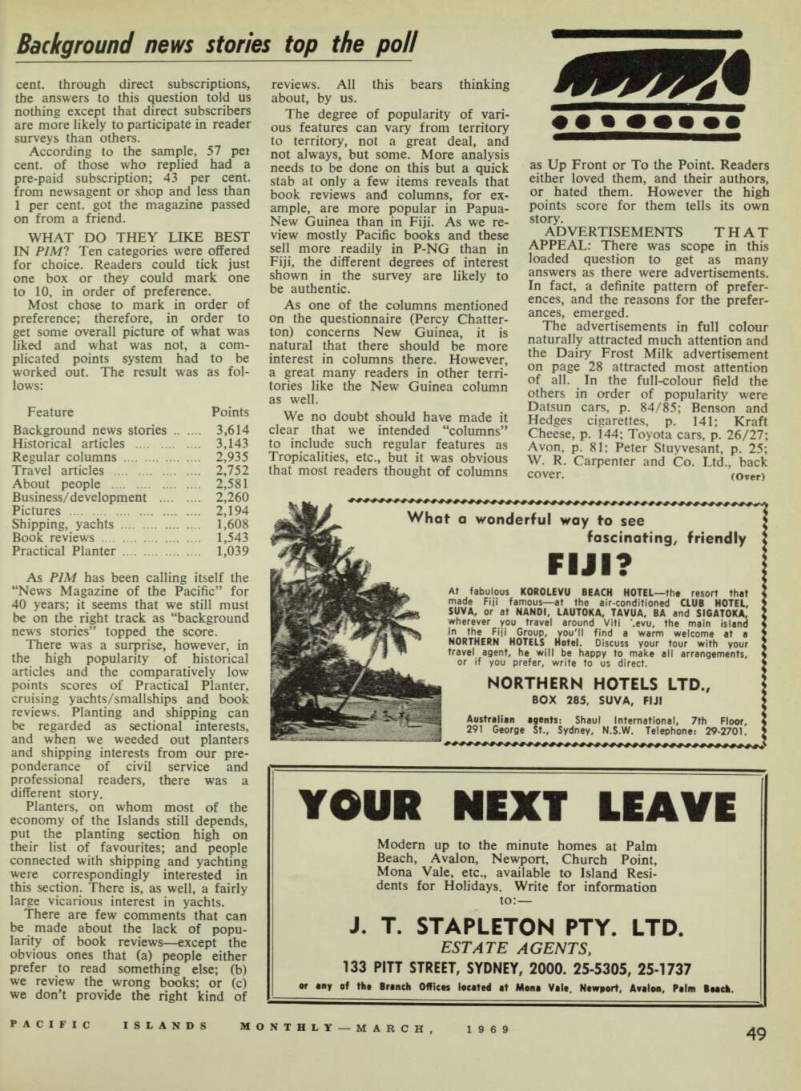
Most chose to mark in order of preference; therefore, in order to get some overall picture of what was liked and what was not, a com plicated points system had to be worked out. The result was as fol lows:
As PIM has been calling itself the “News Magazine of the Pacific” for 40 years; it seems that we still must be on the right track as “background news stories” topped the score.
There was a surprise, however, in the high popularity of historical articles and the comparatively low points scores of Practical Planter, cruising yachts/smallships and book reviews. Planting and shipping can be regarded as sectional interests, and when we weeded out planters and shipping interests from our pre ponderance of civil service and professional readers, there was a different story.
Planters, on whom most of the economy of the Islands still depends, put the planting section high on their list of favourites; and people connected with shipping and yachting were correspondingly interested in this section. There is, as well, a fairly large vicarious interest in yachts.
There are few comments that can be made about the lack of popu larity of book reviews—except the obvious ones that (a) people either prefer to read something else; (b) we review the wrong books; or (c) we don’t provide the right kind of
reviews. All this bears thinking about, by us.
The degree of popularity of vari ous features can vary from territory to territory, not a great deal, and not always, but some. More analysis needs to be done on this but a quick stab at only a few items reveals that book reviews and columns, for ex ample, are more popular in Papua- New Guinea than in Fiji. As we re view mostly Pacific books and these sell more readily in P-NG than in Fiji, the different degrees of interest shown in the survey are likely to be authentic.
As one of the columns mentioned on the questionnaire (Percy Chatter ton) concerns New Guinea, it is natural that there should be more interest in columns there. However, a great many readers in other terri tories like the New Guinea column as well.
We no doubt should have made it clear that we intended “columns” to include such regular features as Tropicalities, etc., but it was obvious that most readers thought of columns
TT , a ? Up Front or To the Point. Readers either loved them, and their authors, or hated them. However the high points score for them tells its own story.
Advertisements That
APPEAL: There was scope in this loaded question to get as many answers as there were advertisements, 1° fact, a definite pattern of prefer • a "l th !. reasons for the Prefer .., „ .
The advertisements in full colour rhi U ni^ att^!t d Tu Vv h tte " t . lon and k ad^rti s ement J^ ge T^ 8 t ? ttrs J£° St f h ' . In full-colour field the others in order of popularity were Datsun cars, p. 84/85; Benson and Hedges cigarettes, p. 141; Kraft Cheese, p. 144; Toyota cars, p. 26/27; Avon, p. 81: Peter Stuyvesant, p. 25; w. R. Carpenter and Co. Ltd., back cover (Over)
Feature Points Background news stories .. ... 3,614 Historical articles ... 3,143 Regular columns ... 2,935 Travel articles ... 2,752 About people ... 2,581 Business/development ... ... 2,260 Pictures ... 2,194 Shipping, yachts ... 1,608 Book reviews ... 1,543 Practical Planter ... 1,039
Apart from the attraction of colour, the other advertisements were chosen either for the information they gave or because of attractive layout or bright style.
Among the favourite “informa tion” advertisements were Akai Elec tric Co., stereograms, p. 5; Win cigarette lighters, p. 19; Braybon Bros. Pty. Ltd., electric generators, p. 22; Arnotts Biscuits, p. 70/71; Macquarie Industries, portable saws, p. 74; George & Ashton Ltd., fibre glass, p. 76; Radio Australia (it gave frequencies and wavelengths), p. 94; Oxford University Press (it detailed specific new books), p. 98; Perrier & Dickinson Pty. Ltd., Gardner diesels, p. 104; Bergus-Kelvin Co.
Ltd., Kelvin diesels, p. 108; James Hardie & Co. Pty. Ltd., building sheets and panels, p. 146.
Non-colour advertisements that were chosen, obviously for their at tractive layout or their style, in cluded almost everything with an air craft in it—the airlines and aircraft firms like Hawker Siddeley Group and Islander Aircraft Sales Pty. Ltd.
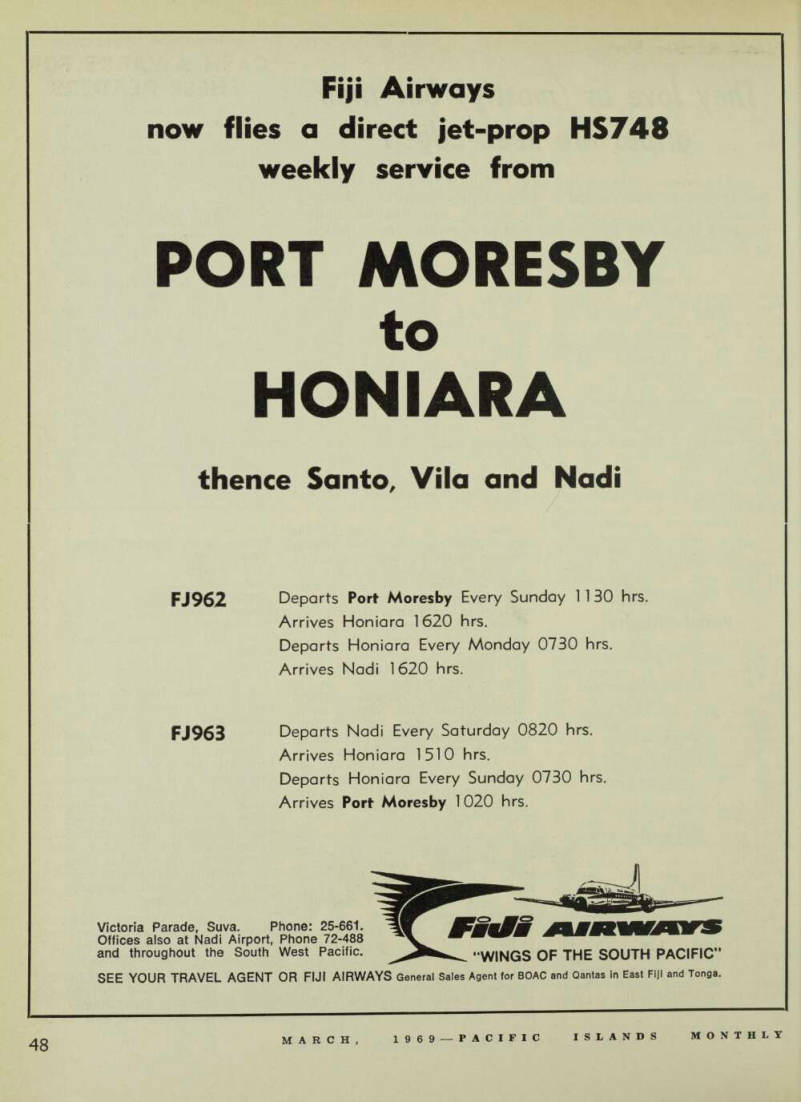
But Fiji Airways’ advertisement on p. 52 attracted the most attention— more than a number of the full-colour advertisements deservedly so, I think, because it was very attractive.
Air New Zealand’s advertisement on p. 58 was also popular, so was the Ronson advertisement, p. 24, for its entertainment value and originality; Steinlager, on p. 72 for its neat lay out; and last, but by no means least, Erinmore tobacco on p. 150. This got more attention than any of the other smaller advertisements. It had a bare-top, Adam and Eve theme, so perhaps sex still sells. It was the nearest thing to a sexy advertise ment in the whole magazine, and attractive to boot.
The advertisements liked least were those that were repeated without change over long periods and, as one reader had it, “said nothing.”
A small proportion took the lofty approach and said that they never read advertisements; others that we had too many. Most accepted them as a fact of modern life, useful and here to stay.
Without advertisements there would be no PIM. The price readers in the Pacific Islands pay for PIM barely pays for the air freight. Ad vertising revenue pays for all the rest.
Judy Tudor,
Publisher. • For some quotes on the things they said, turn to p. 52.