Looking Backwards
pp. 35-142 · Read in the full issue
On Norfolk Island, they're ...
To Go Forwards
From a Norfolk Island correspondent
Norfolk Island citizens are taking a fresh look at the island’s historical assets with a view to promoting them as tourist attractions.
The United States Ambassador to Australia, Mr, William H. Crook, is, in part, responsible for the fresh look.
He said in Hobart early in February that he hoped to get American aid for the restoration of Norfolk’s convict - built structures which he described as a “national treasure”.
Mr. Crook made two brief visits to Norfolk in November, 1968, and was intensely interested in the island’s early American associations.
The Norfolk Island Administration receives an annual grant of $lO,OOO from the Australian Government for the preservation of existing colonial buildings and the restoration of some of the ruins. More funds are needed though, if the programme is to pro ceed as quickly as it should.
The best
However restoration work and general improvement of tourist facili ties is proceeding steadily—if slowly.
For example, at Kingston, the island’s capital since 1788, the Ad ministration’s Department of Works
recently improved beach facilities and at Slaughter Bay wide stone steps have been constructed to provide easier access to the beach, and the old stone sea-wall has been repaired.
"Die Administration compound, which was formerly locked every evening and at weekends, is now kept open so that sightseers may wander about and photograph the best group of colonial buildings still in use on the island.
The include two three-storey buildings, the New Military Barracks, now used as Administration offices; a guard house, now the liquor bond; and a powder magazine.
Two unusual relics of the convict era—a large iron pot and a sand stone millstone—were recently placed on the verandah of the Administra tion Library building.
The iron pot, which bears the date 1846, came from the Brancker Nobbs property at Longridge and has been lent for display by Mrs. M. Mallett and Mr. Herbert Nobbs. The mill stone was lifted from the beach at Cemetery Bay. Both relics are in excellent condition. (Continued on p. 132)
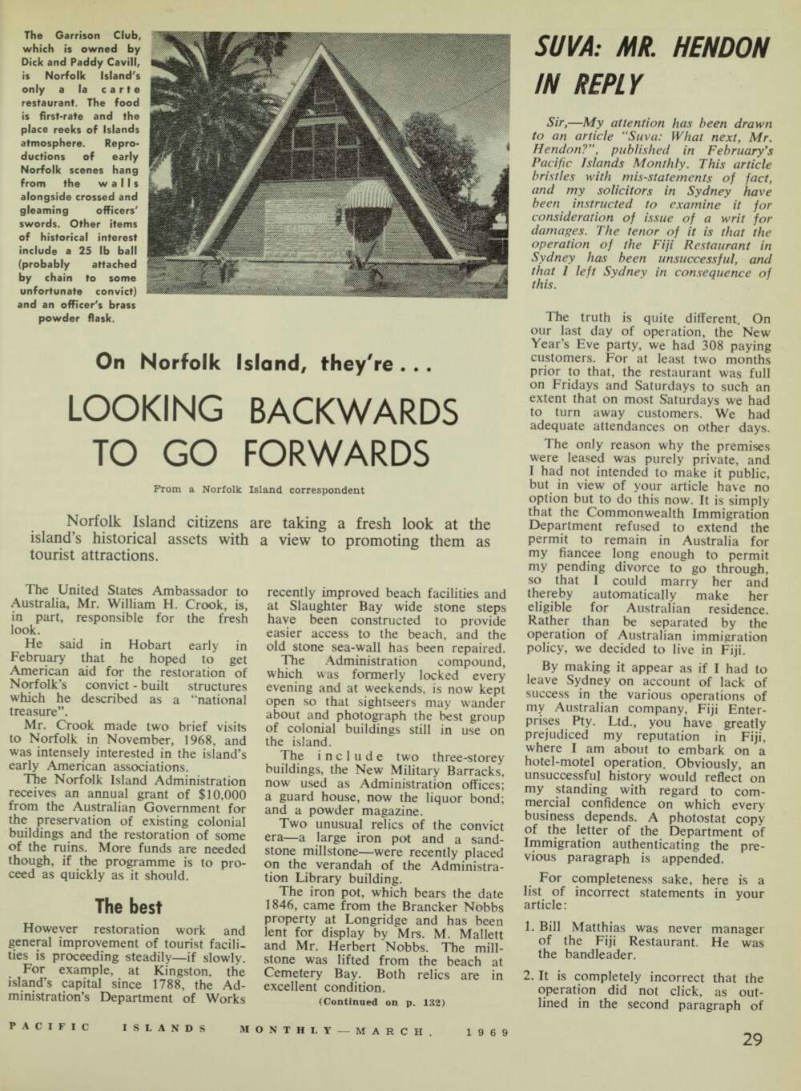
The Garrison Club, which is owned by Dick and Paddy Cavill, is Norfolk Island's only a la carte restaurant. The food is first-rate and the place reeks of Islands atmosphere. Repro ductions of early Norfolk scenes hang from the walls alongside crossed and gleaming officers' swords. Other items of historical interest include a 25 lb ball
(probably attached
by chain to some unfortunate convict) and an officer's brass
powder flask.
Also in the Administration com pound is the Bounty gun which was brought from Pitcairn when the Pit cairners moved in 1856. This historic gun is, unfortunately, suffering from the effects of long exposure to the sea air.
Work has already started on the restoration of the watermill dam at Watermill Valley; the dam and mill race tunnel have been cleared of silt and debris. The Administration has
allotted special funds for this project and the advice of experts in hydrology will be sought.
Restoration of this landmark is ex pected to take about six months —the dam will then be filled.
As far as is known the watermill was last in operation in the early 1860’s when James Dawe, the miller, with the assistance of three Pit cairners, repaired the mill sufficiently to permit the grinding of corn. (Dawe was sent out from England in 1858 to join the Pitcairners at the request of Governor Denison, but stayed only a few years on the island.)
It is hoped later to install a water wheel—built to the original design.
A watermill in operation would be high on a list of “musts” for visitors, and water stored by the dam would be a boon to residents in dry seasons.
For some time the Norfolk Island Council has been resisting pressure from Australians who wish to estab lish industries on the island.
Last year council considered the possibilities of football pools, a rabbit industry and a million-dollar luxury hotel at Kingston.
The companies promoting the foot ball pools and the rabbit industry failed to establish their projects on the island and the hotel proposal— by the American Wendell-West Com pany—has not yet been agreed to.
Council will consider the matter again in March.
While Norfolk remains tax-free, big investors and company promoters will continue to cast longing eyes at the island.
Many of the new settlers, some of the older ones, and a good number of “natives” feel that outside invest ment and new industries are most desirable. However, others are not so sure.
Tradition still there
Traditionally the Norfolk Islander is resistant to new influences. Until well into this century, for example, tradition was sacrosanct and most young islanders respected the views and wishes of their elders.
Many mainlanders who have lived on the island for 20 or 30 years have become assimilated to such an extent that they have acquired something of the traditional outlook.
“We like the island as it is,” they say and complain that the place is getting too commercialised.
But times are changing and Nor folk is developing fast—at any rate as far as business is concerned. In 1960, the population was just over 1,000; there were 207 motor vehicles and 44 motor scooters registered on the island. At that time the total number of companies registered at Kingston was 16.
Today the population is around 1,200; there are 960 motor vehicles and 290 motor scooters, and the latest figures available at the Registrar’s Office show that approximately 850 companies are registered locally.
We already have one vehicle (motor car or scooter) per person, and if development continues at the present rate we will soon have one company to each member of the community!