New Caledonia's sportsmen
pp. 29-31 · Read in the full issue
"Colleen" was a setback for New Caledonia's sportsmen
From GERALD ROUSSEAU, in Noumea Caledonian sporting enthusiasts preparing for the Port Moresby Games have suffered some unhappy setbacks through the passage of cyclone Colleen at the beginning of February.
Worst damage in Noumea was around the beachfront, where sand and boats were strewn across the promenade (see also report in Shipping Section, this issue).
Some damage was reported to the newly-arrived Fireball class yachts, but repairs were soon arranged. The first three Fireballs arrived from New Zealand in January. Several more are awaited, shipment having been delayed by a warehouse fire.
The Caledonians expect to send two yachting teams to Port Moresby to participate only in the regattas.
Judo players have also suffered from the cyclone, as the Judoka building was inundated at the time and some 50 Japanese tatami mats were ruined.
The replacement of these special competition mats is expected to cost about 1A2,000. In the meantime, the club has received a new technical director, Michel Mariotte.
The Judoka receives occasional visits from members of Japanese ships, while last year the club sent several representatives to New Zea land where Christian Beyney put up the best performance.
Tahiti visitors
In basketball, some sweeping up of the grounds seems to have been all that was required after Colleen’s visit.
At the end of February the French Polynesian team was expected in Noumea, to give the men a chance to match their strength. At the 1966 Games, New Caledonia was defeated by her French Polynesian neighbours in the finals. The women continue rather weak. The league’s enthusiastic president, Mr. Francis Otonari cur rently has the assistance of Mr.
Gilles Jaunay, technical adviser, from France.
Over the past two years the club has been filming its main matches in an effort to improve perform ances. In addition, young players are being spurred on by a novel idea mini-basketball. Reduced posts, baskets, etc., have been specially constructed for players under 14 years.
As far as the Noumea Tennis Club was concerned, main cyclone dam age affected the lighting system for evening matches.
New Caledonia’s main tennis star, however, is in France Melane sian Wanaro N’Godrella is at present doing his military service. Under the French system he is able to con tinue his tennis at the Forces’ Sports Centre in Fontainebleau, where he practises two to three hours per day.
Nineteen-year-old Wanaro comes from the offshore island of Mare.
He showed promise at an early age and was sent to Melbourne to train under Mr. John Hildebrand, who accompanied him to Noumea for the 1966 Games.
After his latest success in Paris— defeating an Englishman to win the Michel Bivort Cup for Juniors Wanaro is expected back in New Caledonia in time for the August games.
Meanwhile current Caledonian tennis champion is another youthful player—Jean-Yves Ollivaud.
A search for athletes in the field
August 13th—23rd
and track events continued through out the island in February, with the visit of Mr. Raymond Thomas, French technical adviser.
The Caledonians have been grate ful for aid from France, which has helped them develop local talent.
There had been certain friction and embarrassment, however, in having a whole group of professional coaches fly in from France just before the 1966 Games and take over. Now a happier situation has been reached, whereby the Caledonian amateur coaches remain in command but re ceive the suggestions and aid of French technical advisers.
First athletic trials are expected to be held at the end of March, and Mr. Thomas will return about June to study progress.
Between times, young Caledonians are supervising training: Alain Areski takes care of the runners; Mr. Bone of the throwers; Christian Kaddour, 1966 gold medallist back from training in France, has charge of the jumping.
Plenty of girl swim stars
Two other 1966 gold medallists are still away in France Petelo Wakalina, the javelin thrower, born among the spear-throwing fishermen of the Wallis Islands, and Arnojlt Beer, shot put.
The 22-year-old Beer recently be came engaged in Paris and plans to return to Noumea to marry in July, After the South Pacific Games he will return to contest the European championships.
Currently champion of France in shot put, Beer sprained his finger during preliminary heats at the Mexico Olympics and was eliminated —a severe blow as his official record was 19.30 metres, far above his gold medal winning 15.82 metres in 1966.
He is now reported as training at discus throwing twice weekly and hopes to get to 55 metres before August.
The popular young “Arnojo” has also taken up weight-lifting, where he has reached 375 kilogrammes (825 lb).
Among the women athletes, inland trials showed that Arlette Kopoui made the best long jump of 1968 at 5.04 metres. Arlette was also Cale donian record woman for the 100 metres at 12.65.
Record-holding javelin thrower is Sophie Milot, who reached 35.80 metres. Other local performances in athletics will be known as training of the better prospects gets under way.
Where the Caledonians may be most feared, after their winning of
all 19 gold medals in 1966, is un doubtedly swimming.
Amiable coach is Jacques Mouren —“make sure you say amateur coach; I just learned it from books and watching overseas techniques”.
He had his problems too with the cyclone Colleen interrupted the running of the January champion ships. With the six-day water shortage which followed, the pool could not be filled and the final events had to be abandoned.
But in the meantime his young charges recorded some very interest
ing times. It is the girls who have given specially good performances.
Mr. Mouren explained that of the 66 women’s record titles in France, his Cercle des Nageurs Caledoniens Club holds 27—almost half. Quite an achievement for a small overseas French territory!
Two of his star swimmers were in the French women’s relay team in the finals at Mexico Marie-Jose Kersaudy and Simone Manner. Two other Caledonians —Christiane Legras and Martine Cadet—joined them in France last summer where they created a new French record in the 4 x 200-metre freestyle, clocking 9m 255.
Winner of seven gold medals in 1966, Marie-Jose completed her schoolyear in France after the Olym pics and has not yet regained her form.
The 15-year-old champion’s best time for 400 metres is 4m 41.35, with 1m 3s for the 100 metres. For backstroke the Caledonian girls have reached 1m 15s; for butterfly 1m 10s.
The Caledonian boys have not reached the girls’ level, but 20-year old Jean-Yves Mamelin is now under the minute for the 100 metres.
New hope in the club meanwhile is Marie Dolores Anewy, who gave more startling performances in Jan uary in the under-12 section; 1m 6.2 s in the 100 metres and 4m 58.5 s in the 400 metres.
At the poolside, Mr. Mouren is helped by popular Melanesian coach Joseph Douepere, from the Isle of Pines, who trained in France. Dur
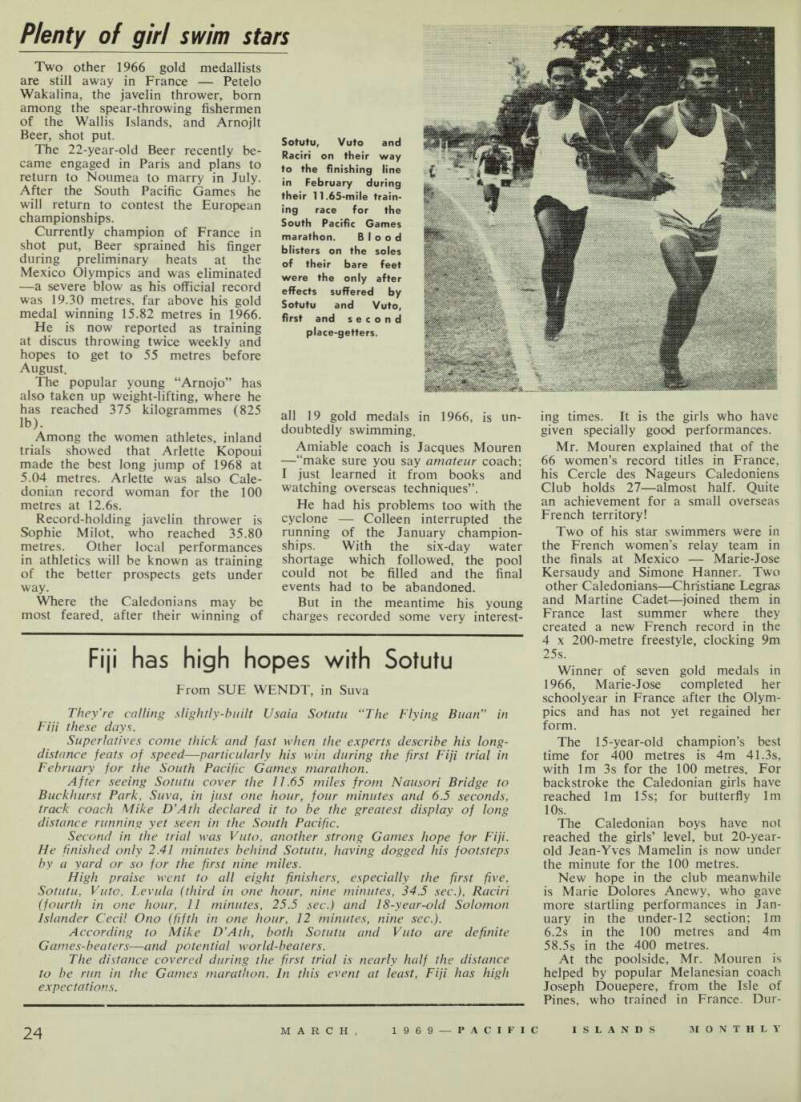
Sotutu, Vuto and Raciri on their way to the finishing line in February during their 11.65-mile train ing race for the South Pacific Games marathon. Blood blisters on the soles of their bare feet were the only after effects suffered by Sotutu and Vuto, first and second
place-getters.
ing January Mr. Mouren also had the aid of Francois Oppenheimer, technical adviser from France.
The 15 swimmers from Noumea who visited New Zealand at the end of February (16-26), give some idea of Caledonian prospects but, as Mr.
Mouren declares, it would be ex tremely difficult for swimmers to re peat the 1966 Games performance out of their own territory. More over, the swimmers are now older and have to devote more serious time to studies, etc.
As for other Games events, the Caledonians will not enter the golf tournament since there is no golf course here as yet.
In volley ball, soccer, etc., we hope to have more details for you next month.
And A Report From Suva
On Fiji's Progress
Street collections and a Fiji-wide general appeal are included among the fund-raising plans of the Fiji Amateur Sports Association, which estimates that sending a team to the Third South Pacific Games in August will cost about $44,000.
The FASA already has funds in hand from general appeals, as well as the $10,000 grant given by the government, but it estimates that some $12,000 will have to come from sports unions and associations alone, contributing on a scale of about $100 for each competitor and official sent to the Games. It is also counting on other money promised by various organisations.
The size of the team won’t be known until about a month before the Games, but an indication of the number of athletes to compete should be known after the Fiji National Athletics Championship at Buckhurst Park, Suva, during the Easter week end.
The national swimming champion ships will be in May and the boxing championships are expected to be held towards the end of April.
Fijian "wonder boy"
Torrential rain did little to help athletes competing in the February 22 athletic trials at Buckhurst Park, Suva—but the difficult conditions didn’t prevent “wonder boy” Usaia Sotutu from winning the 800 metres in 1 m. 56.7 s.
This was only .4 s. outside Mala mala of Fiji’s national and all-comers record, set last year. Malamala hasn’t
been seen very much during recent training, and it’s not known whether he’ll be going to the South Pacific Games—but he’ll have an excellent replacement in Sotutu, if he doesn’t.
Sotutu’s time for the 800 metres was 3.8 s. faster than the time re corded by E. Humuni, of New Cale donia, at the Second South Pacific Games in Noumea in 1966. In that race, Malamala came third, clocking in at 2 m. 2.4 s.—but he set the Games record by running it in 2 m. during the first qualifying heat.
At Buckhurst Park, on February 22, Sotutu also excelled in the 1,500 metres, clocking a winning 4 m. 53 s. in his heat. He is not normally a 1,500-metre runner and the conditions at Buckhurst were very tough.
He competed against five other runners in the 400 metres and won on the slippery grass and in driving rain with a time of 53 s. This is 8.3 s. outside the national and all comers record.
Fastest heat in the 200 metres was run by Samu Yavala, in 22.5 s. He brought off a double by later winning his 400 metres heat in 51.1 s.
In the 100 metres, Joe Radrodro, of Lomavata, won in 11.5, putting Mike D’Ath’s long, hard training to good use.
The junior distance-runner Vuto took the 5,000 metres in 16 m. 07.0 s., after earlier winning the junior 800.
Roy Thomas, the 100 metres record holder, went to the tape in his 200 metres heat in just 22.7 s.—an ex cellent time, considering the water logged conditions.
In the high jump, Fiji’s champion high-jumper, Koresi Naucikidi, gave an encouraging performance in clear ing the highest bar this season— -5 ft 8 in.; he has been training hard at Navuso, where he has already cleared 6 ft. His 1968 championship height was 6 ft 2 in.