Up Front
pp. 4-5 · Read in the full issue
with the Editor
Seeing Norman Camps in Sydney the other day, on one of his occasional flying visits, reminded me of an old, half-dreamed dream of mine to make my fortune at Mount Hagen. The memory was all the stronger because Norman, who is no dreamer but a man of vision nevertheless, has gone ahead and made his.
it all started for me, and Norm Camps, at Mt. Hagen in 1954 when what is now a thriving town in the rich Western Highlands of New Guinea was nothing but a District Office in the centre of what was still regarded as uncivilised New Guinea.
There were eight Europeans there then and only three in private enter prise (if you can use so grand a term). One was the legendary Danny Leahy, at Kuta, and there were Harry Rudd and Frank Aveling, who were sawmilling and trading out of “town”.
No road to the Highlands
Norm Camps first saw Mt. Hagen in that year as a member of a field expedition from the Australian Museum in Sydney. He was 23, and the Highlands fascinated him during several months that the expedition stayed in and around Hagen. They were made welcome by Neptune Blood, of the recently established Korn Government agricultural station, where they were given quarters of native materials.
I first saw this beautiful area the same year as a reporter with the ABC in Port Moresby. There was no road to the Highlands then, and Goroka was the point of entry to Hagen. You flew over the ranges and up the wide Wahgi to Hagen and with luck you got back to Goroka again the same night after the air craft had completed its milk run — Goroka being the only place in all the Highlands with a hotel, a little beauty run by Ellen Pitt with feather eiderdowns and Stuart crystal beer goblets.
I was 27 and it was my dream
that I should quit radio and the lousy coastal weather and establish a private rest house at Mt. Hagen and thus open that end of the Highlands plateau to visitors. The resthouse, I felt sure, would blossom into a small hotel one day.
I talked it over with myself a lot but I never found the money, or more probably the courage, to go ahead with the venture.
Norm Camps had a dream at the same time, but he had the pioneer S Zv \ O 95 b 5 aC whe„ mS i el was on doin g ay n; n v
the” passengers who 8 Z
just arrived at Port Moresby’s airport on the overnight Qantas “Skybag” from Sydney, I came across Norm sitting on a bench at the terminal
building with a slight blonde girl, whom he introduced as his bride of only a few weeks, Esma. Norman was returning to Hagen, where he had entered into a partnership with Nep Blood to start a coffee planta tion, because coffee they felt “had a future” in that area, although nobody had proved it.
“That place has to go ahead be cause it has land and labour.” he told me that day.
"It'll go ahead!"
Norman was to be the active partner in establishing and managing the plantation and thus be became the second European planter at Mount Hagen, after Danny. And didn’t he work! 1 stayed with Norman and Esma on occasions in the pitpit house with hurricane lamps he had erected on one of the two blocks that is now Bindon Plantations, for there was still no hotel.
Of a total of 150 acres he planted up 116 acres with Arabica arabica and Arabica bourhin, and kept the
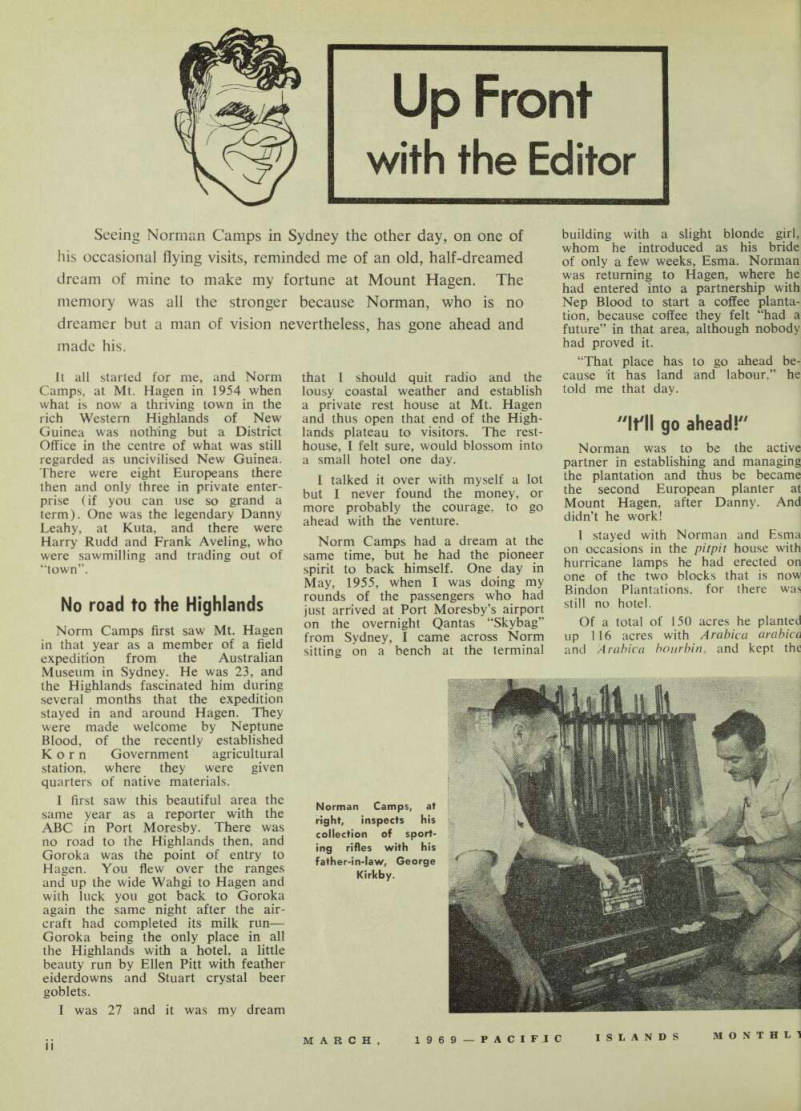
Norman Camps, at right, inspects his collection of sport ing rifles with his father-in-law, George Kirkby.
... L . daily freighting service to the coast on good roads which are improving all the time I visited him and Esma in Hagen not long ago. Their old pitpit house, which they occupied for the first seven years of their married life, when the children began to come along, has now been replaced with a modern comfortable homestead.
Esma is as quiet and as unassum ing as she ever was, and both love their life at Mount Hagen, which is home. Everything they have is there.
He is foundation president and president of the Western Highlands Chamber of Commerce, a past
leanest and healthiest plantation in district which now slowly began to row as more planters were attracted, recall one day finding him gloating ver a mountain of passionfruit skins 'hich nobody wanted but which he ad carted off as rich mulch.
He is not a fellow who is ever still, i addition to his planting activities e ran small trade stores with Danny eahy, and the Shell agency, which e got by the simple expedient of riting away for it one night. Two »C3s a week were now putting down ; Hagen—just imagine!—and on my sits I would find Norm himself md-pumping petrol into their tanks om 44-gallon drums, commenting i the way business was beginning • develop.
With Norman Camps’ activities, ithusiasms and integrity, it was rtain that Mount Hagen had to :pand just to keep up.
As anybody knows who has ever sited one of the famed Hagen lows (this year’s show is on August
!/31 immediately following the
mth Pacific Games in Port oresby), Mount Hagen has now ught up with its future, and is rgmg ahead to greater things.
There are more than 800 Euro ans in the town, and coffee, which s made many fortunes, is now mg surpassed in popularity by tea d a ? dozen other things. Norm imps’ fleet of trucks operates a
president of the Mt. Hagen branch of the Highlands Farmers and Settlers’ Association, a trustee and vice-president of the Western High lands Agricultural Society (which runs the Hagen show) and a trustee of the Hallstrom Park Bird of Para dise Sanctuary.
Norman today operates Bindon Plantations, with its coffee factory, and Kala Motors (and there is still a happy association with Nep). He has the Shell agency for the district, and for the Southern Highlands, and supplies fuels, chemicals and fertiliser by air. Kala Motors, with a work shop that is a showplace of the district, has lucrative agencies, in cluding Lister, Balm, Toyota, Massey Ferguson, Southern Cross Machinery, Lucas and Olympic tyres.
More opportunities
Today, Norm Camps’ business affairs have an annual turnover in excess of $1,500,000. And he is still only 37.
Although he has seen such great development in his 14 years at Mount Hagen, Norm Camps believes Hagen is still wide open for newcomers who want to grow with the town. As some opportunities are closed, new ones are opened. Development, he thinks, has hardly begun.
With his local knowledge, un doubtedly he is talking true. But then, it is easy to dream, as some of us do. Success comes by plunging in and getting on with it, and as an example Norman and Esma Camps have always been my personal ideal.
Stuart Inder
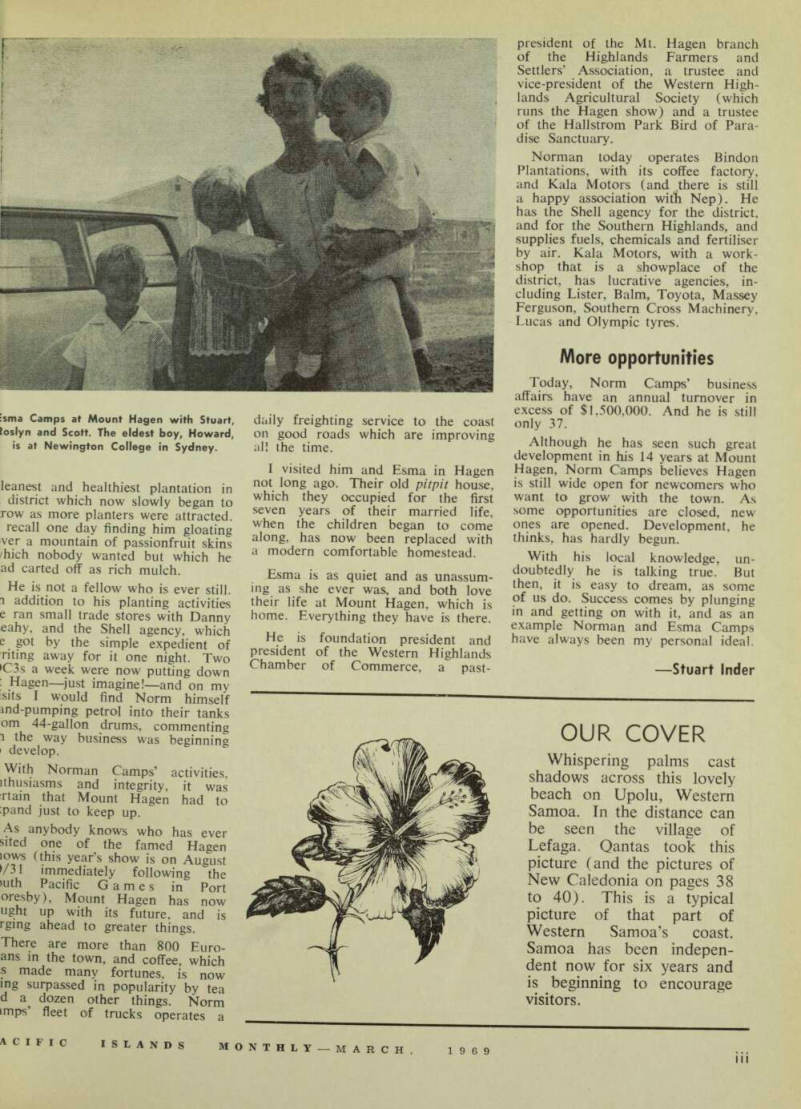
Esma Camps at Mount Hagen with Stuart, Roslyn and Scott. The eldest boy, Howard, is at Newington College in Sydney.