The Practical Planter
pp. 147-155 · Read in the full issue

Good Vegetables Can Be Grown
In The Islands-Here's How
■ There is a lack of vegetables in the Islands of the South Pacific —which means that there is a market for vegetables in the Islands. This article explains how to grow vegetables in the tropics.
Diets in the Islands are generally poor in fresh vegetables, particularly in the green and leafy types valuable for their high vitamin and mineral content. However, most kinds of vegetable can be, and are, grown in the Islands. The following is an extract from a report on vegetables pro duced by the US Trust Territory of Micronesia and printed by the South Pacific Commission.
As well as describing various vegetables and explaining how they can be grown in the tropics, the report also indicates that, although at present limited, commercial production of vegetables in the Islands will become more widespread—given more effort, more equipment, more materials and better-trained labour.
Vegetables should have rich, sandy,
19am soil for good growth. However,
since such soil is rarely found in the tropics, it is necessary to make Th?n f nlhTif°, f ** aVailable * soils can & be f vppp r £ a *L be KT t 0 f roduce ve S®" of orgamc thF romnmt nr -? m °r ZS TSe S r b a y nd a f , :e e use by ot i^C n |uUivtiofn“hod b s y The outlined below Tor paring an area for vegetable production will increase thfchances for higher crop yields: a i • Apply manure, compost, or sea animals at a rate of 1 lb per square foot at least three to four, weeks before planting time. Chicken manure, pig manure, and sea slugs are best—in that order. , . • u B j ore the manure is spaded m, broadcast an application of commercial fertiliser at the rate of 2 lb per 100 square feet. Use a com-
thC S'
W • , ?*. *r 1 °" 8, u °r 10 ' brpab rW« ei tn Ca fertl hsers help to break down the manure, aid in mamand 1 n?nv;L 0 fn ani f C of the S( ? ik a fair sunnlv nf Wlth • Spade in the mini,t . p oe m the manure, compost,
or sea animals together with the commercial fertiliser to a depth of about 6 in. Do not work the soil with a spade or plough the garden with a tractor when the soil is wet * If weeds a PPear, hoe them every seven to ten days. By far the best time t 0 S erminate the weed seeds and kll l the y° un g weeds is before ,h * ac o“r he area - Do not work in the area if the 8011 18 wet enou 8 h to “pack” wherever one • Level the surface with a rake.
Remove anv rough debris and stnnps that ma y stmT present ot the sur! j Make sure that the soil is not in r iLrv condftion and tha? it has not pSked and hecomp u i * *SZtJ I Ju bec ° me hard. Large clods must be broken up or the seedbed will not be satisfactory for sowing small seeds.
ThfKP ran hp nrnwn
1 nese ca n De grown Here are descriptions of some of the vegetables that can be grown in Micronesia and other Islands territories.
Asparagus: Asparagus is grown seed in the tropics are dlfficu,t ship The seed is sown in rows in a seedbed and grown
for several months until the seedlings are about 1 ft high. Thev are then transplanted to a well-drained sandv loam soil high in organic matter The seedlings are set if the bottom of a ditch about 14 in. wide and 6 m. deep, and well-rotted manure is added from time to time until the ditch is completely full. Nitrogen and «° ma’nure and can be ?.PP 1 ‘ ed e;ther before or after the cut *'ng season, which may be within a n bo , u ‘ ‘ w ° kears af f transplanting make the plant go mto its rest period, water should be Wlthheld for two to three months at tbe beginning of the cool, dry season, The tO P s are then cut off, and the area hoed or disced and irrigated regularly.
Spears may be harvested when 6 to 8 in. long over a period of three to six weeks. The cut is made about 1 hi. below- the ground. The lower ends of harvested spears should be placed in a pan of water under refrigeration to maintain quality until cooked, After harvest the top should be allowed to develop for several months to store food in the fleshy roots for the next crop.
Beans: Results with lima beans in Micronesia have been fair during the
:00l season, though pod borers and jafhoppers do considerable damage.
Fruit set will be reduced during the Iry season with temperatures above . , The pod borer is effectively conrolled by dusting or spraying with DDT is ineffective against jod borers, but effective on leafloppers. Lima beans can be harvested iver a longer period than green beans; mder good conditions they will >ear for several years. For best looking quality they should be larvested before the beans reach the vhite stage.
Throughout the year
D , , \ Foie beans (green beans) can be ;rown throughout the year, but best production is obtained when rainfall s not heavy. The beating rains reluce the crop by causing favourable onditions for disease, by interfering /ith pollination and by knocking off ome of the blossoms Rust-resistant Kentucky Wonder and Yardlong are rie only pole varieties showing conistently good yield m the tropics. lean seeds should be planted about i in. deep and spaced 3 to 4 in. part in the row for bush beans, and a e varieties.
A heavy application of well-rotted ompost should be mixed with the Dil during seedbed preparation, and complete fertiliser high in phoshorus added in furrows on either ide of the seed furrow at planting me ’ u° r i b6St P roc uctiai ?’ beans lould be kept growing vigorously ) develop a good-sized plant before owenng begins. A side dressing of
ammonium sulphate is recommended when the first pods are setting. Fertilisation at this time should prolong the harvesting season and increase the s * ze °f pods.
The pods should be harvested while young and tender, before they become lumpy—which is an indication of maturity and toughness. Picking every three or four days keeps the plants producing freely; vines are weakened by allowing pods to hang on to maturity.
Bush beans have a harvest period lasting for two to three weeks, and bear a week or so earlier than pole varieties, which bear for a further two or three weeks - Although bush beans are easier to plant and manage in home gardens, pole varieties usually bear better per unit of ground and do not need to be planted so often.
Broccoli: It is not hard to grow broccoli, which withstands heat and dry conditions better than its close relative—the cauliflower. The large. edible, centre cluster of buds develops first and is harvested just before the yellow flowers begin to open. About the time the centre head is harvested, it is advisable to give a side dressing of ammonium phosphate. This stimulates development of the edible side shoots, which may be harvested over a period of two months.
As the stems below the flower clusters are highly nutritious, stems 4 to 6 in. long should be cut with the main flower head, and stems 2 to 4 in. long with the side shoots.
The top of the centre stem may rot after harvest if rainfall is heavy.
Rotting may be prevented by plac-
ing a moisture-proof paper cap over the cut surface on the stalk or by making a slanting cut at harvest Cabbage: Several varieties *of cabbage in Micronesia have produced heads weighing 2 to 4 lb during the warm season, and 4 to 6 lb during the cool months. There are exceptions of 7 to 9 lb heads produced under good soil conditions and in cool weather.
Apart from the usual preparation of the soil and addition of manure and complete fertiliser before plant ing, it is wise to apply a side dress ing of ammonium sulphate or a corn plete fertiliser shortly after the heads begin to form. A side dressing of nitrogen is particularly important when the cabbage begins to head or when the leaves show yellowing. One tablespoon per plant should be enough T ' .
IremenClOUS difference A combination planting of Golden Acre for early maturity and Succession or Copenhagen Market for later harvest is suggested for the Islands, Varieties having small heads, such as Copenhagen Market and Suc cession, should be spaced about 18 in. apart. It is very important to keep the young seedling strong and vigorous both before and after trans planting. A good start with these seedlings makes a tremendous differ ence in the size of the heads, Chinese cabbage; Chinese cabbage is one of the easiest and most pro ductive vegetables grown in Micro nesia: returns are among the highest for the labour and garden space in volved. Where greens, celery, and
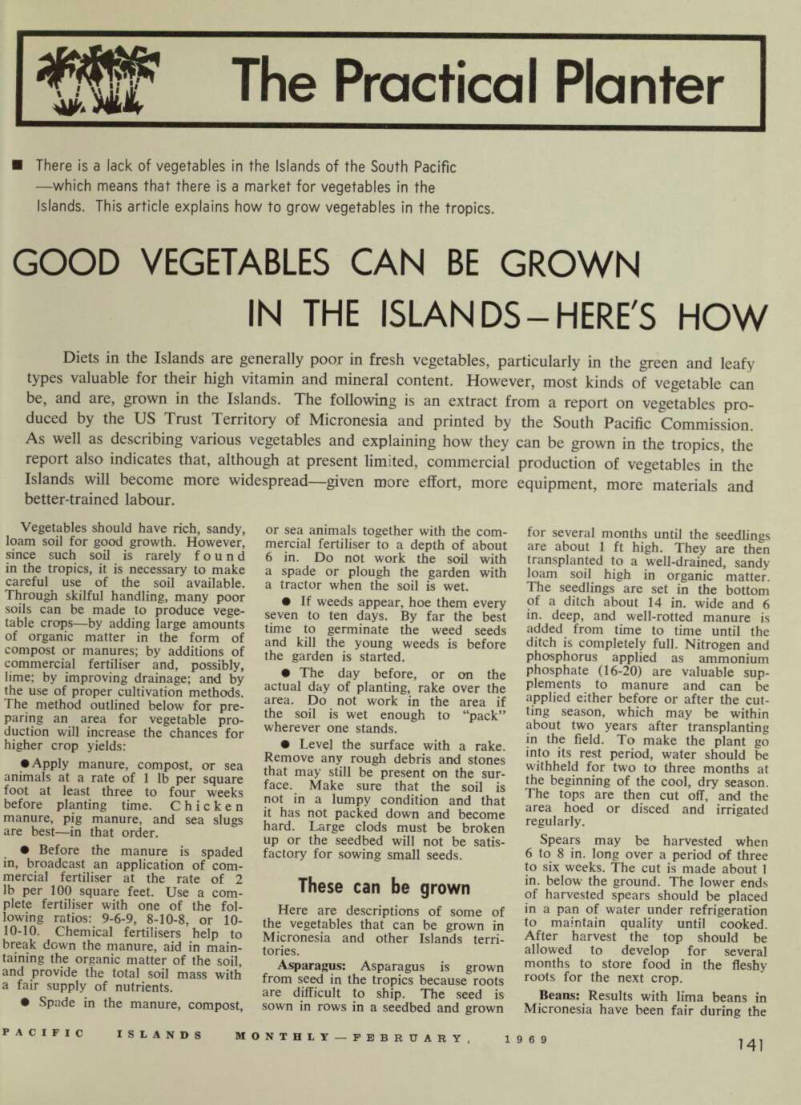
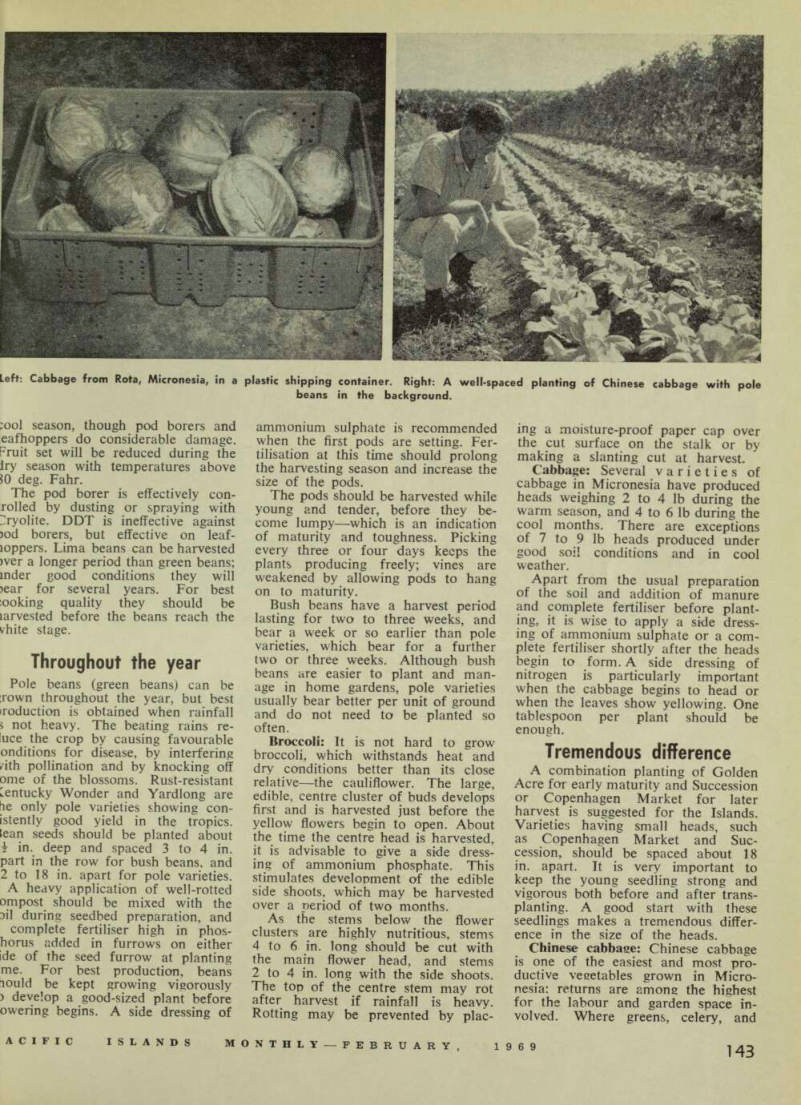
Left: Cabbage from Rota, Micronesia, in a plastic shipping container. Right: A well-spaced planting of Chinese cabbage with pole beans in the background.
head cabbage are scarce, this vege table is popular, particularly in chopped salads. It can be grown all the year round at all elevations pro vided watering is done during the dry spells and enough organic fertiliser is applied.
During the warm season, when Chinese cabbage tends to form loose heads, the young leaves are used for salads or as cooked greens. Generally the Chinese cabbage seed is planted directly in the field, and later thinned to plants 10 to 20 in. apart. Chinese cabbage should be kept growing rapidly with a side dressing of nitrogen or complete fertiliser. Harvesting can begin when the leaves are 3 to 4 in. long.
Excellent
Sweet corn: Excellent roasting ears can be grown throughout the year by succession plantings. USDA-34 and Hawaiian Sugar perform very well throughout Micronesia. Com plete fertiliser and manure, where available, should be mixed with the soil before planting. During the rainy season the seed should be planted on ridges 6 to 8 in. high, in rows spaced 2 to 3 ft apart. A kernel or two is dropped at intervals of 8 to 10 in. in the row. One or two side dressings of ammonium sulphate or a complete fertiliser are advisable at about four-week intervals, beginning when the corn is knee high.
The USDA-34 and the Hawaiian Sugar variety should produce from one to two ears per plant. When ready for harvest the ears should be of good size and firm, and should show dry, brown silks at the tips.
The kernels should be at the milk
or soft-dough stage, which can be determined by pulling back the shuck at the tip of the ear and breaking one or two kernels with the thumb nail. Ears should be checked often because the ideal stage for harvest lasts for only a day or two before the kernels become toughened.
Cucumber: Cucumbers are widely grown in Micronesia both for export and local marketing. Straight Eight, Palomar, and Burpee Hybrid are the popular varieties for export from Rota, Tinian, and Saipan to Guam.
For domestic purposes, the introduc tion of Oriental varieties such as Four Leaf, Yamaki, Kyoto FI, and Kurume FI are adapted to the higher rainfall areas of Micronesia.
Production of the Oriental varieties is heavy when compost or manure is applied in large quantities with light side dressings of chemical fertilisers.
Cucumbers can be harvested at any size, but before they turn yellow they should be gathered at two to three days’ intervals.
Eggplant: Eggplant is a popular warm-season (70 deg. to 80 deg. Fahr.) crop in the tropics. It grows well throughout the year in Micronesia and gives fair to good yields. Seeds are soaked overnight to improve germ ination before planting in a seedbed.
The seedlings are grown to three or four-leaf size, transplanted to another seedbed, and eventually set in the field at a height of 5 to 7 in.
To keep young plants growing vigorously it is important, when neces sary, to irrigate regularly. Spraying with DDT helps keep the foliage free from flea beetles and lacebugs.
An early setback to the young plants will reduce yields. Side dressings of a
complete fertiliser at monthly in tervals when the plants begin to pro duce should help maintain produc tion over many months.
Fruits should be harvested regularly when they are a good size and when the skin shows a slick lustre. Fruits allowed to become mature on the plants will reduce future yields.
Lettuce: Head lettuce varieties such as Imperial 44 and Great Lakes pro duce moderately firm heads weighing about H- lb on the Sabana in Rota.
Mignonette is more heat-resistant than most head-type varieties. It can be grown as a leaf lettuce during the summer, but should be harvested when young because of the possible development of bitterness.
Lettuce can either be transplanted to the garden or planted in place. If planted in place, it may be thinned out slowly; the thinnings may be used for greens even though no heads have been formed. Thinned plants can also be used for transplants.
Mignonette or Manoa may be planted closely, while double rows 6 to 8 in. apart should be used when space is at a premium.
Withstands shading
Lettuce is a good crop to interplant among other plants. It is small and will withstand considerable shading.
In hot weather, overhead shading of lettuce during the warmest part of the day prevents wilting and improves quality. Quick growth of lettuce re sults in crisp, sweet foliage; there fore, good fertility and plenty of water are important during all stages of growth.
A commercial fertiliser such as
Left: A Chinese cabbage—one of the easiest vegetables to grow in the tropics. Right: Yardlong beans picked at right stage of ripeness.
6-9-6, 8-12-6, or 16-20 ammonium phosphate, or 11-48 ammonium sul phate should be applied as a side dressing two to three weeks after plants are up. Lettuce does not do well on highly acid soils. If the soil is acid, lime should be applied at about 15 lb per sq. ft.
Okra: Okra is well adapted to the hot humid tropics. It grows well in all the high islands of Micronesia.
A few plants are enough for the average home garden as they will tend to bear for several months.
Germination can be improved by soaking the seeds for a day before planting—unswollen seeds should be discarded.
The seeds are planted in hills 18 to 24 in. apart, in rows 36 to 40 in. apart. Plants are thinned there after to one or two good plants per hill. The plants should be kept grow ing rapidly by side dressings of a complete fertiliser at four to six weeks’ intervals. The pods must be harvested at intervals of every two to three days when the tips are still tender and break with a snap. If pods are left to mature, they become tough and are not edible.
Okra may be boiled and used in soups, or it may also be combined in a salad with tomatoes and other vegetables.
Popular
Radish: Radishes are widely grown in the tropics, and are one of the easiest short-period vegetables to raise.
Nearly all the varieties perform well.
Early Scarlet Button is a very popular variety, and is excellent when grown at the higher altitudes in winter on the Sabana on Rota. At sea-level, when the temperature is high, and particularly when a drought occurs one or two weeks before maturity, all radishes are likely to be tough, pithy, and very “hot”. The roots may also become elongated rather than enlarge normally.
This can be prevented to some extent by enriching the soil with manure and commercial fertilisers and applying irrigation water regularly when needed. Palm leaf shade is of some help in lowering the tem perature.
As radishes are a short-season crop (three to six weeks), they can be readily intercropped in the row or between the rows of many long season crops. A row 3 to 4 in. wide can be sown and later thinned out so that the plants are spaced about 1 or 2 in. apart and stand three abreast in the row.
Tomatoes; From a nutritional standpoint and for general use in cooking and preparing meals, the
tomato is one of the most desirable home-garden vegetables.
The varieties, Pearl Harbor, County Prechard, Victor, and Homestead are all popular in Micronesia. The small fruited pear-, plum-, and cherry shaped tomato varieties do better in most areas of Micronesia when the temperature, humidity, and rainfall are high.
Fruits should be picked when full size. Green tomatoes of good size can be picked and placed on the window-sill or in a sunny place for ripening. Commercial tomatoes should be picked when of good size but green. They are graded and uniformly packed in medium and large sizes. Extreme care in handling commercial tomatoes is essential at all times to reduce bruising and sub sequent rotting.