Trials And Tribulations
pp. 73-75 · Read in the full issue

Of Fiji Football
By Frank Tinsley, In Suva.
A stranger to Fiji, watching a Rugby match, is almost always assured of exciting entertainment, but very often he is in for some surprises that have nothing to do with the game itself.
If a player is injured and has to leave the field, he will usually strip otf his jersey and hand it to the stripped-to-the-wai&t substitute as he jogs on to the field. The “sub” wriggles into the jersey and carries on in his second-hand, sweat-soaked, and often rain-drenched, garment.
Unfortunately, this unhygienic practice is accepted without protest by Fiji players because many of them cannot afford to buy jerseys (or shorts either, for that matter), and their impecunious clubs often cannot afford to stock sufficient gear to ensure each player his own outfit.
Gratitude
With jerseys so precious, it was with great gratitude that the new Navua Rugby sub-union last year took delivery of an unexpected con signment of 19 brand-new jerseys sent as a gift by the Marist Football Club of Wellington, NZ.
The NZ club had heard that the Navua sub-union was finding it dif ficult to clothe its representative team in green jerseys (green is the sub union’s colour).
A sub-union representative hurried to the Suva Customs on hearing that a package was awaiting collection there, paid the £7 duty demanded on the contents, and hurried back to Navua. Next day the rep. team proudly appeared in their new green garments. There were enough to go round—even for the substitutes!
No boots, no points
Before a team from Fiji left to tour New Zealand, I gave a player two vests to help keep him warm in the colder clime to which he was going.
On his return, I asked the player, “And how were the vests?”
He replied, “They were fine, but as I and a club friend didn’t have jerseys of our own I gave him one and we’re now using them for Rugby training. They make fine jerseys!”
Rugby boots are also short in Fiji and often players, sometimes whole teams, play in bare feet.
The Navua sub-union ordered all club players to appear in boots by a certain date last year, or their club would be docked competition points.
This was fine for the good name of Fiji Rugby but young players from a club in the hill country suf fered as a result of the ruling. Rather than miss a game, they turned up barefoot. They won the game—and then were docked the precious points they had gained!
"Terrible"
But the sub-union’s severity had a happy outcome.
A lady, who read of the boot ruling, in The Fiji Times, declared that she thought it “terrible that keen young players should lose their points just because they had no money for boots.”
And she did something about the terrible situation. She signed a cheque for boots for the team
(and she insisted upon remaining anonymous).
If keenness is any qualification for charity, then these young players certainly had charity coming to them.
Though they have little money, they will beg, borrow or draw from their meagre savings £1 to get them to Navua and back for a game.
11-hour journey
Starting early in the morning, they tramp for four hours over rough country, then board a river boat for a ride of one-and-a-half hours to a spot near the playing field.
After 80 minutes’ Rugby, they set out on their si-hour journey back home. The boat trip cost them 10/each way.
Odds are that these days the
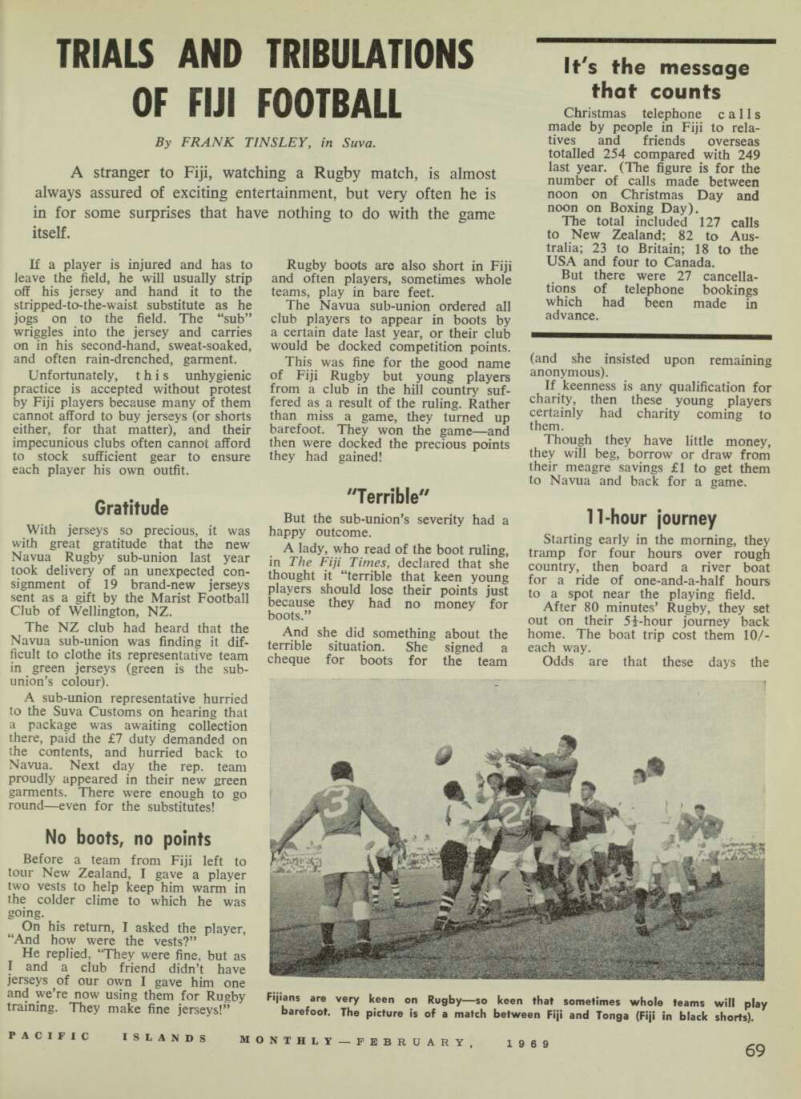
Fijians are very keen on Rugby—so keen that sometimes whole teams will play barefoot. The picture is of a match between Fiji and Tonga (Fiji in black shorts).
players are making their 11-hour round trip with lighter heart, for they have with them their new boots, and in their hearts kind thoughts for their anonymous “Fairy Godmother” in Suva.
Yet another kind deed connected with Fiji Rugby was revealed when a crate containing £5O worth of books arrived at Daviqele District School, Kadavu. The books were the gift of Eddy Whatarau, captain of the Whakarewarewa, NZ Rugby team which toured Fiji in March, and of his team-mates.
Promised to help
Eddy, who had toured Fiji and Tonga in 1960 with the Maori All Blacks, and who teaches school at Rotorua, had visited the Daviqele school during his tour last year, and had promised to help it. The NZ team donated £2O on the spot to the school, then returned home. But they didn’t forget Daviqele.
The books arrived mid-year with a letter from Eddy Whatarau, in which he mentioned “our unforget table memories of Nabukelevu” (where they had played). It added that the team were still talking about Kadavu and the Fijian people, and that they would remember for the rest of their lives the kindness and hospitality they enjoyed there.