Roughs It-And Likes It
pp. 47-55 · Read in the full issue
The Geic, Where The Tourist
By Ken Mcgregor
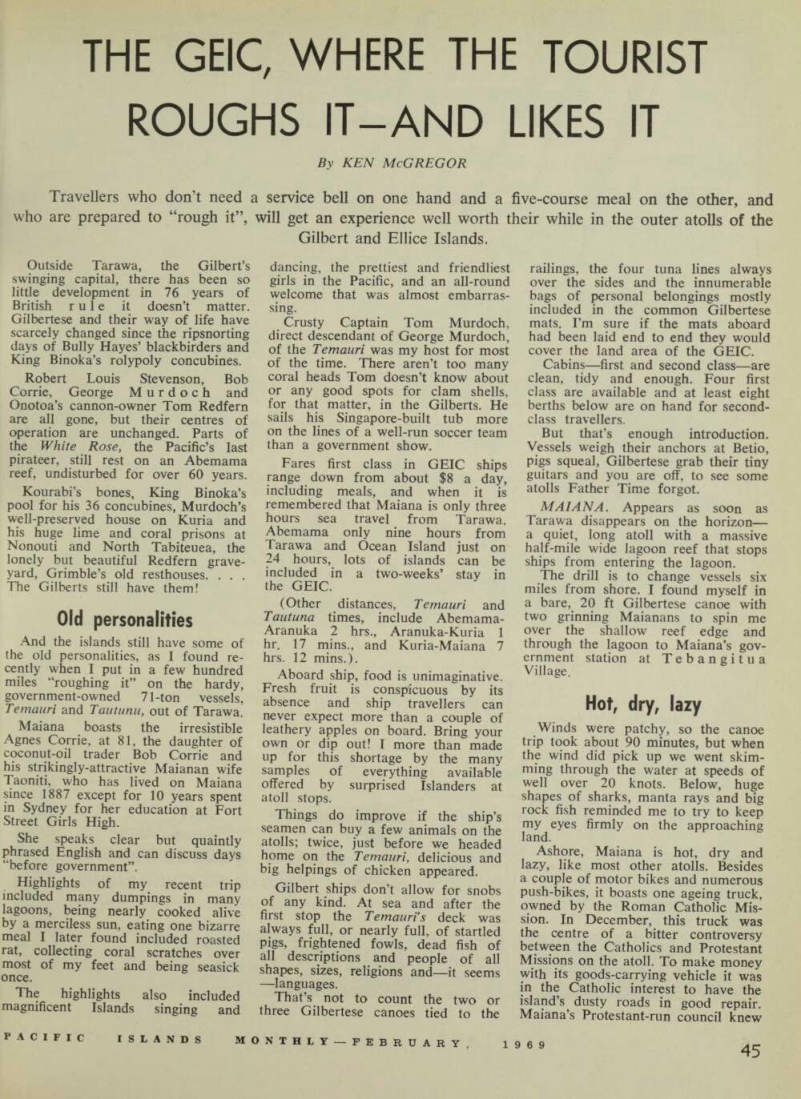
Travellers who don’t need a service bell on one hand and a five-course meal on the other, and who are prepared to “rough it”, will get an experience well worth their while in the outer atolls of the Gilbert and Ellice Islands.
Outside Tarawa, the Gilbert’s swinging capital, there has been so little development in 76 years of British rule it doesn’t matter.
Gilbertese and their way of life have scarcely changed since the ripsnorting days of Bully Hayes’ blackbirders and King Binoka’s rolypoly concubines.
Robert Louis Stevenson, Bob Corrie, George Murdoch and Onotoa’s cannon-owner Tom Redfern are all gone, but their centres of operation are unchanged. Parts of the White Rose, the Pacific’s last pirateer, still rest on an Abemama reef, undisturbed for over 60 years.
Kourabi’s bones, King Binoka’s pool for his 36 concubines, Murdoch’s well-preserved house on Kuria and his huge lime and coral prisons at Nonouti and North Tabiteuea, the lonely but beautiful Redfern grave yard, Grimble’s old resthouses. . . .
The Gilberts still have them!
Old personalities
And the islands still have some of the old personalities, as I found re cently when I put in a few hundred miles “roughing it” on the hardy, government-owned 71-ton vessels, Temauri and Tautunu, out of Tarawa.
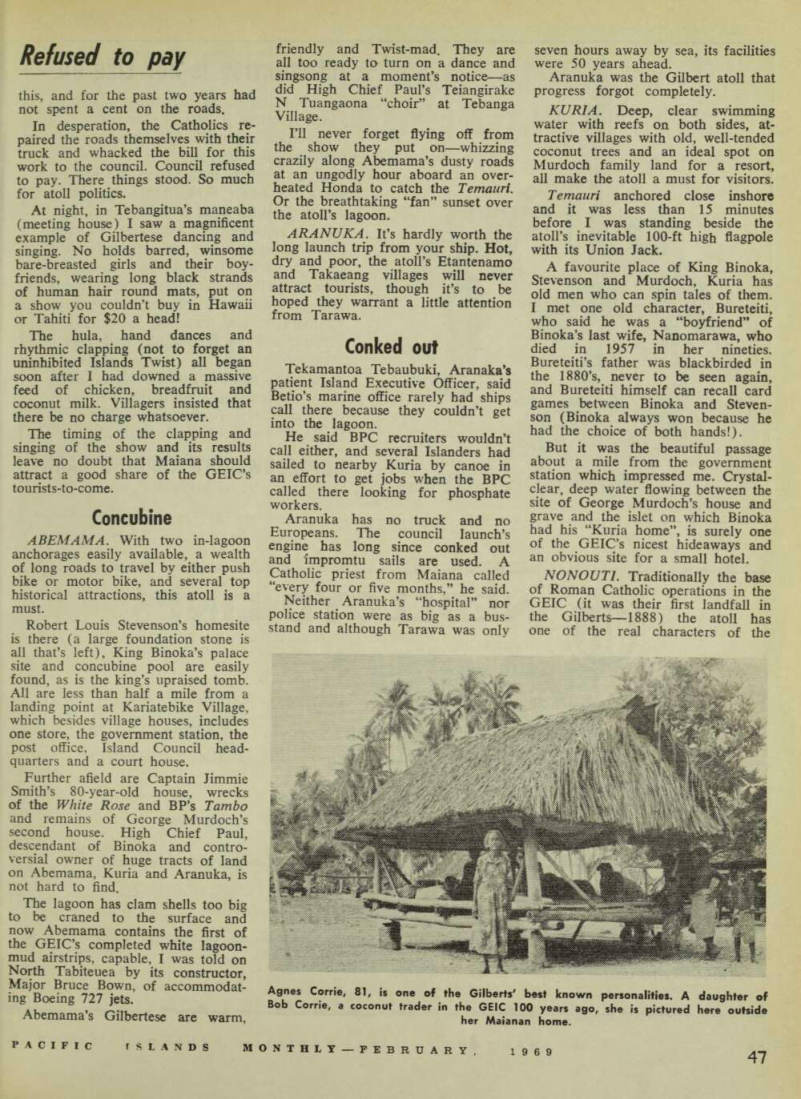
Maiana boasts the irresistible Agnes Corrie, at 81, the daughter of coconut-oil trader Bob Corrie and his strikingly-attractive Maianan wife Taoniti, who has lived on Maiana since 1887 except for 10 years spent in Sydney for her education at Fort Street Girls High.
She speaks clear but quaintly phrased English and can discuss days “before government”.
Highlights of my recent trip included many dumpings in many lagoons, being nearly cooked alive by a merciless sun, eating one bizarre meal I later found included roasted rat, collecting coral scratches over most of my feet and being seasick once.
The highlights also included magnificent Islands singing and
dancing, the prettiest and friendliest girls in the Pacific, and an all-round welcome that was almost embarras sing.
Crusty Captain Tom Murdoch, direct descendant of George Murdoch, of the Temauri was my host for most of the time. There aren’t too many coral heads Tom doesn’t know about or any good spots for clam shells, for that matter, in the Gilberts. He sails his Singapore-built tub more on the lines of a well-run soccer team than a government show.
Fares first class in GEIC ships range down from about $8 a day, including meals, and when it is remembered that Maiana is only three hours sea travel from Tarawa.
Abemama only nine hours from Tarawa and Ocean Island just on 24 hours, lots of islands can be included in a two-weeks’ stay in the GEIC. (Other distances, Temauri and Tautuna times, include Abemama- Aranuka 2 hrs., Aranuka-Kuria 1 hr. 17 mins., and Kuria-Maiana 7 hrs. 12 mins.).
Aboard ship, food is unimaginative.
Fresh fruit is conspicuous by its absence and ship travellers can never expect more than a couple of leathery apples on board. Bring your own or dip out! I more than made up for this shortage by the many samples of everything available offered by surprised Islanders at atoll stops.
Things do improve if the ship’s seamen can buy a few animals on the atolls; twice, just before we headed home on the Temauri, delicious and big helpings of chicken appeared.
Gilbert ships don’t allow for snobs of any kind. At sea and after the first stop the Temauri’s deck was always full, or nearly full, of startled pigs, frightened fowls, dead fish of all descriptions and people of all shapes, sizes, religions and—it seems —languages.
That’s not to count the two or three Gilbertese canoes tied to the
railings, the four tuna lines always over the sides and the innumerable bags of personal belongings mostly included in the common Gilbertese mats. I’m sure if the mats aboard had been laid end to end they would cover the land area of the GEIC.
Cabins—first and second class—are clean, tidy and enough. Four first class are available and at least eight berths below are on hand for second class travellers.
But that’s enough introduction.
Vessels weigh their anchors at Betio, pigs squeal, Gilbertese grab their tiny guitars and you are off, to see some atolls Father Time forgot.
MAI AN A. Appears as soon as Tarawa disappears on the horizon— a quiet, long atoll with a massive half-mile wide lagoon reef that stops ships from entering the lagoon.
The drill is to change vessels six miles from shore. I found myself in a bare, 20 ft Gilbertese canoe with two grinning Maianans to spin me over the shallow reef edge and through the lagoon to Maiana’s gov ernment station at Tebangitua Village.
Hot, dry, lazy
Winds were patchy, so the canoe trip took about 90 minutes, but when the wind did pick up we went skim ming through the water at speeds of well over 20 knots. Below, huge shapes of sharks, manta rays and big rock fish reminded me to try to keep my eyes firmly on the approaching land.
Ashore, Maiana is hot, dry and lazy, like most other atolls. Besides a couple of motor bikes and numerous push-bikes, it boasts one ageing truck, owned by the Roman Catholic Mis sion. In December, this truck was the centre of a bitter controversy between the Catholics and Protestant Missions on the atoll. To make money with its goods-carrying vehicle it was in the Catholic interest to have the island’s dusty roads in good repair.
Maiana’s Protestant-run council knew
Refused to pay
this, and for the past two years had not spent a cent on the roads.
In desperation, the Catholics re paired the roads themselves with their truck and whacked the bill for this work to the council. Council refused to pay. There things stood. So much for atoll politics.
At night, in Tebangitua’s maneaba (meeting house) I saw a magnificent example of Gilbertese dancing and singing. No holds barred, winsome bare-breasted girls and their boy friends, wearing long black strands of human hair round mats, put on a show you couldn’t buy in Hawaii or Tahiti for $2O a head!
The hula, hand dances and rhythmic clapping (not to forget an uninhibited Islands Twist) all began soon after I had downed a massive feed of chicken, breadfruit and coconut milk. Villagers insisted that there be no charge whatsoever.
The timing of the clapping and singing of the show and its results leave no doubt that Maiana should attract a good share of the GEIC’s tourists-to-come.
Concubine
ABEMAMA. With two in-lagoon anchorages easily available, a wealth of long roads to travel by either push bike or motor bike, and several top historical attractions, this atoll is a must.
Robert Louis Stevenson’s homesite is there (a large foundation stone is all that’s left), King Binoka’s palace site and concubine pool are easily found, as is the king’s upraised tomb.
All are less than half a mile from a landing point at Kariatebike Village, which besides village houses, includes one store, the government station, the post office, Island Council head quarters and a court house.
Further afield are Captain Jimmie Smith’s 80-year-old house, wrecks of the White Rose and BP’s Tambo and remains of George Murdoch’s second house. High Chief Paul, descendant of Binoka and contro versial owner of huge tracts of land on Abemama, Kuria and Aranuka, is not hard to find.
The lagoon has clam shells too big to be craned to the surface and now Abemama contains the first of the GEIC’s completed white lagoon mud airstrips, capable, I was told on North Tabiteuea by its constructor, Major Bruce Bown, of accommodat ing Boeing 727 jets.
Abemama’s Gilbertese are warm,
friendly and Twist-mad. They are all too ready to turn on a dance and singsong at a moment’s notice—as did High Chief Paul’s Teiangirake N Tuangaona “choir” at Tebanga Village.
I’ll never forget flying off from the show they put on—whizzing crazily along Abemama’s dusty roads at an ungodly hour aboard an over heated Honda to catch the Temauri.
Or the breathtaking “fan” sunset over the atoll’s lagoon.
ARANUKA. It’s hardly worth the long launch trip from your ship. Hot, dry and poor, the atoll’s Etantenamo and Takaeang villages will never attract tourists, though it’s to be hoped they warrant a little attention from Tarawa.
Conked out
Tekamantoa Tebaubuki, Aranaka’s patient Island Executive Officer, said Betio’s marine office rarely had ships call there because they couldn’t get into the lagoon.
He said BPC recruiters wouldn’t call either, and several Islanders had sailed to nearby Kuria by canoe in an effort to get jobs when the BPC called there looking for phosphate workers.
Aranuka has no truck and no Europeans. The council launch’s engine has long since conked out and impromtu sails are used. A Catholic priest from Maiana called “every four or five months,” he said.
Neither Aranuka’s “hospital” nor police station were as big as a bus stand and although Tarawa was only
seven hours away by sea, its facilities were 50 years ahead, Aranuka was the Gilbert atoll that progress forgot completely.
KURIA. Deep, clear swimming water with reefs on both sides, at tractive villages with old, well-tended coconut trees and an ideal spot on Murdoch family land for a resort, all make the atoll a must for visitors.
Temauri anchored close inshore and it was less than 15 minutes before I was standing beside the atoll’s inevitable 100-ft high flagpole with its Union Jack.
A favourite place of King Binoka, Stevenson and Murdoch, Kuria has old men who can spin tales of them.
I met one old character, Bureteiti, who said he was a “boyfriend” of Binoka’s last wife, Nanomarawa, who died in 1957 in her nineties.
Bureteiti’s father was blackbirded in the 1880’s, never to be seen again, and Bureteiti himself can recall card games between Binoka and Steven son (Binoka always won because he had the choice of both hands!).
But it was the beautiful passage about a mile from the government station which impressed me. Crystal clear, deep water flowing between the site of George Murdoch’s house and grave and the islet on which Binoka had his “Kuria home”, is surely one of the GEIC’s nicest hideaways and an obvious site for a small hotel.
NONOUTI. Traditionally the base of Roman Catholic operations in the GEIC (it was their first landfall in the Gilberts—lBBB) the atoll has one of the real characters of the
Agnes Corrie, 81, is one of the Gilberts' best known personalities. A daughter of Bob Corrie, a coconut trader in the GEIC 100 years ago, she is pictured here outside her Maianan home.
Divorces easy to get
colony, the current priest in charge of Catholic operations, Father Joseph Branstett.
The missionary, with 31 years in the colony, runs the big Catholic teaching operation from a two-storey colonial house only feet from the paper-white sands of the beach and yards from a massive maneaba (“it went up in 1941 when we had nothing else to do and it’s still the biggest in the Gilberts”).
Downing Victoria Bitter, Father Branstett gets philosophical: “In my first 10 years in the Gilberts I began to learn the language and start to understand the Gilbertese. The next 10 years and I could speak Gilbertese and I knew what a Gilbertese was thinking.
“During these last 10 years I realise I know nothing. That’s what the Gilberts are like.”
Nonouti also has a marriage problem. Its very attractive young women marry too young, I was told.
Legal age is 16, but many take a husband at 11, 12 and 13.
Miss Kaennang Kirabuke, 23, a pretty Island Council teacher, told me that divorces are easy to get and cost 50 cents. This led to many of the young couples breaking up when they turned 19 or 20.
“Another problem is there are in complete birth records here so no one knows how old many of us are,” she said. “Many girls are pregnant at 13 or 14, before they are married.
It’s a great shame.”
Witchdoctors
If young misses in bother aren’t problems enough, Nonouti’s quiet medico, Dr. Eritane, in charge of the atoll’s pathetic “hospital”, said he was faced with hot competition by the atoll’s withdoctors and sorcerers.
Not that there were many sick cases, but mostly when a patient is treated by a witchdoctor he was expected to pay with food, while Dr. Eritane’s service was free. Food payments at a time when the atoll was reeling from a prolonged drought were a strain on most people, he said.
Especially when they received herbs or “massage” in return.
North Tabiteuea. Handi
capped by a dark reputation because of its numerous “toddy murders” and stabbings (all men seem to carry long copra knives under their skirts) the atoll will have a 3,800 ft long white lagoon-mud airstrip finished in
Washing the skull
March, two miles south of Utiroa landing point.
Attractive walks, roads and beaches are there, and at tiny Eita Village hangs the much-feared Kourabi’s Bones in a maneaba. Set in a big basket decorated with beautiful shells, the bones hang suspended from the maneaba roof. They include a massive and well-preserved skull, supposed to have been Kourabi’s, who was a warrior son of a long dead Queen of Beru, who conquered Tabiteuea 100 years ago. Every five years those bones and skull are ceremoniously washed by “old men” of Eita.
North Tabiteuea also includes the surviving store and house of Francis Kicking, who was a rugged trader of 80 years ago, and an enormous prison, erected by George Murdoch over 50 years ago.
Its personality is another Catholic priest, Father L. Wrenn, with 20 years in the Gilberts, who said the atoll suffered badly in two ways— there had been no developments (except the airfield) for 60 years, and district officers called far too infrequently. When they did turn up, he said, they stayed only a couple of hours.
Grass skirts
SOUTH TABITEUEA. Vivacious girls in cleverly-woven grass skirts (and nothing else) were common, and the big hope is of rock cause ways because the atoll is broken up into many islets.
One village chief insisted on a picture being taken of his illegal white and red flag (instead of the Union Jack) that his village had had made to celebrate completion of an excellent 150-yard causeway to an adjoining island.
Another local bone that is being gnawed is the forthcoming union of the North Tabiteuea and South Tabiteuea Island Councils. North Tabiteueans own plenty of valuable land in the south and don’t want to pay land taxes, which could go into southern revenues.
DC “Ren” Smith is optimistic that “peace talks” will settle the problem.
ONOTOA, An attractive atoll which boasts an ancient resthouse of Grimble’s time, complete with the late DC’s whispering ghost, Onotoa
is friendly, pretty and well worth the rather long launch trip to shore.
Traditionally the home of Tom Redfern, a colourful trader who kept the blackbirders away with three massive German cannon he got somehow, the atoll has the Redfern cemetery.
I made a three-hour seven-mile trek through swamps, rivers, over causeways by foot, bicycle, tractor and water to find it on a lonely, un inhabited coastline overlooking booming breakers on the reef.
Nearly 40 grey coral graves, mostly in disrepair, were distributed over about 40 yards. Some were upraised and broken and I found two ageing skulls taking in the sun.
Only one name was left on a well preserved granite plaque: “In memory of James Corwin, master mariner, a native of Bornoldswick, Yorkshire, England, who died at Onotea, August 11, 1900”.
A short distance away, half buried in the beach, a VSO, Dick Morris, helped me uncover the ends of two huge cannon about whose history, of course, we knew nothing.
The spot, obviously, could spin a few yarns of the old Pacific.
Onotoa’s people were friendly, its villages and maneabas clean and its big lagoon sleepy and blue. I’d like to return.