Party politics, they said,
pp. 34-165 · Read in the full issue
would 'add lustre'
By staff writer KEN McGREGOR
The seven-day session of the GEIC’s fledgling House of Representatives (at Tarawa in December) was at times exciting, occasionally incomprehensible and sometimes even hilarious.
Proceedings were at times quiet, spirited, irrelevant and downright dull. Witnessing the session was—at least to a new comer like myself—a fascinating experience.
In 90 degree heat some members wore lounge suits of a mid-50’s vintage; others wore lava-lavas and looked the more comfortable for it.
When no one talked, the silence was broken by the six, softly-whir ring ceiling fans. A portrait of the Queen looked with maternal concern upon those gatherend.
The heat which causes the dreaded “Pacific malaise” (or lethargy) cut short debate on controversial subjects such as racial discrimina tion, and it brought to an abrupt end, among other things, a discussion about whether or not lagoon toilets would scare off tourists.
Often a government member would answer a question evasively, but Islands members didn’t protest: they seemed happy with the situation.
Little debate
There appears to be little debate in the GEIC’s House of Represen tatives. The meeting I attended was more a question and answer affair, with only a few curly motions.
Government-appointed members survive unruffled, with no third degree as yet from the 23 elected island members. (There are seven official members).
Normally jovial Assistant Resident Commissioner Derek Cudmore, and the tall, white-haired Finance Sec retary M. D. Allen, between them appear to run the show. They answer more questions and give out more information than all the other officials together, but are frequently helped out by R. G. Roberts, senior assistant seceretary for the GEIC.
A placid, but attentive, Res Com Val Andersen takes little part in general jawing. Separated from official and elected members of the House, who sit opposite one another, in his last few months in control of the GEIC, Mr. Andersen is very much a silent chairman of the House.
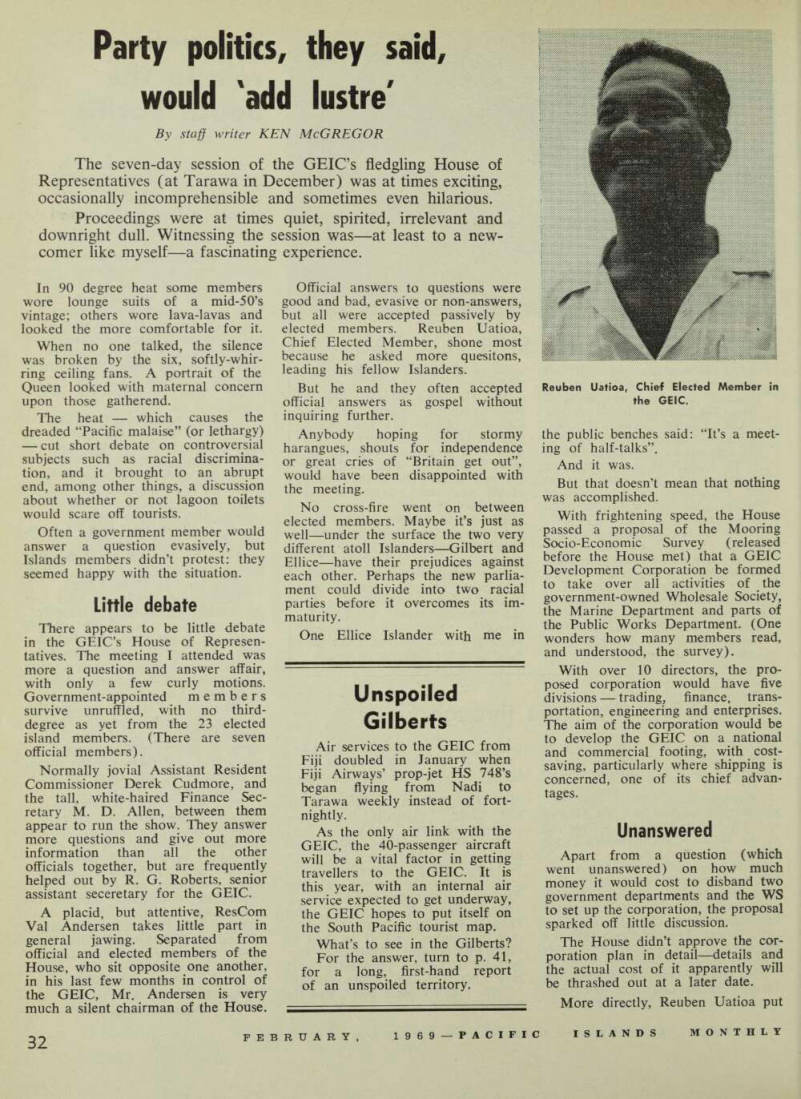
Official answers to questions were good and bad, evasive or non-answers, but all were accepted passively by elected members. Reuben Uatioa, Chief Elected Member, shone most because he asked more quesitons, leading his fellow Islanders.
But he and they often accepted official answers as gospel without inquiring further.
Anybody hoping for stormy harangues, shouts for independence or great cries of “Britain get out”, would have been disappointed with the meeting.
No cross-fire went on between elected members. Maybe it’s just as well—under the surface the two very different atoll Islanders—Gilbert and Ellice—have their prejudices against each other. Perhaps the new parlia ment could divide into two racial parties before it overcomes its im maturity.
One Ellice Islander with me in
the public benches said; “It’s a meet ing of half-talks”.
And it was.
But that doesn’t mean that nothing was accomplished.
With frightening speed, the House passed a proposal of the Mooring Socio-Economic Survey (released before the House met) that a GEIC Development Corporation be formed to take over all activities of the government-owned Wholesale Society, the Marine Department and parts of the Public Works Department. (One wonders how many members read, and understood, the survey).
With over 10 directors, the pro posed corporation would have five divisions trading, finance, trans portation, engineering and enterprises.
The aim of the corporation would be to develop the GEIC on a national and commercial footing, with cost saving, particularly where shipping is concerned, one of its chief advan tages.
Unanswered
Apart from a question (which went unanswered) on how much money it would cost to disband two government departments and the WS to set up the corporation, the proposal sparked off little discussion.
The House didn’t approve the cor poration plan in detail—details and the actual cost of it apparently will be thrashed out at a later date.
More directly, Reuben Uatioa put
Reuben Uatioa, Chief Elected Member in the GEIC.
the question of the GEIC’s future on the line when, after the House had been in session for a week, he asked: Was government contemplating another constitutional development, and, if so what was likely to be the next step?
Assistant Resident Commissioner Derek Cudmore, who semed to do more answering than anyone, was ready for it. No, was the answer.
Government was keeping constitu tional development “constantly in mind” but the current constitution had been in “working existence” only 13 months.
“It is necessary to ensure that stable and responsible government is maintained at all times, and therefore proposals for changes should be carefully examined before decisions are made,” Mr. Cudmore said. Local discussions on constitu tional change could be on at the House’s first meeting this year, he hinted.
Nothing more was said about changes until a couple of hours before the meeting ended, on Dec ember 9.
Naboua Ratieta, Member for Marakei, Northern Gilberts, said he’d like to make a statement on party politics (the GEIC has two small parties, neither strong as yet).
Mr. Ratieta said that the GEIC Government was “trying to dis courage” the growth of the two party system. No provision had been made for it, he said.
Party politics would “add lustre to debates”, encourage creative criticism and “lessen corruption” (which was the only reference to corruption made in the House, though on Tarawa a couple of fraud cases in district offices in recent years have caused quite a scandal).
Derek Cudmore replied that it was not the government’s job to provide for “party politics” this situation arose from differences of opinion over things like economics. Parties arose from the manner in which different people thought government should be run.
The GEIC could not afford cur rently to divide what little talent it had when the only major policy was the drive to economic progress, he said.
Much good debating time was wasted by innumerable questions on Mr, Allen’s 1969 Appropriation Bill, on which elected members, led by Reuben Uatioa, queried the necessity of almost every single expatriate job in the colony—with the exception of Mr. Andersen’s, and he is Resident Commissioner.
(Continued on p. 159)
Ellice Islanders were particularly tough on present and contemplated employees of the Public Works, Marine and Secretariat Departments and it was here that the questions sometimes rang home.
Why were there now five foremen needed in government departments when before there were three? Why was an electrical supervisor needed on both Betio and Bairiki? How many local officers were promoted to posts previously held by expatriates in 1968? (Answer here was a pathetic two—one in each of the police and education departments).
The Appropriation Bill held few surprises. The already-high Tarawa electricity rates were increased and school fees for government primary schools were introduced.
The fees were opposed by several members but it was pointed out that if people want education —and it’s still a battle for Islanders to take what advantage they can of what little there is to offer—they will just have to pay for it.
The fees proposal went through oy a narrow 15 to 13 vote.
The much-awaited select commit tee’s report on the adequacy of the Liquor Ordinance “and the means of enforcing it” was accepted by the House.
Drink problem
It didn’t contain the harsh reforms md criticisms many had expected but t did include one significant resolu ion—the sale of sour toddy should )e restricted. (It’s hard to say how big the sour oddy business has become but a arge proportion of the local drunks lon’t look as if they could have ifforded Victoria Bitter, even to hit )ff with).
The committee had reached four inclusions; drink problems are nainly on urban Tarawa (which weryone knew anyway); these prob ems weren’t “nationally significant”, mrrent liquor legislation was “not nadequate”, and means of enforcing he legislation were “adequate”.
The conclusions made two pro isions—liquor legislation required a few amendments” and the means ►f enforcing it required a “tighten ng-up” in the actual execution of the aw.
Debate over Australian beer, which ollowed a call that the brew be •aimed, was more colourful. Onotoa’s labera Kirata said the Aussie drops
were too strong, “the majority of people were not really interested in getting drunk”, and most needed only light beers to “drink socially”.
Mr. Kirata said if both weak and strong beers were available, “then only those who really wanted to get drunk need to do so”.
Nui’s (Ellice Group) Father Martin then piped in to add that weak beer would make it costly to get drunk, so maybe it would be best not to allow it in after all.
It was all too much for effervescent Reuben Uatioa who had then to re mark that more brands of beer should be imported.
“Then people could make a choice depending on whether they wished to get drunk or not,” he said. With tongue in cheek, presumably.