Mixed villages for Games athletes
pp. 29-30 · Read in the full issue
Games athletes
At Port Moresby in August, men and women competing in the Third South Pacific Games will be housed in the same villages. About 500 athletes will be accommodated at the Ad ministrative College at Waigani, and about 800 at the Port Moresby Teachers’ College. Both places are situated about four miles from Moresby’s airport.
The proposal to have “mixed” villages has been well received by the competing countries.
Each village will have a medical post staffed by medical assistants, and a doctor will be in attendance daily.
Other facilities at the villages indude post offices, banks, canteens, police stations, taxi ranks and laundry services, Special buses will be used to take athletes from the two villages to events and to training grounds.
Students the Administrative College and fr° m the Teachers’ i raming College will act as guides for the visiting teams.
Advice on diets
The advice of competing countries had been sought on the diets necessary for their teams. With so many people coming from so many different countries, the menus will have to offer a fair amount of variety.
The venues for 14 sports to be
held at the South Pacific Games are at 10 different locations. With the exception of judo and golf, all venues are within the Port Moresby town area - Judo will be held at Taurama Army Barracks, just outside the town, and golf will be contested at Lae.
All Port Moresby venues are within a radius of about six miles of the centre of Port Moresby, and are easily accessible. The main stadium, the Hubert Murray Re serve and the Olympic swimming pool are still under construction.
Rugby Union and soccer grounds and netball courts are now being top-dressed and construction of the basketball courts has begun.
The Papuan Rugby League ground will be available for com petitions, and the organising com mittee of the Games has decided to use the League ground as the reserve for boxing and soccer quali fying rounds.
Don Murty, director of the organising committee, says that one of the most heartening things in
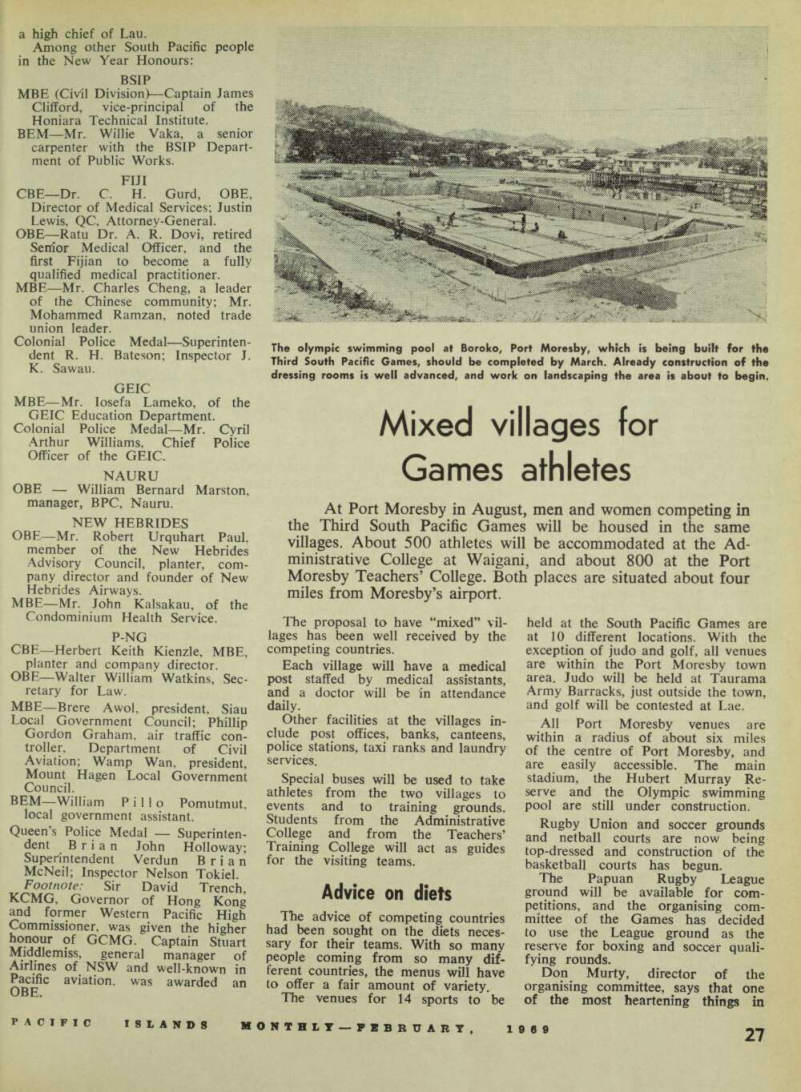
The Olympic swimming pool at Boroko, Port Moresby, which is being built for the Third South Pacific Games, should be completed by March. Already construction of the dressing rooms is well advanced, and work on landscaping the area is about to begin.
connection with the preparation is the effort of the German soccer community in the construction of the Germania soccer ground and clubhouse. The latter, a two-storey building, is proceeding rapidly.
Soccer qualifying rounds will be played on the Germania Club ground as well as the League ground be cause of the number of territories who have entered teams in the soccer competitions.
The soccer finals will be played under floodlight on the main Games arena.
Some recent reports of sporting progress in the territories: FIJI: There is plenty of sporting material in the colony right now— but much of it is raw and untrained.
Some reliable sporting old hands will be representing Fiji in Port Moresby. Among them: • Usaia Sotutu. At the 1966 Games he won the 3,000 metres steeplechase in 9m. 59.25. (defeat ing former Australian title-holder Robbie Morgan-Morris, representing Nauru) and came second in the 10,000 metres event. (Morgan-Morris defeating him with 33m. 4.65.).
Last September Sotutu brought Fiji’s 5,000 metres record down from 15m. 54.65. to 15m. 35.25. (The Games record is held by Morgan- Morris at 15m. 44.8 s.) • Mrs. Toriki Varo. A sprinter and broadjumper, Mrs. Yarn is a veteran of Fijian track and field events. She was the star of the 1966 Games, and she could be a starter in August. She took in 1966 the 100 metres and 200 metres, was in the winning 4 x 100 metres relay, and was third in the long jump.
In boxing and Rugby Union Fiji is strong. The Fiji Rugby team must be rated as the shortest-priced gold medal certainty in the Games.