Smooth Changeover In Last
pp. 27-28 · Read in the full issue
Fiji Catches Up
Territory To Go Decimal
From a Suva correspondent Apart from a faint air of perplexity as people grappled to think in dollars and cents instead of pounds, shillings and pence, Decimal Day in Fiji on January 13 was remarkable for its lack of fuss and bother.
But while on D-day most people rushed to dabble with the new currency, a chorus of consumer com plaints was rising by D-day + three at what can be described as “decimal diddles”.
For instance, before D-day Lorima Waqavesi could buy 12 buns for 1/-.
After D-day: ‘They say that 10c are equal to 1/-, but today when I bought my buns I gave the shop keeper 10c and he only gave me 10 buns.
“I think we should change back to £ s d because we are going to lose with decimals,” protested Lorima.
In dozens of cases the government’s appeal to traders for a square decimal conversion deal went unheeded.
Raised prices
Using the conversion as a smoke screen, cafes, cinemas and pubs raised their prices by a few cents.
The Department of Statistics said the round of increases had led to a marked rise in the cost of living.
But the department added that it had been brought about by small shopkeepers; big, mainly European owned stores had played the game and had not increased their prices at all.
D-day came after nearly two years of preparation and propaganda. Fiji was the last territory in the South Pacific to make the switch from £ s d to $ and c.
The move was made with eager ness, but in fact the decision to do so was an unavoidable one. Fiji would have been at a serious economic and social disadvantage if it had hung on to £ s d while such major trading neighbours as Australia and New Zealand, and lesser ones like Tonga, Samoa and the British Solomons were dealing in dollars.
Furthermore, the end of the manu facture of £ s d machines is due in
1971 when Britain completes its conversion to decimal currency.
Additionally, of course, there were hours of office and school learning time to be saved by calculating in decimals instead of the cumbersome £ s d system.
When in 1964 the Federation of Chambers of Commerce urged that the country should follow Australia and New Zealand in making the switch the government appointed a committee to consider the question.
The committee’s finding was an in evitable “yes” and its report was accepted by the government without reservation. One dollar was to be the equivalent of 10/- and 10 cents equal to 1/-.
Legislative Council approved the required legislation without a mur-
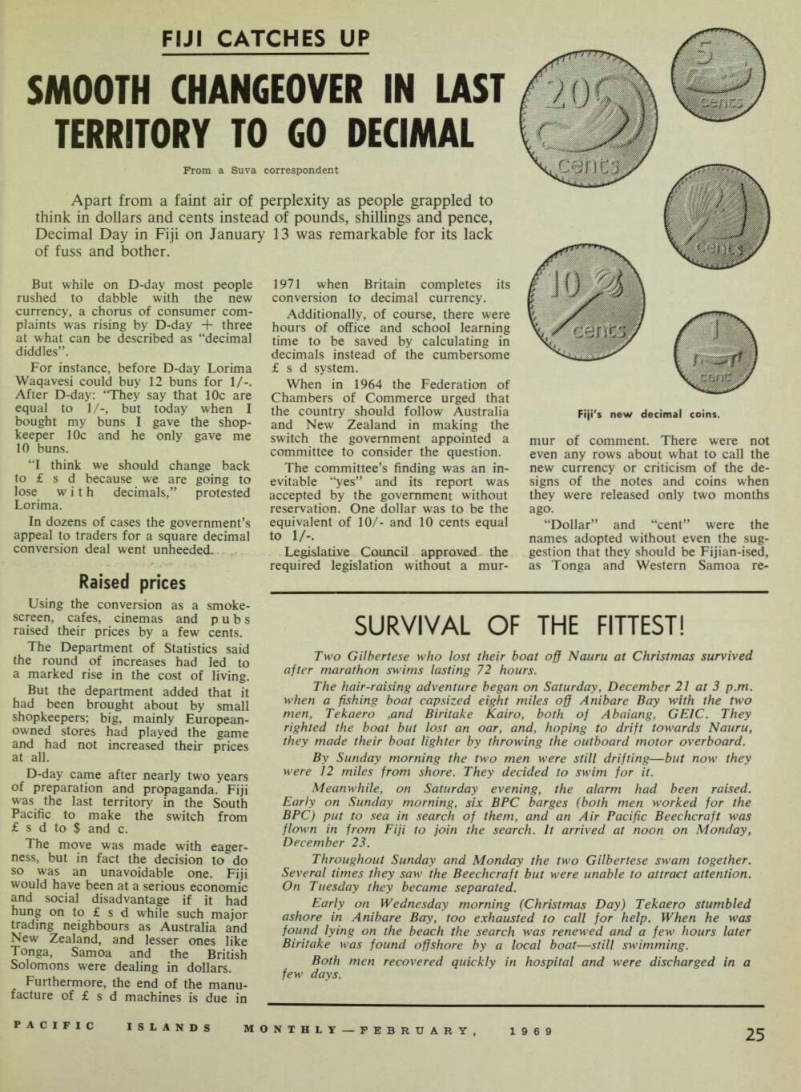
mur of comment. There were not even any rows about what to call the new currency or criticism of the de signs of the notes and coins when they were released only two months ago.
“Dollar” and “cent” were the names adopted without even the sug gestion that they should be Fijian-ised, as Tonga and Western Samoa re
Fiji's new decimal coins.
spective by Tonganised and Samoan ised their decimal currency names.
Fiji’s lateness in converting was to its advantage, as there was the con version experience of Australia, New Zealand and other Pacific Island territories to draw on.
The Australian Treasury sent a member of its conversion team, Mr.
E. J. Williams, to be secretary of the Fiji Decimal Currency Board, and he and other board officials were in New Zealand to watch D-day pro ceedings there at first hand.
The conversion programme closely followed the Australian pattern.
There was a Mr. Fiji Dollar, decimal jingles and slogans broad cast by Radio Fiij, a flood of educa tional booklets and pamphlets and in numerable conversion courses for shop, banking and office staff.
The board’s biggest problem was getting the decimal message to out lying islands, which were reached by only a trickle of printed material.
Schoolchildren were the board’s biggest help here.
Primary schools began teaching decimal money sums two years ago.
This meant adults in main popula tion centres, as well as remoter places, got much of their decimal gen from their thoroughly clued-up kids. First evidence that dollars and cents were really on the way came three months before D-day when motorists buying petrol found pumps registering sales in them.
A week before D-day, 50 Aus tralian and New Zealand technicians arrived to aid local counterparts with
the job of converting some 1,500 office machines of all kinds—a job to be completed in late March.
Meanwhile, under conditions sup posedly of great secrecy, the first year’s issue of the new currency— -27,000,000 coins and $5,000,000 in notes—was arriving from the Royal Mint in London.
Convoys of laden trucks rolling from Suva wharf to the Treasury were meant not to be noticed—rifle toting guards swarming all over the vehicles!
On Wednesday, January 8, all Fiji banks closed at 3 p.m. until D-day, January 13. The Treasury issued the new currency to the banks, who passed it on to the stores and busi nesses.
For thousands of people their first encounter with the new money came early in the morning of Monday, the 13th, as they rode by bus to work and received cent pieces in their change.
Dual currency
As the day progressed, reports from everywhere indicated that people were having little, if any, trouble in handling dollars and cents.
One reason for the easy change was given by Mr. H. P. Ritchie, Min ister of Finance: ‘The people of Fiji generally see more of other currencies than people in other countries.”
By June, it is planned that dollars and cents will have ousted pounds, shillings and pence from circulation.
In the meantime the country has a dual currency system operating.
By the end of the first week pound notes were rarely seen. On January 23, however, the Treasury complained that only 2,500,000 shilling and pence coins—lo per cent, of all the coins issued since 1935—had been returned.
It urged traders to stop issuing old coins as change so that their with drawal could be completed quickly.
But much of the old coinage in circulation is probably in Fiji’s outer islands, many of whose inhabitants have not yet seen a single dollar or cent.
On D-day the Decimal Board’s secretary, Mr. Williams, estimated that it would be up to four weeks before remoter islands had their local D-days, when the next ship from Suva arrived carrying some of the new currency.
Fiji is watching the departure of pounds, shillings and pence with only one real regret; the famous Fiji penny with a hole in it, a memento carried away by thousands of visitors, has been replaced by a holeless one cent piece with no character of its own.