The Practical Planter
pp. 139-143 · Read in the full issue

Brahman Blood For Better Beef
By Geoff Little
Looking forward to celebating its sth anniversary of suc cessful breeding of tropical cattle next year, Cherokee stud at Tanby, near Rockhampton, Queensland, has prepared a simple breeding programme to help clients introducing Brahman blood into a basically Brtish-breed herd.
THIS FINE STUD is part of the holdings of the Brahman Cattle Company headed by Lionel De Landelles on his Tanby property, “Canomie”.
At their second annual stud sale in September, Cherokee bulls sold to $B,OOO with buyers from as far afield as the Mornington Peninsula in Victoria.
Lionel is an esteemed show judge of tropical cattle and his property shows evidence of his methodical approach to all cattle raising activities with an orderly array of neat outbuildings, firm fences and wellmanaged pastures, with a sound use of natural rainfall and stored water.
“Canomie” is in rolling hill country within sight of the sea where it washes the coast at the popular seaside resort of Yeppoon. The soil supports a thriving pineapple-grow-
ing industry all around “Canomie” and the hills were originally heavily timbered with eucalyptus scrub, From his chair on the lawn in front of his home overlooking 100 acres of improved tropical pasture, Lionel lamented some of the changes which 25 years of progress have brought to the surrounding country side, As the great changeover from natural pasture to improved pasture proceeds all over the State he sees a iteady destruction of the environ ment which sheltered the native animals in the past, He hopes to set aside about 100 acres of the 3,600 in “Canomie” as a nature reserve stocked with the wildlife of the district and fenced against predators (including man), “I don’t like to see the native birds
and marsupials vanish from our pastoral scene and here some will find sanctuary . . , and food,” he said.
This move will find support from more than the local people, for “Canomie” and its Brahman cattle have become a tourist attraction drawing 1,500 visitors a year.
Lionel De Landelles is not a man who talks easily about himself or what he is trying to achieve. He knows what he is about and goes about it successfully . . . breeding, culling that which does not fit into his picture of the ideal animal and, above all, recording from day to day what happens on the property. Gradu ally, by listening and questioning, we drew and sorted out his experience of the years as a breeder and a judge.
“The good stud breeder is con trolled in his aims by the com mercial beef breeder,” he said.
"Showy" animals
“I think in the main, Queensland stud men are following this rule but there is certainly some hobbyism in the business—people breeding a showy animal not necessarily aimed at get ting better returns of beef for the dollar spent. Some stud breeders do not give enough thought to what the commercial beast of tomorrow must be like,” he said.
“The beefy characteristic of the animal bred is the most important feature for which we must be look ing.
“Then, in breeding a particular line of cattle, the animals must be characteristic of the breed concerned.
When we are breeding a particular line of cattle we must be bound by the typical beast of the breed . . .
Brahman must have what we might call the ‘Brahman look’, a Braford must look like a Braford, Brangus like Brangus and so on, “Ideally, in the production of the tropical breeds we should be looking for enough Brahman motor com-
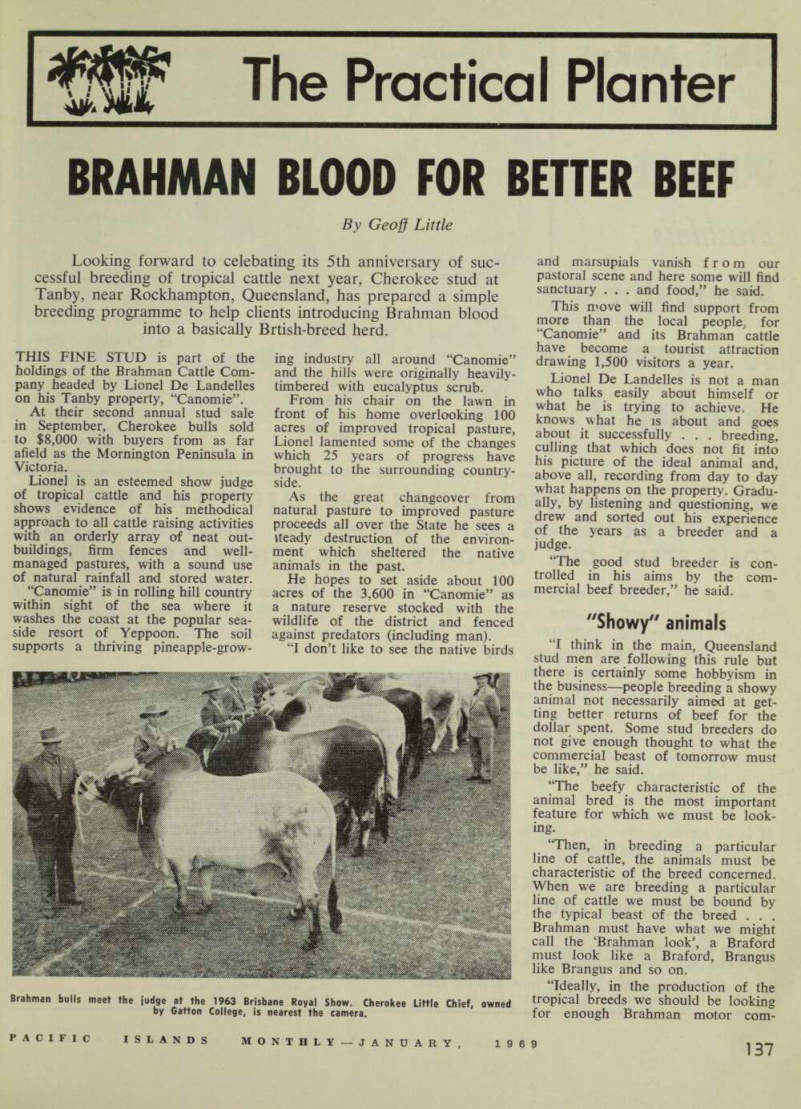
Brahman bulls meet the judge at the 1963 Brisbane Royal Show. Cherokee Little Chief, owned by Gatton College, is nearest the camera.
bined with enough British body for the resultant body to absorb the vibration of the Brahman motor.”
While it does not take the visitor long on “Canomie” to see that the typical Cherokee Brahman can be the silver-grey, popular idea of Brahman beasts, one soon notes a shrewd eye for quality where red colouration is concerned.
Quite reasonably Lionel would not be drawn into any discussion on the relative merits of the various Brah man hybrid lines being raised in Aus tralia. He breeds Brahmans, has done so for a long time now and they have been sufficiently sought after to bring up to $15,000 for a single bull.
Cherokee sires are being used in New Guinea, Alice Springs and from Darwin around the eastern coast to Albany and Derby in Western Aus tralia.
Improved country
Lionel’s expressed preference is for a masculine silver-grey or dark-grey colour for a Brahman bull but he has his successes as a breeder of Angus and Brangus in the dark coloured breeds and on “Canomie*’ there are red bulls and bulls with Braford colourations which would make any breeder of red animals reach for his cheque book.
Most of “Canomie” is in improved country, under natural pasture, well subdivided for easy and efficient man agement of feed and stock. There are 100 acres of tropical pasture worth looking over closely. Siratro and stylo are the chosen legumes entwining a mixture of setaria, green panic, pangola and Rhodes grass.
“Our practice is to wean calves early and lot feed them a mixture of roughage and grain,” Lionel said.
He stated that lot feeding was the most economical way to use pasture land. Queried on the apparent lack of interest in Queensland in lot feed ing he stood by his belief and gave strong reasons for his faith in the future of lot feeding systems.
Big demand
Lionel has an eye to the future as the director of a company ulti mately wholly conerned with beef production.
“In the past 10 years we have seen a big demand for lean beef de velop for Australian cattle raisers.
Feed lots are not the accepted way of raising lean beef but they offer the most economical way of using available pasture. Some day we are going to have to face up to the
economical use of pasture and then we will have a reassessment of lot feeding methods,” he said.
He’ll find a lot of solid cattlemen who will go along with that idea.
His advice to men moving into the breeding of hybrid tropical cattle is fairly simple and easy to follow. It is handed out as a typed sheet with simple diagrams. 1. “When breeding in any method it is the eye of the breeder that
moulds the type of animal he pro duces. 2. “In upgrading or selecting look for the Brahman characteristic as this is a must in either parent. Most Brahmans carry some British genes and as much as 15 per cent, could be British blood. 3. “When making a breed one must spread genes and then start in tensive line breeding. The line breed ing culls out your herd in the early stages and makes progress easier. 4. “The breed type you require is
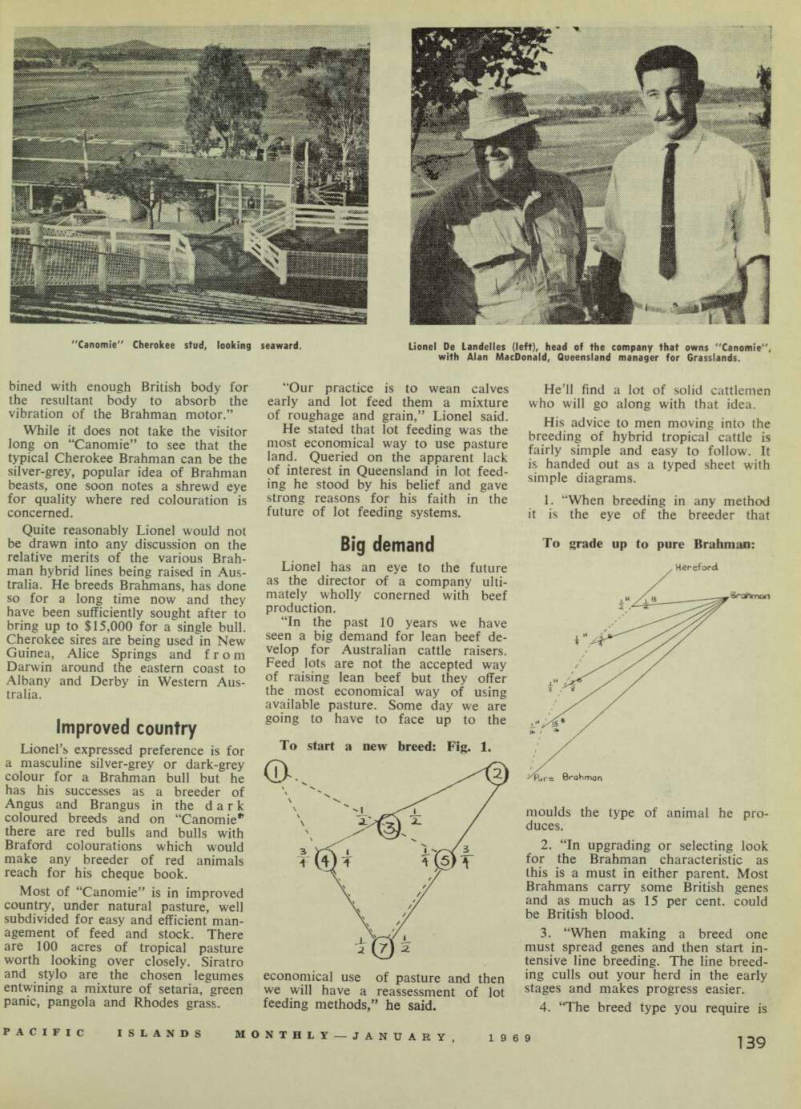
"Canomie" Cherokee stud, looking seaward.
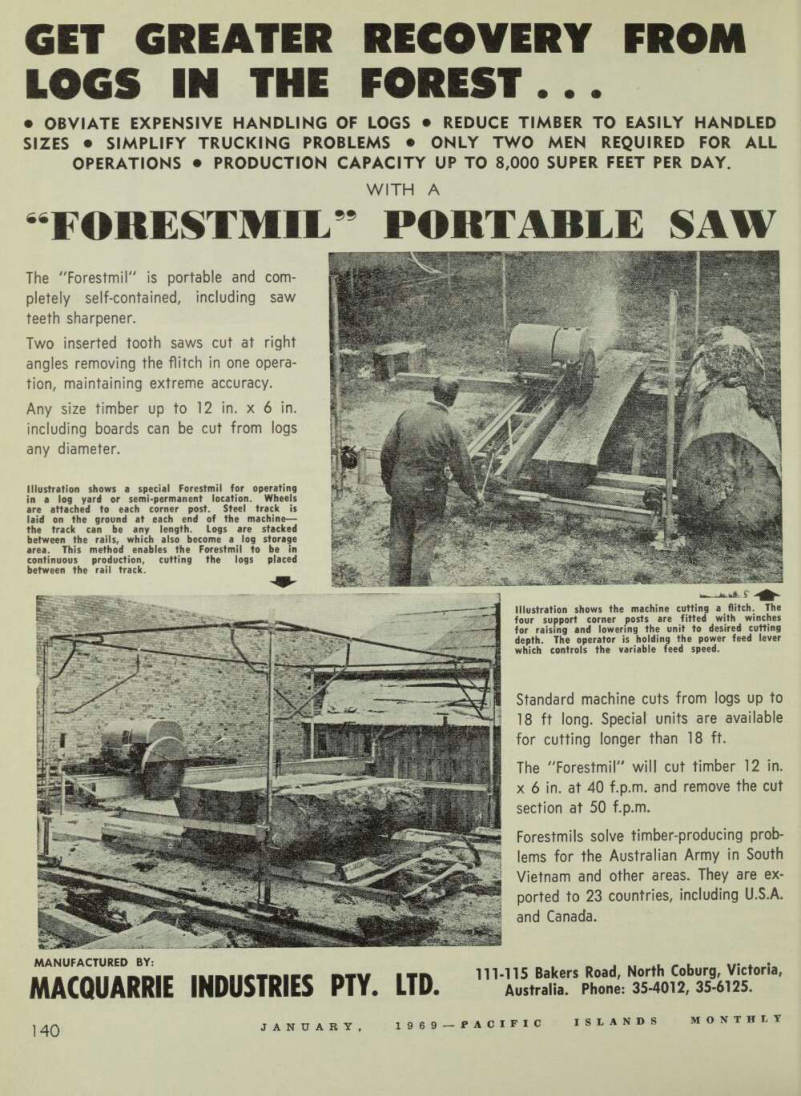
Lionel De Landelles (left), head of the company that owns "Canomie", with Alan MacDonald, Queensland manager for Grasslands.
subjected to re-sale value and this particular type must be bred. If herds are only small, do not cull females till they produce. Sometimes a poor type female could produce and re produce your top animal.
In the diagram is set out the pro cedure for starting a new breed (Fig. 1). Each black line denotes males. Each dotted line denotes females. 1. Female No. 1 mated with male No. 2 produces group three, which is half blood of sire and dam. 2. Females from group three mated with sire No. 2 produce group five, which is I blood of sire No. 2 and i blood of dam No. 1. 3. Males of group three mated with dam No. 1 produce group four which is i blood of dam No. 1 and i blood of sire No. 2. 4. Males of group five and females of group four (or vice versa) produce group seven. This is mathematically half blood of each original pair No. 1 and No. 2.
To grade up to pure Brahman (see diagram, p. 139), all half-bred males must be steered. Three-quarter and upward males have a sound market value at present and for some time to come. Colour would have some bearing on the quickness of producing the right colour for pure breed.
No colour selection
When breeding a sucker mother for meat production, no colour selection required and only females kept.
Brahman conformation is a must with a very feminine appearance.
This goes hand in hand with milk production.
Producing for the market: • Pure Brahman females x Pure British bull gives very top animals. • ft Brahman and Hereford x Pure British bull gives very top animals. • i Brahman and i Hereford x Pure British bull gives very top animals. (If females have been graded up this is as far as you can use British bulls.) I Brahman and i Hereford x Very strong beef type half or f blood Brahman bull. This bull would want to be outstanding. • i Brahman and i Hereford x Pure Brahman if high returns are needed.