Business and Development
pp. 121-126 · Read in the full issue

New boost for inter-territory trade organisation
From a Suva correspondent Although still feeling its way in the field of inter-territorial trade co-operation, the future looks promising for the potentially powerful Pacific Islands Producers’ Association, presently based in Suva.
In December its members—Fiji, Western Samoa, Niue and the Cook Islands—were eagerly awaiting news of a permanent secretary, to be pro vided by the UK Ministry of Over seas Development.
Once the secretary is installed— hopefully, within the next month or two —and a constitution drawn up, real progress can be made towards expanding PIPA’s functions beyond that of protecting the banana-market ing interests of member-countries.
The possibilities for inter-island trade are numerous, since there’s currently a great imbalance. Fiji’s exports to Tonga, for instance, far outweigh its Tongan imports. There is scope for increased shipments of Tongan vegetables—and corn, for Fiji’s livestock food mill. The Cook Islands could supply citrus juice— and purchase cement.
Exchange of information
The desirability of centralising all copra-processing activities at the Suva oil mill has also been discussed— with members envisaging a time when the marketing of all copra and coconut oil may be handled by PIPA.
But those plans are for the future.
For the time being, PIPA’s business is bananas.
In October-November a party of 36 banana growers and government officials from Tonga, Fiji and Western Samoa toured those three territories as part of the association’s scheme to step-up exchange of information, ideas and technical developments in the banana-producing areas.
The tour organiser, Mr. John Deering, who is information officer for the Fiji Department of Agri culture, described the 2i week tour —the first to be undertaken by the
growers themselves—as “completely successful, well worth doing again.”
The growers—who were selected, according to John Deering, because they were men of considerable experi ence and influence within their own communities—visited plantations and inspected cultural methods, watched banana cutting and packing and studied inspection methods in each territory.
The long-term benefits of such a tour were hard to define, Mr. Deering felt, but it was obvious that growers who made the trip came to appreci ate each other’s problems. And the problems of the New Zealand fruit importing body, Fruit Distributors Ltd.
“The growers were quick to appreciate the company’s complaints that Islands fruit tends to be bruised, that Fijian packs are slack, that Tongan fruit is shorter than the market requires and the stem-end rot disease is frequently present in bananas from Western Samoa,” he said.
“During the visit to Fiji packing stations, the group discussed the problem of slack packs with those doing the packing and members made some suggestions.
“It may be of significance that the Fiji Produce Inspector, Mr. A. L.
Hazelman, commented at the sub sequent banana shipment that he noticed an impressive improvement.
"Impressed"
“The Tongan growers on tour were impressed by the size of fruit com monly packed in both Fiji and Western Samoa—and they were the first to criticise packs shown to the group in Tonga.
“It was felt that the problem of
stem-end rot in Western Samoa was not so simple but growers and officials discussed possible techniques to reduce it to reasonable proportions.
“Tongan packing sheds and the various layouts designed to suit local conditions were of particular interest to the Fijian and Western Samoan growers.”
In Fiji, the group visited the key banana-producing centres of Waidina, Wainibuka and Lomaivuna. They spent five days inspecting banana growing villages on Upolu Island, Western Samoa and a further five days in Tonga.
"Inadequate"
Mr. Deering said tour members had agreed that in all three terri tories visited, the washing of fruit prior to packing was inadequate— and New Zealand’s complaints of sap stain generally justified.
Fijian and Tongan growers showed considerable interest in the clean weeding of Samoan plantations—and Tongans and Samoans were sympa thetic when they saw Fiji’s hill plantations. One large Tongan grower was heard to remark that if he had land like that, he wouldn’t be grow ing bananas at all.
Whatever the immediate benefits
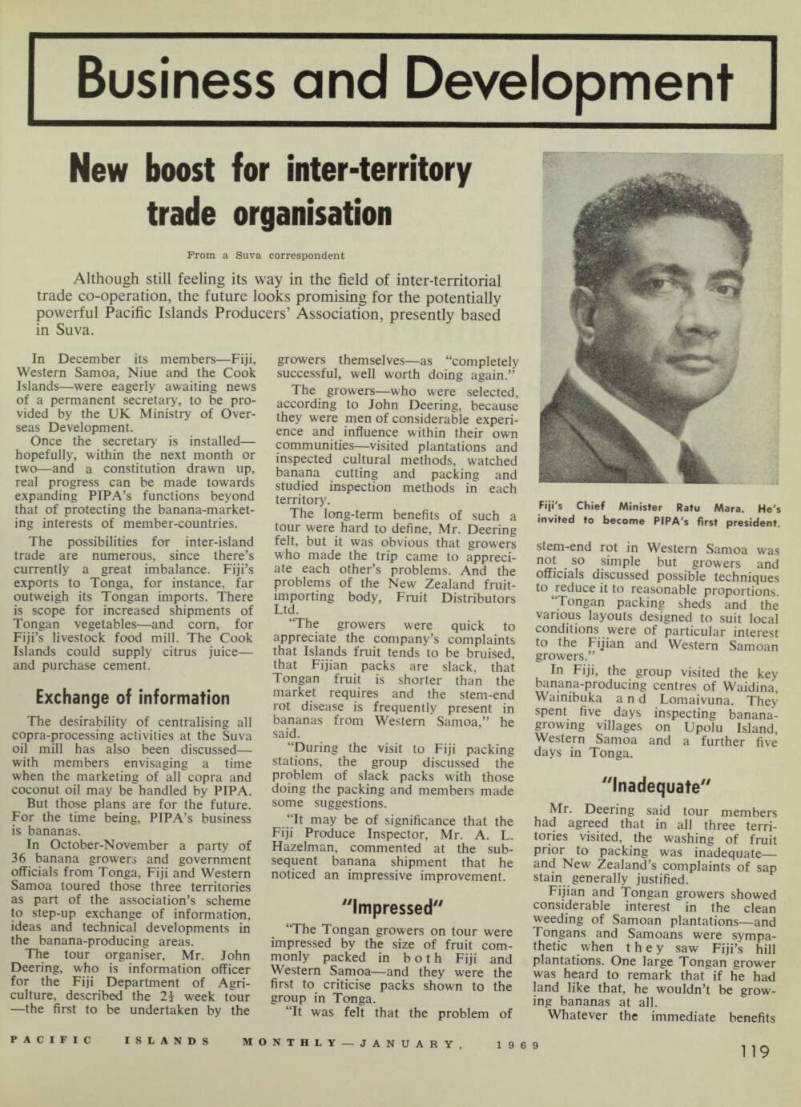
Fiji's Chief Minister Ratu Mara, He's invited to become PIPA's first president.
of the recent banana growers’ tour, it’s evident that future tours, in other spheres and under the auspices of PIPA, will do much to strengthen the desire for common quality standards and a united approach to marketing among the member countries.
The beginnings of PIPA go back to late 1964, when a Fiji delegation led by the Chief Minister, Ratu Mara, visited New Zealand to negotiate on quotas and prices for Fiji bananas supplied to New Zealand.
It was evident then that closer co operation was needed between the island territories supplying bananas to the New Zealand market. Early in 1965, the Fiji delegation visited
Western Samoa, where it was decided to set up a Pacific Islands Producers’
Secretariat (PIPS). Tonga was in vited to join.
The first official meeting was held in Western Samoa in 1965, with delegations from the three initial member countries. Representatives from the Cook Islands also attended as observers and the Cooks later be came a full member. Some time later, Niue also joined the fraternity, As a result of the first meeting, the Secretariat commissioned a sur vey of the New Zealand banana market by the Economist Intelligence Unit. At the second meeting—held in Suva in February, 1967—it was
resolved that all future negotiations concerning bananas should be con ducted jointly on behalf of all PIPS members.
It was agreed that the bananas im ported from Ecuador and Costa Rica to New Zealand to make up the short fall from the Islands had shown the housewife a completely new standard in presentation. Though Islands bananas were probably preferable in flavour, it was clear that if they failed in quality and quantity, there were very ready substitutes.
It was obviously desirable—in view of the vulnerability of the Pacific area to climatic disturbances and the haphazard incidence of disease—to plan for a surplus in each territory.
In this way, shortfalls to New Zea land from one South Pacific country could be taken up by another —rather than by South America.
And, looking towards new future markets, the meeting agreed that only by aggregating surpluses from all the territories could a significant quantity be realised.
Recommendations
This second meeting also set up a technical sub-committee, consisting of the Directors of Agriculture from the countries represented by PIPS.
The committee undertook tours to Fiji, Tonga and Western Samoa in 1967 and 1968 —and produced re ports on the existing methods of banana production, with recommenda tions for improvements and the exchange of technical information.
At the third meeting, held this year at Nukualofa, it was decided that the organisation should assume a more dynamic role, that it should have a permanent office and executive staff and that it should become known as the Pacific Islands Producers’ Asso ciation.
Application was made in July to the UK Ministry of Overseas Develop ment, requesting the appointment of a permanent secretary to be based in Suva.
Fiji’s Chief Minister, Ratu Mara, was invited to become PIPA’s first president —an office he’ll hold for two years from the acceptance of a constitution. Until the permanent secretary is appointed, the office of the Fiji Minister for Natural Re sources is handling PIPA’s affairs.
All-time high
in Cook Is. copra
In late November Cook Islands’
Copra Officer, Mr. R. W. F. Thomson, estimated that 2,000 tons of copra would have been exported from the Cook Islands before Christmas and
that this would bring an income to producers and traders of SNZ3OO,OOO, less the 5 per cent, copra levy.
Spurred on by high prices, Cook Islanders produced a total of 1,650 tons of copra between January and November, with the atolls of the northern group providing three quarters of it.
During the July-September, 1968, period, Cook Islands’ copra producers received around $lBO per ton, the highest ever price. Although the price fell to between $l2O to $125 per ton during the latter part of the year, copra production was still con sidered lucrative; 1968 should be a record year for copra revenue.
The Cooks exported 2,440 tons of copra in 1925, plus 100,000 coconuts, but prices then did not compare with those of 1968.
Copra exports rose sharply again in 1965 when the Cooks exported 1,750 tons.
In recent years, exports have been as low as 1,000 tons. In common with most Islands territories where copra is indigenously produced, there is a great variation in exports from year to year. When the price is high, the people will cut copra; when it is low, they won’t be bothered. As far as the Cooks are concerned, the avail ability of shipping also has a lot to do with exports. Some of the northern islands, where the bulk of the copra comes from, are completely isolated for long periods.
Considerable thought has been given to overcoming these stop-go practices; and efforts have also been made to produce better quality copra.
Mr. Thomson has designed a small, prefabricated hot-air copra drier which has done much to improve quality. The driers are inexpensive, easy to install and copra producers may buy them with loans from the Economic Development Fund.
Six or seven years ago most Cook Islands copra was sun-dried and often of poor quality. Over 100 hot air driers are now in use, including four at Palmerston Atoll, and more recently, four at Nassau.
The December, 1967, hurricane did considerable damage to the coconut palms of the southern group islands with the result that copra output from there was low in 1968.
Aitutaki and Manuae could have produced another 300 tons in 1968 but for hurricane damage.
The people of Atiu are showing interest in clearing and planting Takutea, a small, uninhabited atoll which belongs to the Atiuans and lies 15 miles from Atiu.
Copra officers have been appointed for Atiu, Mauke, Aitutaki. Penrhyn, Manihiki, and Rakahanga. One officer
is responsible for Pukapuka and Nassau, and two others are employed, on a casual basis, one at Palmerston and the other at Mitiaro.
Thinning out coconut palms on the northern group islands is planned for 1969, and this is expected to double copra production. Owing to its high cost, and the percentage of wastage, fertiliser is used on young coconut palms only in the northern atolls.
Other methods to boost production include: Injection of coconut palms in fected with chlorosis; ground clear an c e and planting leguminous creepers as cover crops; and plant selection designed to produce vigor ous palms in future years.
BP'S shipping losses
may tumble this year
The sale of the Bulolo and the proposed sale of the Malekula could reduce Burns Philp’s shipping losses by 50 per cent, in the current year.
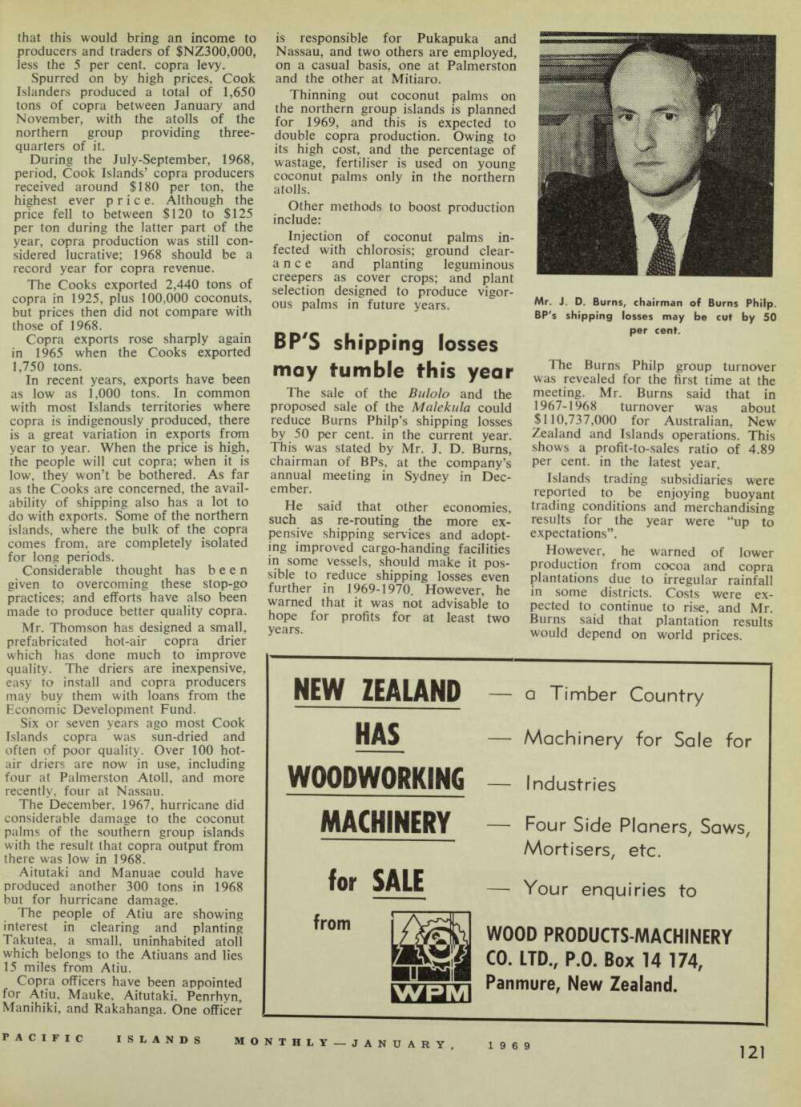
This was stated by Mr. J. D. Burns, chairman of BPs, at the company’s annual meeting in Sydney in Dec ember.
He said that other economies, such as re-routing the more ex pensive shipping services and adopt ing improved cargo-handing facilities in some vessels, should make it pos sible to reduce shipping losses even further in 1969-1970. However, he warned that it was not advisable to hope for profits for at least two years.
The Burns phil P group turnover was revealed for the first time at the meeting. Mr. Burns said that in 1967-1968 turnover was about $110,737,000 for Australian, New Zealand and Islands operations. This shows a profit-to-sales ratio of 4.89 P er cent, in the latest year, Islands trading subsidiaries were reported to be enjoying buoyant trading conditions and merchandising results for the year were “up to expectations”.
However, he warned of lower production from cocoa and copra plantations due to irregular rainfall in some districts. Costs were ex pected to continue to rise, and Mr.
Burns said that plantation results would depend on world prices.
Mr. J. D. Burns, chairman of Burns Philp.
BP's shipping losses may be cut by 50 per cent.
Fiji happy with new
sugar agreement
The conditions under which Fiji sells under the Commonwealth Sugar Agreement will be maintained until 1977—subject to a provision concerning Britain’s application to join the European Common Market.
Announcing this in Suva in December, the managing director of South Pacific Sugar Mills Ltd., Mr.
A. S. Hermes, said the outcome of 1968’s CSA talks in London were “a tribute to the far-sightedness of forces in Britain which still strive to strengthen Commonwealth re lations”.
“Fiji’s negotiated price quota of 140,000 tons is maintained and there will be no change in the negotiated price during the next three years,” he said.
The basic price is £43/10/- sterling a ton, plus a special supplement of between £l/10/- and £4, depending on the level of the world price.
“The agreement is now one of indefinite duration, continuous in nature but subject to periodic review, the first of which will take place in the autumn of 1971,” Mr. Hermes said.
“The vitally important provisions of the agreement dealing with negotiated price quotas at a reason
ably remunerative price are subject to six years’ notice for the develop ing countries—in effect, these pro visions, subject to a provision regard ing the UK’s application to join the EEC, will now continue for Fiji until the end of 1977.”
In the event of Britain joining the Common Market, there is a clause covering Britain’s obligations under the CSA from 1975 onwards.
“Although the UK cannot be committed now to continuing con tractual obligations under the agree ment after December 31, 1974, we have been given satisfactory as surances that, in this event, they will consult with the other parties to the Commonwealth Sugar Agreement with a view to seeking other ways of achieving the agreed objectives of the agreement,” he said.
Mr. B. Dowling, who represented Fiji during the London talks, has commented from London that the satisfactory outcome means Fiji can look forward to reasonable income stability in the years ahead.
“A strong, efficient industry must strengthen our negotiating position at the next triennial review, in 1971,” he said.
NZ increases
Pacific trade
Good and regular shipping runs between NZ and New Caledonia and Tahiti are helping NZ exporters to increase their share of those rich markets. This view was put forward by the NZ Trade Commissioner for the Pacific, Mr. G. M. McLaren, on his return from a fortnight’s tour of the two French territories.
Between 1967 and 1968 NZ’s trade with Tahiti jumped 71 per cent. NZ exports to Tahiti in 1968 were worth 53.6 million plus, compared with $2.1 million in 1967.
Mr. McLaren told reporters that while Tahiti has global exchange control duties, NZ would continue to increase its share of the Tahitian market.
Mineral search
Two companies—Le Bureau de Recherches Geologiques et Minieres, of France, and Rio Tinto, of Britain —have been granted permits to look for several types of minerals on Santo and Malekula, New Hebrides.
The French company will search on Santo and the British group on Malekula. Minerals mentioned include nickel, bauxite, manganese, phosphate, zinc, chrome and iron ore.
Hopes for practical
Islands fisheries
Over $BOO,OOO will be spent over the next three years to help Pacific Islanders fully exploit the fish life of their reefs and lagoons—if the United Nations agrees to contribute half the funds to finance the project.
The UN Development Programme Division is expected to allocate funds in January, and things could get moving by May or June.
The project was approved by the South Pacific Commission at its meeting in Noumea in September and member governments of the SPC are ready to put up $409,300 in cash, technical assistance and equip ment.
A body called the South Pacific Islands Fisheries Development Agency (SPIFDA) based in Noumea, would run the project and, in theory, conduct 10 schemes.
They would be: • A survey of marine turtles, found in most low-lying atolls and islands; • Scad mackerel fishing methods demonstrated to Islanders; • Tahitian pearl-shell lure methods demonstrated to Islanders; • Information to be made avail able on handling, marketing and distribution of fish; • Encouragement of beche-de-mer fishing and processing; • Edible oysters examined as potential industries in selected areas; • Trials of improved methods of mother-of-pearl and pearl production; • Intensified research into fish poisoning; • Investigation of fish farms; • Investigation of coastal and lagoon fisheries resources, including bait fishes.
Mr. Val Hinds, Fisheries Program Officer for the SPC, is hopeful that the project would have practical results and not be confined to academic findings.
“Pacific Islanders are sick to the teeth of experts doing surveys,” he told PIM. “They’ve had surveys.
They want practical help and some one who can come down and show them how to do things instead of putting their turtles or crabs under the microscope inside the concrete walls of an institute.
“SPIFDA won’t be an institute or a convenient study centre for over seas personnel. Noumea will merely be a base from which practical ex perts can go to places like the Gilberts or the Carolines and actually help Islanders get fishing projects going,” declared Mr. Hinds.
“Fish resources have been neglected
by Pacific Islands territories. There are only seven fisheries officers in the Islands and only New Guinea is doing something to train Islanders as officers. Islanders as assistants are no good,” he said.
Mr. Hinds said the SPC, in Sep tember, had also approved a project for tuna fisheries. This plan differed from one that was rejected by the SPC in 1967, because it featured short-time offshore operations, similiar to current day-long operations out of Papeete.
He said this project, like the reef and lagoon scheme, was dependent on the UN contributing funds on a dollar-for-dollar basis.
Record copra exports
for Penrhyn atoll
Penrhyn atoll, in the northern Cooks, exported a record 430 tons of copra from January to September.
The islanders produced between 12 and 15 tons a week.
Manihiki produced 300 tons of copra during the same period when the high price of $lBO per ton encouraged copra producers to extra efforts.
Penrhyn’s former rahui, a period when coconuts are not allowed to be taken from the motus, lasted six months, and this caused the loss of many nuts. The rahui has now been reduced to two months with greatly improved results.
Copra production in the southern group islands was poor last year due to damage to coconut palms caused by last December’s hurricane and it may take another year before pro duction is back to normal.
BSIP is now
exporting rice
Guadalcanal Plains Ltd., which harvested rice commercially for the first time in 1968 in the Solomons, has begun exporting rice and sorghum to two overseas markets and has received inquiries from nearly 10 other countries interested in buying Solomons rice.
The company has sent five tons of rice on the Solomons trader Belama to Tarawa, GEIC, for sale to the Wholesale Society and is now hope ful it can supply a big share of the 1,225 tons of rice the GEIC imports from Australia at a cost of $176,000 a year.
In late October it shipped 300 tons of grain sorghum on the China Navigation vessel Chengtu for sale to Mitsui and Company, of Japan.
Future exports of sorghum are likely to depend on prices offered and the
yield per acre sorghum can be grown.
Mr. Paul Brown, the company’s general manager, told PIM that GPL was examining rice exports prospects in the New Hebrides and New Caledonia.
C. Sullivan (Export) Pty. Ltd., of Sydney, has been appointed overseas agents for GPL’s rice, and the com pany has received inquiries for Solomons rice from Fiji, New Zea land, Hong Kong, Britain and Nationalist China.
“There is little doubt that if the Solomons can produce the rice, buyers will easily be found overseas,” a company officer said.
GPL is growing rice at Tetere, east of Honiara, on Guadalcanal (PIM, June, p. 33). In August it installed a rice processing mill at Okea, 14 miles outside Honiara, which will be able to process two tons of polished rice an hour.
The mill came from the Japanese firm of Sataka.
In mid-January the first of three big rice drying machines for GPL is expected to arrive in Honiara.
Ordered from Norlin Products Pty.
Ltd., of Sydney, it is worth about $7,000 and is the biggest ever ex ported from Australia.
The machine will dry 110 tons of rice a day in storing sheds which are 216 ft long by 30 ft wide (much larger than the storing sheds normally used).
Prouds for
Norfolk Is.
Sydney jewellers, Prouds Pty. Ltd., which already operate a branch of the business in Suva, in December were to open on Norfolk Island.
Manager will be Mr. Ron Orphin, of Sydney.
Undersea mineral
search in Fiji
If there is any gold, copper, lead or zinc to be found at the bottom of the sea around Fiji’s two main islands, a team of American scientists —from Crawford Marine Specialists Inc., of California—hopes to bring it to light.
Following similar programmes in many countries, Crawford Marine Specialists has obtained off-shore prospecting and mineral concessions all around Vanua Levu and in parts of Viti Levu.
The scientists began their undersea probe in mid-October in the belief that gold and other heavy minerals may have been washed out of the soil and deposited on the seabed centuries ago. (Over)
A team of five, headed by geologist Dale Y. Anderson, spent the early part of October in the Tavua area, conducting a mapping survey to enable boundaries to be fixed for underwater exploration.
Copra market
should remain firm
Mr. lan McDonald, chairman of the P-NG Copra Marketing Board, gave the following report on P-NG and world copra market trends on December 26: Market prices of practically all edible oils and oilseeds advanced slightly during December. Philippine copra moved from SUS2OO at the beginning of December to SUS2OB by mid-December. At these levels, the average Philippine copra price, on which the board’s contracts are based, will be around SUSI 77 for the three months period, October/ December.
There are several factors currently bearing on the edible oil market.
The possibility of a longshoremen’s strike in US ports could affect exports of soyabean and soyabean oil.
Other factors which have con tributed to uncertainty in the oil seed market include the very much reduced offerings of sunflower seeds, the uncertainty of effects of typhoon damage to the coconut growing areas in the Philippines, the unrest in world money markets and the con tinuing civil war in Nigeria, which has restricted exports of nutkernels and oil from that country.
Indications are that over the next few months a general firmness will continue in edible oils.
An interesting development in the Philippines is the installation of a coconut plant which will absorb about 7 per cent, of the total Philippines’ copra production.
The plant will produce about 7,000 tons of plasticizer, some 400 tons of glycerine as well as coconut oil, fatty acids and fatty alcohols.
Later the plant is expected to produce detergents and margarine and the plant will probably have some effect on the European market as far as copra is concerned—though perhaps not a very serious effect.
The year 1968 has been a record production year for P-NG, Copra receivals for the 11 month period from January to November reached about 123,000 tons. December re ceivals were expected to be well up on the average of 8,500 tons. There fore an overall receival of 130,000 tons was assured—7 per cent, better that the previous record year in 1965.