Pacific Shipping
pp. 101-111 · Read in the full issue
Fijians will crew Levuka's life-giving fishing fleet
By A. F. TINSLEY , in Suva
In Arctic sub-zero temperatures of minus 30 degrees, at Levuka, Fiji, is stored an almost constant supply of from 800 to 1,000 tons of fish in the huge deep-freeze storage plant of one of Fiji’s more recent commercial enterprises, the Pacific Fishing Company, jointly owned by Japanese and Fiji interests.
Stacked high in their rock-hard icy shrouds are thousands of tuna and other South Pacific fish, caught for the firm by Japanese, Formosan and Korean fishing-boats for trans portation to American, Japanese and other overseas markets, and for con sumption in the colony itself.
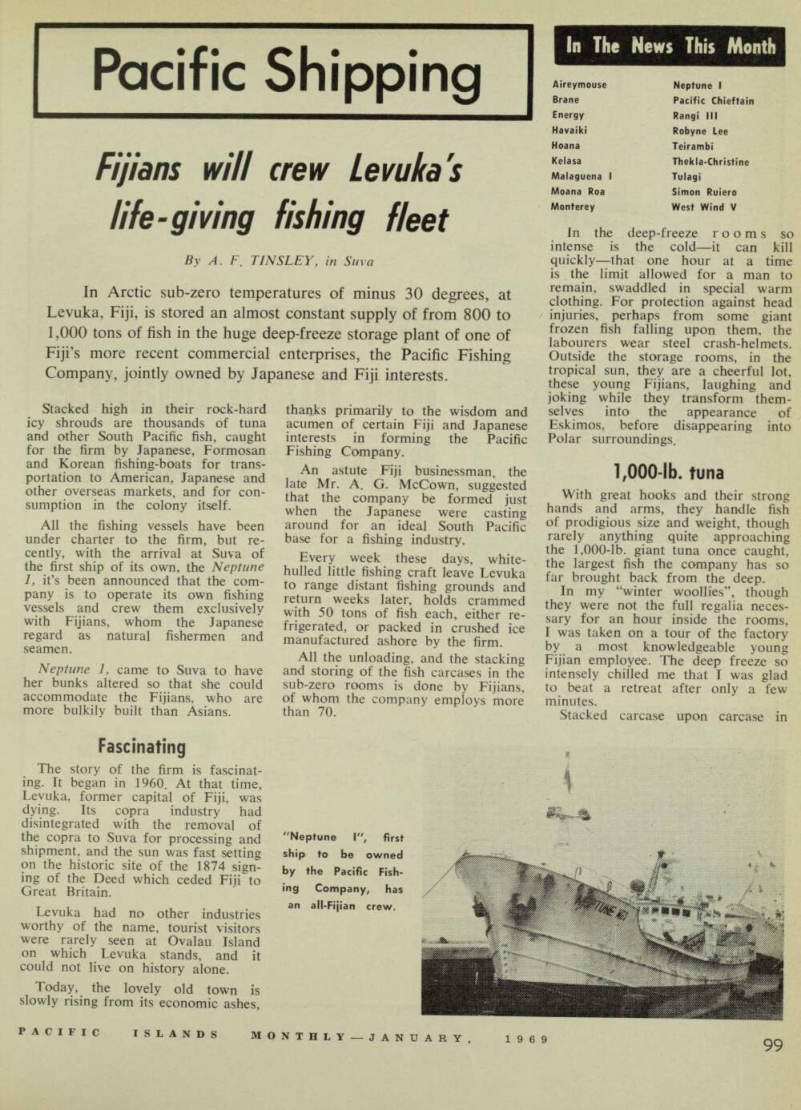
All the fishing vessels have been under charter to the firm, but re cently, with the arrival at Suva of the first ship of its own, the Neptune 1, it’s been announced that the com pany is to operate its own fishing vessels and crew them exclusively with Fijians, whom the Japanese regard as natural fishermen and seamen.
Neptune 1, came to Suva to have her bunks altered so that she could accommodate the Fijians, who are more bulkily built than Asians.
Fascinating
The story of the firm is fascinat ing. It began in 1960. At that time, Leyuka, former capital of Fiji, was dying. Its copra industry had disintegrated with the removal of the copra to Suva for processing and shipment, and the sun was fast setting on the historic site of the 1874 sign ing of the Deed which ceded Fiji to Great Britain.
Levuka had no other industries worthy of the name, tourist visitors were rarely seen at Ovalau Island on which Levuka stands, and it could not live on history alone.
Today, the lovely old town is slowly rising from its economic ashes,
thanks primarily to the wisdom and acumen of certain Fiji and Japanese interests in forming the Pacific Fishing Company, A n actllto .. ]at Mr A r Mrro«;n man ’ g* “ r ; sug i es . te(^
when we'Je castin'g
around for an ideal South Pacific base for a fishing industry.
Ever y week these days, white- Neptune hulled little fishing craft |eaye Leyuka to range distant fishing grounds and return weeks later, holds crammed with 50 tons of fish each, either re frigerated, or packed in crushed ice manufactured ashore by the firm, ... , , All the unloading, and the stacking and storing of the fish carcases in the sub-zero rooms is done by Fijians, of whom the company employs more than 70.
In the deep-freeze rooms so intense is the cold—it can kill quickly—that one hour at a time is the limit allowed for a man to remain, swaddled in special warm clothing. For protection against head injuries, perhaps from some giant frozen fish falling upon them, the labourers wear steel crash-helmets.
Outside the storage rooms, in the tropical sun, they are a cheerful lot, these young Fijians, laughing and joking while they transform them selves into the appearance of Eskimos, before disappearing into Polar surroundings.
1,000-lb. tuna
With great hooks and their strong hands and arms, they handle fish of prodigious size and weight, though rarely anything quite approaching the 1,000-lb. giant tuna once caught, the largest fish the company has so far brought back from the deep.
In my “winter woollies”, though they were not the full regalia neces sary for an hour inside the rooms, I was taken on a tour of the factory by a most knowledgeable young Fijian employee. The deep freeze so intensely chilled me that I was glad to beat a retreat after only a few minutes.
Stacked carcase upon carcase in
"Neptune I", first ship to be owned by the Pacific Fish ing Company, has an all-Fijian crew.
their frigid coatings of ice, I saw great hulks more resembling Egyptian mummies or hunks of hard grey iron, than fish that not long before had swum the warm South Pacific.
In the large ice-making section I saw hundreds of tons of ice being made into huge blocks, and then crushed for consignment to the holds.
Particularly striking was the spot less condition of the whole factory, where one might have expected it to be a rather messy, smelly one.
There was very little odour.
Each fishing craft carries 35 miles of stout rope which is paid out over areas chosen by the skipper to be fished, and is kept floating by numerous small buoys spaced out along its length. From the master line, dangling far down into the depths, are 2,000 perpendicular lines with baited hooks at their extrem ities.
Handling the great fish coming aboard is a man-sized, risky job, as the deck becomes a wildly-animated scene of frantically leaping, slithering, lashing giants whose tails can kill with one strike, and whose bites can inflict painful or serious injuries.
But the fishermen are experts, and the fish are quickly clubbed to death with special instruments handled by highly-skilled operators.
Welcomed
International friendship has devel oped between the Japanese and the local Levukans. Most people have welcomed them and like them.
Mr. H. Morita, a Japanese, and director of the firm in Fiji, was sent to Levuka long before the firm began operating in 1964, to super vise the building of the factory and otherwise prepare for business. He and his wife have been most happy in Levuka, and one only has to mention their names around town to find how well liked they are and how much they have become a part of Levuka life.
Other Japanese have settled down well and the children of one or two of their administrative staff attend the local Levuka Public School, where they are popular and have made great strides with their studies, especially English. The story is told of a Japanese brother and sister who, when reduced to quarrelling, now do so in English so that mother,
who does not speak the language, is kept out of the argument.
If an occasional spot of bother breaks out, perhaps when fishing crews return from long spells at sea and celebrate over-boisterously, the company can be a tough employer.
Speedy banishment home is one way used of punishing those who bring discredit upon the company and their country.
An especially harmonious relationship exists in local sports. Many Japanese have learned snooker and billiards from the Levukans, and
pleasant games are enjoyed on tables at the Royal Hotel. In Nasau Park, the township’s beautiful public play shining Pacific on one , lde '. " Ith a ° f mo “ n ‘ ai " s dominating the fields from behind apa , n f e bas f^ a " ‘f am ? pla >', wlt , h ! ocal eams ;, At the ’IT 1 ' m « clu^ s ,‘ he membership includes . men of . the . flshm « . company - A Ja pa nese is also rap am of one of the local Rugby XV s.
Mr. Morita, who comes from a land where bowling on the green is little known, has become a bowling “addict”, and finds in a game at
the Levuka Bowling Club relaxation from the world of fish.
The Royal Hotel’s two motor launches take international parties to nearby islands for picnics, and Fijians in Ovalau villages invite the Japanese fishermen and others out for magitis (feasts) and mekes (dancing) in the evenings. There are regular “Kimono Evenings” at the Royal.
During the last Cession Day observances in October, Ovalau schools staged colourful mekes in Nasau Park, and among her school mates from Levuka Public School was the small daughter of Mr.
Kurihara, an official of the fishing company, looking a dream in her ancient Fijian costume, singing in Fijian and performing all the symbolic gestures as if she had lived all her life in Fiji.
The Japanese and Levukans have much in common in their happy out look on life, and inherent politeness.
The locals found Japanese politeness catching. Said one, “We found their habit of bowing a bit strange at first, but after a while found we were doing it ourselves”.
The Japanese presence there, as today’s harbingers of a better Levuka tomorow, is a tonic for the town ship,
Fishing Boats Two
Drift Voyages
The latest drift voyage story to come out of the South Pacific con cerns not the usual blown-away fishing canoe, but a motor fishing vessel which made two drift voyages in succession.
The first was from Panama to Bora Bora, and the second from Bora Bora to Rarotonga.
Early in August, 1968, the 48 ft MFV Energy was ten days out of Panama on a delivery voyage to New Zealand when the generator power ing the ship’s radio broke down and could not be repaired.
Four days later, the 88 hp Kelvin diesel stopped working owing to badly corroded injectors. There was only one spare injector on board and the engine could not be started again.
With Captain John Moorhouse, were Colin Kennedy, Michael Blong, Mathias Nilsson, and Tony James, who acted as engineer.
Captain Moorhouse is a deck officer in the mercantile marine, and neither he nor his crew are qualified engineers. He took delivery of Energy in Gilbraltar and was sail ing the vessel to Wellington, NZ, for her new owners. Capt. Moorhouse advertised for a qualified engineer in
London and Gibraltar, but there were no takers.
Energy left Balboa on July 27 and was halfway to the Tuamotus when the engine died. Capt. Moor house then used jib, gaff-mainsail and mizzen to keep on course. But a fishing boat under sail does not perform like a yacht, and progress was slow. The average daily log was only 32 miles, but occasionally this was increased to 90 miles when winds and currents were favourable and when two extra “sails”, made from tent covers, were used.
During the fortnight before the engine broke down they had sighted only one vessel, and that was hull down on the horizon. No more ships were sighted until they sighted the Tuamotus 65 days later and spotted three other vessels.
They attempted to signal two of them by flashlight, but the ships did not read them well and sailed on into the darkness without understanding the urgency of the Energy's position.
The third craft was a small fishing boat several miles distant, and com munication was not established.
“We had ample supplies of drink ing water,” Captain Moorhouse said on arrival at Rarotonga, “but three weeks before we arrived at Bora Bora food had to be rationed.”
When the Enegy lay becalmed fish rested in the shade of the hull and the hungry crew waited at the gun wales with fish spears. When the fish swam lazily upwards, they were easily speared by the half-starved men.
“We caught a total of 16 fish with spears and handlines,” Captain Moorhouse said. “The biggest was a dorado which measured 4 ft, 6 inches.
But during the last three days before we reached Bora Bora the food situation was getting grim. We were down to eating a mixture of jam,
mayonnaise, and old stocks of dried, and very hard peas.”
The fishing boat with its bearded and half-starved crew reached Bora Bora on September 30 and was towed to an anchorage by a local launch.
Mr. Tony James, the Australian member of the crew, returned home from Bora Bora and six weeks after arrival at Bora Bora the fishing boat left for Rarotonga, Fifteen hours out of Bora Bora the engine failed again, but they pressed on for Rarotonga under sail.
They would have drifted past the island altogether except for the alertness of a local resident who possessed a high-powered telescope.
Mr. lan Forbes, chief of Raro tonga’s Philatelic Bureau, was re laxing on his verandah that Sunday evening when he spotted the vessel drifting, although under sail. He brought his telescope to bear and found that she was flying a flag which he could not understand. He also observed that the ship was drifting far to the west and required immediate assistance if it was to reach Rarotonga, He telephoned the Union Steam Ship Co. manager who told him that the unusual flag meant “assistance required”, A launch crew was found and Energy was towed into Avatiu harbour at 9.30 p.m. on December 1. She had taken 18 days from Bora Bora instead of the estimated three.
Both radio and engine were repaired at Rarotonga and she sailed direct for Wellington on December 11.
Avarua's New Wharf
Open For Business
After only seven weeks’ work, the new wharf at Avarua, Rarotonga, was completed in late November. It extends 60 feet into the harbour and is solidly constructed with sheet pil
"Energy" at Avatiu Harbour, Rarotonga, in December after a five-month drift-and sail voyage from Gibraltar.
mg, solid fill, and a capping of rein forced concrete. It includes a small boat pen capable of holding one lighter.
The old wooden wharf, badly damaged by a storm in 1966, and again by the December 1967 hurri cane, has been demolished. The new wharf was built with an $lB,OOO grant from the New Zealand Govern ment.
The wharf was used for the first time on November 27 when passen gers from the Matson vessel Monterey landed there. Cargo from the Moana Roa was brought ashore in early December, the first time incoming and outgoing cargo has been handled direct from Avarua for about a year.
After the old wharf was damaged by the hurricane, cargo had to be dis charged at Avatiu harbour one mile away.
This meant a slower turn round of the Moana Roa, and increased costs for cartage, electricity, and a higher wage bill for lighter crews and night watchmen. These extra costs, where the Moana Roa was concerned, were carried by the Union Steam Ship Company for a year.
During the past 12 months, and as a direct result of the December 1967 hurricane, sea walls of coral rocks cemented together have been built along the Ruatonga waterfront —from Avatiu harbour and extending towards Awarua harbour—and at
Ngatangiia. The walls had to be built to protect the coastal road, houses and other buildings which lie close to the inland verge of the road.
In effect this was land reclamation as the empty areas behind the sea walls were filled in with, in the case of the Ruatonga wall, spoil obtained by dredging Avarua harbour during the building of the new wharf; and in the case of Ngatangiia sand and soil obtained from other areas. Grass and trees will be planted on these reclaimed areas.
Retaining walls of similar construc tion have been built along the banks of the Avatiu and Takuvaine streams which empty into Avatiu and Avarua harbours.
Death Of "Tulagi"
Officer In Santo
John Merrit, 26-year-old assistant purser on the Burns Philp motor vessel Tulagi, died as a result of head injuries received in Santo in December—despite a mercy dash by an RAAF Hercules from Australia to the New Hebrides to save him.
Merrit was admitted to Santo hos pital after receiving the injuries, and hospital authorities made an emerg ency call to Australia for specialist aid.
Flight-Lieutenant Hyland flew his Hercules, with a medical team on board, the 3,000 miles from Rich mond, NSW, RAAF base to Santo.
After examining the patient, the team’s surgeon, Squadron-Leader G.
Nelson, and the anaesthetist. Flight- Lieutenant P. Degotardi, realised that Merrit needed immediate surgery.
With nurses M. Gale and O. Hines and Medical Orderly LAC J. Drew, they performed a two-hour operation.
In an operating theatre, with the temperature at 110 degrees, two holes were bored in Merrit‘s skull to re lieve pressure on his brain. On the return flight to Sydney an oxygen re suscitator was used to keep Merrit breathing.
On arrival in Sydney he was rushed to Prince Henry Hospital, where he died some 12 hours later.
In Sydney in late December, the City Coroner’s Court was awaiting a police report from Santo before de ciding whether an inquest would be held.
Charter Vessel
Launched In Suva
Fiji’s latest charter boat is the 46 ft Rangi 111, built by Mr. Hector Harman and launched at Charles Whippy’s boatyard in Suva in late November. Mr. Harman, a retired civil servant, will base her in Suva for charter as a game-fishing,
pleasure-cruising and day excusion vessel.
The Rangi 111, which has a 14 ft 6 in. beam and 4 ft draft, has sleep ing capacity for 10 people and fuel and water capacity allowing a wide range. She is built from well-seasoned timber from a Harman property at Wainunu and lined throughout with Formica.
Two 120 h.p. Perkins diesels give her a cruising speed of nine knots.
She will enter the fishing charter and tourist field when the fitting out process has been completed towards the end of January.
"Pacific Chieftain"
A Total Loss
Pacific Chieftain, owned by Mr.
Clive Wilson of Lord Howe Island, was a total loss after striking “Flat Rock” off Lord Howe during bad conditions in November.
Mr. Wilson, his party (Mr. and Mrs. I Packer, Mr. and Mrs. R.
Shaw, Mr. and Mrs. S. Grimmond, Mr and Mrs. P. Rayner, Mr. and Mrs. L. Holmes and Miss T.
Waldram) and two crew, all of whom escaped the wreck in an inflated raft, were picked up near the Admiralty Islets two-an-a-half hours after striking the rock by Mr.
Carl Dignam in his vessel Centauri.
Mr. Clive Wilson, who received a bad wound under the chin, and several passengers with minor injuries were later treated at Lord Howe’s hospital,
Findings Of Inquiry
Into Loss Of "Bev"
The Administrator of P-NG, Mr.
D. O. Hay, in late November ap proved the report of the findings of the Marine Board of Inquiry held in Samarai in July into the loss of
the 39-ton coastal trading vessel Bev in November, 1967. Nine people died.
The Board of Inquiry found that the Bev was properly manned, equip ped and seaworthy as required by law and that she had adequate stability at the time of her loss.
The probable cause of the loss was the rolling effect of the wave which caused the vessel to broach to, coupled with the force of the wind under unsual cyclonic conditions on the superstructure, which held the vessel in a position of extreme heel.
The loss was not attributable to error or neglect and nothing ad
ditional could have been done to save life on the vessel.
The Bev, a 62 ft single-screw wooden motor vessel departed from Samarai on November 11, 1967, on a voyage to Misima and anchored off Gubagabatau Island in the Con flict Group the next day. In the evening of the same day the wind velocity began to increase and soon had reached such force that the anchor cable parted.
Although by this time the main engine had been started, the weather made the vessel unmanagable. An attempt was made to run before the wind but at about midnight the vessel broached to and lay on her beam end. The engine room filled with water and she eventually sank by the stern.
The vessel carried a master and a crew of nine and also had on board six passengers.
All but one passenger were able to get away on two life-rafts and two lifebuoys. Seven people, in cluding the master managed to make Bunora Island, although one Euro pean passenger died. They were found on the island by searching aircraft and subsequently picked up by FRY Tagida. A further survivor was sighted by searching aircraft on November 16, 1968, and picked up later on the same day by the MV Yelangili. No trace was found of the remaining eight people.
The "Teirambi", the first of several fish ing boats planned by the Ra b i Island Council, was launch ed at Miller's boat yard, Suva, in October. She will be used, with a crew of four, for com mercial deep-sea fish ing ventures. The 26 ft "Teirambi's" sail is intended as a
steadying device,
with the main source of propulsion being a diesel engine. A spokesman for Millers said the Rabi Island Council in tended to have a further two or three fishing boats built this year.
Flying a 150 ft pay ing off pennant BPs "Malekula" leaves Port Moresby on her last voyage. In late December BP was still negotiating with buyers for her sale.
New On The
Fiji Registry
The former New Zealand coastal vessel Onehunga was re-registered in Suva as the Jean Philippe in November. The owners are a Fiji company, Reef Shipping Ltd.
Another ship expected to go on the Fiji registry before long is the Australian crayfish vessel Ata, which operates in Tonga.
The Ata is also owned by a Fiji company, Fathom Fisheries, but she was originally registered in Sydney, where she was built last year.
Captain, Crew Of "Chin
Ching Fwu" Fined In P-Ng
The captain of a Formosan fishing vessel, the Chin Ching Fwu, was fined a total of $435 on three charges, and 13 of his crew members were each fined $2O on one charge, after a hearing in the Milne Bay District Court, P-NG.
The captain, Hscu Liang, was fined S4OO in default of two months im prisonment on a charge of having entered the territory other than at a port. This charge was laid under the Migration Ordinance.
He was fined $l5 in default of one month imprisonment on a charge laid under the Criminal Code, of having in his possession copper to the value of SUSIOO unlawfully taken from a wrecked vessel on Rossel Spit.
He and 13 crew members were each fined $2O in default of two months imprisonment, on a charge, laid under the Migration Ordinance, of having entered the territory with out being holders of an entry permit.
The Reserve Magistrate, Mr, E. R.
Johnson, gave them one month to pay the total fines of $695.
Charges against two of the crew members of having entered the ter ritory without a permit, were dismis sed by the Magistrate when the interpreter was unable to com municate with the men. All gaol sentences, if they were to be executed, were to be concurrent, the magistrate ruled.
Contract Won For
Kieta Wharf Facilities
The P-NG Ministerial Member for Works, Mr. O. I. Ashton, has announced that a tender has been accepted from Dowsett Engineering (New Guinea) Pty. Ltd. to con struct facilities at Kicta Wharf The contract, which is worth $133,518, is expected to be completed by July.
Included in the facilities to be built are a customs shed, a fertiliser store, a Copra Marketing Board
shed, a stevedores’ mess with an ablution block, a gatehouse and toilets.
Associated site services such as water supply, sewerage, drainage, paving and sealing, fencing, floodlights and a fire alarm system are
a,S^T ClU ?l-
When complete, the wharf and facilities will have cost the Administration approximately $400,000. 3 ’ // dciaiuia // uci dc in .AOAMrrr
Salvage Japanese Sub
The Solomons’ biggest ship, the motor vessel Belama, has recently been taking a big hand in current efforts to salvage a Japanese sub-
marine in about 90 ft of water off Komimbo Bay, Guadalcanal, Belama was used to try to raise a 19-ft-long gun from the submarine, She was a bi e recover the gun’s 6-in. barrel, breech lock and some Q f its pivoting mechanism.
The submarine was said to be one r.•. ■ T „ . ?/ “ th , e Q A P ," e „ Ft was k ~' n , 94 v, 7 dl 8 „ n engagement with two NZ corvettes, Kiwi and Moa; 150 Japanese died.
Mr. Cyril Ashton, in charge of salvage operations, plans to give the gun to a NZ frigate expected in the Solomons early this year. It will be carried back to NZ and displayed in a museum.