Fiji's Got It Made Despite
pp. 47-51 · Read in the full issue
Pockets Of Pessimism
By STUART REID, after a visit to Fiji.
Fiji, most people who have been there chorus, has it made as far as tourism is concerned. After all, with those mountains, those bays, those lagoons, those beaches, and those ever-smiling people (not to mention duty-free shopping) how can she lose?
It seems she cannot. Yet one senses that some people in the Fiji travel business are not exactly bouncing with confidence.
A feeling of pessimism is evident when they go into group therapy—as, for instance, at the eighth annual tourist convention in Suva last October.
And to an extent their pessimism is understandable, R. S. Odell’s report (stating that there are too many hotel rooms in Suva and recommending that the government curb hotel deth , e fity until 1971)
tww. pat*’. ‘p/. ii u"
though FATA s Marvin Flake, who knows his tourists at least as well as Odell, said “hooey” to the report and pointed out that capacity must always stand ahead of demand.
But, despite the pessimism, there is some pretty impressive development and optimistic talk of development in the colony. First, hotel development.
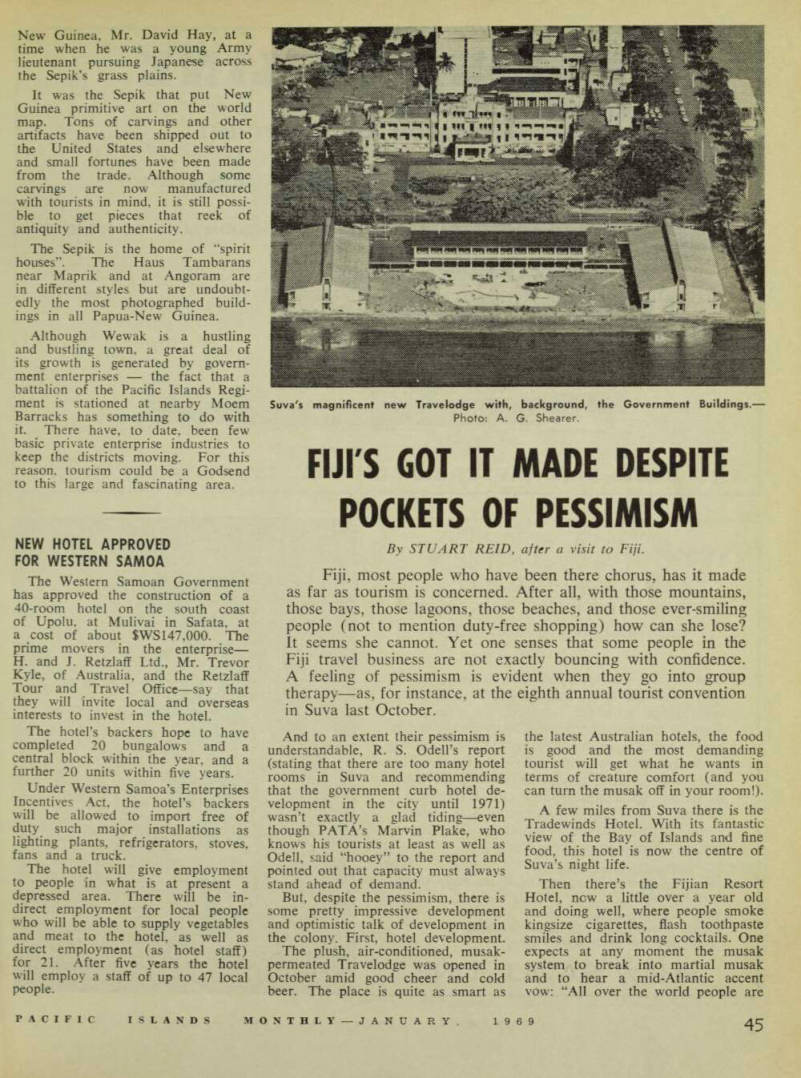
The plush, air-conditioned, musakpermeated Travelodge was opened in October amid good cheer and cold beer. The place is quite as smart as
the latest Australian hotels, the food is good and the most demanding tourist will get what he wants in terms of creature comfort (and you can turn the musak off in your room!).
A few miles from Suva there is the Tradewinds Hotel. With its fantastic • r .. , r T „, , , . . . ...-• t . . f
*“£.f.ht hfe
d s 8111 mc ‘ Then there’s the Fijian Resort Hotel, new a little over a year old and doing well, where people smoke kingsize cigarettes, flash toothpaste smiles and drink long cocktails. One expects at any moment the musak system to break into martial musak and to hear a mid-Atlantic accent vow: “All over the world people are
Suva's magnificent new Travelodge with, background, the Government Buildings.— Photo: A. G. Shearer.
The development talkers
smoking P. . . . S . . . .”).
The Fijian is the last word in James Bond sophistication—even though a lady has been known to wear curlers to (snack) lunch—and in two years it will have a nine hole golf course.
The Fijian, like the older—and cheaper—Korolevu Hotel, lies on the Coral Coast. Both hotels have magnificent beaches and offer swim ming (pool and sea) and fishing . . . and a time to relax.
And then, of course, there is a rash of hotels around Nadi. Latest hotel in the area is the aptly-named Gateway. It is three minutes from the airport and it is large and clean and air-conditioned.
There are quite a few others in the area—and not all of them reek with confidence. Some look as though they were put up by people who were not quite convinced of the tourist potential of Fiji, with the result that these hotels have a makeshift look.
"Another Travelodge"
Then there’s the Man Friday de velopment plan. Man Friday, a magnificently-sited holiday spot on the Coral Coast, has taken the first step in its SAIOO,OOO extension pro gramme with the completion of the new 2i mile (access) road from Queen’s Road to the resort.
All those are among the latest de velopments. What about the talk?
Perhaps the most impressive develop ment talk at the moment comes from the Hooker Corporation ( PIM, Dec., p. 127).
A top executive with Hooker told me in December that he had been to Fiji three times in 1968 sounding out real estate and tourist possibilities.
He said that he knew that Odell had recommended that the government curb hotel development in Suva until 1971. His conclusion: “I think it likely that Suva will need another Travelodge by the end of 1969.”
He also told me that he was keen for Hooker’s to set up a resort hotel along the Coral Coast (with other organisations if necessary)—and a resort hotel is something that the Hooker organisation has never built anywhere.
That the Hooker organisation is in terested in developing tourist attrac tions in Fiji is an encouraging sign for the Fiji tourist people and one that should lessen the pessimism caused by Carpenter’s decision not to go ahead with hotel ventures in the colony.
Fiji, then, as far as tourism is con cerned, is a place of first-class hotels, of good hotels and of hotels that haven’t quite made it, and Fiji is a place of unlimited potential and talk of potential. Soon, no doubt, develop ment will get into full swing and the people who live in Fiji will take con fidence in themselves, and tourism will replace sugar as the colony’s main money earner.
In other words, the place may soon become another Hawaii—that is, a place that offers tourists what they want for a price, a place where a good standard of living is enjoyed by the whole population and where there is no racialism because the people need to work together to keep the tourist business afloat.
Hawaii-phobia
Not everyone, of course, jumps for joy at the prospect—although it would be hard to find an ordinary Fijian or Indian who would not like the idea. Many Europeans regard the prospect of Fiji becoming another Hawaii with the same horror that members of the Melbourne Club re gard a poker machine.
The people with the Hawaii-phobia have it because they fear that an Hawaiianised Fiji would, one, lose its “authentic Islands atmosphere” and, two, become inundated by that monster, the American tourist (a creature, it is unfairly alleged, in a screaming shirt, bedecked with cameras, who is ignorant of every point of mildly good manners, who is rude to waiters and bears an un
speakable name—like Elmer).
First Point. Fiji has already lost its “authentic Islands atmosphere”—or at any rate very nearly.
What’s authentic about a group of Fijian villagers, floodlit, in gear that looks as though it has come straight from a wardrobe department, singing the Isa Lei next to a swimming pool?
What’s authentic about the village chief’s hut where pictures of every English monarch since Edward VII stare accusingly at you from every wall.
And what’s authentic about gar landing jetsetters with leis at Nadi air port?
The answer: Nothing. But the sing ing and the garlanding and the chief’s open hut are pleasant and harmless and the tourists enjoy them.
Point two. Even if the ugly Ameri can does exist (and if he does he is certainly—from my experience in the hotel business—no more ugly than the Englishman or Australian; just richer and, often, more generous) why should that wori7 the Fijian?
No man should object to serving a bald pate and a fat cigar if in return he gets a fistful of dollars?
If Fiji becomes another Hawaii, good for Fiji—in particular, good for the Fijians.
The danger, however, is not that Fiji will become another Hawaii but that it will become another Queens land Gold Coast. The Gold Coast is a mixture of everything that is abominable in American and English architecture. If anything like Main Street, Surfers Paradise, went up in Fiji, it would be a tragedy.
Nadi s latest hotel, the Gateway, a few minutes from the airport. Photo: A. G.
Shearer.