among Fiji policymakers
p. 34 · Read in the full issue
New spirit of reasonableness among Fiji policymakers
From a Suva correspondent
“The tone of the debate has been higher than at any other time in this House in my experience. It has been of very high quality and I think it augurs well for the future.”
This was the Fiji Legislative Council Speaker, Mr. R. G.
Kermode’s summing up of the council’s December proceedings, which wound up after only 10 days of debate on the budget.
Everybody, particularly the Gov ernment, remarked on the “new spirit” which prevailed in the council chamber. There was an air of reasonableness and decorum over the majority of matters discussed, with only an occasional caustic comment and flash of belligerence.
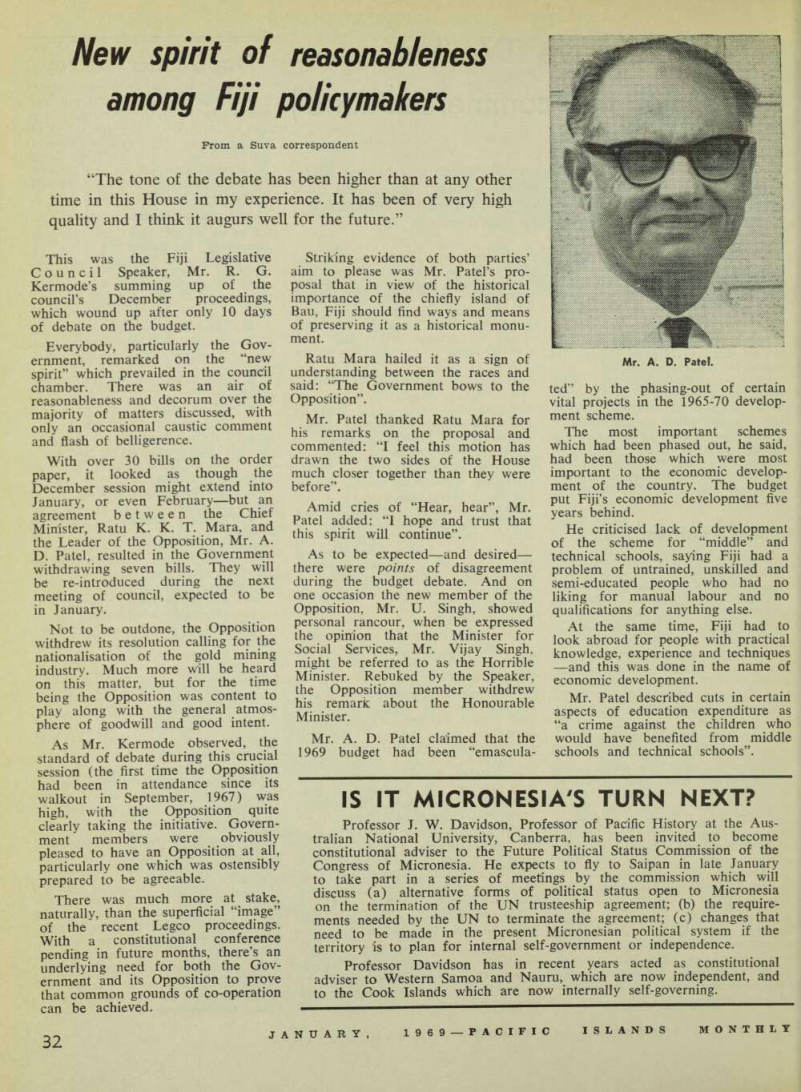
With over 30 bills on the order paper, it looked as though the December session might extend into January, or even February—but an agreement between the Chief Minister, Ratu K. K. T. Mara, and the Leader of the Opposition, Mr. A.
D. Patel, resulted in the Government withdrawing seven bills. They will be re-introduced during the next meeting of council, expected to be in January.
Not to be outdone, the Opposition withdrew its resolution calling for the nationalisation of the gold mining industry. Much more will be heard on this matter, but for the time being the Opposition was content to play along with the general atmos phere of goodwill and good intent.
As Mr. Kermode observed, the standard of debate during this crucial session (the first time the Opposition had been in attendance since its walkout in September, 1967) was high, with the Opposition quite clearly taking the initiative. Govern ment members were obviously pleased to have an Opposition at all, particularly one which was ostensibly prepared to be agreeable.
There was much more at stake, naturally, than the superficial “image” of the recent Legco proceedings.
With a constitutional conference pending in future months, there’s an underlying need for both the Gov ernment and its Opposition to prove that common grounds of co-operation can be achieved.
Striking evidence of both parties’ aim to please was Mr. Patel’s pro posal that in view of the historical importance of the chiefly island of Bau, Fiji should find ways and means of preserving it as a historical monu ment.
Ratu Mara hailed it as a sign of understanding between the races and said: “The Government bows to the Opposition”.
Mr. Patel thanked Ratu Mara for his remarks on the proposal and commented: “I feel this motion has drawn the two sides of the House much closer together than they were before”.
Amid cries of “Hear, hear”, Mr.
Patel added: “I hope and trust that this spirit will continue”.
As to be expected—and desired— there were points of disagreement during the budget debate. And on one occasion the new member of the Opposition, Mr. U. Singh, showed personal rancour, when be expressed the opinion that the Minister for Social Services, Mr. Vijay Singh, might be referred to as the Horrible Minister. Rebuked by the Speaker, the Opposition member withdrew his remark about the Honourable Minister.
Mr. A. D. Patel claimed that the 1969 budget had been “emascula-
ted” by the phasing-out of certain vital projects in the 1965-70 develop ment scheme.
The most important schemes which had been phased out, he said, had been those which were most important to the economic develop ment of the country. The budget put Fiji’s economic development five years behind.
He criticised lack of development of the scheme for “middle” and technical schools, saying Fiji had a problem of untrained, unskilled and semi-educated people who had no liking for manual labour and no qualifications for anything else.
At the same time, Fiji had to look abroad for people with practical knowledge, experience and techniques —and this was done in the name of economic development.
Mr. Patel described cuts in certain aspects of education expenditure as “a crime against the children who would have benefited from middle schools and technical schools”.
Mr. A. D. Patel.