Party Without A Platform
pp. 25-26 · Read in the full issue
Makes Itself Felt
From a Port Moresby correspondent In the second week of the November meeting of P-NG’s House of Assembly, legislation occupied only a small part of the sitting time and aroused little interest. It wasn’t very interest ing legislation. Nevertheless the House displayed its allergy towards hurried law-making by postponing consideration of a few bills to its next meeting, which will probably be held in February.
An exception to the general lack of interest was provided by the Coffee Marketing (Appointment of Inspectors) Bill. The subject of coffee can always be relied upon to open the flood-gates of oratory; and at the committtee stage Chimbu Regional’s Eric Pyne, who is in the coffee marketing business himself, came up with some amendments which won both approval and praise from the Government benches.
But the main interest centred on motions—Michael Somare’s motion on West Irianese refugees, Jason Garrett’s motion on education allowances and subsidies, and the motion to “take note of” the Five Year Plan for economic develop ment.
Strong criticism
Michael Somare’s motion was mild enough in itself: “That this House expresses its sympathy with the plight of the West Irianese refugees in the territory and urges the Administration to treat them with every consideration”.
His speech, however, was far from mild. He strongly criticised the handling of the refugee problem by the Administration, and particularly the sudden evacuation to Manus Island of those West Irianese who had been granted permissive residence and had settled down in the Wewak area.
Percy Chatterton reminded the House that about 1,500 West Irianese had crossed the border since the Indonesian take-over. Of these a few hundred had been granted per missive residence, one had been deported under a deportation order, and the remaining thousand or so had, according to the official account, agreed to return voluntarily to West Irian after being interviewed at border posts.
He was sceptical about the adequacy of the interviewing and of the voluntary nature of 'their return to West Irian. He thought it reason able that those granted permissive residence should be required to move away from the border, but de precated any arrangement that re motely resembled a concentration camp.
Senior Official Member Frank Henderson opposed the motion with unexpected vehemence. He claimed that its wording implied that the Administration had not been treating the refugees with consideration and he denied that this was so.
The House seemed set for a lively debate, but at this point Ron Neville (Southern Highlands Regional) moved the closure, which was agreed to by 62 votes to 20. It looked as if Neville was co-operating with the Government to avoid a debate which might prove embarras sing to it; however, when the motion was put, he himself was among those who rose to support it. Nevertheless it was defeated by 56 votes to 24.
Percy Chatterton doesn’t easily give up, and a couple of days later he asked at question time whether the West Irianese at Manus were free to leave for other parts of the territory (excluding the border areas) provided they had an as surance of jobs and accommodation.
Mr. Henderson, not wanting any more cracks about concentration camps, replied with a firm “yes”.
Jason Garrett’s motion on educa tion allowance and subsidies had as its background a recent decision of the Public Service Arbitrator which granted an increased subsidy to public servants whose children are at school in Australia. There had been no flow-on to parents working in the private sector, who continue
to receive subsidy at the old and lower rate.
Mr. Garrett’s motion requested that “an equal allowance and subsidy be provided to all people of the territory who are desirous of educat ing their children in Australia”, and considered that “the equalisation of educational allowances and sub sidies is a government responsibility”.
The Government opposed the motion, but was defeated on a division by 49 votes to 36, its second major defeat at this meeting.
On the face of it, the terms of Mr. Garrett’s motion would include New Guineans who wanted to have their children educated in Australia.
However, this is not a very live issue. Each year about 20 selected indigenous pupils are awarded scholarships covering the full cost of secondary schooling in Australia.
Few other New Guinean parents would be likely to want to have their children educated in Australia, and still fewer would be sufficiently affluent to be able to bridge the gap between subsidy and actual cost.
The dullest
In the first week of the meeting, the longest debate, that on national unity, had also been the dullest. This pattern was repeated in the second week during the interminable debate on the Five Year Plan. Pangu Pati did its best to inject a little liveliness into it by opposing the plan on the ground that most of its benefits would accrue to expatriate com mercial and industrial enterprises and few of them to New Guineans.
But most of those who took part in
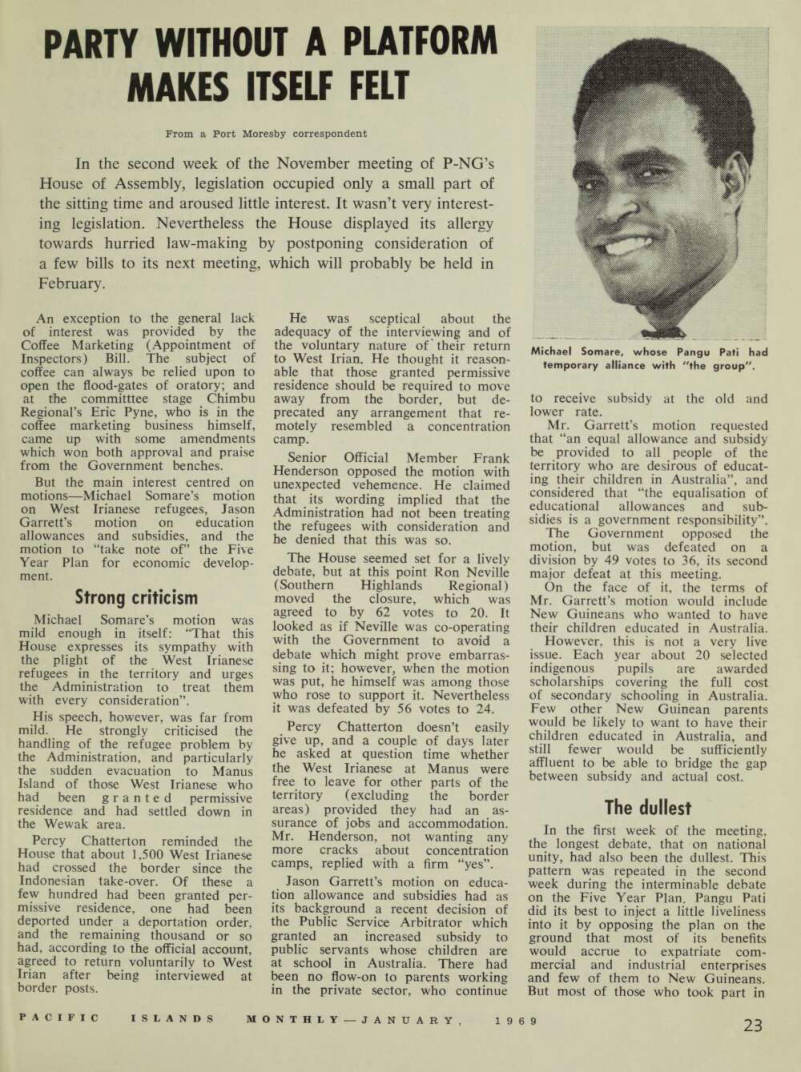
Michael Somare, whose Pangu Pati had temporary alliance with "the group".
the debate had little to say and took a long time saying it.
The general trend was that if Australia was prepared to spend a lot of money on developing the ter ritory’s economy she should be en couraged to do so. On the motion to “take note of the paper”, Pangu Pati managed to rally a few indepen dents to its side for a “No” vote of 12; 68 voted “Aye”.
A motion by Wally Lussick (Manus and New Ireland) pledging the support of the House in the implementation of the plan was carried on the voices, after an un successful attempt by Percy Chat terton to insert a proviso to the effect that the pledge should not be regarded as committing the House in advance to approval of any specific piece of legislation.
Trustful mood
The House, in a trustful mood, felt that it would be ungracious to look a gift horse in the mouth. Time will show whether or not it was right.
Of the remainder of the House’s business perhaps the most important and far-reaching was a request to the Administrator to appoint a com mission of inquiry into P-NG’s elec toral system. This was passed with out debate or opposition, in spite of the fact that it was sponsored by Pangu Pati.
The need for such an inquiry has since been underlined by the re velation that the long delay in making public the Chief Electoral Officer’s report on the 1968 Elections has been due to the fact that it con tained some forthright comments, particularly in relation to the voting age (21 as against 18 for local gov-
ernment council elections), which the Administration has been re luctant to publicise.
Vis-a-vis the ineptitude of the tactics alike of the Government and of Pangu Pati, the so-called “inde pendent group”—the party without a platform—did not have to try very hard in order to take the tricks.
Significantly, on the two major issues on which the Government suffered defeat, it was defeated by a temporary alliance between the “group” and Pangu.
Just how long will it be before the “independent group” finds a platform and becomes a party?
Question of time
Opinions differ, but most observers, and the leaders of the “group” them selves, seem to regard it as only a question of time. The “group” claims to number 57, but it is not likely that all of these will be pre pared to subscribe to a party plat form.
It looks as if we may end up with three parties—the new party, Pangu and the Government party (i.e. the official and ministerial members), any two of which will be able to combine to defeat the third, though with a sufficient floating vote of un committed members to ensure that the result will never be entirely pre dictable. An entertaining prospect!
Whether it will be conducive to good government or not is another matter. But at least it will be an improvement on the situation in the first House, in which the permuta tions and combinations of 53 elected members, all independents, produced division lists which were the despair of the trend hounds.
Eric Pyne . . . approval and praise from the Government benches.
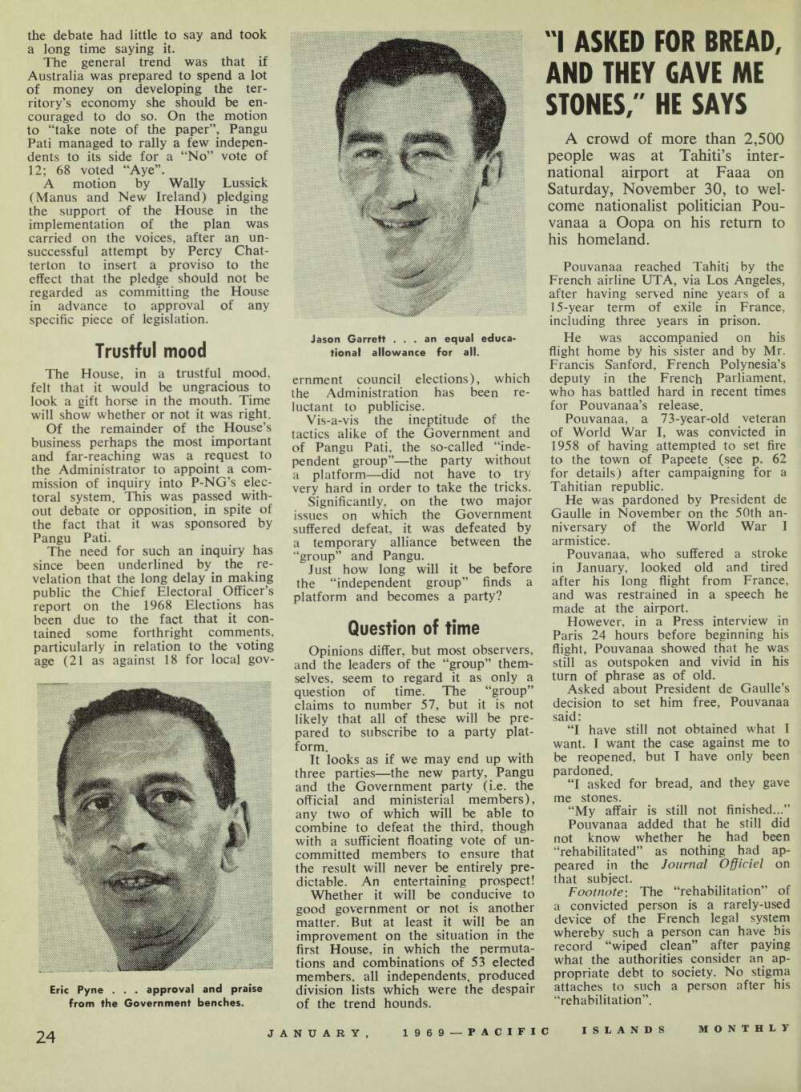
Jason Garrett ... an equal educa tional allowance for all.