Pacific Shipping
pp. 109-117 · Read in the full issue
French passenger ships to disappear from South Seas
Messageries Maritimes, the French shipping line which has maintained a passenger service across the Pacific for many years, is to sell the eight passenger vessels in its fleet over the next five years.
The sale of the eight passenger ships will not affect the operations of the Messageries Maritimes pas senger-cargo vessels currently serving the Pacific.
The Messageries Maritimes ships operate between Marseilles and Sydney, with calls at Taiohae (Marquesas), Papeete, Vila and Noumea.
The president of Messageries Mari times, Mr. Gilbert Grandval, an nounced the plan to sell the eight passenger ships in October.
The ships are the Caledonien, Tahitien, Laos, Cambodge, Pierre Loti, Jean Laborde, Pacifique {ex- Vietnam) and Pasteur.
The ships will be sold because the development of air services through out the world has made them un economic.
Messageries Maritimes is four fifths owned by the French Govern ment and is heavily subsidised by it.
The Caledonien and Tahitien are
the only two MM passenger ships currently operating in the Pacific.
They will be sold at the end of next year—the first of the eight ships to be taken out of service.
The Caledonien and Tahitien have been part of the MM fleet since November, 1952, and June, 1953, respectively. Each carries 100 first class passengers, 100 tourist class and 200 third class.
To be abandoned
When they are sold, they will be temporarily replaced on the Pacific run by the Laos and Cambodge. The Laos and Cambodge are currently used on a service to the Far East, which is to be abandoned.
The Pierre Loti and Jean Laborde, which operate a service to Mada gascar, will be sold at the end of 1970 and replaced by one ship, the Pacifiqne. When the Pacifique is sold a year later, the Madagascar service will be abandoned.
At the end of 1972, the Laos and Cambodge will be sold and this will bring an end to the Pacific service.
Only one ship, the Pasteur, cur rently used in a service to South America, will then remain. The Pasteur will be sold at the end of 1973.
"Malekula" Sold
To Singapore
Burns Philp’s 16-year-old pas senger-cargo vessel Malekula has been sold for an undisclosed sum to a Singapore buyer, Ankan Shipping. After she reached Sydney m late November her crew were to be paid off and the ship handed over to the buyers, Ankan Shipping were to sail Malekula from Sydney in late
December for Singapore, where plans are to refurbish her and put her on a regular South-East Asia passenger cargo run, to include Cambodia and Malaysia. She will be renamed.
As with most BP ships, Malekula’s cost had been “written off” many years ago. BP had been after a buyer for some time without success and finally accepted the Singapore offer, with the approval of the Aus tralian Government, for a relatively low sum.
The 3,786-ton trader had been on Australia-New Guinea runs for most of her 16 years and recently she had been plying Sydney - Brisbane - Port Moresby-Samarai, and return.
Her sale follows that of the venerable Bulolo by only a few months and reduces the BP medium sized freighter fleet to four. Left
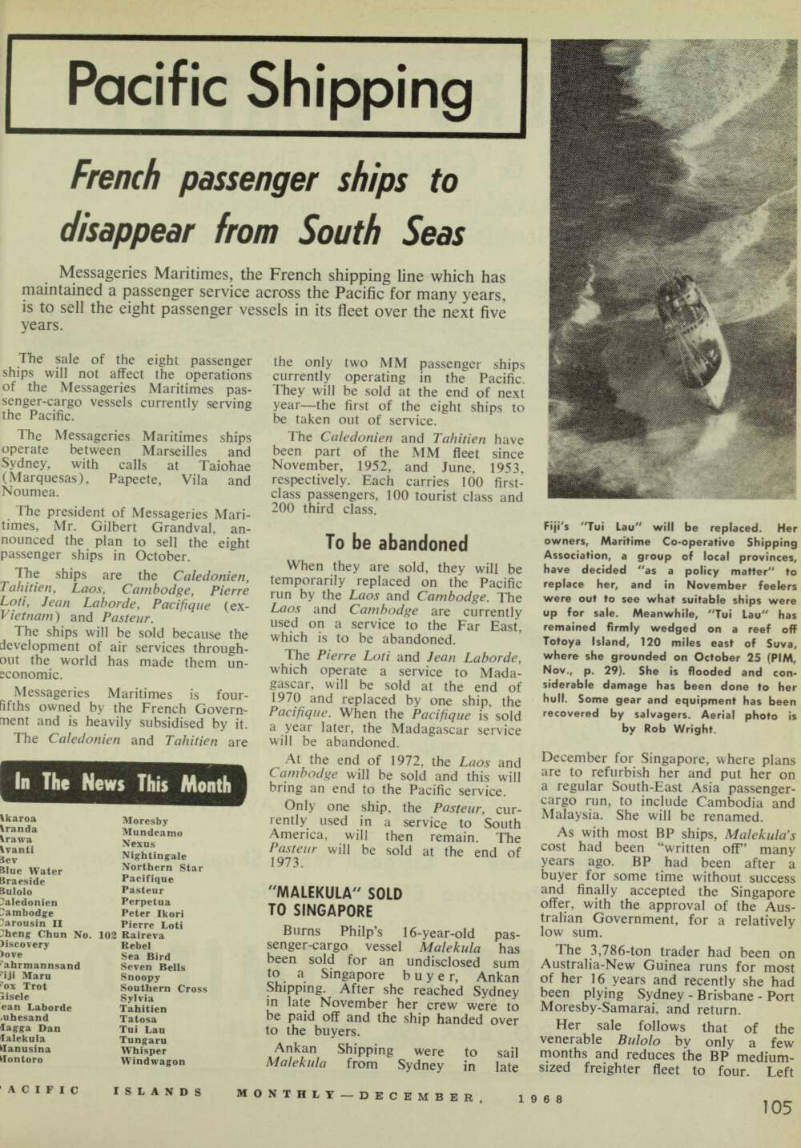
Fiji's "Tui Lau" will be replaced. Her owners, Maritime Co-operative Shipping Association, a group of local provinces, have decided "as a policy matter" to replace her, and in November feelers were out to see what suitable ships were up for sale. Meanwhile, "Tui Lau" has remained firmly wedged on a reef off Totoya Island, 120 miles east of Suva, where she grounded on October 25 (PIM, Nov., p. 29). She is flooded and con siderable damage has been done to her hull. Some gear and equipment has been recovered by salvagers. Aerial photo is by Rob Wright.
are the 19-year-old Braeside, the 14year-old Tulagi, the 12-year-old Montoro and the three-year-old Moresby. BP will retain them.
Three of them have recently been modernised with improved cargo handling facilities, and the company may even charter a modern vessel for NG operations.
Policy remains to have the ships making profits by 1970, after over 20 years of continuous losses.
What Will Nauru Do
With Her New Ship?
The Republic of Nauru’s first and only vessel, a 6,000-ton passenger/ cargo ship, is to be launched in Leith, Scotland, on December 19, and is expected to start on its delivery voyage next March. The President of Nauru, Hammer Deßoburt, will attend the launching with his wife, who will carry out the launching ceremony.
In November the name of the new vessel was still undecided. Originally the ship was to be named Nauruan Chief, but there was some opposition to this in the republic because it was felt too many Pacific ships were named “chief”.
Nor has it been decided where the ship will operate. The decision to build the vessel was taken before independence. The economics of the exercise were based on the fact that she would probably operate Sydney- Port Moresby-Honiara-Nauru with passengers and general refrigerated cargo, and Nauru-Cairns-Brisbane on the return journey, carrying phos phate.
There is a superphosphate works at Cairns, and it was thought that delivery at Cairns of 5,500 tons of phosphate a voyage (at delivery charges of something like S 4 a ton) would be a lucrative cargo for the ship. The new vessel was in fact especially designed with shallow draught with Cairns in mind, as BPC ships are too big. With this loading, only an additional 200 tons of general cargo from Australian ports would make the ship a paying proposition.
However, latest plan is to run the vessel to Melbourne, which happens to be Nauruan headquarters in Aus tralia. There is little cargo offering in Melbourne—most comes out of Sydney—and some observers insist that it won’t be economic to take the vessel any further south than Sydney.
There is, though, a possibility that the vessel may establish some regular link with the US Trust Territory of Micronesia, and officers of Micro nesian Interocean Line Inc. were in Melbourne recently, talking to the Nauruans about the possibility of the
vessel operating a rationalised service in that area in conjunction with other MILI vessels.
One attitude on Nauru is that the vessel should be retained as a prestige vessel, and for the occasional work of re-laying the deep moorings at Nauru (a job which she is specially fitted out to undertake).
But prestige vessels are too ex pensive for little nations which have to pay their own way and there is also pressure on the government to put Nauru’s new vessel to practical use and earn profit from it. A lot of people will be interested in the out come. (See also MILI report, p. 110).
Third Queensland-Ng
Service Mooted
There are moves in Northern Queensland to start a new shipping cargo service next year between Queensland and Papua-New Guinea.
Queensland interests, supported by the Townsville District Development Bureau, are behind the moves, and they claim that they can operate with cargo rates much lower than present ones. They plan to use a 900-ton ship and call at major ports in the territory, including Kieta, Bougain ville. The Bougainville Company is not involved in the new plan.
There are two other services be
tween Queensland and New Guinea :urrently operating Queensland Papua Line Pty. Ltd., registered in Papua, offering a 16 day service out ff Brisbane to Thursday Island, Port Moresby and Samarai, with the MV 10-tor, and Keith Holland Shipping, vhich operates from Cairns to Dam md Port Moresby, with the Jardine.
Mr. Ken Thomas, a Sydney busi lessman and a major shareholder in Ceith Holland, told PIM the :ompany intended to expand its ervices to New Guinea next year vith a bigger vessel than the Jardine, yhich had been too small to handle ome of the recent cargoes offering.
He said Keith Holland would come d an arrangement with a territory rm and charter or buy a 900 or ,000-ton refrigerated freighter. It oped to carry sawn timber for back fading trips to Queensland.
Meanwhile, when news of a third “rvice was reported in P-NG, nporters mostly said they welcomed but they doubted if sufficient cargo 'ould be available over a long period ) make the run economical. Some ointed out that several ports were urrently over-catered for and if a ripper did not get an almost full argo load north, his journey would e a loss because southbound cargo mdings were virtually non-existent.
Lew One For
He Solomons
The Solomons’ Markwarth Ship ing Company has added a new ader to its fleet of inter-island rips—a 70 ft vessel capable of irrying 60 tons of cargo. The trader called Gisele and will trade be yeen Honiara and Gizo.
Otorious Ile Nou To
E Linked With Noumea
Port improvements in Noumea ean that He Nou, the largish island f Noumea which was once ftorious as a French penal settle ent, is to be connected with oumea soon.
A Brussels report says that the □rnmon Market countries and the inque Europeene d’lnvestissement ive concluded an arrangement ider which New Caledonia will re ive a loan of SUSI million to irtially finance improvements in the >rt of Noumea.
The loan will enable deep water rths to be built for passenger ssels and ships engaged in the ckel industry, as well as a dike to •nnect He Nou with Noumea.
The report says that the deep iter berths will have an important aring on the development of the unst industry, and that the link tween He Nou and Noumea will
open up new development land.
He Nou, which is about three miles long and half a mile wide at its widest part, is separated from Noumea’s Pointe de I’Artillerie by barely a quarter of a mile of water.
The use of He Nou as the head quarters of a French penal establish ment in New Caledonia began in 1864 and continued for 40 years.
Most of France’s long-term prisoners during that period were in carcerated on He Nou, and the place is associated with many horror stories common to penal establishments.
He Nou is still a penal island— Nouville Prison being situated there.
Auki School
Will Keep Going
Auki’s Boat Building School, on Malaita, will be run for the next two years by the BSIP Govern ment on a “trial” commercial and apprenticeship basis (PIM, Nov., p. 103).
In co-operation with the protec torate’s Marine Department and its marine base at Tulagi, the yard will be run by its previous chief in structor, Frank Faulkner, who is now senior foreman.
On hand will be 10 former students of the boat building course
at the yard who will carry out any business the yard can attract. A new planing machine and a logging saw has arrived and a recent project was repairs on a 30 ft vessel. PlM’s correspondent on Malaita said resi dents were hopeful the yard could continue building boats and training Islanders.
Daiwa Line Calls
At Tarawa
The Daiwa Line’s first vessel to call at Tarawa, Gilbert Islands, was to arrive on November 22, out of Yokohama, Japan. Mr. S. Takato, general manager of the company’s business department, told PIM the
vessel, the 9,685-ton Fiji Mari* would carry cement, canned foods canned beer, and steel products ano her only call on the way to Taraws would be at Guam.
Daiwa’s call was earlier than expected; previously it was am nounced that it would be next yea: ( PIM, Nov., p. 103).
Mill Thinks Micronesia
Should Have Wider Horizons
The US Trust Territory’s nev shipper, Micronesian Interocean Lint Inc. (better known to Islanders MILI) has ambitious plans to linl up the territory—which the compam thinks has been the Siberia of the Pacific for too long—with the Soutl Pacific by means of a regular ship ping run south.
MILI sees the future of thi Carolines, Marshalls and Marianas a; being with the South Pacific and ii has already begun trying to establisl links southwards. There have beei talks in Australia, New Zealand am with leaders or represenatives 01 several Pacific Islands territories, bui no new schedules had been plannee by December.
The company realises that ;
First Visit
To Suva
Russia's newest research ship, "Akademik Korolev", attracted great interest in Suva when she spent a few days there during her maiden voyage in October.
Built at Vismar, East Germany, the 7,000ton ship is conduct ing meteorological research in various seas and oceans during her around the-world trip.
limited number of Australasian goods are already selling very well in the Marshalls and it would like to carry these goods itself.
Plans would probably include chartering at least two additional freighters under 5,000-tons, with refrigerated space. The ships would be on monthly runs out of Sydney or Auckland to the Marshalls, calling on as many Pacific Islands as possible on the way.
MILI in September won a 10-year contract with the US Government for a shipping route from the US to the US Trust Territory and within the Trust Territory (PIM, Oct., p. 103).
Several freighters of under 5,000ton are already on charter or bought and traders in the territory, such as Ponape’s Carlos Etscheit, with his trader Tungaru, have taken up share holdings in the company.
Navigational
Aids For Fiji
The operation of VRO in Fiji will be improved next year by the in stallation of powerful new trans mitters—probably before August.
The Minister for Communications, Works and Tourism, Mr. C. A.
Stinson, said the government was do ing everything possible to speed up installation.
He felt that the new transmitters would obviate the need for a mari time radio service in the Lautoka area—a suggestion made by delegates to the Fiji Tourism Convention in October.
Air Search Called Off
An air and sea search for a miss ing Nationalist Chinese vessel, Cheng Chun No. 102, has been called off by the Solomons and GEIC Govern ments.
The boat, based out of Pago Pago, American Samoa, was last heard of in late September when she reported her engine on fire between the Gilbert and the Ellice Islands. Glass fishing floats were recovered in the area, but it is not known if they came from the Cheng Chun.
Holm Charters
Two For Tahiti
Holm and Company Ltd. has chartered two vessels to maintain the companys New Zealand-Tahiti cargo run. They are the Fahrmannsand and the Luhesand.
The company recently returned to its owners the Magga Dan, a Danish vessel of 1,700 tons it had chartered for 12 months until May, 1969, be cause it had proved too slow and it would not be needed for tourist
cruises of the Antarctic this year.
In the first-ever tourist cruises of the Antarctic last year Magga Dan made news in Australasia when it was grounded on ice for a short period. This year it has operated monthly passenger-cargo services from Auckland to Rarotonga and Papeete.
Steamies To Build
Own Replacements
Steamships Trading Company Ltd. has let a contract for construction of a new steel motor vessel for operations around the New Guinea coast. The vessel will be the same design as another vessel currently being built in Steamies’ Port Moresby yards.
The company’s coastal shipping operation profits in the year ended Fune 30 were “considerably reduced” because of heavier expenses and overhauling costs, directors say in heir annual report.
Steamies lost her trader Bev last November in a storm, with eight ives. In February this year a new :oastal vessel Peter Ikori, built in Queensland, went into service.
Company policy is to phase out older wooden coastal vessels and eplace them with new vessels, built •y Steamies herself.
\Merican Samoa
Jeeds More Vessels
American Samoa’s Port Admin itration had only two vessels —Tatosa nd Manusina —“that were worth ending out to sea”, Governor Owen Lspinall said in November.
He said the administration had had ix launches, but one had been sunk ecently in 40 ft of water near Pago ago’s Marine Railway. Governor ispinall said the administration’s lunches were “not worth the money takes to keep them in repair.
“American Samoa would have to nd additional boats to do work hich could not be provided by )mmercial boats,” he said.
Viall Ships Wharf
Dr New Hanover
New Hanover Island, off the north estern tip of New Ireland, NG, will :t a $9,000 small ships wharf at the id of a 300 ft causeway at eterankan, on the islands’ south •ast.
The causeway, straddling a coral ef, was to be finished by December d then the NG Administration and “ island council were to jointly lance the wharf.
New Hanover is a big copra-pro cing area, with European and New jinean plantation owners shipping
copra regularly to Kavieng and Raba u 1 . There are numerous anchorages, but Meterankan is the only suitable all-weather harbour.
Shaw Savill To
Ann rn ire cicct
Add To Its Fleet
Shaw Savill will add two passenger liners to its present fleet of three ships on its around-the-world route, via Rarotonga and Papeete, in the Pacific Islands.
The new ships, the 20,000-toners Arawa and Aranda, will be transferred from the company’s South American trade. Their arrival in early 1969 will enable Shaw Savill to begin
Pacific cruises with the liners Northern Star and Southern Cross.
Both will begin cruises to South- East Asia by the middle of next year, and in early 1970 cruise calls at New Zealand and the Pacific Islands wdl begin. Ports at which Shaw Savil l will call at have not been an nounced, but the company will be after new calls in the Islands and these could include Vila, Santo and Honiara as well as old regulars like Suva, Noumea, Apia, Pago Pago and Nukualofa.
Meanwhile, the company’s most recent addition in the South Pacific, Akaroa, will continue on her trans- Pacific voyages.