Strange anchor may be clue
pp. 94-95 · Read in the full issue
to ancient Pacific shipwreck
Mystery No. 2
Has anyone ever seen a "pick" like this?
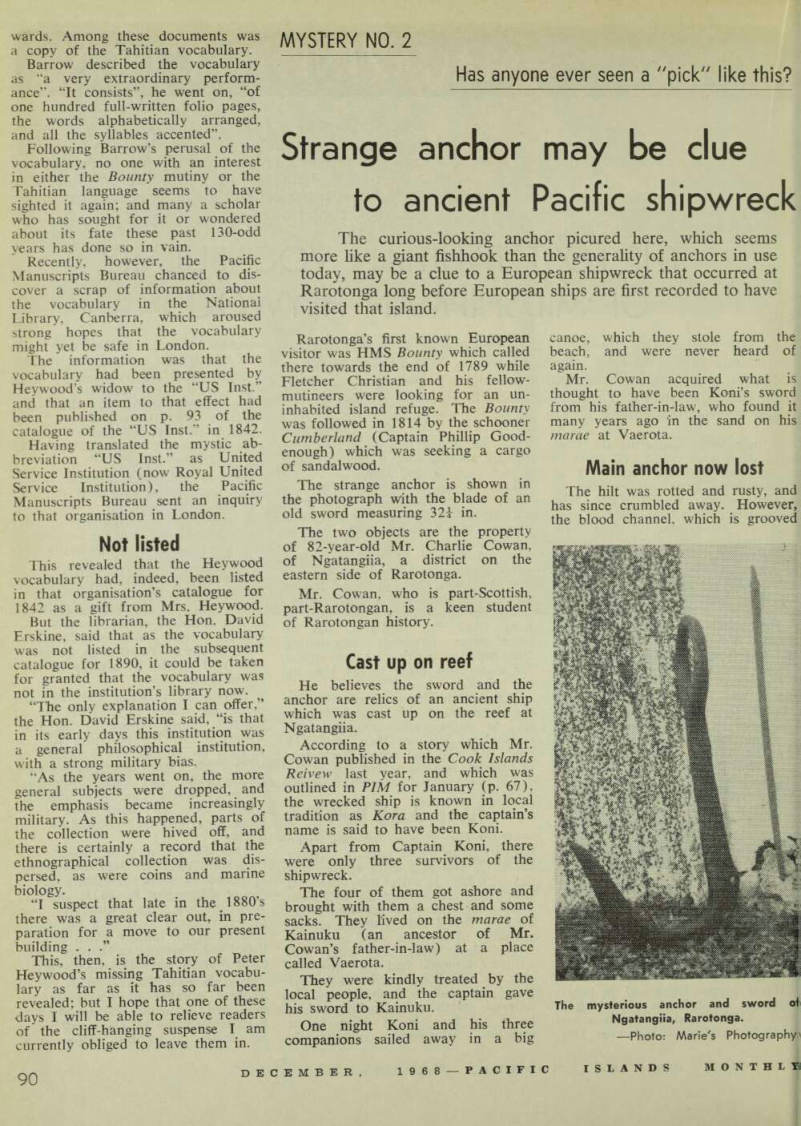
The curious-looking anchor picured here, which seems more like a giant fishhook than the generality of anchors in use today, may be a clue to a European shipwreck that occurred at Rarotonga long before European ships are first recorded to have visited that island.
Rarotonga’s first known European visitor was HMS Bounty which called there towards the end of 1789 while Fletcher Christian and his fellow mutineers were looking for an un inhabited island refuge. The Bounty was followed in 1814 by the schooner Cumberland (Captain Phillip Good enough) which was seeking a cargo of sandalwood.
The strange anchor is shown in the photograph with the blade of an old sword measuring 32i in.
The two objects are the property of 82-year-old Mr. Charlie Cowan, of Ngatangiia, a district on the eastern side of Rarotonga.
Mr. Cowan, who is part-Scottish, part-Rarotongan, is a keen student of Rarotongan history.
Cast up on reef
He believes the sword and the anchor are relics of an ancient ship which was cast up on the reef at Ngatangiia.
According to a story which Mr.
Cowan published in the Cook Islands Reivew last year, and which was outlined in PIM for January (p. 67), the wrecked ship is known in local tradition as Kora and the captain’s name is said to have been Koni.
Apart from Captain Koni, there were only three survivors of the shipwreck.
The four of them got ashore and brought with them a chest and some sacks. They lived on the marae of Kainuku (an ancestor of Mr.
Cowan’s father-in-law) at a place called Vaerota.
They were kindly treated by the local people, and the captain gave his sword to Kainuku.
One night Koni and his three companions sailed away in a big
canoe, which they stole from the beach, and were never heard of again.
Mr. Cowan acquired what is thought to have been Koni’s sword from his father-in-law, who found it many years ago in the sand on his marae at Vaerota.
Main anchor now lost
The hilt was rotted and rusty, and has since crumbled away. However, the blood channel, which is grooved
The mysterious anchor and sword of Ngatangiia, Rarotonga.
Photo: Marie's Photography
n the sword, can still be plainly ;een.
The anchor now in Mr. Cowan’s >ossession was found on the beach tear where the Kora is reputed to lave been wrecked.
Mr. Cowan has told PlM’s Raro anga correspondent, Mr. W. H.
'ercival, that the Kora’s main anchor sed to lie in Ngatangiia lagoon and lat the Takitwnu, a schooner built iere in 1891, used to tie up to it. lowever, this anchor was later lost i deep water just off the reef.
For mooring?
A feature of the extant anchor is at it has a small hole in its crown )ase). This and the fact that it is only one fluke suggest that the ichor was used for mooring, as e somewhat similar anchors today.
Nicholls’s Seamanship and autical Knowledge (Glasgow, 1959) scribes a modern mooring anchor usually having only one fluke and ing used to hold buoys and beacons shallow water.
“The anchor is lowered to the ttom by means of a slip rope rove ough a shackle in the crown,” cholls’s handbook says.
Webster’s dictionary contains a !tch of a modem mooring anchor nplete with shackle in the crown, ich is basically similar to Mr! wan’s anchor.
Marked differences
Jowever, three features of the two hors differ markedly. 1) The curvature of the fluke of . Cowan’s anchor is much more nounced than in the modern hor. 2) The eye for the stock in the Jem anchor is many times smaller i that in Mr. Cowan’s anchor. 3) Whereas the eye of Mr yan’s anchor faces what might be :nbed as “north and south”, that be modern anchor faces “east and have spent many hours searching ugh reference books in an effort find a picture of an anchor tly resembling Mr. Cowan’s Ut so far, the sketch in Webster’s onary is the nearest I have come any PIM reader knows of such cture, or can throw any light on ors of the kind in Mr. Cowan’s sssion, he could well help to date what has all the appear s of a fascinating South Seas ery.