Atiu's Natural
pp. 79-83 · Read in the full issue

Vaine Rere:
Leader
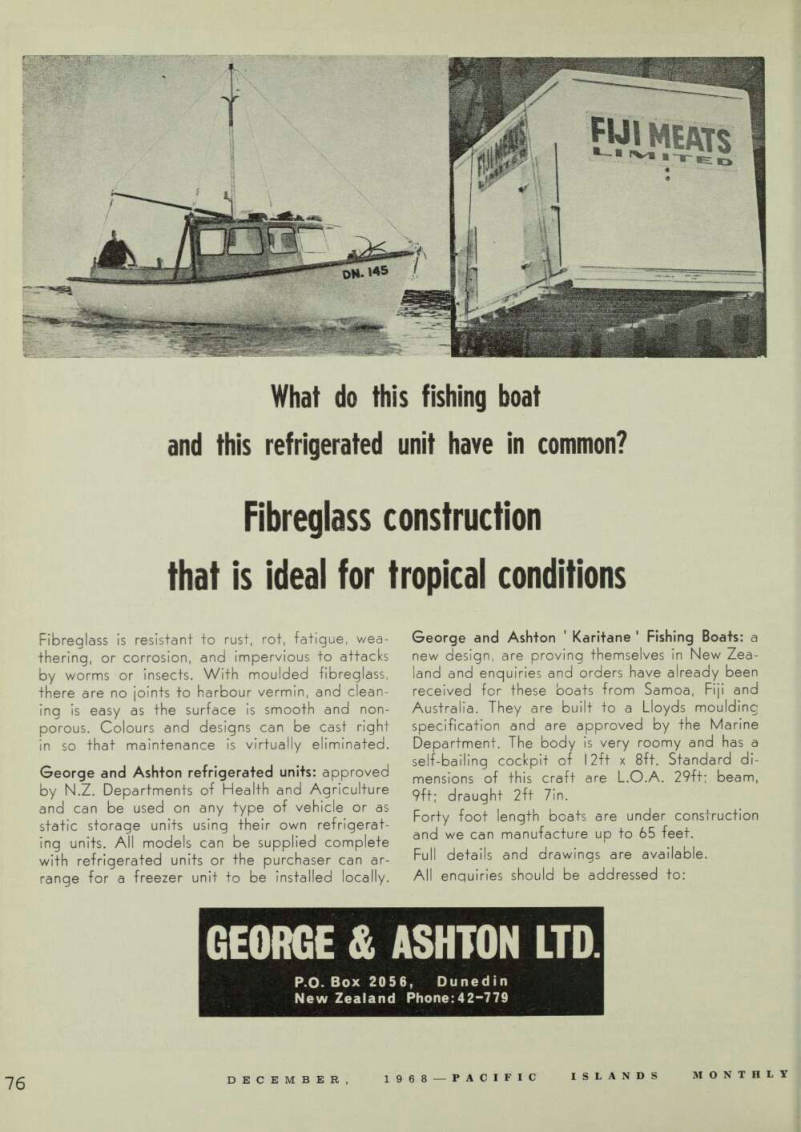
From W. H. Percival, in Rarotonga Vaine Rere, a plump and jovial man with a ready smile, a bright intellect and an urge to get things done, represents his home island of Atiu, in the Cook
Islands’ Legislative Assembly.
(He was a member of the As
sembly once before—from 1958
to 1965.) A natural leader, he is headmaster of Atiu’s primary
school, a captain in the Boy’s
Brigade, and he is in charge of
Atiu’s housing development.
Although educated only on Atiu he speaks perfect English.' A church deacon, he was the driving force behind the recent renovations to Atm s church (for which he designed and carved wooden symbols), Atiu’s 6,654 acres are of volcanic origin. The island has no lagoon and its five villages are situated ori rounded and flat-topped hills some 300 ft above sea level. Atiu is encircled by a cliff of dead coral and ls protected by a coral reef through which there are a few small boat passages, none of them good.
In pre-Christian times the warlike Atmans conquered the neighbouring islands of Mauke and Mitiaro, and were greatly feared for their ferocity and ruthlessness. Today, they are known as hard workers who are pre pared to stay on their own island while other Cook Islanders travel to
Vaine Rere.
Trained as a teacher
Rarotonga and from there to New Zealand.
“Why is it,” I asked Vaine Rere, “that the young people of Atiu are willing to stay at home and work while most other young Cook Islanders seem keen to emigrate?”
“I should say there are three reasons,” he replied. “One, they know that when their fathers are too old to work they will hand over the family citrus plantations to them.
Two, they are allowed to use the village meeting houses for youth club activities. This was not the case in the past. Three, some of them know that they can build and own their own houses.”
Vaine Rere, a well-preserved 57, was trained as a schoolteacher, and he taught until he resigned to further his own general knowledge. To do this he went to sea—in 1934.
For almost six years he sailed under veteran skipper “Andy”
Thomson, first on the old auxiliary schooner Tagua, and then the famous Tiare Taporo. In 1940, having learned a lot through travel, he returned to school teaching on Atiu.
Eleven years later he was appointed headmaster of Atiu’s primary school.
To London
In 1954 he travelled to London with 14 other Cook Islanders to attend the centenary of the death of Sir Alexander William Smith, the founder of the Boy’s Brigade. The Cook Islanders camped on the play ing fields of Eton.
Some years earlier, during a visit to New Zealand, Vaine Rere first heard about youth clubs and decided that there ought to be some on Atiu.
In 1955 Mr. Lyall Noakes, the director of the government’s newly formed Social Development Depart ment, helped Vaine Rere form Atiu’s first youth club. Soon each of Atiu’s villages had its own government guided youth club.
Vaine Rere took early advantage af the housing loan scheme when most Cook Islanders were suspicious af it. In 1961 he started to build his own house of concrete blocks, the first of its kind on Atiu.
Until 1965, it was possible to sorrow only £2OO, interest free, on a non-security loan. These loans were made in building materials and never n money. No allowance was made :or labour—the applicant and his : amily were expected to provide their >wn. Repayments were usually made
He persuaded them
through deductions from salaries or wages, or from the proceeds of crop sales.
But £2OO would build only the shell of a house measuring 24 ft by 20 ft. This amount would pro vide a concrete floor, walls, either of concrete blocks or timber frames lined on one side only, and a flat or a gabled roof of corrugated iron.
It did not take Vaine Rere long to work out that the cost of building a house had to be cut. But how?
He took the problem to Resident Agent J. J. “Jock” McCauley, with the result that supplies of cement were imported direct from New Zealand at 11/3 per bag—a big saving. Local boatmen charged £4 per ton to ferry goods from ship to shore and, after a lot of persuasion, Vaine Rere finally got them to agree to a more realistic price of £l/10/- per ton —but for housing materials only.
But expenses were still too high.
Atiu labourers charged 10/- each to load a truck with sand, and they refused to lower their rates when Vaine Rere first talked to them.
Better health
So he decided on a less direct approach. Improved housing meant better health for all, and once he could prove that such houses could be built, by doing it himself, other people would follow his lead.
He persuaded members of the Boy’s Brigade to load trucks with sand for building purposes for 5/each, and then persuaded the island’s Boy Scouts to do the same thing.
The result of this was that the labourers brought their rate down to 5/ —a rate which still applies.
When Vaine Rere recently attended a meeting of the Cook Islands Legislative Assembly in Raro tonga he brought with him applica tions for housing loans from 19 \tiuan families.
Vaine Rere’s latest activity in Atiu Is the introduction of a Public Lending Library. Books are borrowed Tom the Cook Islands Library and Museum in Rarotonga. Membership >f the Atiu library, originally 24, aas grown to 56.
The small and self-governing Cook [slands could use a lot more natural eaders of Vaine Rere’s calibre.