Suva's hotel headache
pp. 59-63 · Read in the full issue
Suva has too many hotel rooms, says Mr. R. S. Odell, NZ tourist expert, id jie proves it with statistics. Good thing, too, says Marvin Plake, e "Think Big" executive director of the Pacific Area Travel Association. j insists that capacity should stand ahead of demand. All of which is little confusing for Suva's tourist industry. SUE WENDT reports again.
Suva needs more rooms, Suva doesn’t need more rooms— even the experts disagree. And Fiji’s tourist interests, travel agents and hotel developers find themselves in something of a quandary.
It hurts the agents to have to turn ay business during the busy months, »en demand outstrips supply. And > a bitter kind of irony to see some tels with empty rooms and idle ff during the slack months. The :>blem is whether to put the brakes development and cater simply * immediate needs—or forge ahead the hope of creating a bigger, )re dispersed demand.
A grand new edifice, the Aus lian-UK financed Suva Travel- Ige, opened in October with a al of 140 international-standard ams.
At the same time, New Zealand irism expert Mr. R. S. Odell’s ?ort on Fiji’s hotel requirements served that Suva had a serious er-supply of rooms—and suggested vernment curtailment of building tivities (by withholding assistance der the Hotel Aids Ordinance if cessary) in the area at least until 71.
The local industry’s reaction to s section of the report—prepared
at the request of the Fiji Govern ment—was a mixture of concern, un certainty and scepticism regarding the real picture behind the statistics,
many of which seemed open to a certain amount of misinterpretation.
A visiting authority on inter national tourism, Mr. Marvin Flake (who is executive director of the Pacific Area Travel Association) made no bones about his own re action. He described Mr. Odell’s suggestion as “provincial and danger ous thinking”.
"Capacity ahead of demand"
The 267 delegates—9B of them from overseas—who attended Fiji’s annual tourism convention in October were fired with enthusiasm by Marvin Flake’s “Think Big” philosophy, which he delivered with persuasive finesse.
“Tourism in a free area cannot be turned on and off by pressing bureaucratic buttons!” he said.
“Don’t be lulled into thinking that because you’ve completed a couple of hundred new rooms a miracle has been achieved. Fiji is just barely getting in to a competitive position with a thousand other places.”
He urged that, instead of “allow ing negative influences to stifle initiative/’ Fiji’s tourist industry should take the positive approach— “ Capacity must always stand ahead
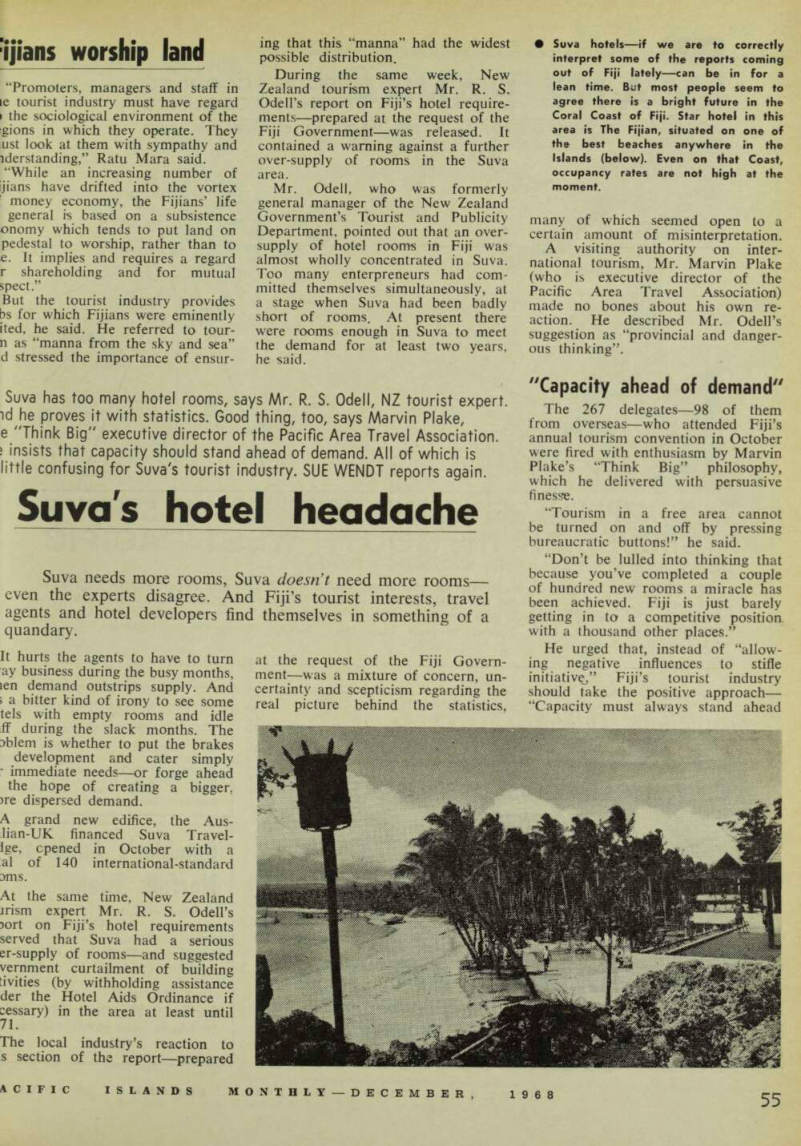
Suva hotels —if we are to correctly interpret some of the reports coming out of Fiji lately—can be in for a lean time. But most people seem to agree there is a bright future in the Coral Coast of Fiji. Star hotel in this area is The Fijian, situated on one of the best beaches anywhere in the Islands (below). Even on that Coast, occupancy rates are not high at the moment.
hose occupancy figures
: demand if you are to succeed g!”
He claimed that the suggested nitations on the number of new oms for Suva did not appear to ke due notice of developing patterns, nich indicated that the annual imber of visitors was increasing a very much greater rate than iginally predicted.
Nor did this section of the Odell sort appear to take into considera n the increased average length of y, which added approximately 25 r cent, to the visitor-night total. It ;med also to ignore the trend vards group travel, which Mr. ike predicted would increase notice ly in Fiji within the next few mths. ‘And it does not appear to take 0 consideration the distinct pos ility of 747’s operating in the ith Pacific within 24 months,” he ie didn’t, however, make specific ament on the statistics produced Mr. Odell, showing that during •7 Suva’s supply of beds was 32.5 cent, of the Fiji total, while the land was only 24.9 per cent, of total.
'he 1967 bed occupancy rate per t. was 48 for Suva and 72 for li-Lautoka. he equivalent room occupancy ' was 56 per cent, for Suva and per cent, for Nadi-Lautoka.
The Coral Coast
oral Coast bed occupancy rate 40 per cent, and room occupancy 47 per cent. he report made it obvious that the 1 supply of rooms and their distribution in relation to the and was causing, and would con e to cause, problems. asing his estimates on the Harris r-Forster formula, Mr. Odell ulated that although Fiji would ; a total of 1,541 rooms (648 them in Suva) by the end of year, the annual demand would or 1,348 rooms. e suggested that for planning loses the estimated increase in number of visitors should be pted at 30 per cent, for this and at 20 per cent, for the five years. On this basis, Fiji d expect to have 181,000 visitors 973. fide from the question of Suva’s mmodation, Odell and Plake
Get away from Suva
were m agreement regarding the desirability of tourist development elsewhere in Fiji.
Mr. Odell urged the early estab lishment of a major resort area at Natadola; more hotel rooms in the Nadi Airport area; night flights by Fiji Airways from Nadi to Nausori; and the development of comfortable, round-the-island coach tours.
Marvin Plake spoke of more parks and monuments; a marineland; a major golf course; “living drama” such as a greater outdoor pageant held three or four times yearly; side walk cafes amidst a bazaar—even, as an atmospheric extra, the boom ing of a cannon at high noon.
Staff training needed
He urged staff training as a joint project conducted by the Fiji Gov ernment and private concerns, em phasising the importance of on-the iob training. And he enthused over -he prospect of turning Fiji’s Coral Coast into another Gold Coast, 90- Vfile Beach, Waikiki or Bora Bora.
A couple of delegates rose to ask, serhaps apologetically: “And what ibout the money?” But Marvin, i positive thinker if ever there was me, refused to be daunted.
Look overseas, he said. Places ike Japan, Hong Kong and Singa (ore would supply both tourists and noney for investment. If Fiji was o strengthen its position in inter lational tourism, it had no choice 'Ut to keep planning, building and leveloping . . . whatever the cost.