Aviation
pp. 53-57 · Read in the full issue
South Seas
Spreads
[?]Ts Wings
y a staff writer
Fiji Airways Ltd. is quickly emerging as the unrivalled regional carrier of the Pacific Islands. So much so that the growing airline is currently looking for a better name to reflect its other interests besides Fiji.
For people new in the South icific, Fiji Airways means Fiji. But e airline also calls at Nauru, the EIC, the Solomons, the New jbrides, Western Samoa and Tonga. jw Guinea and the Marshall ands will be added to this list next ar.
Why then, not give it a name th broader implications?
Board members are tossing all rts of suggestions around but so • no name has been agreed upon, uth Pacific Airways? Pacific Islands rways? Island Airways? They are under review.
Fiji Airways’ second HS74B is due Suva on December 21 and already :re is talk of a third 748. Regional (hts will increase next year: Tonga three times a week, the Solomons twice a week and the GEIC to ze a week.
Fhe big November news was, of arse, the airline’s tie-up with astern Samoa.
W. Samoa in Fiji Airways
Phe Government of Western noa has finally decided to take financial interest in regional air 2S.
Fiji’s affable Minister for Com inications, Works and Tourism,
Mr. Charles Stinson, said Western Samoa will take up 10,000 shares in Fiji Airways Ltd. and 5,000 shares in Polynesian Airlines Ltd.
In turn, Fiji Airways will buy 20,000 shares in Polynesian Airlines and take over the management of Polynesian under a contract arrange ment.
The news is a much-delayed victory for Fiji Airways and a set back for Pan American Airways.
Now, Fiji Airways has on its board and as a shareholder every territory it flies to, with one notable exception —Nauru. Nauru would much prefer running its own airline.
Apart from its real owners— Qantas, BO AC, Air NZ and the Fiji Government—Fiji Airways now has Tonga, Western Samoa, the Solomons, the GEIC and the New Hebrides around its board table in Suva, and it is by far the Pacific Islands’ strongest regional carrier.
The Western Samoan shareholding is a most noteworthy prize for Fiji Airways for several reasons. Because of differences between Mr. E. F.
Paul, president of Polynesian Air lines, and Western Samoa’s Prime Minister, Fiame Mataafa,. govern mental shareholding in the privately owned, Apia-based Polynesian Air-
lines had not eventuated, despite several proddings from Fiji Airways in recent months.
PanAm in W. Samoa
The Western Samoan Government had not completely dismissed PanAm efforts to get its own Pago Pago-Apia services going, and it hoped by keeping these plans hanging over Polynesian Airlines’ head it could strike a better bargain if it attempted to come into Polynesian itself or get involved with Fiji Airways.
Now, if PanAm does succeed— and it has reciprocal rights because Polynesian Airlines operates into Pago Pago—it will be on Western Samoa’s (or is it Fiji Airways’) terms.
PanAm argues that current Pago Pago-Apia air services are not
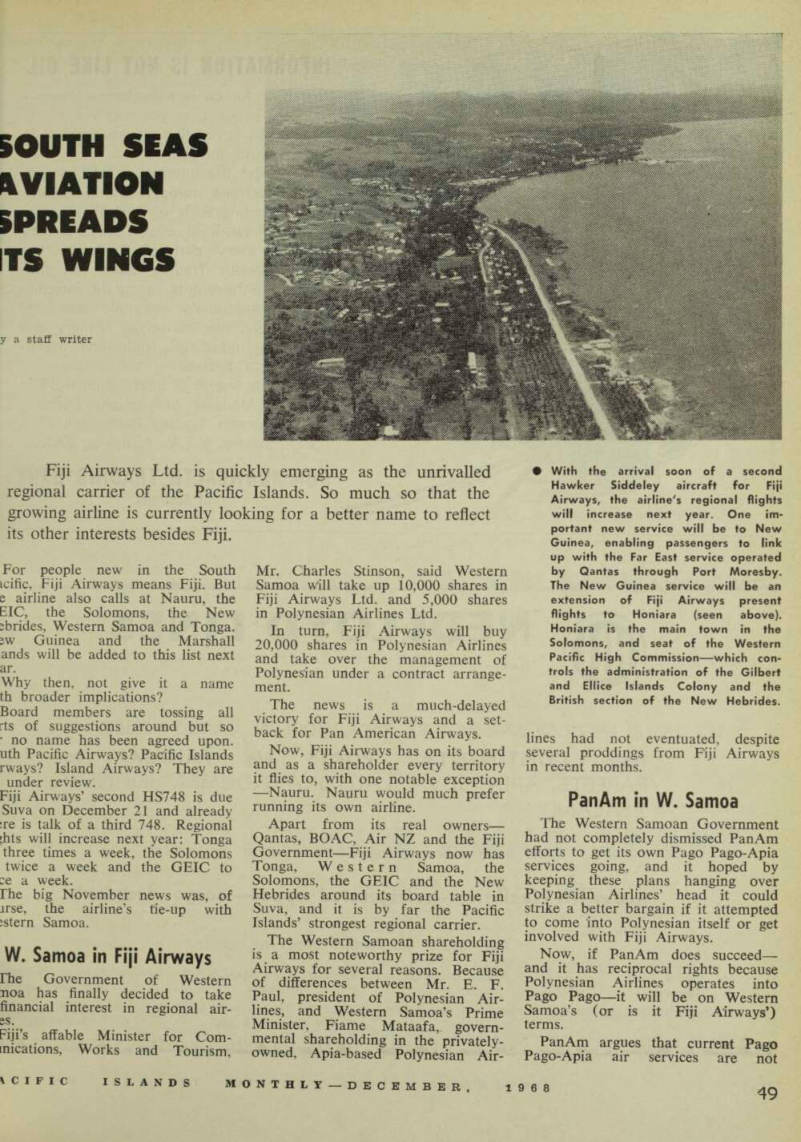
With the arrival soon of a second Hawker Siddeley aircraft for Fiji Airways, the airline's regional flights will increase next year. One im portant new service will be to New Guinea, enabling passengers to link up with the Far East service operated by Qantas through Port Moresby.
The New Guinea service will be an extension of Fiji Airways present flights to Honiara (seen above).
Honiara is the main town in the Solomons, and seat of the Western Pacific High Commission—which con trols the administration of the Gilbert and Ellice Islands Colony and the British section of the New Hebrides.
'hey're all hoping
Ficient and are not regular enough get the tourists from Pago’s inter itional airport into Apia.
Cook Islands question
Who will run air services to the lok Islands for the two years from arch next year? Rarotonga’s air ip will not be available because will be under re-construction for e start of international jet opera ms in 1971 and Aitutaki will offer b only strip suitable for outside • connections of the group.
As reported in PIM last month, >rk is already underway on up ading Aitutaki’s coral strip for »ular services from March {PIM, iv., p. 51). Just who will run these rvices hasn’t yet been announced, ic New Zealand Government, of urse, will have the say in deter ning who runs the service.
There are four possibilities: • Air New Zealand will operate :ekly return Electra services out Auckland. • Polynesian Airlines will operate 24 services out of Apia and on to peete or Auckland. • Fiji Airways will operate ekly HS74B services as part of its panding regional network. • The New Zealand Royal Air rce will continue periodical return :rcules services out of New aland, subject to demand.
Polynesian's hopes
Polynesian Airlines, more than yone, wants the run and has been er it for many months. This air s’s reputation has been the big )rtcoming in Polynesian travel in recent months be ise of a shortage of equipment and too many last-minute schedule mges. But its controversial char sd DC4, conspicious by its icnce (or grounding) for some te, recently went back into the fhe company is well aware of mch hopes to fly down from aeete to the Cooks and it would ip at the chance of a “triangle
i” Apia-Aitutaki-Papeete in return
French regional rights into the oks until 1971.
"iji Airways will have two HS74B’s ulable next year but a service to Cooks would stretch out this lipment perhaps a little too far. xt year Fiji Airways wants to >and services to New Guinea, the
larshall Islands and New Cale onia, as well as increasing services n current routes.
An Aitutaki service would appeal *r less than a Noumea run, to an [ready developed tourist destination.
Air New Zealand’s attitude is to eep the Aitutaki service in the imily at all costs until those DCS ts can start booming through Raro ►nga. But the airline owns a little ss than a quarter of Fiji Airways, id it controls a bigger share of olynesian than any other airline, > a service by one of these two gional carriers would not be i anathema to Air NZ.
However, because the Cooks are If-governing and not independent, gular air links with their parent mntry NZ seem essential and :rhaps the Cooks’ carrier would ive to operate out of NZ.
Air NZ may operate itself— luctantly—with Electras.
The Electras created a problem eviously at Aitutaki because loose ral was easily picked up into their gines, and this bugbear would have be overcome.
Boac's Vc-10'S
One interesting recent development s been the formation in Auckland Cook Islands Air Services Ltd. le company’s S2OO capital is held Mr. F. A. Reeves, general man er of Air NZ, and Mr. A. A. atson, secretary of Air NZ.
Internal air services for the >oks? As well as strips on Aitutaki d Rarotonga. Penrhyn has a ■viceable though infrequently sd —strip which was used by nerican forces during World War Three NZ engineers paid a trip Penrhyn, incidentally, less than o years ago.
BOAC’s decision to introduce its
j m. • x o rear-engined VC-10 jets on its South Pacific routes in October next year has made its two Commonwealth partners, Qantas and Air New Zealand, hopping mad.
By offering passengers a different and more attractive looking aircraft
than Boeing 707’s or DCB’s, BOAC may increase its market share of trans-Pacific travellers at the expense of these two airlines.
The BOAC move indicates that this airline is going to pay more attention to its South Pacific runs than before. It is working towards its aim of daily trans-Pacific services (it operates three services a week now).
Its change of terminal point on the US West Coast from San Francisco to Los Angeles is shrewd because Los Angeles is the heart of the fastest-growing area of the US—southern California.
Aitutaki atoll, with its wartime air strip, will shortly be a key traffic point in the Cook Islands. The present strip at Rarotonga, the main island, is to be closed and rebuilt as a full jet strip for trans-Pacific services.
Aitutaki has been in the news lately because an American syndicate wants to lease it as a tourist resort. But the idea looks like coming to nothing.