raises a local ripple
pp. 33-34 · Read in the full issue
Great debate on unity hardly raises a local ripple
From a Port Moresby correspondent November 23.
The third meeting of the second House of Assembly has run half its course, and the chief items on the menu so far have been a debate on national unity and a private member’s bill for the reform of the Public Service arbitration system.
The national unity debate, which ook up about a half of the week’s itting time, was on a motion by (rere Awol, member for West Sepik 'oastal, calling for the promotion f a sentiment in favour of national nity through its advocacy by lembers of the House, by Admin itration radio stations, and by the chools —“to tell the people what ley will gain by keeping together s a single country”.
Most of the speeches were either ymns in praise of unity or ariations on the theme, “The more r e are together the wealthier we’ll e”.
It was perhaps unfortunate that >me of the members from the areas f unrest, namely New Britain and ougainville, seemed reluctant to iin the chorus. Matthias To Liman, icmber for one of the New Britain ectorates and Ministerial Member >r Education, wondered whether the lotion had come too late, and •ged that action rather than oratory as needed to reconcile the break vay elements to “one name, one ig, one anthem”.
Action not words
Pangu Pati’s leader and East Sepik sgional member, Michael Somare, so called for action rather than ords. The attitude of Pangu Pati the motion was necessarily ►loured by the fact that its own 11 seeking to establish Niugini as e “one name” had been roundly Seated a day or two earlier—not cause the House disliked the name elf, but because it had reservations 'out the timing and mode of esentation of the proposal.
Moresby’s Percy Chatterton sup •rted Messrs. To Liman and •mare’s call for action, and sug sted that the kind of action needed is more devolution of respon )ility and authority from the centre the perimeter. He advocated the
creation of representative district and regional councils to fill the gap between the House of Assembly and the local government councils.
Paul Lapun and Donatus Mola of Bougainville were in recalcitrant mood. Their people had a right to self-determination, they insisted.
Late on Friday afternoon the motion was carried on the voices, and no doubt Senior Official Member Frank Henderson hurried off to the telegraph office to transmit it to New York, where two members of the House, Paulus Arek and John Maneke, are about to confront the critics of Australia’s handling of territory affairs.
During the debate several mem bers claimed that the Bougainville secessionists represented only a tiny minority of their people. If this is true, perhaps the best thing we can do is hold a referendum right away.
A substantial “no” vote in a referendum for secession would cut
more ice in New York than the rather milk-and-water motion now winging its way there.
Many books have been written on how to win friends and influence people. Mr. C. E. Barnes seems to have been studying one on how to lose friends and infuriate people.
Canberra’s eleventh hour attempt to manoeuvre Manus and New Ireland Regional’s Wally Lussick into with drawing or postponing his bill for the replacement of the Public Service arbitrator by a three-man commission so angered the elected members that they would have voted for almost any measure to demon strate their displeasure.
Sound measure
However, this measure appears to be a sound one, and no real criticism of it has been voiced either by the Administration or by any one else.
Any minor flaws which may be ex posed in it can easily be repaired, if necessary, by an amending bill.
The basic reason for the elected members’ anger was a suspicion that Canberra is deliberately seeking to establish a monopoly in the presenta tion of major legislation and trying to discourage private members from bringing down bills on any but minor matters.
Wally Lussick’s bill, with a few minor amendments, was passed on the voices after only token opposition by the official members, who had seen the writing on the wall. It is ironical that this measure of quite major importance to the territory’s future only occupied the attention of the House for about the tenth of the time spent on Brere Awol’s unity
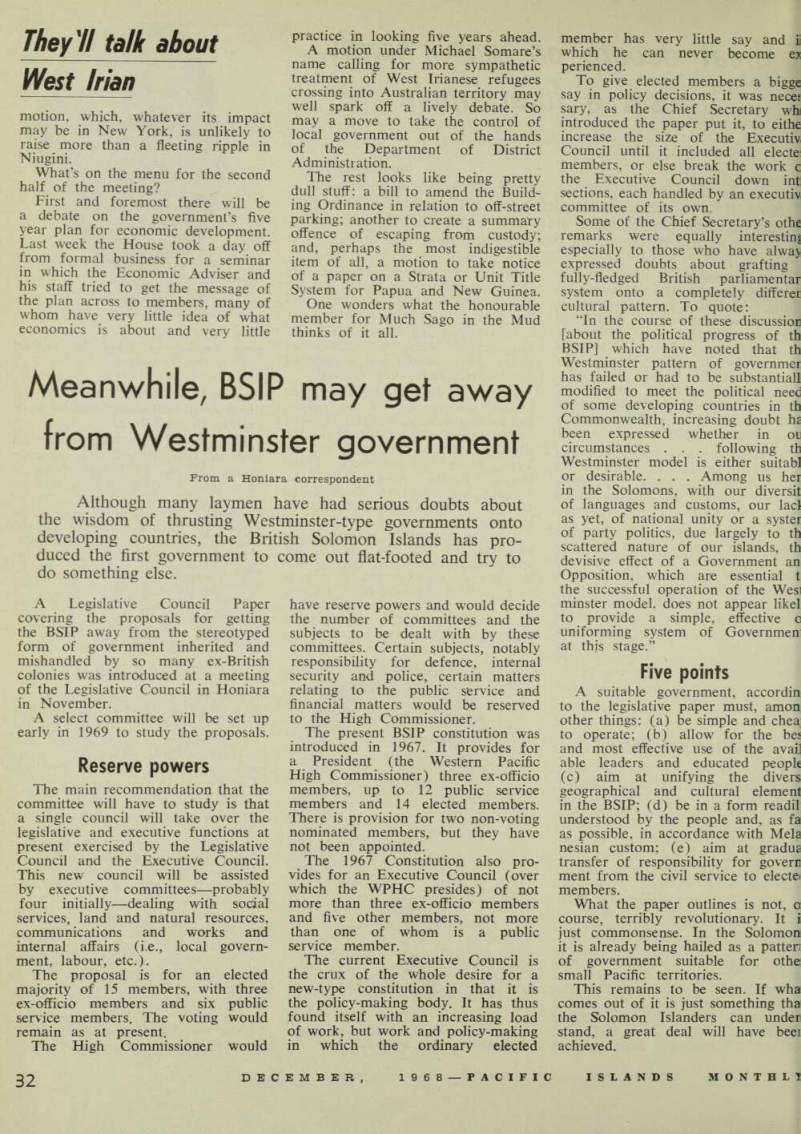
Wally Lussick—they tried to manoeuvre him on his arbitration bill.
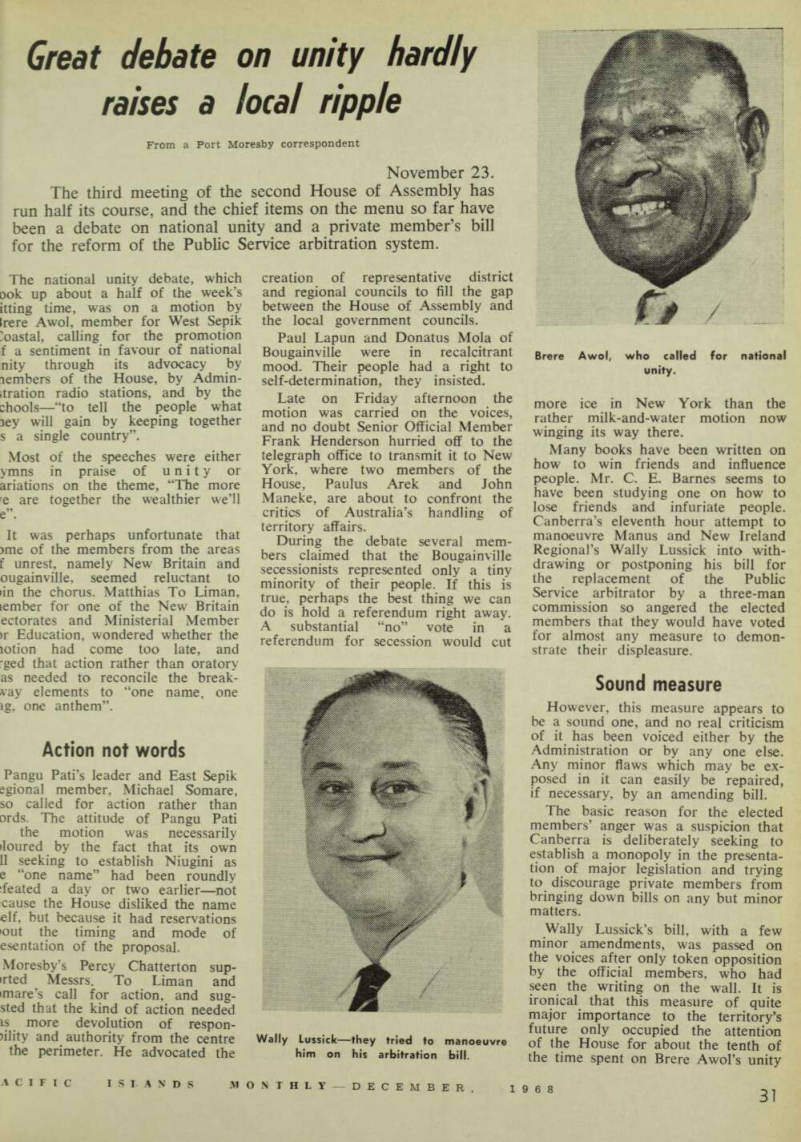
Brere Awol, who called for national unity.
They 'll talk about l/Vest Irian
motion, which, whatever its impact may be in New York, is unlikely to raise more than a fleeting ripple in Niugini.
What’s on the menu for the second half of the meeting?
First and foremost there will be a debate on the government’s five year plan for economic development.
Last week the House took a day off from formal business for a seminar in which the Economic Adviser and his staff tried to get the message of the plan across to members, many of whom have very little idea of what economics is about and very little
practice in looking five years ahead.
A motion under Michael Somare’s name calling for more sympathetic treatment of West Irianese refugees crossing into Australian territory may well spark off a lively debate. So may a move to take the control of local government out of the hands of the Department of District Administration.
The rest looks like being pretty dull stuff: a bill to amend the Build ing Ordinance in relation to off-street parking; another to create a summary offence of escaping from custody; and, perhaps the most indigestible item of all, a motion to take notice of a paper on a Strata or Unit Title System for Papua and New Guinea.
One wonders what the honourable member for Much Sago in the Mud thinks of it all.