own rice variety
pp. 147-151 · Read in the full issue


Fiji may soon have own rice variety
A new era in Fiji rice-growing was reached recently with the appointment of Mr. Alwyn Chan Choong as rice plant breeder for the Fiji Department of Agriculture. With two graduate officers (the other is Mrs. Suliana Siwatibau) now working towards the creation of new varieties of rice, Fiji may soon move into line with territories which tailor-make their own varieties to suit their own requirements.
It is slow, expensive work and it would be foolish to expect immediate results, but it is the basis from which real results can be achieved. The hope is that it will lead to self sufficiency for Fiji in rice.
In a report in September, Mr. John Deering, information officer for the department, warned against expecting too much of good varieties which produce high yields in one type of environment.
He said that although the Philip pines produced IRS variety, known as “miracle rice”, was undoubtedly a fine piece of work by rice breeders, the claims made for it tended to mislead those who didn’t realise that every variety of every crop has its preferences regarding climate, soil
and cultural treatments.
IRS was introduced to Fiji in 1966 and while rather spectacular results— -2i tons to the acre—were achieved under experimental conditions at Dobuilevu in Ra earlier this year, another trial at Korovisilou in Serua resulted in a much less impressive yield of 14 cwts.
But not always
In the case of Korovisilou, the variety was grown as transplanted wetland rice. Although the yield was still above the national average, it was of little interest to those seeking a big improvement.
In an identical trial at Vuci, Nausori, earlier this year, IRS pro
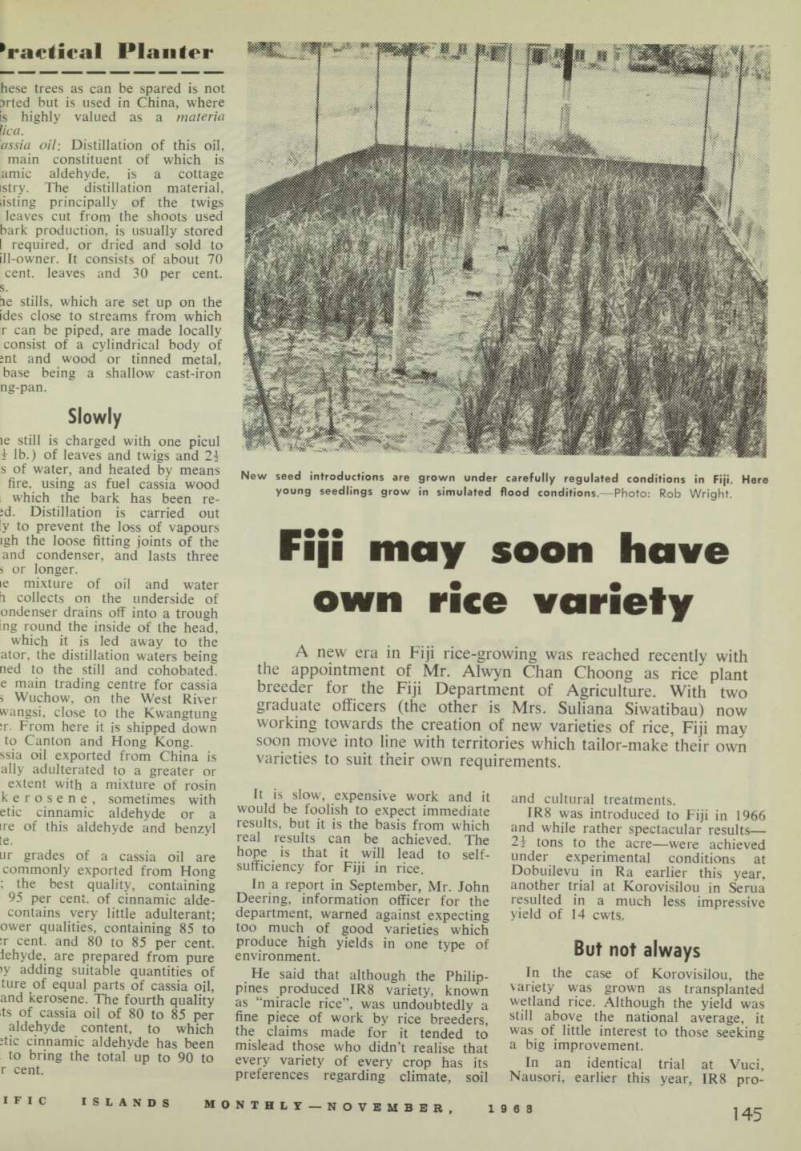
New seed introductions are grown under carefully regulated conditions in Fiji. Here young seedlings grow in simulated flood conditions. Photo: Rob Wright.
«d well over 35 cwts —proving t a good variety will not neces ily maintain its high yields if en from one set of conditions to fher.
R 8 also leaves something to be ired as a food. Fiji is not a erty-stricken, starving country and [seholders will buy imported rice, n if it costs more, providing its king and eating qualities are erior. n their search for improved eties Mr. Chan Choong and Mrs. atibau will look for heavier yields, d cooking quality, adaptability various conditions likely to be met farms and a type which will make ning easier. 3 Fiji the most worrisome pests diseases are leafhoppers, army m, leafrollers, fool’s rice and it, as well as a host of diseases :h attack young seedlings. All of e can be controlled with nicals, but it is an expensive and procedure. Obviously, Jtence to disease will be an ntial characteristic of any new variety developed in Fiji.
Bother problem with rice is that more it carries, the more chance e is of it blowing over in rain wind. Fallen, or lodged, rice is ' difficult to harvest—almost im ible with mechanical harvesters id the grain is frequently lost or
wetted so that it is hard to store and may start to germinate in the sack.
The trend is to grow shorter strawed varieties which are stronger, with more woody stems capable of supporting a greater weight. The new variety FKI3S, released after extensive testing at Kornovia research station and other centres, is an example of this stronger variety. It is typical of the new varieties now being produced—any farmer who has grown a crop of the old New Guinea variety, with its problems of lodging, is well aware of the advantages, T
»W 0 main C^OUpS
Rice varieties fall into two main groups—those which pass from sowing to harvest in a fairly fixed number of days regardless of the time of year at which they’re planted, and those which flower and mature at a fixed date each year, whether they’ve been sown in the ground for eight months or three. The latter varieties are sensitive to the shortening period of daylight as the winter months ap proach, and, in Fiji, normally mature around the end of April, To increase yields, particularly from limited acreage, its obviously desirable to try to grow two crops a year. This is quite feasible, since most good varieties take only four or five months to mature—and it is especially so if soil moisture can be controlled to allow planting when ever the farmer chooses, This need has led to the develop-
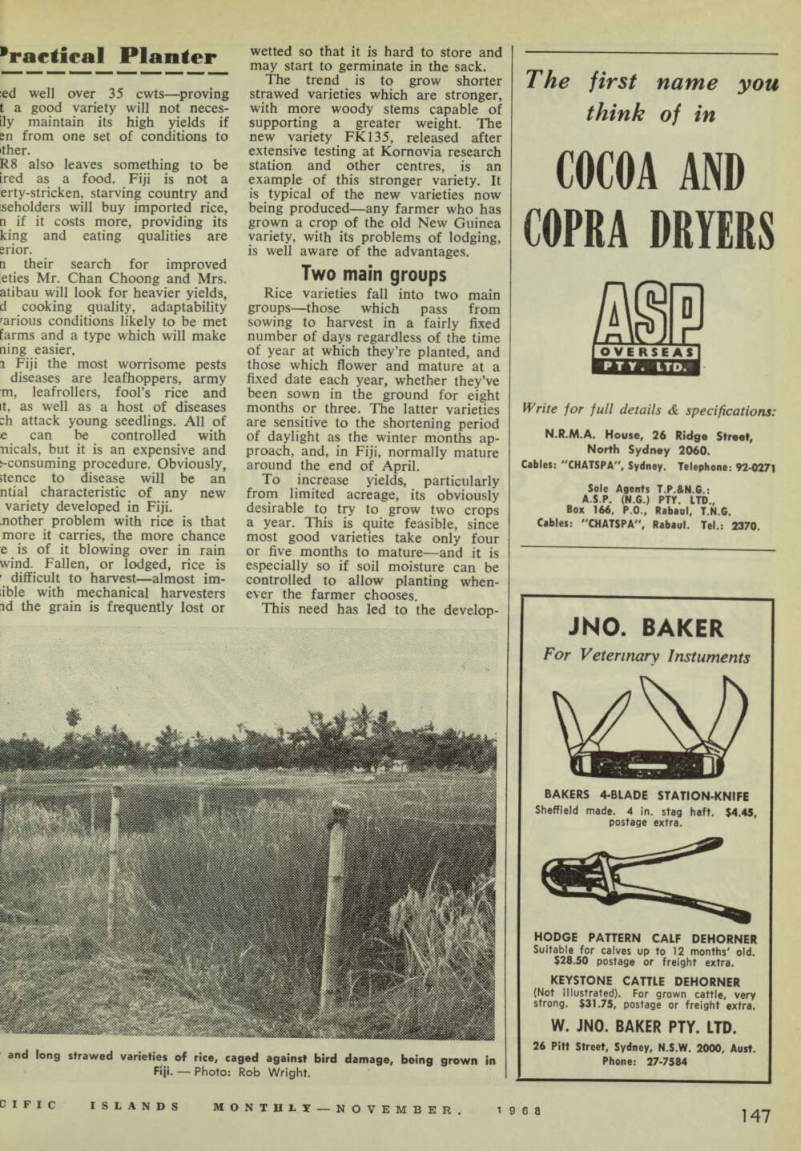
and long strawed varieties of rice, caged against bird damage, being grown in Fiji. Photo: Rob Wright.
nt of the double-cropping system Koronivia, but it has also neces ted the establishment of an :ient irrigation and drainage :em so that water can be run on off the fields at any time.
Varieties like IRS, IRS, FKI3S and
from Taiwan-Taichung—ripen
inder four months. The backbone Fiji’s rice industry for several ades the old light sensitive ety known as BG7s—can be very uivenient, since it is almost certain ripen within a week or two of end of April. This applies whether is planted in October or in aary.
Twice a year
he new pilot project in the Rewa ey, incorporating both irrigation drainage, will be based on one he new varieties and considerable aground work has been done at onivia and in the nearby farming s to enable farmers to be fairly tin of a good crop twice a year, rials have been carried out to the best planting times and to ?lish the best cultural methods as spacing of rows and the unt of seed to sow. New and - sophisticated insecticides have tried and new seed dressing to rol diseases in young seedlings, eeds are always a hazard in any i of agriculture, and trials with ariety of weed killers are in ress. Fertiliser responses vary— ; rice varieties yield quite well r impoverished conditions but r little improvement with ferti while others respond magnifi y, quite justifying the cost of the iser. ork in Fiji over the last few ! has been almost entirely ted to investigating the best ways rowing and improving its own lished rice varieties and the new from overseas. Now, the aim is jvelop a Fiji product, eminently 1 to its climate and conditions.
The asparagus-like vegetable ca, one of Fiji’s national icies, was blamed in September n outbreak of sugar cane disease awn as Fiji Disease—in the wai mill area. Fiji Disease is d by sap-sucking insects which on both daruka and sugar cane.
SPSM spokesman warned that srs who planted daruka near sugar cane crops were taking > risk, unless they ensured that laruka seed was clean.