Development
pp. 123-126 · Read in the full issue

Bunsiness and
$4M Timber Project
For Papua
A $4 million timber and harbour project for McFarlane Harbour, Marshall Lagoon, 100 miles southeast of Port Moresby, was announced in October by Mr. Steven Rich, chairman of ANG Holdings Ltd., Papuan sawmiller, rubber and coffee grower and owner of Moresby’s celebrated local “sky scraper”, ANG House.
The project is aimed at the Aus lian and Japanese markets for hard d softwood logs and sawn timber d the Japanese market for wood ips. Development will be over a ee-year period.
Partners in the project will be ANG ddings (51 per cent.), Jardine itheson and Co. (Aust.) Pty. Ltd. ) per cent.) and several Austra a finance houses and industrial npanies (24 per cent.), lardine Matheson is a member of • big Hong Kong-based merchant •up but it is understood funds will ne from its Australian subsidiary.
Three stages
fhree other investors are the steel nt, BHP, the insurance group, r C, and the South Pacific sub iary of the Honolulu-based Dil ?ham Corporation. There will also loan funds from the ANZ Bank I the P-NG Development Bank.
Tie project features three stages: > Construction of a 17-mile road m Kupiano, McFarlane Harbour, a sawmill owned by a subsidiary ANG Holdings—Pacific Islands -poration —at Kapa r i , Cape dney. (Work on the road has :ady been begun by Dillinghams).
I Dredging of McFarlane Harbour constructing berthing and other ilities to handle vessels of up to 30 tons. These are to be finished September next year.
I Development of the harbour, cessing and loading facilities to ble pneumatic loading of 20,000wood-chip carriers by 1970-71.
Tie headquarters of Pacific Islands ■poration will move from Port resby to Kupiano, where a town > housing 750 Papuans and 50 opean families will be built.
PIC holds nearby timber leases of about 175,000 acres with exceed 1,000 million super feet of timber.
Exports are expected to reach $2 million by 1970 and $4 million by 1972, Mr. Rich said.
The project has been announced at a time when many NG timber log ex porters are wondering just what is the future of their industry. For several months they have been offered prices often lower by 20 per cent, than paid a year ago by Japan—really the only market for logs. Several timber firms, particularly on New Britain, have argued that at current prices it is just not economical to export logs.
Japan is overstocked with timber and she is currently in the happy position of offering to buy logs— at her own reduced prices—from several major timber producers in South- East Asia as well as New Guinea.
One major producer on Bougain ville recently told PIM the great weakness of NG timber exports, which have been bounding ahead in recent years, is that they are sold mainly to the one source, which in the end names her own price.
ANG Holdings is already deeply committed in timber operations. Fol lowing two encouraging, but small, profits, its listed company suffered a $89,865 loss in the year ended June 30 because its major sawmill lost nearly five month’s operations follow ing a serious fire Forecasts of dividends by the listed company have not eventuated.
The company’s view is that timber prices will recover and good markets will be made in Australia. Jardine Matheson, through its Hong Kong offices, will act as selling agent and the company hopes that good markets will eventually be won in South Korea as well as Japan.
Carpenter's profit
a real beauty!
It’s impossible not to view the W. R. Carpenter Group’s 1967-68. result as anything but a rip snorter.
Despite devaluation losses of over $300,000, despite increased labour and general expenditure, despite low prices for Fiji’s sugar and despite “disappointing” profits from its two coconut oil mills at Rabaul and Suva, the group has turned in besTever profits and upped its dividend for the second year running.
W. R, Carpenter Holdings Ltd. made a consolidated net profit of $5,165,344 in the year ended June 30 —a figure which includes an extra $lBO,OOO by two New Guinea sub sidiaries. It is the first time the group has exceeded ssm. profit.
Yearly dividend was raised from 16 to 18 per cent, (a payout to share holders of $2,700,000) and the final interim payout of 10 per cent, is equal to an annual rate of 20 per cent., which was last paid in 1950-51.
Subsequently, last year’s small profit drop—which broke a run of
23 successsive rises in profits—has been reversed. More important, the group’s falling trend in earning rates in recent years has been reversed also.
Profit jumps by 8.2 per cent.—or $392,083 —and earning rate recovers from 31.9 per cent, to 33.2 per cent; a very healthy cover for the 18 per cent, dividend.
Fiji residents will be more than interested in the directors’ admission that the group made a profit—over book values—of $1,598,491 —on the insurance settlement paid by Lloyds of London on last year’s loss of the trans-Pacific passenger-cargo vessel Lakemba.
This money, shown as part of a figure of $1,715,312 for profits on fixed assets, is not included in the consolidated net profits. (The Lakemba hit a reef off Vatulele Island, Fiji, in October last year and later sank).
Directors said higher prices and bigger production of copra and cocoa, advances in merchandising turnovers in the Islands and improved weather conditions, particularly in Fiji, were the major factors in the improved figures.
They report that turnover and earnings have been maintained in the opening months of this financial year but declined to offer any firm fore casts.
Copra production for 1967-68 rose by 288 tons to 10,896 tons, and cocoa was up by 208 tons to 1,300 tons.
Production of the Suva coconut oil mill was still below capacity but showed an improvement of 20 per cent, on the previous year. The Rabaul mill’s production rate was maintained. Prices fell recently, they said.
Turnover of merchandising activ-
ities in NG rose by “about 22 per cent.” while in Fiji they “showed an overall increase”.
The chairman and managing direc tor, Mr. C. H. Carpenter, made the following points; • Earlier plans the company had to invest in hotel ventures in the Islands or Australia are off. • There will be no replacement for the lost Lakemba. • Small profits from the NG tea project, which will cost Carpenters $3 million, are expected late next year. • Profits from the Rabaul desic cated coconut project are already coming in—although this scheme has taken longer to get going and cost Carpenters more than was originally anticipated, • The political climate in both Fiji or New Guinea was not as bad as was generally reported by news media and these two territories re mained conducive to investment.
Directors did not think—at this stage —they should withdraw or withhold investment from these major Pacific Islands territories. • Plucking the company’s NG tea crops by machine was virtually out.
No machines had yet been found which could properly do the job and hand labour would most likely be used.
All considered, it was an impressive report and few doubt that if nothing unforeseen happens Carpenters will return next year to its proud 1951 20 per cent, dividend. The group’s 50 cent, shares, incidentally, were around their 52.50 mark in late October. Little wonder.
Tongan oil 'worth
more investigation'
Tonga’s oil potential at Eua “not negative”, according to a senh geologist with the Shell Company < Australia, Mr. W. F. Kleinmiede, wl paid a four-day visit to Eua in Sej tember.
He examined seepages of oil four by Tongans at Eua in September ar confirmed soon after by Mr. J. C Grover, Fiji’s Director of Geologic Surveys. ( PIM, Oct., p. 27).
Mr. Keinmiede said the oil se page in Eua was not contaminatio It was worth further investigate and Shell would decide whether i continue its search when sample tes and technical considerations we: known.
Record nickel
exports
New Caledonia’s mining indust] broke all records in the first nil months of this year with expor (principally nickel) worth aboi 7,376,667,000 Pacific francs (approx mately $A73,766,670).
The only other exports were coff< (849 tons worth 48,813,000 francs copra (809 tons, 12,262,000 franci and trochus (31 tons, 327,0( francs).
The future for the nickel indust] in New Caledonia at present is e: tremely bright, as the world produ tion of that metal next year is n expected to meet the world deman The French Secretary of State f( Overseas Territories, Mr. Mach Inchauspe, said in an interview c Paris television after a visit to Ne Caledonia in September, that 6,0( new jobs would be created in Ne Caledonia soon because of expansic in the territory’s mining industry.
However, Mr. Inchauspe said in Press interview that there were st: delays in setting up a second minii company with the Intemation Nickel Company of Canada as participant to exploit New Cal donia’s nickel.
Mr. Inchauspe said “lack of o ordination” was the cause of tl delays. However, a memoranda of agreement had now been drav up, and its final approbation depend* only on technical problems.
At present, the Rothschild-own* Societe le Nickel is New Caledonia only nickel miner. It has been mu* criticised by New Caledonians recent years because of its strangll hold on their country’s economy.
The French Government announce
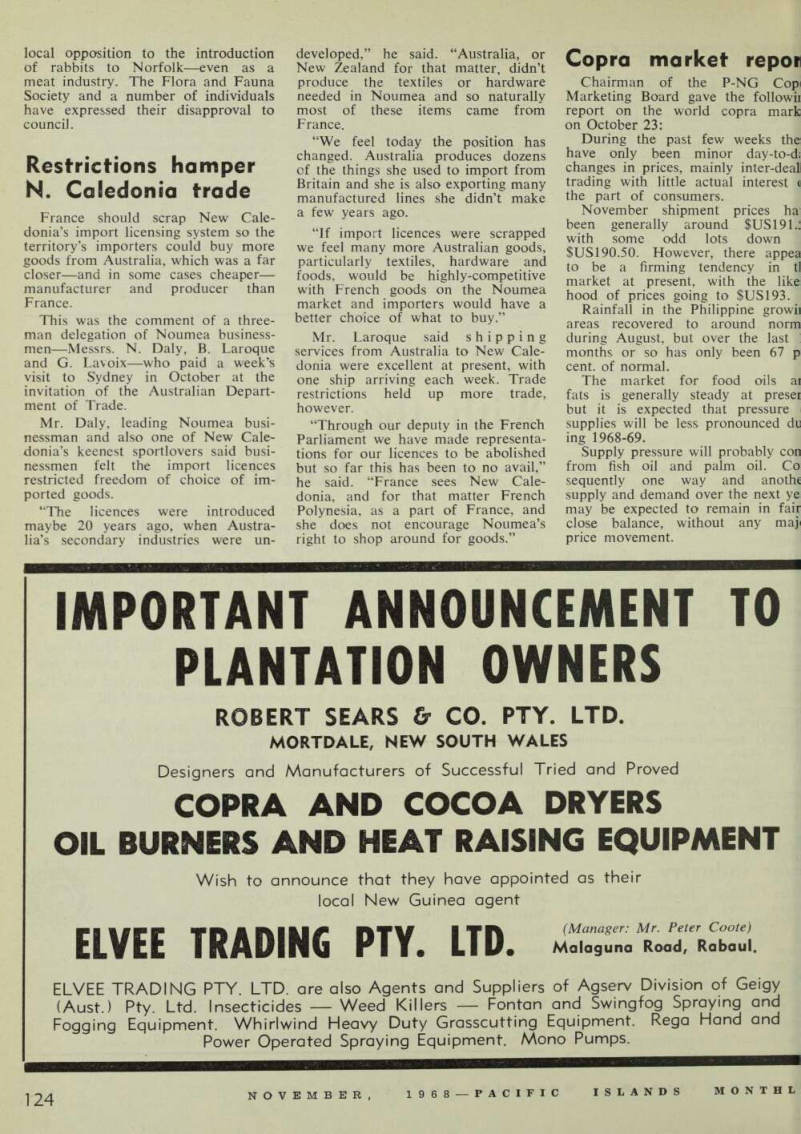
Mr. S. S. Proud, a director of W. R.
Carpenter Holdings Ltd.
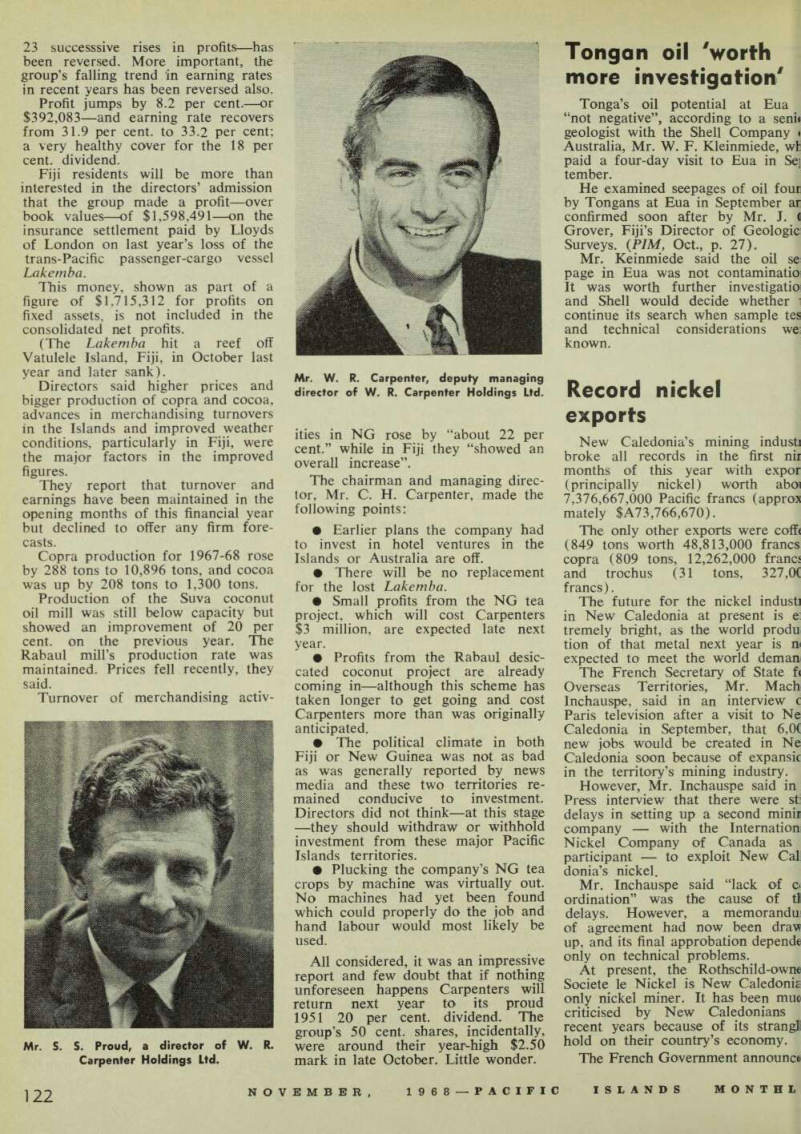
Mr. W. R. Carpenter, deputy managing director of W. R. Carpenter Holdings Ltd.
arly two years ago that it intended end the monopoly that Le Nickel d enjoyed for about a century ’IM, Jan., 1967, p. 142).
In making the announcement in )umea at the time of the Second -uth Pacific Games, the then French inister for Overseas Territories, meral Billotte, said that the second mpany would have French, New Jedonian and foreign interests, but foreign interests would be in the nority.
There have been many reports since :n about the likely make-up and istruction of the new company, t a definite agreement has yet to erge.
ales to Reds help
iji trade figures
Fiji’s trade deficit for August was y £F329,000 —a vast improvement the average monthly deficit of 690,000 for the first half of this ir.
Fhe Fiji Bureau of Statistics report s the improvement is due to bigger ;ar exports. Two-thirds of the gust income from exports, which died £2,721,000, was for 46,174 s of sugar exported to Britain,
nada and neighbouring Pacific
mds. interesting feature of August le was the shipment of 1,504 tons coconut oil to Russia for a return £192,000. It was the biggest ship it ever of goods from Fiji to ;sia. Total Russian have never risen ►ve £28,000 a year, aigust exports also included 11,175 ounces of gold, worth £170,000 4,842 cases of bananas worth )00. Exports of watermelons pro ed over £4,000. mports for August cost £3,050,000 lightly up on the first seven months this year.
Tie adverse balance of trade at the of August stood at £10,700,000 ipared with £7,700,000 for this od last year.
srfolk to have
for industry
he Norfolk Island Council in ober gave its approval to the blishment of a fryer (rabbit breed industrv on the island—even leh the Administrator, Air Corn lore R. N. Dalkin, who is chair i of the council, voted against it. .monq reasons given in council the establishment of a fryer in ry: > It could solve the present un ilovment situation.
• One hundred and twenty tons of fertiliser would be available each week which would improve pastures. • Prices for rabbits and rabbit production, would be lower than in Australia. • Such an industry could en courage young people to go back to the land.
At present two applications are before council for permission to set up commercial rabbit farms; one is from two Australian business men, Messrs. Jamison and Williams, and the other is from local trader Ken Prentice.
Air Commodore Dalkin gave coun cil the following reasons for voting
against the introduction of rabbits: There were some weighty argu ments against it from the conser vationist viewpoint; long-term there may be some unsavoury aspects for the island, such as the effluent problem and the proliferation of flies; the economic prospects may not be as fruitful as people imagined; and the type of employment may not be at tractive, especially to younger people.
He said there was no guarantee that only one operator would set up business. Two more such businesses on the island “might affect adversely the unique characteristics of the island.”
Meanwhile, there is considerable
local opposition to the introduction of rabbits to Norfolk—even as a meat industry. The Flora and Fauna Society and a number of individuals have expressed their disapproval to council.
Restrictions hamper
N. Caledonia trade
France should scrap New Cale donia’s import licensing system so the territory’s importers could buy more goods from Australia, which was a far closer—and in some cases cheaper— manufacturer and producer than France.
This was the comment of a three man delegation of Noumea business men—Messrs. N. Daly, B. Laroque and G. Lavoix—who paid a week’s visit to Sydney in October at the invitation of the Australian Depart ment of Trade.
Mr. Daly, leading Noumea busi nessman and also one of New Cale donia’s keenest sportlovers said busi nessmen felt the import licences restricted freedom of choice of im ported goods.
“The licences were introduced maybe 20 years ago, when Austra lia’s secondary industries were un
developed,” he said. “Australia, or New Zealand for that matter, didn’t produce the textiles or hardware needed in Noumea and so naturally most of these items came from France.
“We feel today the position has changed. Australia produces dozens of the things she used to import from Britain and she is also exporting many manufactured lines she didn’t make a few years ago.
“If import licences were scrapped we feel many more Australian goods, particularly textiles, hardware and foods, would be highly-competitive with French goods on the Noumea market and importers would have a better choice of what to buy.”
Mr. Laroque said shipping services from Australia to New Cale donia were excellent at present, with one ship arriving each week. Trade restrictions held up more trade, however.
“Through our deputy in the French Parliament we have made representa tions for our licences to be abolished but so far this has been to no avail,” he said. “France sees New Cale donia, and for that matter French Polynesia, as a part of France, and she does not encourage Noumea’s right to shop around for goods.”
Copra market repor
Chairman of the P-NG Copi Marketing Board gave the followii report on the world copra mark on October 23: During the past few weeks the: have only been minor day-to-d: changes in prices, mainly inter-deall trading with little actual interest c the part of consumers.
November shipment prices ha been generally around SUSI9I.I with some odd lots down 5U5190.50. However, there appea to be a firming tendency in tl market at present, with the like: hood of prices going to SUSI 93.
Rainfall in the Philippine growii areas recovered to around norm during August, but over the last ' months or so has only been 67 p cent, of normal.
The market for food oils ai fats is generally steady at preset but it is expected that pressure ■ supplies will be less pronounced du ing 1968-69.
Supply pressure will probably con from fish oil and palm oil. Co sequently one way and anothe supply and demand over the next ye may be expected to remain in fair close balance, without any maj< price movement.