Cruising Yachts
pp. 103-110 · Read in the full issue
Pacific Shipping And Cruising Yachts
Central Pacific Ships
Are After Business
The Gilbert and Ellice Islands look set to take a bigger share of Central Pacific shipping operations themselves and thus save valuable revenue, and make some good profits.
An aggresive attitude by colony anners could see the GEIC in ming months set up regular ship ng links—with Gilbert ships—to auru, parts of Micronesia, the lemons and the New Hebrides.
A northern link to Japan, however, )uld be the biggest success.
Some of the same pushing that ablished the Tarawa-Majuro trade k about a year ago with the Whole e Society’s Moana Raoi is currently eded to take advantage of the jsels owned directly, or indirectly, the GEIC Government.
The vessels include the Ninikoria , $500,000-plus buy which arrived August, the Moana Raoi, the lolesale Society’s smart trader, Teraka, the seamen’s training ship ich arrived back in Tarawa from >ng Kong on September I and is w doing some inter-island work tead of merely “bedding-down” at rawa, and the four smaller tourers vanga, Temauri, Tautunu and bakea.
Successful trip
Moana Raoi has now made her ond successful trip to Sydney. She ried 400 tons of top-quality sun ed copra each time. A day’s run her Tarawa-Sydney route could e her additional stops at New ledonia or the New Hebrides, the them Solomons, Nauru or Ocean md. fhe 997-ton Ninikoria, which can ry up to 150 deck and cabin pas gers, has been maintaining services Fiji, has had recruiting trips to the w Hebrides, the Line Islands and ;rnal runs in the GEIC. ■'o extend operations GEIC is ly to encounter stiff opposition m other shippers. Nauru will get 6,000-ton ship next year and is ious to run her own line with jruan ships. Micronesia Interocean e Inc., based in Saipan, Marianas,
would welcome a link-up with Tarawa or Nauru itself and it will also make efforts to replace GEIC trading links in the Marshalls with its own ships.
Burns Philp and Co. Ltd. and the Karlander Line would not let the Moana Raoi into the Solomons or New Hebrides without a fight and Fiji would obviously rather send transshipment cargoes from Suva to Tarawa itself.
But the colony, with the help of the former Wholesale Society manager, Mr. W. J. Kirkby-Jones, has had very great success with its Marshall Islands run and at Majuro, more than any other port, the sight of the Moana Raoi is a very happy one to locals.
One correspondent at Majuro said
in September; “The arrival of the Moana Raoi is getting to be an event that one looks forward to. It does mean a profusion of food and trade goods in the local stores”.
Another correspondent, Mr.
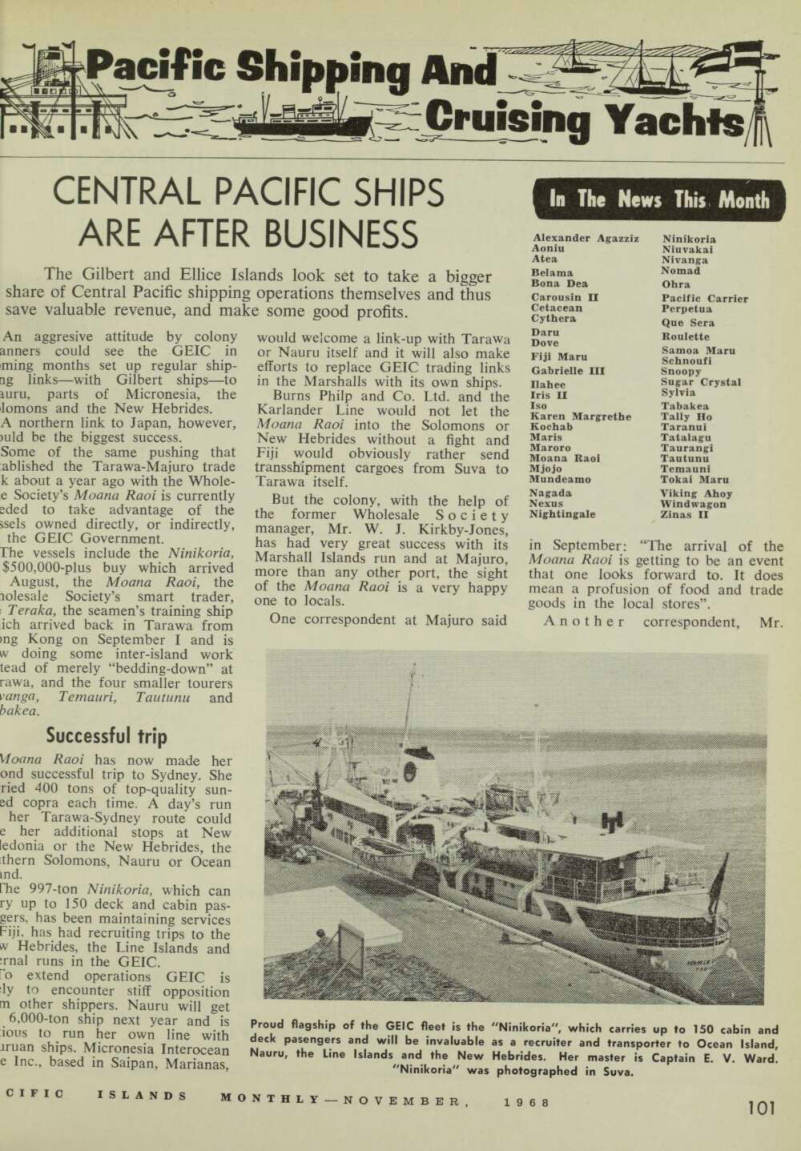
Proud flagship of the GEIC fleet is the "Ninikoria", which carries up to 150 cabin and deck pasengers and will be invaluable as a recruiter and transporter to Ocean Island, Nauru, the Line Islands and the New Hebrides. Her master is Captain E. V. Ward.
"Ninikoria" was photographed in Suva.
dney E. Patterson, said many idents of Majuro liked to see the ->ana Raoi “coast up to our dock, its white majesty filled with goodies the Marshalls.” He added: ‘I wonder if there are readers of M who are aware that they can ler now from New Zealand, Aus lia, Fiji and Tarawa with the vices that the Wholesale Society made available through the ninal in Majuro,” he said.
This is merely the beginning of /ice throughout the islands of :ronesia, and in time may allow to unite with the Gilberts, possibly a confederation called South East :ronesia.
I proposed this name to the EC’s Colony Information Notes ;n I was in Tarawa last September I was informed that even though IC was looking for a new colony le, this venture with the Marshalls ild have too much of a political rtone, but the article was even ly printed, I understand.
Now, with the ships joining us, e again as we used to be before two world wars, and with the Micronesia route and Fiji Airways te to intersect at Majuro, this icular confederation does not
seem so remote, at least to some of U 5 here in the M a rs hal ls.” (Before 1914, Burns Philp, with small steamers and schooners, maintained calls in the Marshalls, via the GEIC, despite German commercial and government opposition).
Mr. Patterson said the only real difference between the Marshallese and Gilbertese was that one group speaks “Queen’s English” and the other, “Americanese”.
“South East Micronesia” or not, there does seem opportunities at present for the GEC to extend shipping operations. The colony has the ships, it continues to produce excellent seamen and its copra and phosphate economy has everything to gain by making its mark felt in regional shipping operations.
Japanese Shipping Moves
Into Central Pacific
Daiwa Line, the Japanese shipping company which operates a monthly passenger-cargo service from Japan to Guam and the Pacific Islands, hopes to extend its calls to Tarawa, GEIC, early next year.
Mr. S. Takato, general manager of the company’s business department, said Daiwa would appoint the Wholesale Society, Tarawa, as its agent for cargoes of canned goods, textiles, cement, steel products and motor vehicles.
He said three vessels—the 9,685ton Fiji Maru, 9,369-ton Samoa Maru and 9,779-ton Tokai Maru —would operate in the South Pacific. Of these motor vessels, Fiji Maru had a speed of 13 knots and the other two ships n knots.
Daiwa currently calls at Pago Pago, Apia, buva, Labasa, Lautoka, Noumea, Vila and Santo.
Whither The Auki
Boatbuilding School?
, What s the future of Auki’s Boat Building School, on Malaita, in the Solomons?
PlM’s correspondent on Malaita recently reported that the school was abeyance at the moment” with nothing finalised about the future, The school’s instructor, Mr. Frank Faulkner, was on leave in Hawaii and n °t expected back in Auki until October and the school’s assistant instructor, Mr. David Pratt, a Solo ™°. n blander f ro ™ Mimda, was super- V1S1I ?8 small repair jobs Smce the Solomons Government took over the sch ° ol from the South P acif ic Commission, over $60,000 , s b . een s P e nt on the school, primarily to instruct 24 Pacific Islanders on two-year boat building courses. The first two-year course l uly thi , S yea , n No other u ses have been P lanned -
Vila Wharf: Tonga
May Submit Bid
Tonga is expected to submit a sub contracting bid for Vila’s proposed milllon P lus deepwater wharf, Tenders for construction of the wharf will close on November 14 (PIM, Sept., p. 103) and at least 12 builders from Australia, Britain and France will make offers. The New Hebrides Condominium will announce the successful tenderer by February next year, and it is hoped work will get underway by mid-1969.
Tonga has already had valuable— and successful—experience in wharf building. Its government-owned Tonga Construction Company combined with English consulting engineers to build
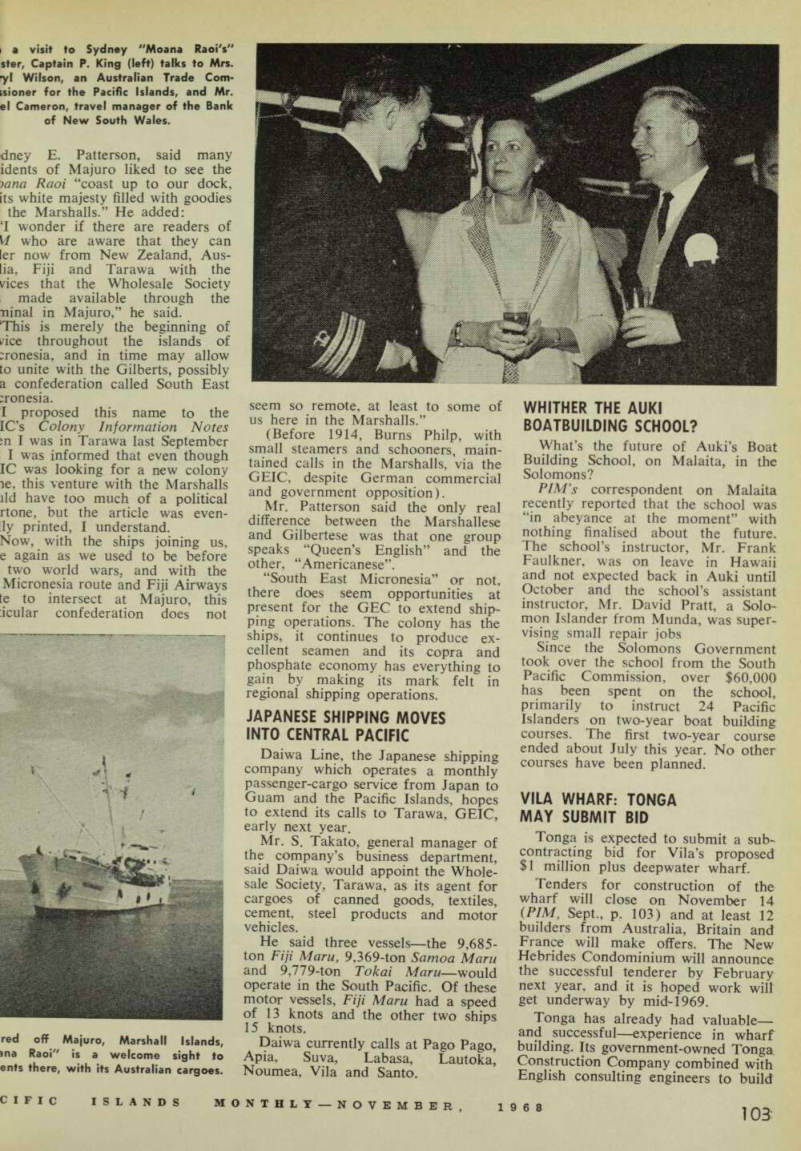
visit to Sydney "Moana Raoi's" [?]ster, Captain P. King (left) talks to Mrs. [?]yl Wilson, an Australian Trade Com [?]sioner for the Pacific islands, and Mr. el Cameron, travel manager of the Bank of New South Wales.
[?]red off Majuro, Marshall Islands, [?]na Raoi" is a welcome sight to [?]ents there, with its Australian cargoes.
Queen Salote Memorial Wharf Nukualofa, n late September Mr. J. R. Taylor, •artner in Wilton and Bell Dobbie I Partners, and Mr. Jack Woods, lirector of G. Dews and Company 1., made an on-the-stop final lection of this wharf and they are ected to report that the project ; a complete success, partly because the “unequalled teamwork by igans”. representative of the Tongan istruction Company flew to Vila early October to inspect the site the Vila Wharf. is a result of this visit, the com y was expected to offer a sub tract bid in association with G. vs, who will make a full tender, he New Hebrides.
Ivate Eyes 7 Look For
I Pacific Current
omewhere below the surface of South Pacific Ocean is a lost or current, reports Glen Wright, Apia. Ten American “detectives” now searching for it. hey are oceanographers from the pps Institute of the University California, aboard the research el Alexander Agazziz. They ;ed Western Samoa recently en te to where they think they may the elusive flow, heir task is to find and trace the :t course of the current, which r suspect passes near the Samoan ids. It originates in the north intic near Greenland, sweeps n the Atlantic and around arctica, then comes up into the ific off the coast of New Zealand, veen there and the Antarctic it ppears. previous research trip by the pps scientists from Melbourne to paraiso resulted in proof that great “river in the sea” heads ird Tahiti and the Samoas before ets lost. Their present voyage is the purpose of finding and trac ks course farther into the Pacific, he Scripps experts explained that » quite easy to identify such a y of water within water even igh it is deep beneath the surface.
Arctic stream that feeds it has iin properties of salinity, tem ture, dissolved oxygen and micro ient content which makes it ; distinctive. imples of water, flow measure ts and depth soundings are used race the course. he work is regarded by the cander Agazziz staff as pure re :h at the present stage. However, tical applications of the informa discovered will be sought, as the
JS Navy takes an interest in such esults. A large body of water which i drastically different from the water round it can make an excellent iding place for a submarine.
The Scripps private eyes of the ;a will intensively explore the ocean etween here and Tahiti and will iturn to Apia unless positive traces f the current are found. In that ase, Tahiti will then become the lexander Agazziz’s last port of call efore returning to California.
0 Re-Scheduling
Dr Bank Ships
Two directors of the Bank Line imited of London—Mr. I. S.
IcEwen and Mr. E. B. Oliver— ok a six-week look at ports in Aus alia and the Pacific Islands in ctober and November.
They visited Sydney, Brisbane, oniara, Suva, Nukualofa and Apia, id major NG ports to see at first md recent developments.
A Bank Line spokesman in Sydney Id PIM that the company did not an re-scheduling its services to lands ports which handle big loads copra, coffee or cocoa.
He said the company was now king small quantities of NG High nds tea to Britain and had also en approached by Islands timber porters to carry timber. Most ships ;re full of other Islands produce r Europe at present and there were • plans to begin carrying timber on big scale, he said.
Igar Cargo Record
The biggest cargo of sugar ever to ive Fiji has been carried in a ,894-ton British bulk carrier, ap □priately called Sugar Crystal.
The carrier, owned by the Sugar ne Ltd., of London (a subsidiary the Tate and Lvle Group) took 17,000 tons of sugar at Labasa d Lautoka before sailing for ndon at the end of September.
Hie Glasgow-built Sugar Crystal, lich features luxury accommoda n and a swimming pool for its :w of 35, entered service in January s year.
1 Reef Blasting
An Gets Going
Captain S. B. Brown, of the iroro, has reported the completion the first phase of the Fiji Marine partment’s reef blasting programme improve access for shipping in the ;er islands.
Captain Brown said that the pas :e at Viwa Island had been lightened and coral heads at the ide of the lagoon removed to )w an anchoring for larger vessels, 2 passage and inner anchorage
now have a minimum depth of 15 ft, but the passage is still narrow at the outer entrance.
A boat passage into the village at Yasawa-i-rara island has also been completed. The removal of coral heads in the outer harbour will now allow small Government boats to anchor in the lee of protecting rocks.
Shipping Briefs
„ T , „ • Norfolk Islands new $135,000 bulk petroleum plant stepped into top gear for the first time in October when the tanker Pacific Carrier discharged 160,000 gallons of petroleum products in 10 hours. The tanker, chartered by Mobil Oil Australia
Ltd., discharged the petrol at the nearly-completed Mobil plant at Ball Bay. When contractors complete the plant, by the end of the year, supplies will be delivered locally in bulk by a tanker lorry. In future, tankers will have to make only two calls at Norfolk a year because of the plant, The Norfolk Islander quoted Mr.
Frank Thompson, the local Mobil a S ent > a s saying that petrol prices would be reduced once deliveries started from the plant, • For the next two or three months, the Suva-registered freighter Taranui and her Fijian crew will be investigating marine life, conducting
magnetic research and taking echo soundings and plankton samplings in New Zealand waters and the western Tasman. The 954-ton freighter, owned by the South Seas Shipping Company, has been chartered by the New Zealand Department of Scientific and Industrial Research. ® A $14,000 wharf will be built at Graciosa Bay, Santa Cruz, in the southern Solomons. Work will be done by the Public Works Department and will start in June next year. Waters at the wharf will be 12 ft deep at low tide so the wharf will be able to accommodate ships protectorate’s Itoe7ve™ ,ly ** protectorate s largest vessel. • The European Common Market has granted New Caledonia a SUSI
million loan for deepening and improving its Noumea Harbour to handle more of the bigger liners ply ing the Pacific Islands on cruises out of Europe, the US and Australia.
Liners have been calling at Noumea for several years now but many pas sengers have said facilities and amenities were not as good as Suva or Papeete.
New Caledonia has also been granted a $U5671,000 subsidy by the Common Market for the start of construction of a sea wall which will eventually link Noumea with the nearby island of Nou loan is for 20 years with two per cent, annual in terest, and payments must start after three years.