The Editors Mailbag
pp. 59-61 · Read in the full issue

Early Rice Growing
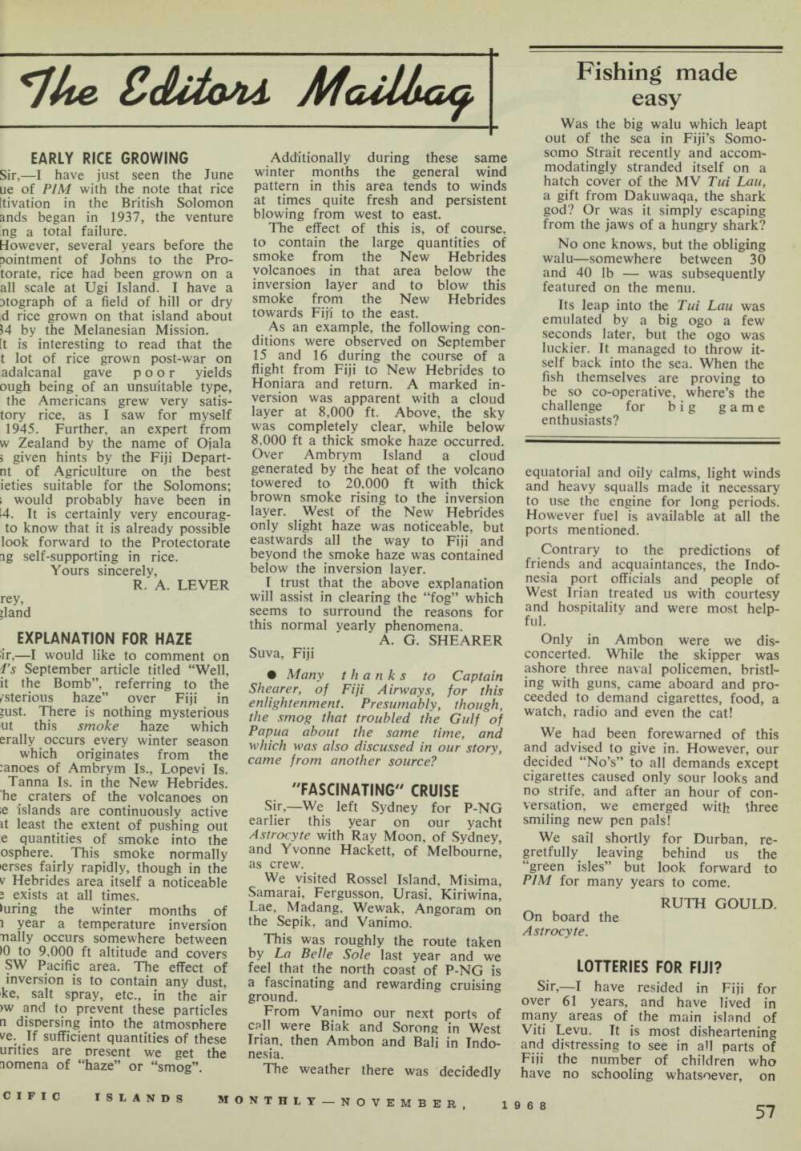
Sir,—l have just seen the June ue of PIM with the note that rice Itivation in the British Solomon ands began in 1937, the venture ng a total failure.
However, several years before the pointment of Johns to the Pro torate, rice had been grown on a all scale at Ugi Island. I have a Dtograph of a field of hill or dry d rice grown on that island about 14 by the Melanesian Mission. [t is interesting to read that the t lot of rice grown post-war on adalcanal gave poor yields ough being of an unsuitable type, the Americans grew very satis tory rice, as I saw for myself 1945. Further, an expert from w Zealand by the name of Ojala 5 given hints by the Fiji Depart nt of Agriculture on the best ieties suitable for the Solomons; ; would probably have been in 14. It is certainly very encourag to know that it is already possible look forward to the Protectorate ig self-supporting in rice.
Yours sincerely,
R. A. Lever
rey, *land
Explanation For Haze
■ir,—l would like to comment on i’s September article titled “Well, it the Bomb”, referring to the haze” over Fiji in ?ust. There is nothing mysterious ut this smoke haze which erally occurs every winter season which originates from the :anoes of Ambrym Is., Lopevi Is.
Tanna Is. in the New Hebrides, 'he craters of the volcanoes on ;e islands are continuously active it least the extent of pushing out e quantities of smoke into the osphere. This smoke normally >erses fairly rapidly, though in the v Hebrides area itself a noticeable 5 exists at all times, luring the winter months of i year a temperature inversion nally occurs somewhere between 10 to 9,000 ft altitude and covers SW Pacific area. The effect of inversion is to contain any dust, ke, salt spray, etc., in the air >w and to prevent these particles n dispersing into the atmosphere ve. If sufficient quantities of these urities are present we get the lomena of “haze” or “smog”.
Additionally during these same winter months the general wind pattern in this area tends to winds at times quite fresh and persistent blowing from west to east.
The effect of this is, of course, to contain the large quantities of smoke from the New Hebrides volcanoes in that area below the inversion layer and to blow this smoke from the New Hebrides towards Fiji to the east.
As an example, the following con ditions were observed on September 15 and 16 during the course of a flight from Fiji to New Hebrides to Honiara and return. A marked in version was apparent with a cloud layer at 8,000 ft. Above, the sky was completely clear, while below 8,000 ft a thick smoke haze occurred.
Over Ambrym Island a cloud generated by the heat of the volcano towered to 20,000 ft with thick brown smoke rising to the inversion layer. West of the New Hebrides only slight haze was noticeable, but eastwards all the way to Fiji and beyond the smoke haze was contained below the inversion layer.
I trust that the above explanation will assist in clearing the “fog” which seems to surround the reasons for this normal yearly phenomena,
A. G. Shearer
Suva, Fiji • Many thanks to Captain Shearer, of Fiji Airways, for this enlightenment. Presumably, though, the smog that troubled the Gulf of Papua about the same time, and which was also discussed in our story, came from another source?
"Fascinating" Cruise
Sir, —We left Sydney for P-NG earlier this year on our yacht Astrocyte with Ray Moon, of Sydney, and Yvonne Hackett, of Melbourne, as crew.
We visited Rossel Island, Misima, Samarai, Fergusson, Urasi, Kiriwina, Lae, Madang, Wewak, Angoram on the Sepik, and Vanimo.
This was roughly the route taken by La Belle Sole last year and we feel that the north coast of P-NG is a fascinating and rewarding cruising ground.
From Vanimo our next ports of call were Biak and Sorong in West Irian, then Ambon and Bali in Indo nesia, The weather there was decidedly
equatorial and oily calms, light winds and heavy squalls made it necessary to use the engine for long periods.
However fuel is available at all the ports mentioned.
Contrary to the predictions of friends and acquaintances, the Indo nesia port officials and people of West Irian treated us with courtesy and hospitality and were most help ful.
Only in Ambon were we dis concerted. While the skipper was ashore three naval policemen, bristl ing with guns, came aboard and pro ceeded to demand cigarettes, food, a watch, radio and even the cat!
We had been forewarned of this and advised to give in. However, our decided “No’s” to all demands except cigarettes caused only sour looks and no strife, and after an hour of con versation, we emerged with three smiling new pen pals!
We sail shortly for Durban, re gretfully leaving behind us the “green isles” but look forward to PIM for many years to come.
Ruth Gould.
On board the Astrocyte.
Lotteries For Fiji?
Sir, —I have resided in Fiji for over 61 years, and have lived in many areas of the main island of Viti Levu. It is most disheartening and distressing to see in all parts of Fiji the number of children who have no schooling whatsoever, on
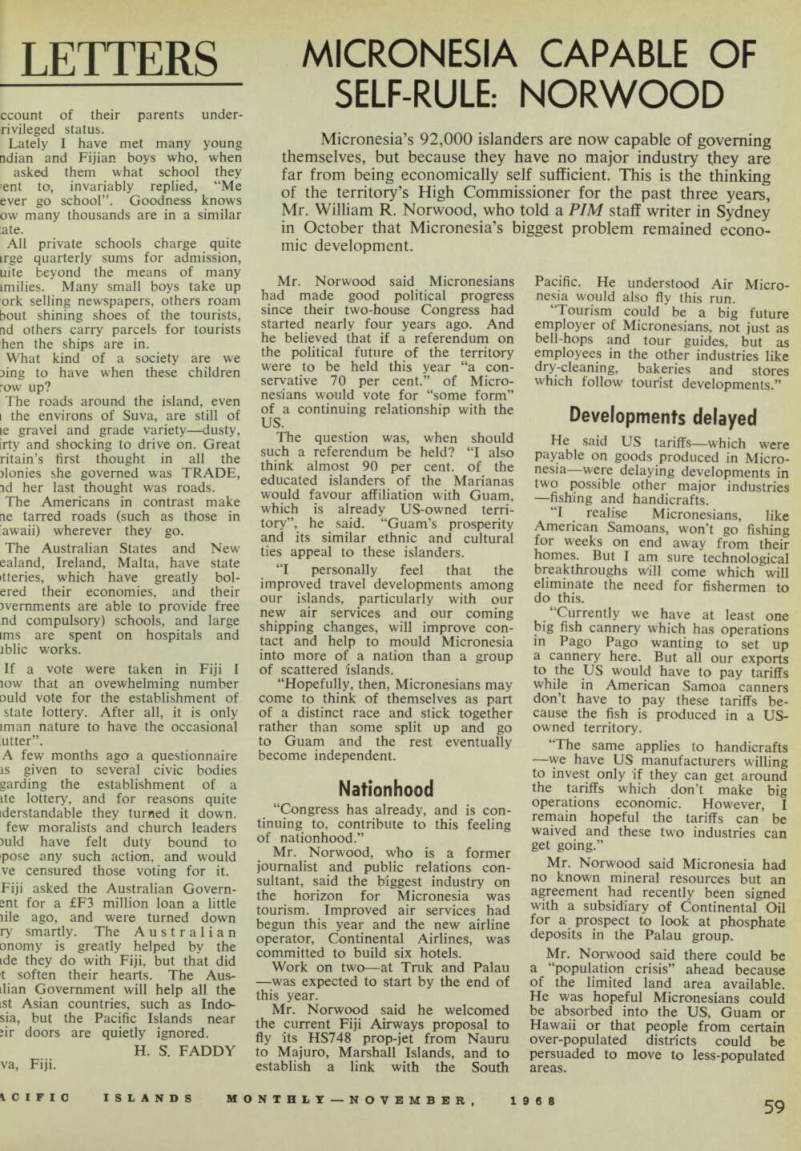
ccount of their parents under rivileged status.
Lately I have met many young tidian and Fijian boys who, when asked them what school they 'ent to, invariably replied, “Me ever go school”. Goodness knows ow many thousands are in a similar ;ate.
All private schools charge quite irge quarterly sums for admission, uite beyond the means of many imilies. Many small boys take up ork selling newspapers, others roam bout shining shoes of the tourists, ad others carry parcels for tourists hen the ships are in.
What kind of a society are we ring to have when these children row up?
The roads around the island, even i the environs of Suva, are still of ic gravel and grade variety—dusty, irty and shocking to drive on. Great ritain’s first thought in all the rionies she governed was TRADE, id her last thought was roads.
The Americans in contrast make lie tarred roads (such as those in 'awaii) wherever they go.
The Australian States and New ealand, Ireland, Malta, have state itteries, which have greatly bol ered their economies, and their ivernments are able to provide free nd compulsory) schools, and large ims are spent on hospitals and iblic works.
If a vote were taken in Fiji I low that an ovewhelming number ould vote for the establishment of state lottery. After all, it is only iman nature to have the occasional utter”.
A few months ago a questionnaire is given to several civic bodies garding the establishment of a ite lottery, and for reasons quite iderstandable they turned it down, few moralists and church leaders )uld have felt duty bound to pose any such action, and would ve censured those voting for it.
Fiji asked the Australian Govern ent for a £F3 million loan a little file ago, and were turned down ry smartly. The Australian onomy is greatly helped by the ide they do with Fiji, but that did t soften their hearts. The Aus trian Government will help all the ist Asian countries, such as Indo sia, but the Pacific Islands near rir doors are quietly ignored.
H. S. Faddy
va, Fiji.