Onscious
pp. 47-51 · Read in the full issue


Ravel
Merican
Amoa Has
[?]Igger
[?]Lans
By Ken Mcgregor
Cricket, American Samoan style, is today so far away rom the cricket that early missionaries brought to the Samoans ■ l ust doesn t matter, and lovers of real cricket will have to lake allowances when they visit American Samoa. But it will € worthwhile to watch a game, if only for the sheer fascination f it.
imoans have vastly changed ish cricket rules and procedures transform the game Islands ion. But they also bet quite ily on a game. A loss can mean one village is SUS3OO out-of et!
I watched a vigorous ' of Samoan cricket played a le of miles from Pago. Faleniu Pavaiai villages combined to Taputimu village by an innings two runs. ic whole game had a musical with Samoans clapping all the dancing and singing. Samoan nen were apt to miss most of wildly-tossed balls, but when connected the result was often auty —with the ball ending up a way away, in a nearby lagoon, ips, or past a nearby busy e teams had 25 men, or boys, de for batting, and at least le this number for fielding, e bowls were delivered alter ed from each end of the pitch dozens of villagers not in the collected on the sidelines to loud Polynesian songs. th at least 50 fielders of varying spread out up to 200 yards from the sand-pitch, the eyes
of the bowling team were on two Samoans near the pitch, each armed with a whistle.
All fielders slow-clapped until a batsmen was caught, or bowled out.
Then silence.
Victory dance
Suddenly the Samoans with whistles began blowing them loudly.
These two started a short vigorous victory dance which every fielder immediately copied. With the whistle bursts being the only sounds for about two minutes, the dance worked up to a climax when everyone jumped in the air with a cry of glee.
Meanwhile, the next batsman had arrived, supported by an exuberant song from the sidelines. And the extraordinary game went on.
At the finish, Faleniu and Pavaiai villagers collected SUS2S from the luckless Taputimu villagers.
Samoan cricket is one of the treats in store for visitors to Ameri can Samoa. The territory’s main (but small) island of Tutuila has a great deal to offer tourists during a two or three-day stay.
American Samoa is serviced almost daily by Pan American jets out of
New Caledonia, Australia, New Zealand, Hawaii or the US, and it boasts one of the most attractive and modern resorts in the Pacific Islands—Pago Pago’s 101-room, fully airconditioned Intercontinental Hotel.
During my stay at the Inter continental in early September, the hotel’s manager, Mr. Rudy Ritcher, told me the hotel had begun making good profits since early this year.
Since it opened in late 1965 the hotel has chalked up considerable losses and this is the first year it has entered the black.
Mr. Ritcher said the hotel had maintained a 75 per cent, room occupancy this year and several times had been full, with more visitors, particularly Americans, making three or four-day stopovers in American Samoa before heading northwards to Tahiti or Hawaii or southwards to Australia or New Zealand.
Intercontinental’s current high room occupancy is the best argument for a $2.2 million, 114-room ex tension to the hotel, which the American Samoan Government hopes the US Will pay for.
Most of the new rooms, each of which, like the present rooms, would have a bathroom, are planned for the Pago Pago side of the hotel,
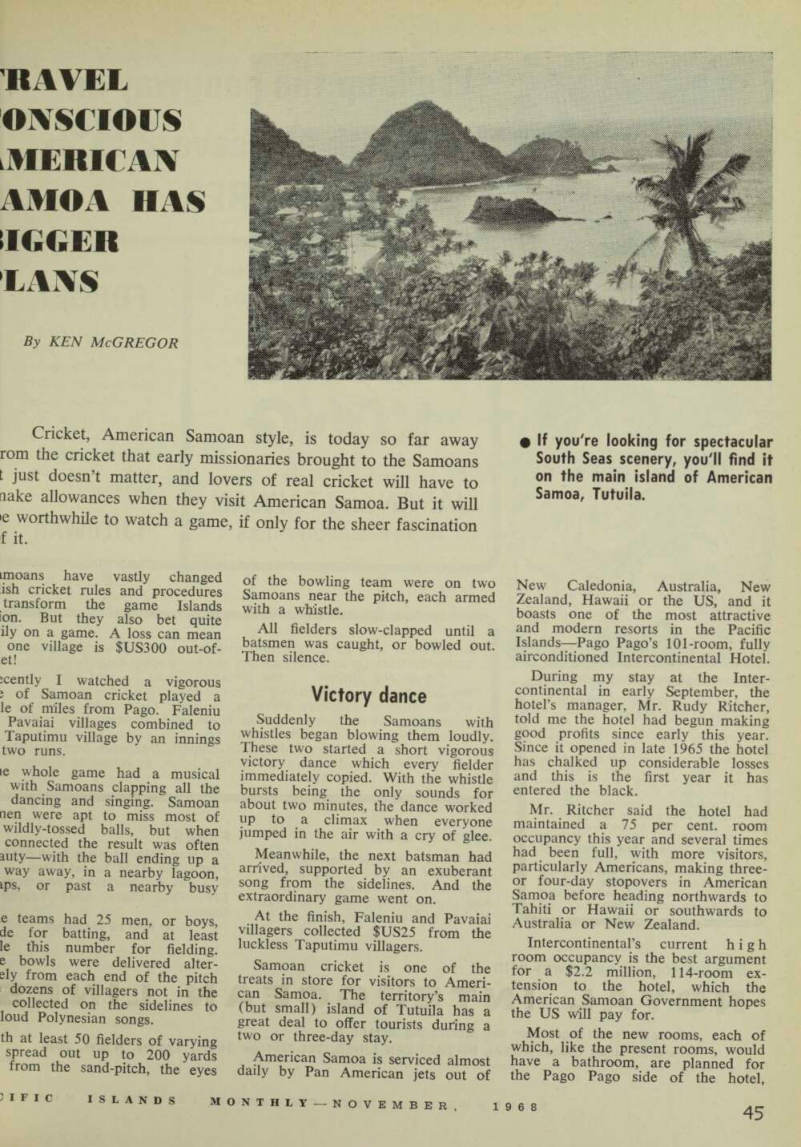
• If you're looking for spectacular South Seas scenery, you'll find it on the main island of American Samoa, Tutuila.
lore hotel rooms soon
ar an oil dock area. They would larger than the present rooms.
Regular diners at the hotel told i that since Mr, Ritcher arrived rlier this year to take up a ©ne ar contract job to manage the tel for Intercontinental Hotels (a n American Airways subsidiary) vice had greatly improved.
Big improvement
‘Before, we had to wait up to minutes before we were asked at we wanted,” one American said.
Iso, the food has improved.” \mericans said the hotel’s prices food compared well with prices Tokyo and Hawaii hotels. Some, vcver, commented that the general el service was not as good as over s hotels. ‘The hotel is overstaffed because hink Samoans as hotel employees not yet as productive as some el employees elsewhere,” a Cali lian said. l2O Samoans are employed the hotel as waitresses, waiters, tenders, cleaners, cooks, pool sndants, gardeners and service ids.
The ideal number of employees fid be about 100, but Samoans not yet trained to the extent of rseas hotel employees and can’t expected to work as well,” Mr. :her told me.
I stay on the hotel grounds as :h as possible to try to keep constant touch with all our depart its. In this way I am getting to w the Samoans better and find- I can help them more.” ome Australians and New landers will find that on top of jasic tariff of from SUSIS to >25 for a room without meals, es generally are high. But they about the same as in French mesia and New Caledonia—and e hotels in Fiji can be dearer.
Spectacular scenery
ji unanswered question crops up i the hotel’s current profitability: t returns can the 1,200 Samoan eholders, who contributed 1350,000 to its original cost, set? The undisclosed losses up to year may prevent dividends for e time yet, but a statement from hotel’s nominal owner, the ;rican Samoan Development Cor ition, to put these Samoans in picture would be well-received lly. Somebody should do it. fter travelling Tutuila’s major
Tourist future looks very good'
jstern and eastern roads and its iwly-developed road across the high irt of the island to Fagasa Bay, it obvious that one of American xnoa’s greatest tourist assets is its ectacular scenery.
Smooth, sealed roads, often curl ? within yards of bright beaches, d the impact of the jagged >untain ranges that surround you Pago, are tourist-getters.
But if the visitors are looking for changed islanders in traditional five huts then they would be tter off almost anywhere else in s South Seas. On Tutuila the new rricane houses have almost re ced traditional fales.
Although there is the anxiety to :ourage tourists, some visitors n’t always find themselves properly ved when they get there. There i be an irritating attitude of it’s )d-enough.
Short measure!
»Vith three others I took a Dutapu Tour with Samoa Tours I Travel Agency, a Samoan-run r operator. We each paid SUS 6 the tour in a late model Ford an to the western side of the nd. Time of the tour was ad fised in a Samoa Tour handout as 5e hours and the charge: “SUSS person”. )ur Samoan driver-guide stopped V once, for five minutes, near a top. Although he reeled off the les of villages as we passed them guide didn’t tell us anything ut the places we saw, despite ly questions from us. /e were back at base in an hour a half, where we found the active girl who had sold us the had gone home and her replace it, equally attractive, was unable inwilling to explain why the tour half as long as advertised, at ter cost.
Three new hotels?
ast year, 10,000 people stayed e than a day in American Samoa.
Y stayed an average of three to i-and-a-half days and spent a
of SUS 2 million. This year
00 visitors are expected, and they spend at least SUS4OO,OOO more. ie territory’s two major tour ators are Samoan Tours and > Pago Tours, owned by the -sified islands firm, N. F. ibuhl, Inc. iere is talk of at least three new t hotels to be built on Tutuila. osals from two American air-
fines, Continental and Eastern, depend upon their obtaining flying nghts into the territory and the final government go-ahead has not been given for a locally-financed hotel, to be built near Tafuna airport.
Governor Aspinall’s attitude re mains that a profitable future for Intercontinental Hotel must be assured before other hotels go up, and he is unlikely to allow additional hotel construction before he is con vinced the hotel’s 1,200 Samoan shareholders will not suffer as a result of hotel competition.
Generally, American Samoa’s tourist future looks very good. More hotels certainly will be built, a golf course is proposed behind Pago Pago, and Tafuna airport is likely to become even a busier stopover for trans-Pacific jets in the near future.
A model Samoan village and a modern restaurant are planned on reclaimed land areas in Pago Pago Bay.
What needs attention is the service out of Pago to Apia, Western Samoa, and some of the onward connections from there. I heard many com plaints in Pago about the unreliable air connections between Tafuna and Apia, operated by Polynesian Air lines. One man was furious at hav ing been delayed a fortnight in Tonga because Polynesian flights from Apia did not arrive; it cost him $lOO and upset his entire Pacific travel itinerary, he said. The thing to do is to check and double check, and even then not work to a tight schedule. • See "American Samoa: In Many Ways You've Got to be Im pressed", p. 60.
A Britten-Norman Is lander aircraft off the Australian coast.
They'll shortly be seen in New Guinea.
See story at right.