more power for the Islanders
pp. 32-138 · Read in the full issue
There was blood and thunder about more power for the Islanders
From KATHLEEN HANCOCK, in Noumea Beetles and burgeoning populations loomed large on the horizon at the Bth South Pacific Conference held here in October. For 10 days, delegates from Islands territories serviced by the South Pacific Commission aired their views on subjects that ranged from rhinocerous beetle control to mental health.
And they also approved or cut items in the works programme and budget submitted to them by the commission.
Delegates arrived from islands as distant as Guam and Tahiti, the Solomons and the Gilberts. The problems that face them in their home territories are equally diverse.
Some are as old as the Pacific itself, but most of them have been aggravated by contact with Western civilisation.
Fiji’s Chief Minister, Ratu K. K. T.
Mara, chaired the conference, and it was clear from the outset that he had no intention of being a mere figurehead.
In his opening address he said, “While I shall certainly do my best to be a fair and impartial chairman, I do not propose to be a silent one. In fact, Ratu Mara will be in a much more favourable position to catch the chairman’s eye!”
More say
He suggested that delegates should have a more direct say in the pro jects proposed for their benefit. And he put forward the idea that dele gates to the South Pacific Conference should be elected representatives of their peoples, rather than appointed, as they are now. This would help to ensure that conference decisions would be carried out in the terri tories.
It was soon clear that the chair man was frustrated—to put it mildly —by the relationship of the Islands’ delegates to the six commissioners, who sat at the top of the confer ence room, looking rather like a group of schoolmasters in charge of a study group.
It’s not beyond the realms of pos sibility that ancient Pacific rivalries could have entered into this attitude.
Western Samoa, in the person of that formidable old party, Afoafouvale Misimoa, sits with the commissioners
of the five Western Powers admin istering South Pacific territories.
By right of her complete independ ence, Western Samoa was elected to the “ Commissioners’ Club” some years ago. And however gratifying it may be to other Pacific territories to have one of their own occupying a commissioner’s seat, old jealousies die hard.
When Ratu Mara stated bitterly that under the present rules Fiji was less equal than some who participated there, it could be that he had Western Samoa in mind.
As for the commissioners them selves, probably they did not feel like schoolmasters so much as prisoners in the dock, under strong verbal attack from the bar. The UK Senior Commissioner, Mr. F, D.
Webber, proposed that next year the commissioners be distributed among the delegates.
The chairman referred in his open ing address to the “extension and strengthening of the conference in the operation of the South Pacific Com mission.” He thanked the metro politan powers for “their readiness, not only to accept this new concept, but to actively co-operate in making it work.”
Irked
But later in the week he said that although he didn’t think the com missioners intentionally tried to muzzle him by asking him to become chairman, he was irked by the idea that the commission could impose its decisions on the delegates.
“It seems,” he said, “ that the delegates have come of age, but not the Commission.”
There was also a good deal of blood and thunder from the floor
of more power for delegates. Tor who sends a delegate, but has vote because of her British adv on defence, complained that decisi of the conference lacked finality.
“Why,” asked Inoke Faletau, the decisions of the conference as recommendations to the a missioners? What right has session (of commissioners) to del what the conference puts forwarc He went on to make the pi that the South Pacific Commis; was not recognised by the UN an entity. And so there would alv be delays in getting assistance fi the international agencies for c< mission projects that requ monetary or specialist help.
But in the end, the confere delegates ended with far more in affairs than some of tl apparently expected.
At this 1968 meeting there seer to be signs of a more indepenc attitude on the part of the Fre Pacific territories. Last year, and gates from New Caledonia, Fre Polynesia, and Wallis sat obediently to put forward t whispered views of their advisers to approve the pronouncements their commissioner. This year tl were healthy signs of an inten to stand on their own feet.
Mr. Nettre, the French Comi sioner, for some reason stroi opposed the extension of the rh cerous beetle research project a United Nations Development 1 gramme help. This attitude to a search project that is literally matter of life and death to s( islands puzzled the conference, met with a barrage of criticism.
Mr. Nettre was roundly defeated
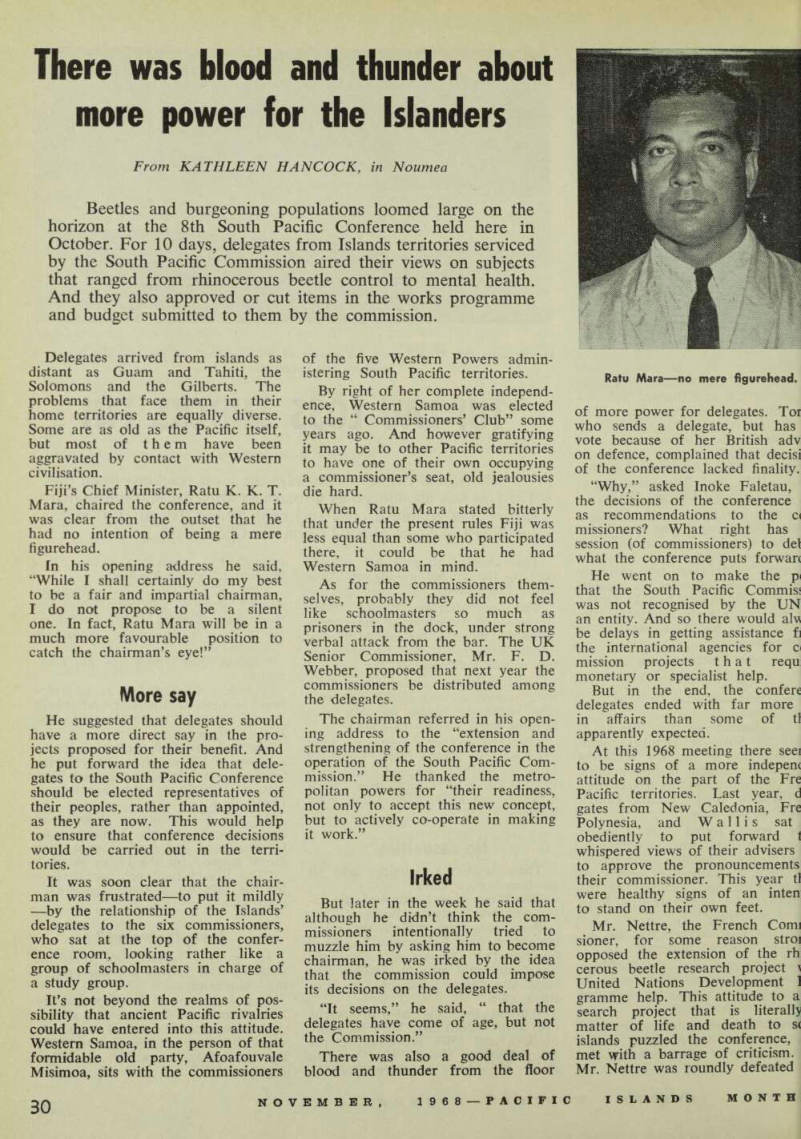
Ratu Mara—no mere figurehead.
:nch Polynesia’s Jean Bambridge 1 that though his islands didn’t ’er from infestation, they would ! to share the problems of other itories and make a contribution the cost of the project.
I new feeling of sympathy towards Commissioner for France finally jrged. This could have arisen n Mr. Nettre’s acceptance of the iv of independent thinking from e French Pacific delegates. Or :ou!d have come from a wider isation of the totally different re mship between France and her •seas territories, in contrast to the e bonds that tie the US, Great ain, Australia and New Zealand heirs. itizens of French territories are ichmen, represented in the French eminent in Paris. And so it’s im ible for the French Commissioner ;ive a snap decision on matters :ting their welfare. The French eminent, as their elected repre itive, has the final say. was interesting to hear Ratu a, in spite of earlier criticism 'ranee’s blocking tactics, compli t Mr. Nettre on making a great ession in agreeing to a confer discussion on the future of the h Pacific Commission. And I t think there was any tongue-in k about his sentiments. ’oafeuvale Misimoa at one point out of his way to congratulate French Commissioner for stick to his guns. And Mr. O. P. tes, speaking for New Zealand, ; the point that relations between rs and territories were not ys the same. seemed obvious that here he red to the often difficult posi- Mr. Nettre found himself in. The nissioner for France has been up into something of a confer bogey-man over the years, partly ise of his insistence on precision accuracy in the area of finance, aostly because he is often forced stonewalling tactics by France’s ic relationship with her Pacific es. £ imminent upgrading of Nauru delegate to commissioner will anew look to the group of men” at the top of the confer room. When the membership ais newly independent Pacific i is confirmed (in about three is), the commission won’t be so ly weighted in favour of the ipolitan powers. The delay in i’s entry was merely technical, g from the need for the French nsult with Paris, sident Deßoburt, though not
(Continued on p. 135)
t officially on the SPC, spoke with the force and authority of a com issioner proper. From his delegate’s it he strongly supported Ratu ara’s stand on the need for an mediate review of the South cific Commission’s role in the cific. And he was bitterly dis pointed in Albert Henry’s resolu n recommending the postponement the consideration of a review com ttee until the 1969 conference.
Dne of the biggest projects con ered by the conference was the ablishment of a reef and lagoon icries agency. Both the UNDP and : FAO promised all the help they ild give with this.
Fhe UNDP observer said his ;ncy was prepared to recommend allocation of 5U5477,000 over ee years. It might seem odd that mds communities need help in an a they’re been concerned with thousands of years, but this is t another example of the effect raising health and living standards, ks Pacific populations have in ased, the lagoons have been fished Islanders have found them es short of the one source of tein freely available at low cost, and so they need to leam to build / types of boats to fish outside reef. The habits of deep sea must be studied. Old methods st be discarded, new ones learnt, 'here was some indecision last r about whether the so-called tall conference” held every year ; an improvement on the “large ferences” that used to take place ry three years.
No doubt
'his year there was no doubt in :gates’ minds. A “small confer -3” will be held every year. There some feeling that the time wed—eight days—was too short. 1 the question of venue also came Noumea was decided on for t year, but if the budget allows, may be the host the following *. The idea is to have them at ;rent venues as in the past, he feeling round the table at this th South Pacific Conference ved an increasing concern with subjects of youth work, mental th, conservation of food and re ces. And this concern, coming \ a gathering of peoples un istomed in the past to thinking id, is tribute enough to the in
tensive work carried out by the South Pacific Commission over the past 21 years.
Credit for the emergence of anew pattern of thinking in Islands terri tories can largely be laid at the door of the hard-working, under-paid, totally professional staff of the South Pacific Commission.
Talk of tourism took up a size able piece of the delegates’ time at the conference Oddly enough, the subject first came up during an early discussion on the devastating effects the introduction of foot-and-mouth disease could have on the economy of the South Pacific.
It wouldn’t be only livestock that would be affected. Joe Blow, his pockets stuffed with lovely dough, would be so restricted in his move ments between islands that he would, at least temporarily, disappear from the Pacific scene.
At this point the UNDP observer suggested that the approprite depart ment of the UN would be willing to undertake a preliminary study of tourism in the Pacific in 1969 or 1970.
Ratu Mara didn’t think the rules permitted discussion of tourism, but the commissioners said the rules could be bent by amendment. Even that stickler for precision and pre cedence, Mr. Nettre, was heard to say that the rules of procedure were a frame from which one should be able to break away. (Gasps all round.)
He waxed eloquent
And Albert Henry waxed eloquent on the subject of tourism. He said that co-ordination and planning in this area benefited every territory. (Remember that this was early in fhe piece).
On the last morning of the con ference the subject of tourism came up again. But what a volte face from the Cook Islands! His territory, said the Prime Minister, could not accept the idea of entry into an outside tourist organisation. All the charm of the Cook Islands would be lost if it were to be sold for tourism. (Mental picture of the lovely Cooks being sold into tourist White Slavery by the wicked UN.) “I do not accept the idea of chang ing my way of life to suit the tourist,” said Mr. Henry. “I will not change—you will not find a multi storey hotel in the Cook Islands. I will build nothing higher than the coconut tree!”
Now this last statement rang a distant bell. Up in the far-off New Hebrides, a US-Hong Kong syndicate has bought 5,000 acres of land at
Hog Harbour on Espiritu Santo, where the beaches are the most beautiful in the Pacific.
They are going to rename the whole area Champagne Beach, which should give Tom Harrisson pause.
And among the slogans of this syndicate is the cry—“We will build nothing higher than the coconut tree!”
Later that morning, over a cup of tea, Ratu Mara said that tourism had many more advantages than dis advantages. It provided work for a great number of people and the benefits filtered down through the community. Crafts were fostered.
The influx gave a stimulus to market gardeners and other producers of foods. And services like water and electricity were being brought faster to once remote areas. (Will Fiji ever get That Road?)
Pretty relaxed
“And like a woman,” Ratu Mara said, “a country that is admired will start to adorn herself.” Now the villages in Fiji are cleaner, and that section of gaol formerly reserved for offenders against civic tidiness has fallen into disuse.
Inoke Faletau of Tonga was pretty relaxed about the whole thing, too. “Tourists can’t take away your culture,” he said.
Western Samoa made a nice point.
“We have no tourists,” said Pito Fa’alogo. “We have visitors and they are welcome.”
Ratu Mara pointed out that tourism was necessary for over-populated countries like Fiji, where the popula tion was approaching half a million.
Papua-New Guinea’s Joe Paul Langro was all for tourists, too, and said his government had just estab lished a Tourist Board. And French Polynesia echoed Ratu Mara, saying that tourism could help Tahiti with the financial problems arising from conditions that will soon bring her population to 100,000.
UNDP’S Alexander Hixon cleared up a few points on tourism by say ing that no one was less fond of the typical cruise director than he was.
However, there was no place to go but on, and a UN study of tourism in the area could result in great sav ings of money and effort. It seemed, from what Mr. Hixon was saying, that no one was going to be pushed about—only informed, so that they wouldn’t build the wrong kind of hotel in the wrong place for the wrong kind of people.
(Continued on p, 136)
The end result was that the Unite Nations Interterritorial Adviser c Tourism is to undertake a preliminan tourist survey of the South Pacif to submit proposals for a full tourr study later.
Finally, some of the things thj were noted in passing at the Sout Pacific Conference: ® The articulate and trenchai comments from the younger delegat* from Western Samoa, the Coo Islands and Tonga—a new generatio of Pacific politicians, this. ® The rapport between Fiji an Tonga. ® Albert Henry’s constant n iteration that he was “all muddle up”. The Cook Islands’ Prime Mil ister is about as muddled up j France’s sharp-eyed Mr. Nettre. 9 The avoidance of any serioi discussion of land tenure, except b the NZ Commissioner, Mr. O. 1 Gabites, who stated roundly th: land tenure was an impediment 1 progress in the Pacific and th a societies that had this problem woul not get ahead as quickly as the should. 9 US Commissioner Carl et o Skinner’s strong backing of any mo 1 * to put more power into the ham of the Islands’ delegates. 9 The pleasure with which tb SPC Publications Bureau announce its contribution of SAII,OOO to tb SPC budget—the amount being tb bureau’s profit on the sale of scho< readers to the member territories. 9 The willingness of the le prosperous territories to contribu financially to SPC projects, indica ing the value of the work of tb SPC in the eyes of those most direct' involved. • The reiteration of Fiji’s del gate, Mr. Vijay Singh, of his 196 statement that indigenous peopL have a right to share in the busine field. Last year he had pointed oi that one of the most disruptive fora in politics was the feeling that weall was concentrated in the hands of a alien people. • The plea of the director of tb SPC’s Social Development Sectic for specialist services in the testini guidance and selection of students ft secondary education. • The telling comments by S Gawain Bell, on the poor salary scai prevailing at the SPC. He said th austerity was not necessarily goc for morale and that high-level sta should not be obliged to keep loo' ing to means of saving a dollar he; and a penny there.