Calmer approach to Fiji's
pp. 29-30 · Read in the full issue
political problems
From a Suva correspondent An easing of tension and a calmer approach to Fiji’s politi al problems came in October, although meetings held by the 7 ijian Association—the Fijian political arm of the Alliance *arty—continued to give rise to anti-Federation Party state ments.
was hoped that the Chief ister, Ratu K. K. T. Mara, who Iso president of the association.
Id make a statement relating to in Association activities. How , journalists interviewing him >wing his return from the South fic Commission Conference were d to refrain from political itions. Up until the end of )ber, Ratu Mara had not been uaded to comment on the subject, he Chief Minister may have felt, nany others do, that “no talk is 1 talk” at the moment—at least i tempers have cooled sufficiently animosity arising from Fijian iciation —Federation Party clashes ided.
Appeals to government
eas not to over-emphasise race lict resulting from the September lection results came from several :tions. Thirty-eight employees of •uva engineering company ap ;d to government authorities and Press to cut down on the “un l and unnecessary amount of icity shedding light on the mous friction that exists between two party opponents”. This city, they said, “extols more i rather than mollifies the situa ley urged that incidents of nee be placed in a proper >ective and recognised as being mmon social problem of today ;her than the direct result of it political and racial friction, couldn’t be denied however, cases of stone-throwing and lit reached a disturbing peak in October. During one two-week d, Western Division police re d reports of 60 cases of crate stoning of cars, taxis and ; and 33 cases of stoning of js and shops. In several cases, lefendents claimed their reasons political. One said he stoned les because he was not in agree
ment with Federation Party policy.
Another said he was disturbed by the result of the elections.
Magistrates voiced their concern over the increased violence and hooliganism, emphasising the court’s neutrality in matters of political and racial consideration. Social problem or not, it was obvious that the political climate had become an excuse for some to give vent to feelings of tension and resentment.
Europeans had no cause for com placency either, since Fijian Associa tion meetings showed that the Fijian people had discovered a new deter
mination to play a much larger role in the governing of things.
At a meeting at Labasa, a resolu tion was passed stating that Legisla tive Council membership should be restricted to people of Fijian descent
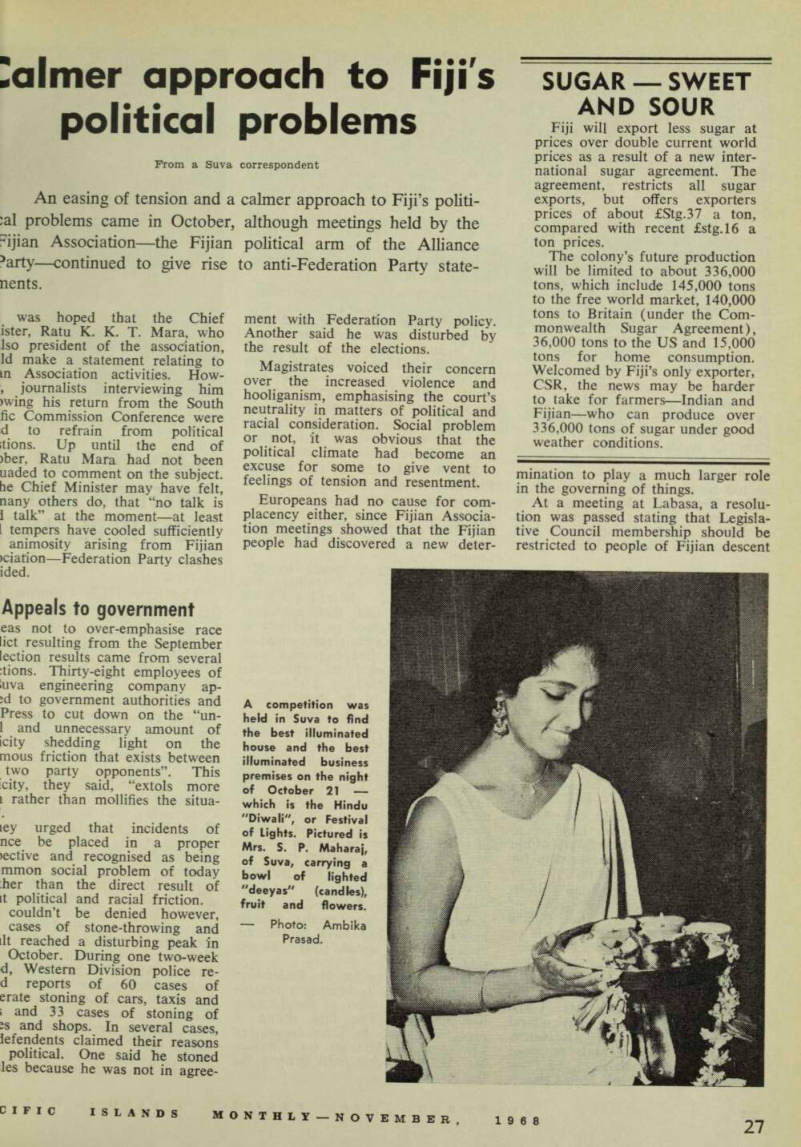
A competition was held in Suva to find the best illuminated house and the best illuminated business premises on the night of October 21 which is the Hindu "Diwali", or Festival of Lights. Pictured is Mrs. S. P. Mahara[?], of Suva, carrying a bowl of lighted "deeyas" (candles), fruit and flowers.
Photo: Ambika Prasad.
through either the maternal or paternal side.
“This is in keeping with the rules of the Indian Parliament, where persons other than Indians are not eligible for membership,” the resolu tion stated.
“Using the same principle the Fiji Legislature should be open only to persons who have a trace of Fijian blood.”
The meeting decided that big businesses like South Pacific Sugar Mills, Carpenters, Burns Philp, Morris Hedstrom, Millers, the in surance companies and banks and town councils, township boards and the government should strike a racial balance between Indians and Fijians, department by department—“even if by so doing the standard of efficiency suffers slightly”.
Other resolutions approved were: • Indians who had lived for seven years or more in Fiji should not be issued with a Fiji passport. Their right to reside by virtue of being resident for seven years should be “unilaterally abrogated” and they should be given six months to leave Fiji. Those of this category in employment in the government and commerce should be dismissed and their positions filled by Fijians.
Deportation
• Those not descended from in dentured labourers should have their names removed from the electoral role so that they may not be an elector or a candidate in national or local elections. • Those descended from in dentured labourers should be kept under surveillance—if it is estab lished that their activities “are not consistent with the general desire for good neighbourliness and good race relations, they should be given six months’ notice to leave Fiji”. • Legislation should be intro duced to limit Indian families to three children. Deportation within six months would be the penalty for failure to comply with this.
At the Fijian Association’s meet ing at Tavuki, on the island of Kadavu, it was stated that Fijians of Kadavu did not want officials or even members of the Federation Party to set foot there.
The meeting also repeated earlier demands for the deportation of the Federation Party leader, Mr. A. D.
Patel, repeal of the Agricultural Landlord and Tenant Ordinance, abolition of the two seats proposed for Indians on the Native Land Trust Board, no renewal of Indian leases
and no common roll until the Fijians were ready for it. It opposed immediate independence, but sup ported internal self-government.
The Federation Party was quick to challenge the legality of the deportation demands, stating that deportees would be the responsibility of the United Kingdom Government —which would have to defend such action in the United Nations.
Furthermore, it stated, India would be under no obligation to take back any of the British Indians who had gone aboard and who were no longer citizens of “Free India”.
A high official in the government agreed with the illegality of deporta tion. “These demands absolutely cannot be implemented—they carry no legality whatsoever,” he said.
“You cannot deport people en masse like that—you can’t even deport one person without very good reason, certainly not for political beliefs.
“All these resolutions do is express the very strong feelings of a certain section of the Fijian community.”
The Suva branch of the General Electors’ Association passed a unanimous resolution at its annual meeting in Suva on October 22, opposing any reduction in General Electors’ seats in the Legislative Council.
This following a speech by Mr.
Charles Stinson, the Minister for Communications, Works and Tourism, who said that last year ministers had agreed in principle to consider reducing their representation —and that the time to accept such a reduction would be when dis cussions were held in London on further changes to the constitution.
Mr. Stinson said the decision had been reached at a time when ministers considered that racial understanding of politics in Fiji was improving. It was reached before the walk-out of the Opposition at the Legislative Council, before the intro duction of policies of boycott and non-co-operation with representatives of other races and before the launch ing of a “vicious campaign based on racial and class hatred and personal abuse of opponents”.
“I have been disturbed by these events and by the results of the by-elections. They have caused me to change my mind,” Mr. Stinson said.
It still remains for the Federation Party to reveal its intentions regard ing the next session of the Legisla tive Council. The first sitting is expected to be held on November 22, when the Minister for Finance, Mr. H. P. Ritchie, will present his Budget report.