Cruising Yachts
pp. 105-109 · Read in the full issue
Pacific Shipping And Cruising Yachts
Micronesian shipping contract will mean big improvements
Marine Chartering Co., Inc., of San Francisco, California, las won an agreement with the United States Government for , shipping route from the US to the US Trust Territory and rithin the Trust Territory.
he company beat six other pro ds to run the service—one of the Id’s longest shipping routes. larine Chartering will form a oration called Micronesia Inter m Line Inc., which will give six its 12 board appointments to ronesians. Shares in the new pany will be offered to Micro ms and already people and busi concerns in the Trust Territory 5 indicated they would buy 250,000 worth. lands the new service is expected connect include Koror, Rota, cus, Saipan, Jaluit, Ponape, ffthuap, Kusaie, Yap, Eniwetok, Liro, Kwajalein and Truk. ans include replacing the govern t-owned World War II ships now jrvice in the first year of opera and setting up more frequent at all major ports in the iana, Marshall and Caroline ids. It is also hoped to train •onesians as seamen and steve s and improve wharf handling ities at Micronesian ports. ne plan, “to provide a direct ce to the easternmost districts”
IS ports could adversely affect a ing trade built up by the GEIC’s lesale Society over the last two s between Tarawa and Majuro, ihalls. creasing supplies of Australian Is have been filtering into the >halls via Wholesale Society :1s (worth 5A300,000 last year), e official disapproval of US com e. icronesia’s new sea transporta system, due to start right away, ly follows its new aircraft ces, also begun this year. arine Chartering already has a i in the South Pacific; an as
sociate company is general agent for the Polynesia Line Ltd., which regularly services Papeete and Pago Pago with the motor vessel Graziella Zeta.
They've Invited People
To Build That Wharf
Vila’s deepwater wharf, the most talked-about unbuilt wharf in the Pacific Islands in recent years, came a step closer to reality in September when tenders were called by the New Hebrides Condominium for its con struction.
Wilton and Bell Dobbie and Partners, consulting civil engineers to the condominium, have recom mended that the 700 ft wharf be
built to the south of Vila township, in Pontoon Bay.
A dozen contractors from Aus tralia, Britain and France are ex pected to submit tenders which close on November 14.
Overseas vessels to Vila have always had to anchor about half a mile offshore and offload cargo into slow and small lighters because, in contrast to its sister port, Luganville, Santo, Vila has never had a deep-
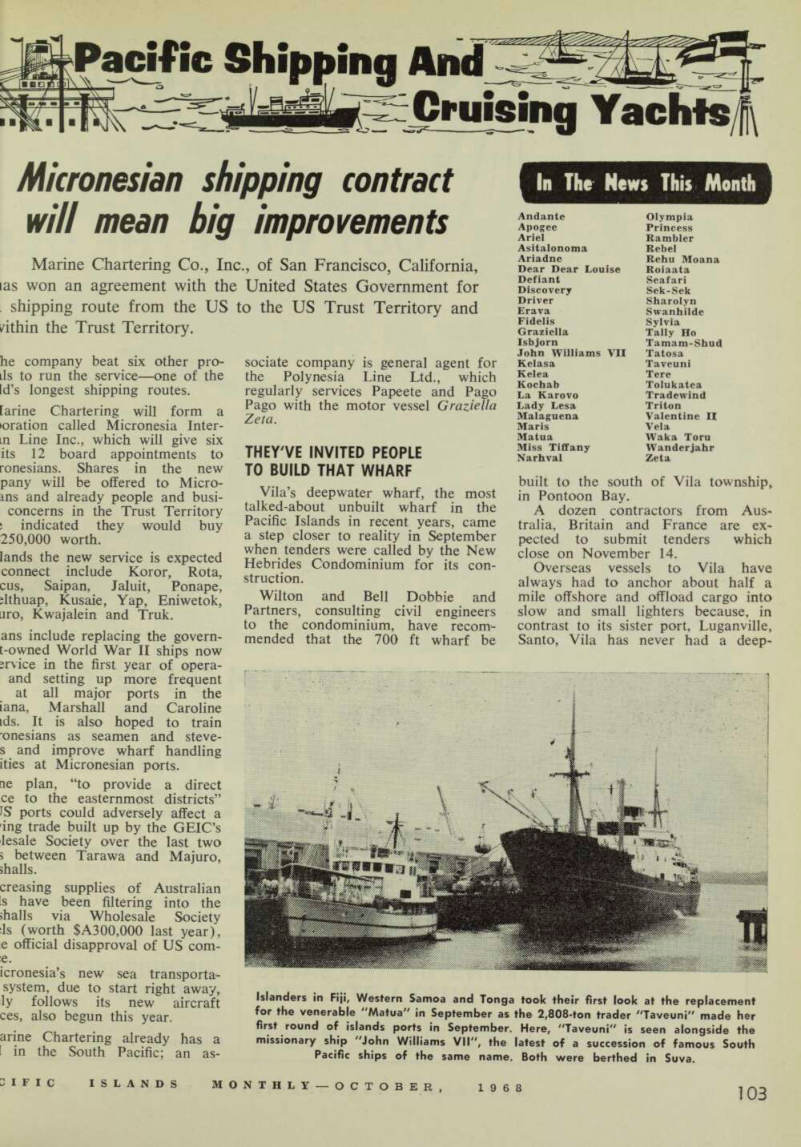
Islanders in Fiji, Western Samoa and Tonga took their first look at the replacement for the venerable "Matua" in September as the 2,808-ton trader "Taveuni" made her first round of islands ports in September. Here, "Taveuni" is seen alongside the missionary ship "John Williams VII", the latest of a succession of famous South Pacific ships of the same name. Both were berthed in Suva.
iter wharf capable of handling even tall ocean-going freighters.
Thus Santo has excellent deepwater larf facilities while Vila, the ministrative capital and far bigger atre, has not.
A Vila wharf would boost tourism cause cruise liners would be able berth easily. All the cruise ship erators are after new island stops the South Pacific and two—Sitmar d Matson are already making dr first appearances in Vila late s year.
In late 1964 the estimated cost of ; wharf, a cargo shed and access ids, was £Stg.soo,ooo. Costs since ;n presumably have risen consider ly but the condominium today has Dbably never been in a better sition to foot the bill—with the momy booming last year.
J Shipping Future
R Pago?
Could Pago Pago rival Suva as : Pacific Islands’ major shipping nsportation terminal in the 1970’s 1980’s?
Not if Fiji can possibly help it, t if hopes expressed to PlM’s ship ig roundsman in Pago Pago re itly come to fruition, Suva could d herself fighting a battle in the ning days of bigger ships and con aerisation.
Phis Pago Pago thinking is essenti / long-term, when markets of the cific Islands are expected to have >wn significantly to a stage when itainerised vessels on trans-Pacific ites make only one stop-over in the ith Pacific to offload cargo de led for four or five territories.
Cargoes would be off-loaded in itainers and then trans-shipped by ders to other ports, giving the itainerised vessels a faster cross . With Fiji by far the biggest itral market, the days when Fiji go is off-loaded at Pago Pago, if t, seem as far off as at present.
Fhe US has long regarded Pago ?o, with its huge sheltered bay, tow entrance and extensive deep ter facilities, as the best island hour in the South Pacific. This is ictly why Tutuila was originally imed by America. some Americans now argue that »o Pago Harbour, since its con l was taken from the US Navy the US Department of the In ior 17 years ago, has been fleeted as a potential trans-ship nt centre for American, Australian New Zealand goods bound for er bigger Pacific Islands markets, h as Western Samoa, Tonga and i.
Mr. John Calver, 51, master of
American Samoa’s new government seagoing tug, Tatosa, believes Pago Pago has a “great future” with new “monster” ships scheduled to reach the South Pacific in coming years.
He said at a cost of a “few thousand dollars”, coral heads and obstructions could be cleared from Pago Pago Harbour to widen the entrance of the harbour to four times the width.
Mr. Calver said the harbour’s new terminal and oil dock could already take big liners and tankers with drafts of over 30 feet. With addi tional dredging and coral clearing
Pago Pago could berth ships with “great drafts of up to 42 feet.”
“I believe that the money the US has been putting into American Samoa should be more directed to the territory’s prime usefulness—a sea transportation terminal—if Ameri can Samoa is ever going to amount to anything,” he said.
Suva, Mr. Calver felt, would grow as a business centre and Pago Pago would grow as a port. The Govern ment of American Samoa should recognise this, and exploit Pago Pago’s harbour facilities now, he said.
Producing Ferro
Icrete Vessels
Fiji Airways pilot with little ious experience in boat building gone into the ferro-concrete boat ling business, successfully build craft with a hard-chine hull, e is Mr. James H. Mair, formerly lydney, who has been in Fiji for and a half years. Before that, spent five years as a navigator Air New Zealand. r iss Tiffany, a34ft 6 in., £7,500 e fishing cruiser named after his thter and built by him at Nausori yard, was launched on the Rewa :r in September. She was christ -I—with a glass of beer over her s—by Fiji’s Minister for Com ications, Works and Tourism, C. A. Stinson, who took the op unity to hint that government tance might soon be available locally-built boats intended for ism. r. Stinson said import duty was be reimposed on similar craft ght in from overseas—a measure pied to encourage the local stry. Craft like Miss Tiffany, he were certain to be forerunners xtensive boat-building operations Fiji tourism. r. Mair’s new company, Ferro t Limited, was registered in Fiji LUgUSt. e has already received a firm r for a 38 ft ferro-concrete diesel and industrial concerns in Fiji shown interest in at least three r tugs. There have also been •us inquiries about two house s, a catamaran capable of carry -40 passengers and intended for as a sightseeing craft in the iwas, and the possibility of build a number of 200 ft ocean-going
cargo barges of ferro-concrete.
“Experiments carried out while we were building Miss Tiffany proved that it’s possible—using new tech niques—to produce a hard-chined hull that is lighter, stronger and more economical than a conventional timber-planked hull,” Mr, Mair said.
“Given a more favourable tariff entry into Australia there seems no reason why these hulls cannot be exported there and to other island territories.”
Miss Tiffany has been fitted with the latest gamefishing equipment, to standards laid down by the Inter national Game Fishing Association.
She has one double and four single berths, plus air conditioning, an automatic fresh water system, 7 ft
headroom, shower and toilet, dual control and an aft platform with entry doors for skin-diving parties, The craft can cruise for 10 days without refuelling and carries sufficient lifesaving and medical equipment including an automatic inflatable lifecraft, to ensure safety for 29 passengers. She is powered with a 130 b.h.p. Perkins diesel, Miss Tiffany will be based at Suva and made available for game-fishing and cruising charter. Mr. Mair said that, depending upon capital, his company intends to open a number of fishing lodges on islands near to Suva. Negotiations are still under way, but it is expected that construc tion of the first lodge will begin before the end of the year.
[?]s Tiffany", after her launching on Rewa River. — Photo: Stan Whippy.