war in the Pacific
pp. 101-103 · Read in the full issue
New assessment of the war in the Pacific
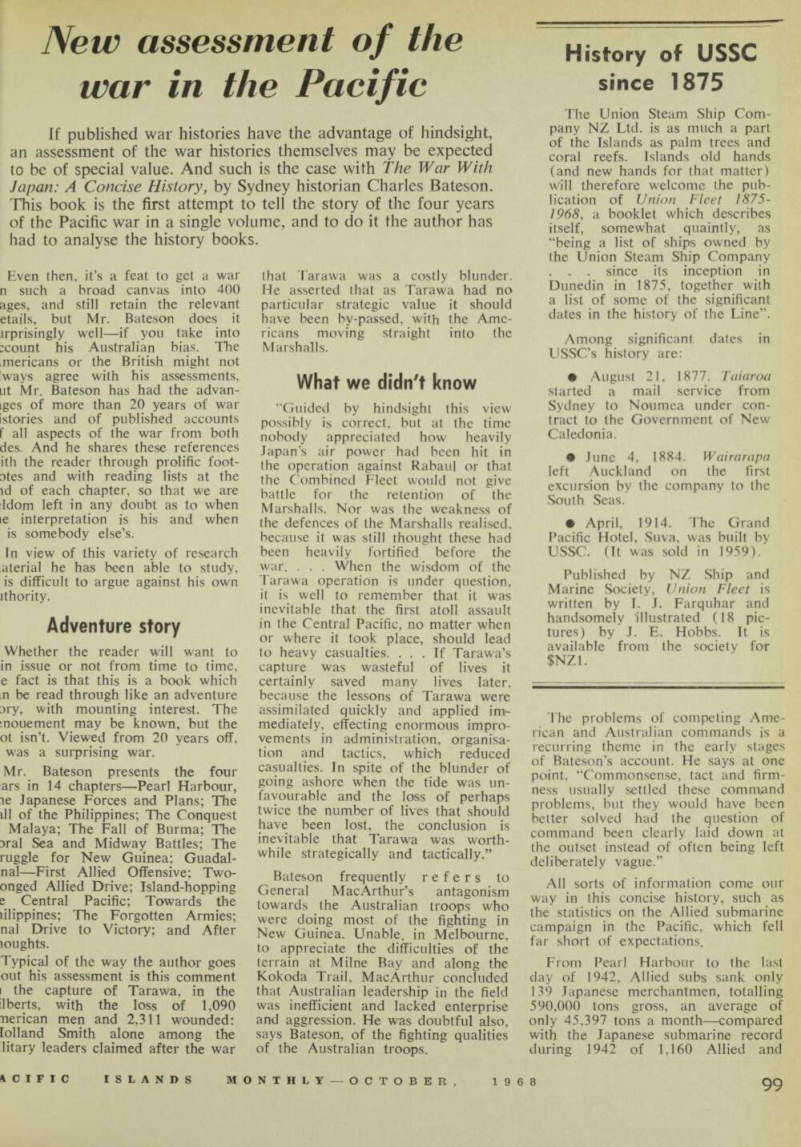
If published war histories have the advantage of hindsight, an assessment of the war histories themselves may be expected to be of special value. And such is the case with The War With Japan: A Concise History, by Sydney historian Charles Bateson.
This book is the first attempt to tell the story of the four years of the Pacific war in a single volume, and to do it the author has had to analyse the history books.
Even then, it’s a feat to get a war n such a broad canvas into 400 ages, and still retain the relevant etails, but Mr. Bateson does it irprisingly well—if you take into :count his Australian bias. The mericans or the British might not ways agree with his assessments, ut Mr. Bateson has had the advan iges of more than 20 years of war istories and of published accounts f all aspects of the war from both des. And he shares these references ith the reader through prolific foot- Dtes and with reading lists at the id of each chapter, so that we are Idom left in any doubt as to when ic interpretation is his and when is somebody else’s.
In view of this variety of research aterial he has been able to study, is difficult to argue against his own ithority.
Adventure story
Whether the reader will want to in issue or not from time to time, e fact is that this is a book which m be read through like an adventure Dry, with mounting interest. The mouement may be known, but the ot isn’t. Viewed from 20 years off, was a surprising war.
Mr. Bateson presents the four ars in 14 chapters—Pearl Harbour, ic Japanese Forces and Plans; The ill of the Philippines; The Conquest Malaya; The Fall of Burma; The :>ral Sea and Midway Battles; The ruggle for New Guinea; Guadal nal—First Allied Offensive; Two onged Allied Drive; Island-hopping e Central Pacific; Towards the lilippines; The Forgotten Armies; nal Drive to Victory; and After loughts.
Typical of the way the author goes out his assessment is this comment i the capture of Tarawa, in the ilberts, with the loss of 1,090 uerican men and 2,311 wounded: lolland Smith alone among the litary leaders claimed after the war
that Tarawa was a costly blunder.
He asserted that as Tarawa had no particular strategic value it should have been by-passed, with the Ame ricans moving straight into the Marshalls.
What we didn't know
“Guided by hindsight this view possibly is correct, but at the time nobody appreciated how heavily Japan’s air power had been hit in the operation against Rabaul or that the Combined Fleet would not give battle for the retention of the Marshalls. Nor was the weakness of the defences of the Marshalls realised, because it was still thought these had been heavily fortified before the war. . . . When the wisdom of the Tarawa operation is under question, it is well to remember that it was inevitable that the first atoll assault in the Central Pacific, no matter when or where it took place, should lead to heavy casualties. ... If Tarawa’s capture was wasteful of lives it certainly saved many lives later, because the lessons of Tarawa were assimilated quickly and applied im mediately, effecting enormous impro vements in administration, organisa tion and tactics, which reduced casualties. In spite of the blunder of going ashore when the tide was un favourable and the loss of perhaps twice the number of lives that should have been lost, the conclusion is inevitable that Tarawa was worth while strategically and tactically.”
Bateson frequently refers to General MacArthur’s antagonism towards the Australian troops who were doing most of the fighting in New Guinea. Unable, in Melbourne, to appreciate the difficulties of the terrain at Milne Bay and along the Kokoda Trail, MacArthur concluded that Australian leadership in the field was inefficient and lacked enterprise and aggression. He was doubtful also, says Bateson, of the fighting qualities of the Australian troops.
The problems of competing Ame rican and Australian commands is a recurring theme in the early stages of Bateson’s account. He says at one point, “Commonsense, tact and firm ness usually settled these command problems, but they would have been better solved had the question of command been clearly laid down at the outset instead of often being left deliberately vague.”
All sorts of information come our way in this concise history, such as the statistics on the Allied submarine campaign in the Pacific, which fell far short of expectations.
From Pearl Harbour to the last day of 1942, Allied subs sank only 139 Japanese merchantmen, totalling 590,000 tons gross, an average of only 45,397 tons a month—compared with the Japanese submarine record during 1942 of 1,160 Allied and
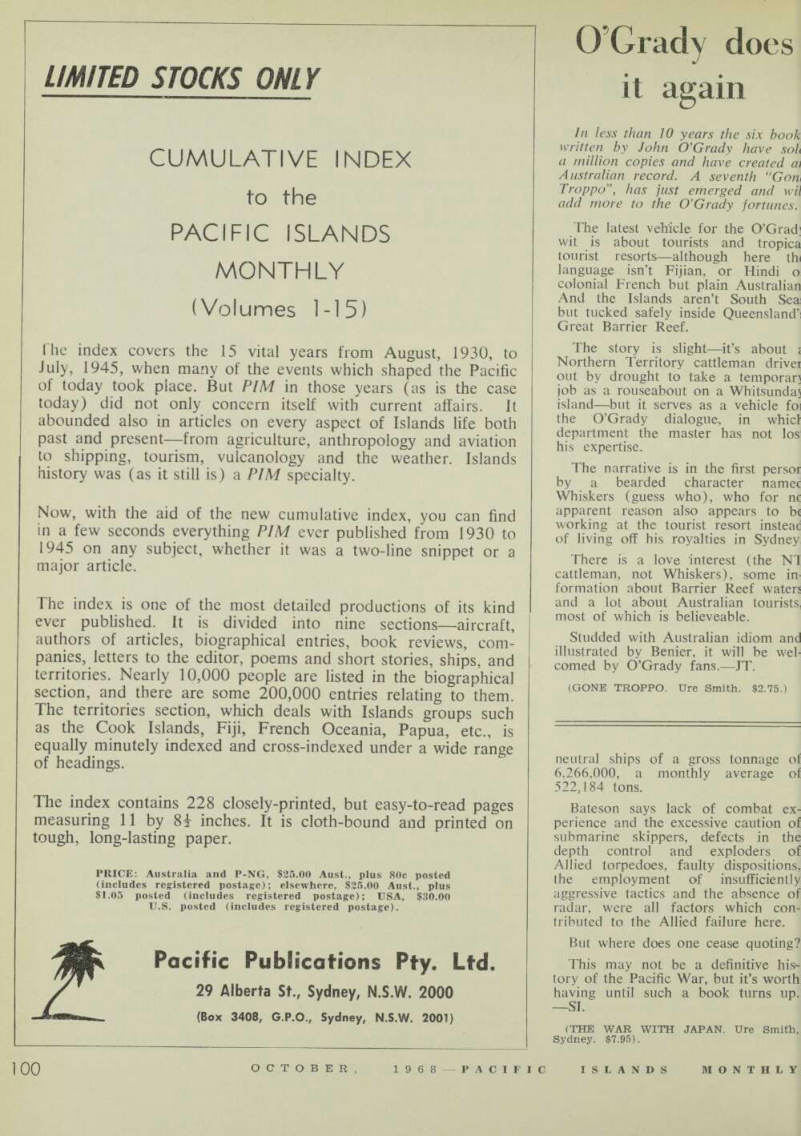
neutral ships of a gross tonnage of 6,266,000, a monthly average of 522,184 tons.
Bateson says lack of combat ex perience and the excessive caution of submarine skippers, defects in the depth control and exploders of Allied torpedoes, faulty dispositions, the employment of insufficiently aggressive tactics and the absence of radar, were all factors which con tributed to the Allied failure here.
But where does one cease quoting?
This may not be a definitive his tory of the Pacific War, but it’s worth having until such a book turns up.
SI.
(The War With Japan. Ure Smith,
Sydney. $7.95).
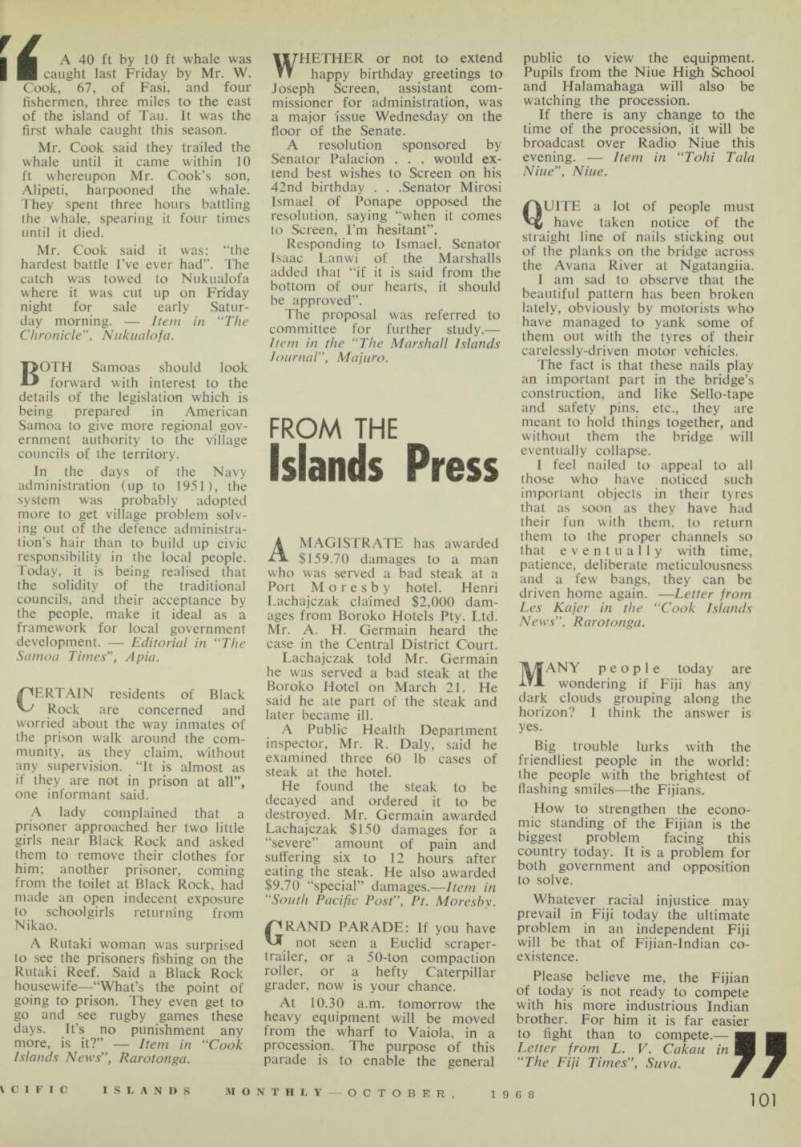
A 40 ft by 10 ft whale was ■ caught last Friday by Mr. W.
Cook, 67, of Fasi, and four fishermen, three miles to the east of the island of Tau. It was the first whale caught this season.
Mr. Cook said they trailed the whale until it came within 10 ft whereupon Mr. Cook’s son, Alipeti, harpooned the whale.
They spent three hours battling the whale, spearing it four times until it died.
Mr. Cook said it was: “the hardest battle I’ve ever had”. The catch was towed to Nukualofa where it was cut up on Friday night for sale early Satur day morning. Item in “The Chronicle”, Nukualofa.
BOTH Samoas should look forward with interest to the details of the legislation which is being prepared in American Samoa to give more regional gov ernment authority to the village councils of the territory.
In the days of the Navy administration (up to 1951), the system was probably adopted more to get village problem solv ing out of the defence administra tion’s hair than to build up civic responsibility in the local people.
Today, it is being realised that the solidity of the traditional councils, and their acceptance by the people, make it ideal as a framework for local government development. Editorial in “The Samoa Times”, Apia.
CERTAIN residents of Black Rock are concerned and worried about the way inmates of the prison walk around the com munity, as they claim, without any supervision. “It is almost as if they are not in prison at all”, one informant said.
A lady complained that a prisoner approached her two little girls near Black Rock and asked them to remove their clothes for him; another prisoner, coming from the toilet at Black Rock, had made an open indecent exposure to schoolgirls returning from Nikao.
A Rutaki woman was surprised to see the prisoners fishing on the Rutaki Reef. Said a Black Rock housewife—“ What’s the point of going to prison. They even get to go and see rugby games these days. It’s no punishment any more, is it?” Item in “Cook Islands News”, Rarotonga.
WHETHER or not to extend happy birthday greetings to Joseph Screen, assistant com missioner for administration, was a major issue Wednesday on the floor of the Senate.
A resolution sponsored by Senator Palacion . . . would ex tend best wishes to Screen on his 42nd birthday . . .Senator Mirosi Ismael of Ponape opposed the resolution, saying “when it comes to Screen, I’m hesitant”.
Responding to Ismael, Senator Isaac Lanwi of the Marshalls added that “if it is said from the bottom of our hearts, it should be approved”.
The proposal was referred to committee for further study.— Item in the “The Marshall Islands Journal”, Majuro.
From The
Islands Press
A MAGISTRATE has awarded $159.70 damages to a man who was served a bad steak at a Port Moresby hotel. Henri Lachajczak claimed $2,000 dam ages from Boroko Hotels Pty. Ltd.
Mr. A. H. Germain heard the case in the Central District Court.
Lachajczak told Mr. Germain he was served a bad steak at the Boroko Hotel on March 21. He said he ate part of the steak and later became ill.
A Public Health Department inspector, Mr. R. Daly, said he examined three 60 lb cases of steak at the hotel.
He found the steak to be decayed and ordered it to be destroyed. Mr. Germain awarded Lachajczak $l5O damages for a “severe” amount of pain and suffering six to 12 hours after eating the steak. He also awarded $9.70 “special” damages.— ltem in “South Pacific Post”, Pt. Moresby.
GRAND PARADE: If you have not seen a Euclid scraper trailer, or a 50-ton compaction roller, or a hefty Caterpillar grader, now is your chance.
At 10.30 a.m. tomorrow the heavy equipment will be moved from the wharf to Vaiola, in a procession. The purpose of this parade is to enable the general
public to view the equipment.
Pupils from the Niue High School and Halamahaga will also be watching the procession.
If there is any change to the time of the procession, it will be broadcast over Radio Niue this evening. Item in “Tohi Tala Niue”, Niue.
QUITE a lot of people must have taken notice of the straight line of nails sticking out of the planks on the bridge across the Avana River at Ngatangiia.
I am sad to observe that the beautiful pattern has been broken lately, obviously by motorists who have managed to yank some of them out with the tyres of their carelessly-driven motor vehicles.
The fact is that these nails play an important part in the bridge’s construction, and like Sello-tape and safety pins, etc., they are meant to hold things together, and without them the bridge will eventually collapse.
I feel nailed to appeal to all those who have noticed such important objects in their tyres that as soon as they have had their fun with them, to return them to the proper channels so that eventually with time, patience, deliberate meticulousness and a few bangs, they can be driven home again. — Letter from Les Kajer in the “Cook Islands News”, Rarotonga.
MANY people today are wondering if Fiji has any dark clouds grouping along the horizon? I think the answer is yes.
Big trouble lurks with the friendliest people in the world: the people with the brightest of flashing smiles—the Fijians.
How to strengthen the econo mic standing of the Fijian is the biggest problem facing this country today. It is a problem for both government and opposition to solve.
Whatever racial injustice may prevail in Fiji today the ultimate problem in an independent Fiji will be that of Fijian-Indian co existence.
Please believe me, the Fijian of today is not ready to compete with his more industrious Indian brother. For him it is far easier to fight than to compete.— mm ■■ Letter from L. V. Cakau in H ‘‘The Fiji Times”, Suva. J J