Book Reviews
pp. 97-99 · Read in the full issue
Vivid reminiscences of a New Guinea district officer
G. W. L. Townsend, known throughout his New Guinea career as Kassa Townsend, was one of those stalwarts of Empire who are now virtually extinct because (thanks partly to them) the world has become too safe, civilised and well-organised to have need of them.
For more than 20 years, Townsend ved in the old Mandated Territory New Guinea as a patrol officer, ing deputy district officer, acting trict officer and finally district icer.
His headquarters for long periods re in the wildest and most isolated ces at the Back of Beyond, where Uen tracks did not exist, where low Europeans were few, and ere unpredictable, headhunting ives were numerous. \bout nine years of his career re spent in the uninviting Sepik strict, where, almost single-handed, brought law and spread Govem nt influence to some 20,000 square es of untamed, unmapped and le known country. His chief job 5 to stamp out inter-tribal fight and the practice of taking heads.
"Agin the Government"
t was a job for only the hardiest I most determined of spirits, as Sepik people were “agin the vernment” for the very good son that the Government (i.e., vnsend) interfered with customs ich they wished to preserve.
They were determined to con ic their old ways. I was deter led to stop them,” Townsend says his vivid, posthumous auto graphy, District Officer.
So it developed into a game, the ;s of which they understood very -kly, and as quickly turned to ir own advantage.
They learned that they could k;e all their preparations—even let r intentions be known abroad— that, according to the rules of /ernment which I followed, I ild be unable to take any action inst them until such time as a I or a fight had actually taken :e.
“On several occasions I arrived at a village to find that they were mak ing new ceremonial carvings in con nection with a projected head-hunting raid or tribal war. I was even permitted to see them and the sago palm leaf that was being sewn together to partition a part of the House Tambaran for one of their nefarious purposes.
Impasse
“At these times I would sit down among the old men of the village and argue the Government’s position and point out that Government’s idea of law and order did not include either head-taking or war between neighbours.
“It made no difference. Just as strongly the elders would point out, perfectly logically as far as they were
concerned, that there was now an increasing number of young men in the village who had not taken their heads and therefore could not get married or take their places in the community.”
Having reached this impasse, and being unable to station sufficient police in the district to “prevent what we called crime and what these people regarded as a way of life”, Townsend would fall back on what became a well-known warning—that if the people killed, the Government would hang them.
Occasionally, it seems, Townsend’s warnings had the desired effect. But three times, during his time in the Sepik, various villages went on head hunting sprees in direct defiance of his warnings.
On each occasion, Townsend and his native police went in relentless
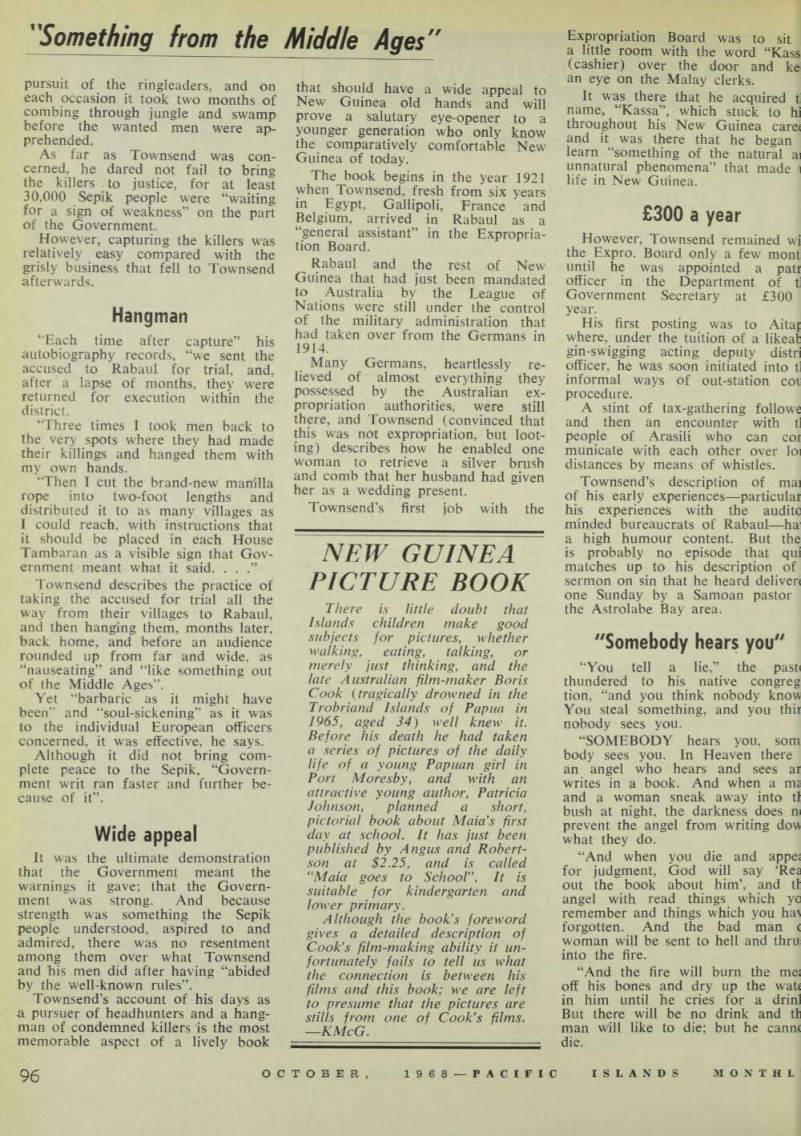
Kassa Townsend.
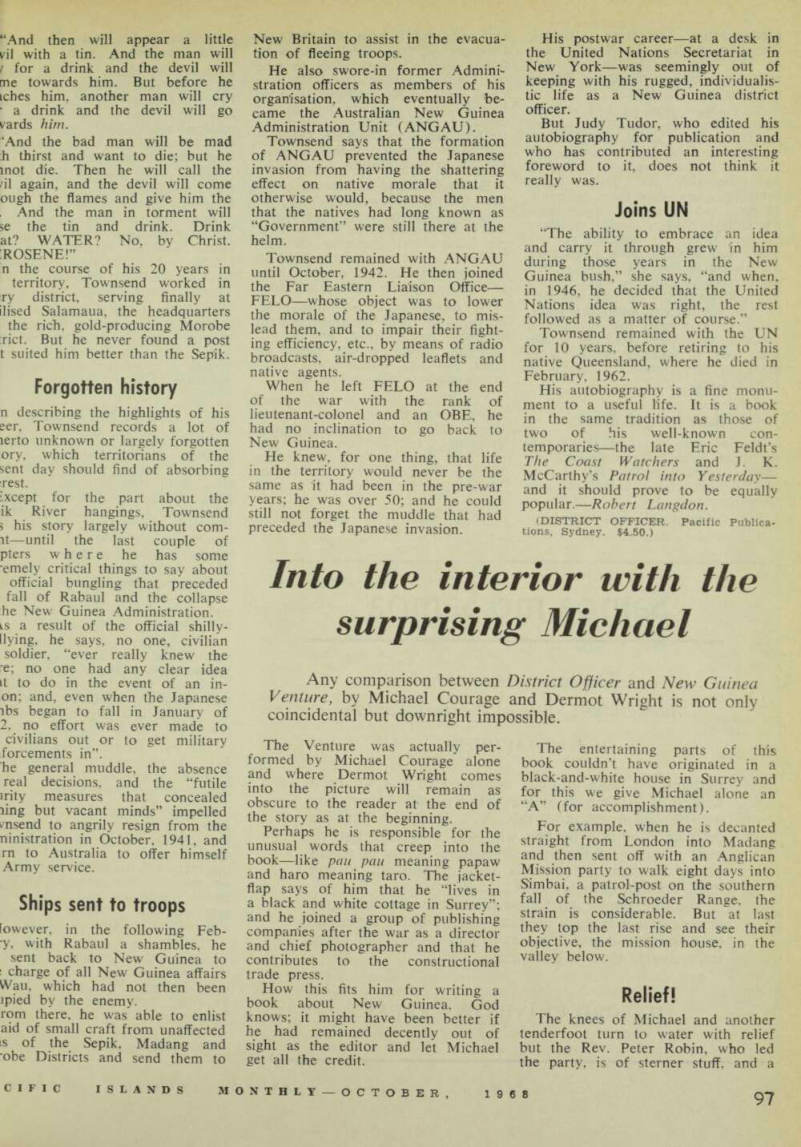
Wewak as it was in 1937, when Kassa Townsend was bringing law and order to the Sepik.
''Something from the Middle "
pursuit of the ringleaders, and on each occasion it took two months of combing through jungle and swamp before the wanted men were ap prehended.
As far as Townsend was con cerned, he dared not fail to bring the killers To justice, for at least 30,000 Sepik people were “waiting for a sign of weakness” on the part of the Government.
However, capturing the killers was relatively easy compared with the grisly business that fell to Townsend afterwards.
Hangman
“Each time after capture” his autobiography records, “we sent the accused to Rabaul for trial, and, after a lapse of months, they were returned for execution within the district.
“Three times I took men back to the very spots where they had made their killings and hanged them with my own hands.
“Then I cut the brand-new manilla rope into two-foot lengths and distributed it to as many villages as I could reach, with instructions that it should be placed in each House Tambaran as a visible sign that Gov ernment meant what it said. ...”
Townsend describes the practice of taking the accused for trial all the way from their villages to Rabaul, and then hanging them, months later, back home, and before an audience rounded up from far and wide, as “nauseating” and “like something out of the Middle Ages”.
Yet “barbaric as it might have been” and “soul-sickening” as it was to the individual European officers concerned, it was effective, he says.
Although it did not bring com plete peace to the Sepik, “Govern ment writ ran faster and further be cause of it”.
Wide appeal
It was the ultimate demonstration that the Government meant the warnings it gave; that the Govern ment was strong. And because strength was something the Sepik people understood, aspired to and admired, there was no resentment among them over what Townsend and his men did after having “abided by the well-known rules”.
Townsend’s account of his days as a pursuer of headhunters and a hang man of condemned killers is the most memorable aspect of a lively book
that should have a wide appeal to New Guinea old hands and will prove a salutary eye-opener to a younger generation who only know the comparatively comfortable New Guinea of today.
The book begins in the year 1921 when Townsend, fresh from six years in Egypt, Gallipoli, France and Belgium, arrived in Rabaul as a “general assistant” in the Expropria tion Board.
Rabaul and the rest of New Guinea that had just been mandated to Australia by the League of Nations were still under the control of the military administration that had taken over from the Germans in 1914.
Many Germans, heartlessly re lieved of almost everything they possessed by the Australian ex propriation authorities, were still there, and Townsend (convinced that this was not expropriation, but loot ing) describes how he enabled one woman to retrieve a silver brush and comb that her husband had given her as a wedding present.
Townsend’s first job with the
Expropriation Board was to sit a little room with the word “Kass (cashier) over the door and ke an eye on the Malay clerks.
It was there that he acquired t name, “Kassa”, which stuck to hi throughout his New Guinea care( and it was there that he began learn “something of the natural ai unnatural phenomena” that made i life in New Guinea.
£3OO a year
However, Townsend remained wi the Expro. Board only a few mont until he was appointed a patr officer in the Department of tl Government Secretary at £3OO year.
His first posting was to Aitap where, under the tuition of a likeafc gin-swigging acting deputy distri officer, he was soon initiated into ti informal ways of out-station cor procedure.
A stint of tax-gathering followe and then an encounter with t] people of Arasili who can cor municate with each other over loi distances by means of whistles.
Townsend’s description of mai of his early experiences—particular his experiences with the auditc minded bureaucrats of Rabaul—ha' a high humour content. But the is probably no episode that qui matches up to his description of sermon on sin that he heard deliver* one Sunday by a Samoan pastor the Astrolabe Bay area.
"Somebody hears you"
“You tell a lie,” the pash thundered to his native congreg tion, “and you think nobody know You steal something, and you thir nobody sees you.
“SOMEBODY hears you, som body sees you. In Heaven there an angel who hears and sees ar writes in a book. And when a ms and a woman sneak away into tl bush at night, the darkness does n< prevent the angel from writing dow what they do.
“And when you die and appe< for judgment, God will say ‘Rea out the book about him’, and tl angel with read things which yo remember and things which you ha\ forgotten. And the bad man c woman will be sent to hell and thru: into the fire.
“And the fire will burn the mei off his bones and dry up the wate in him until he cries for a drinl But there will be no drink and th man will like to die; but he canm die.
“And then will appear a little yil with a tin. And the man will I for a drink and the devil will me towards him. But before he iches him, another man will cry • a drink and the devil will go vards him. ‘And the bad man will be mad h thirst and want to die; but he mot die. Then he will call the dl again, and the devil will come ough the flames and give him the And the man in torment will se the tin and drink. Drink at? WATER? No, by Christ.
Rosene!”
n the course of his 20 years in territory, Townsend worked in ry district, serving finally at ilised Salamaua, the headquarters the rich, gold-producing Morobe rict. But he never found a post t suited him better than the Sepik.
Forgotten history
n describing the highlights of his eer, Townsend records a lot of icrto unknown or largely forgotten ory, which territorians of the sent day should find of absorbing rest.
Except for the part about the ik River hangings, Townsend s his story largely without com it—until the last couple of pters where he has some emely critical things to say about official bungling that preceded fall of Rabaul and the collapse he New Guinea Administration, is a result of the official shilly llying, he says, no one, civilian soldier, “ever really knew the *e; no one had any clear idea it to do in the event of an in on; and, even when the Japanese ibs began to fall in January of 2, no effort was ever made to civilians out or to get military forcements in”. he general muddle, the absence real decisions, and the “futile irity measures that concealed ling but vacant minds” impelled msend to angrily resign from the ninistration in October. 1941, and rn to Australia to offer himself Army service.
Ships sent to troops
[owever, in the following Feb •y, with Rabaul a shambles, he sent back to New Guinea to ; charge of all New Guinea affairs SVau, which had not then been jpied by the enemy, rom there, he was able to enlist aid of small craft from unaffected is of the Sepik, Madang and obe Districts and send them to
New Britain to assist in the evacua tion of fleeing troops.
He also swore-in former Admini stration officers as members of his organisation, which eventually be came the Australian New Guinea Administration Unit (ANGAU), Townsend says that the formation of ANGAU prevented the Japanese invasion from having the shattering effect on native morale that it otherwise would, because the men that the natives had long known as “Government” were still there at the helm.
Townsend remained with ANGAU until October, 1942. He then joined the Far Eastern Liaison Office— FELO—whose object was to lower the morale of the Japanese, to mis lead them, and to impair their fight ing efficiency, etc., by means of radio broadcasts, air-dropped leaflets and native agents.
When he left FELO at the end of the war with the rank of lieutenant-colonel and an OBE, he had no inclination to go back to New Guinea.
He knew, for one thing, that life in the territory would never be the same as it had been in the pre-war years; he was over 50; and he could still not forget the muddle that had preceded the Japanese invasion.
His postwar career—at a desk in the United Nations Secretariat in New York —was seemingly out of keeping with his rugged, individualis tic life as a New Guinea district officer.
But Judy Tudor, who edited his autobiography for publication and who has contributed an interesting foreword to it, does not think it really was.
Joins UN
“The ability to embrace an idea and carry it through grew in him during those years in the New Guinea bush,” she says, “and when, in 1946, he decided that the United Nations idea was right, the rest followed as a matter of course.”
Townsend remained with the UN for 10 years, before retiring to his native Queensland, where he died in February, 1962.
His autobiography is a fine monu ment to a useful life. It is a book in the same tradition as those of two of his well-known con temporaries—the late Eric Feldt’s The Coast Watchers and J. K.
McCarthy’s Patrol into Yesterday— and it should prove to be equally popular. —Robert Langdon. (DISTRICT OFFICER. Pacific Publica tions, Sydney. $4.50.)