The Pacific
p. 35 · Read in the full issue
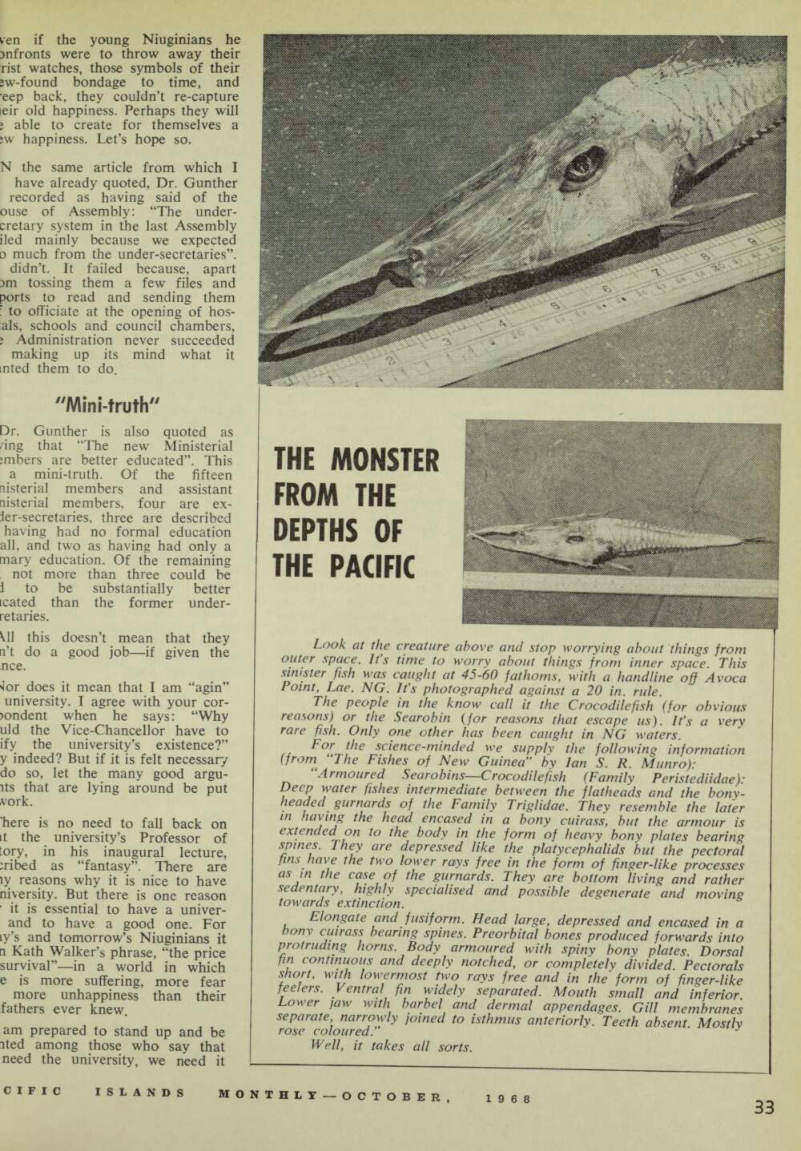
The Monster
From The
Depths Of
The Pacific
Look at the creature above and stop worrying about things from outer space. It’s time to worry about things from inner space. This siwster fish was caught at 45-60 fathoms, with a handline off Avoca Point, Lae, NG. It’s photographed against a 20 in. rule.
The people in the know call it the Crocodile fish (for obvious reasons) or the Searobin (for reasons that escape us). It’s a very rare fish. Only one other has been caught in NG waters.
For the science-minded we supply the following information (from “The Fishes of New Guinea” by lan S. R. Munro): “Armoured Searobins—Crocodilefish (Family PeristediidaeV Deep water fishes intermediate between the flatheads and the bony headed gurnards of the Family Triglidae. They resemble the later in having the head encased in a bony cuirass, but the armour is extended on to the body in the form of heavy bony plates bearing s P ine *- They are depressed like the platycephalids but the pectoral fins have the two lower rays free in the form of finger-like processes as in the case of the gurnards. They are bottom living and rather sedentary, highly specialised and possible degenerate and moving towards extinction.
Elongate and fusiform. Head large, depressed and encased in a bony cuirass bearing spines. Preorbital bones produced forwards into protruding horns. Body armoured with spiny bony plates. Dorsal fin continuous and deeply notched, or completely divided Pectorals short, with lowermost two rays free and in the form of finger-like feelers. Ventral fin widely separated. Mouth small and inferior Lower jaw with barbel and dermal appendages. Gill membranes separate narrowly joined to isthmus anteriorly. Teeth absent. Mostly rose coloured. J Well, it takes all sorts.