P-NG’s Budget meeting
pp. 24-139 · Read in the full issue
was a talk-fest
From a Port Moresby correspondent The second meeting of Papua-New Guinea’s second House of Assembly began on August 26 and ended in the early hours of September 13—making it the longest single meeting in the legislature’s history.
It was the Budget meeting, and the second reading debate on the 1968-69 Budget was easily the longest and dullest on record. Gone were the fire works sent up in former years by Downs, Stuntz and Barrett. Ron Neville occupies lan Downs’ seat opposite the senior official member, Frank Henderson, but if lan Downs’ mantle has fallen on Ron Neville’s shoulders it can hardly be said to be a good fit.
Treasurer Newman listened happily while Ron Neville and Pangu’s leader Michael Somare made, from opposite points of view, criticisms which neatly cancelled each other out. Tony Voutas offered his usual painstaking, slightly academic analysis, a bit above the heads of many of his fellow members.
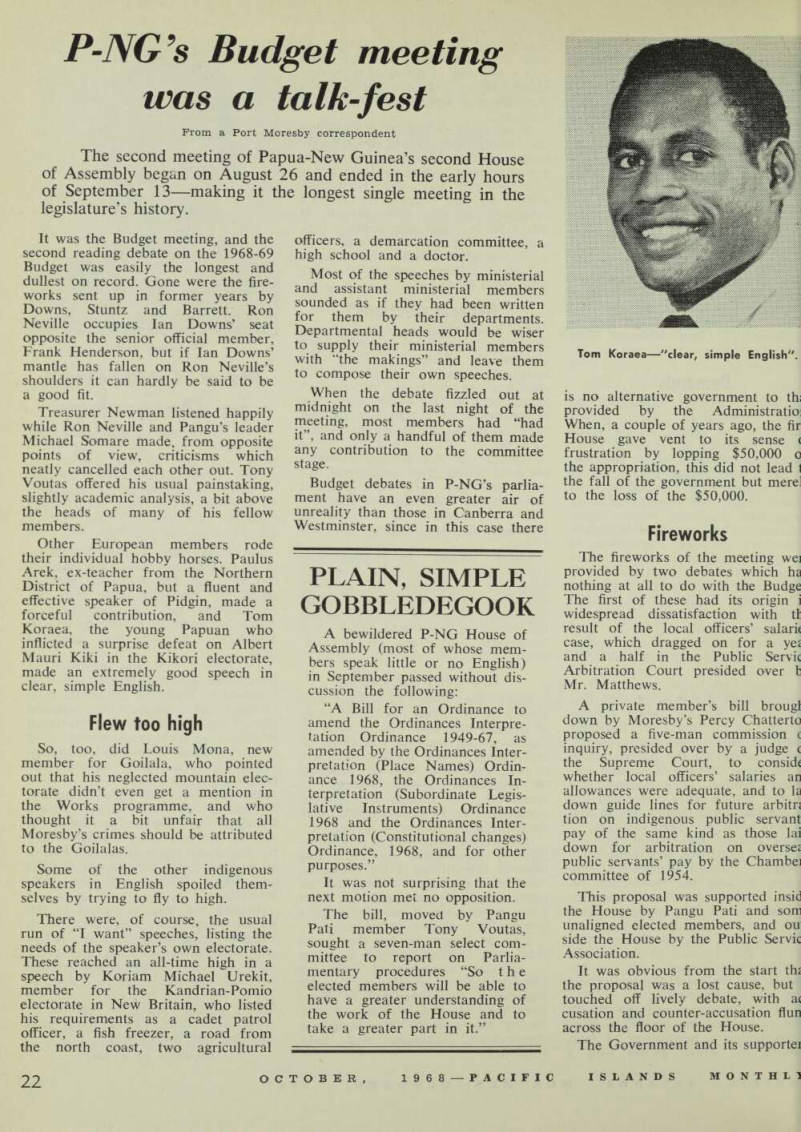
Other European members rode their individual hobby horses. Paulus Arek, ex-teacher from the Northern District of Papua, but a fluent and effective speaker of Pidgin, made a forceful contribution, and Tom Koraea, the young Papuan who inflicted a surprise defeat on Albert Mauri Kiki in the Kikori electorate, made an extremely good speech in clear, simple English.
Flew too high
So, too, did Louis Mona, new member for Goilala, who pointed out that his neglected mountain elec torate didn’t even get a mention in the Works programme, and who thought it a bit unfair that all Moresby’s crimes should be attributed to the Goilalas.
Some of the other indigenous speakers in English spoiled them selves by trying to fly to high.
There were, of course, the usual run of “I want” speeches, listing the needs of the speaker’s own electorate.
These reached an all-time high in a speech by Koriam Michael Urekit, member for the Kandrian-Pomio electorate in New Britain, who listed his requirements as a cadet patrol officer, a fish freezer, a road from the north coast, two agricultural
officers, a demarcation committee, a high school and a doctor.
Most of the speeches by ministerial and assistant ministerial members sounded as if they had been written for them by their departments.
Departmental heads would be wiser to supply their ministerial members with “the makings” and leave them to compose their own speeches.
When the debate fizzled out at midnight on the last night of the meeting, most members had “had it”, and only a handful of them made any contribution to the committee stage.
Budget debates in P-NG’s parlia ment have an even greater air of unreality than those in Canberra and Westminster, since in this case there
is no alternative government to th; provided by the Administrate: When, a couple of years ago, the fir House gave vent to its sense < frustration by lopping $50,000 o the appropriation, this did not lead 1 the fall of the government but mere! to the loss of the $50,000.
Fireworks
The fireworks of the meeting wei provided by two debates which ha nothing at all to do with the Budge The first of these had its origin i widespread dissatisfaction with tf result of the local officers’ salari< case, which dragged on for a ye£ and a half in the Public Servic Arbitration Court presided over t Mr. Matthews.
A private member’s bill brougl down by Moresby’s Percy Chatterto proposed a five-man commission ( inquiry, presided over by a judge c the Supreme Court, to conside whether local officers’ salaries an allowances were adequate, and to la down guide lines for future arbitn tion on indigenous public servant pay of the same kind as those lai down for arbitration on oversee public servants’ pay by the Chambei committee of 1954.
This proposal was supported insid the House by Pangu Pati and som unaligned elected members, and ou side the House by the Public Servic Association.
It was obvious from the start th< the proposal was a lost cause, but touched off lively debate, with a( cusation and counter-accusation flun across the floor of the House.
The Government and its supportei
Tom Koraea—"clear, simple English",
Salary debate was i lost cause
ad no difficulty in defeating the ;cond reading by a substantial lajority; but the fact that 15 elected lembers were sufficiently uneasy on ic issue to abstain from voting, and lat five of these were ministerial id assistant ministerial members, uck out like a sore thumb.
A worried Government indicated at, in spite of its previous in ansigence on the issue of a ultiple bench and an appeal system r Public Service arbitration, it Duld now give sympathetic con leration to a bill on these lines lich Wally Lussick, member for 2w Ireland and Manus Regional, ntemplated bringing down. This Ite-face gave Chatterton an open l for a parting crack to the effect at as an ex-minister of religion he is suspicious of eleventh hour con rsions.
Wally Lussick’s bill was tabled on ' last day of the meeting and will debated in November.
Storm in tea-cup
Lhe second and smaller tea-cup rm was occasioned by a Covena nt bill designed to give the Land les Commission a new look. All portant cases will in future be ird in the first instance by a bench three commissioners instead of by ; sitting alone, and the judges iring appeals will be given more ow room through a wider range grounds for appeal and a wider ge of possible verdicts.
"lo one disagreed with these pro als in principle, though Tony Jtas was concerned to note that Government was advocating in land titles field exactly what it so reluctant to grant in the field Public Service arbitration. •ut a number of members were happy about the new rules for eals being applied to appeals ady lodged against decisions ch had been handed down by the emission, especially as some of 132 appeals currently outstanding e appeals by the Administration f against decisions favouring genous groups. notable example is Port -esby’s, “Newtown” case, where the ministration is appealing against a sion by the Chief Land Titles
Commissioner that an area of land with $2 million worth of improve ments on it actually belongs to a native group and not to the Crown.
Percy Chatterton, in whose baili wick Newtown is situated, objected to the rules of the game being changed at half time to give the losing side a better chance of winning in the second half. Secretary for Law Wally Watkins repudiated the sug gestion that the processes of the courts could be compared with a foot ball match. A substantial majority of members agreed with him, and the bill became law.
However, this victory could boome rang, as it will make it much more difficult for the Government to argue against Wally Lussick’s proposal for a similar structure in Public Service arbitration.
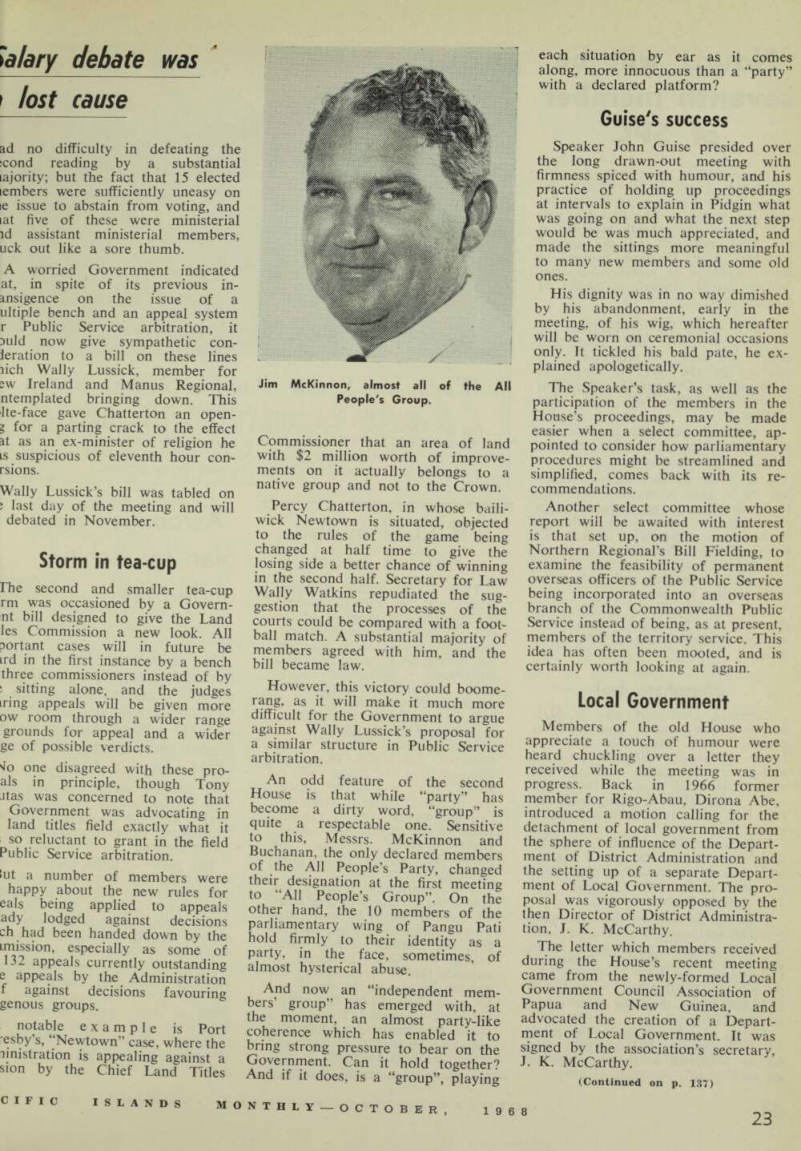
An odd feature of the second House is that while “party” has become a dirty word, “group” is quite a respectable one. Sensitive to this, Messrs. McKinnon and Buchanan, the only declared members of the All People’s Party, changed their designation at the first meeting to “All People’s Group”. On the other hand, the 10 members of the parliamentary wing of Pangu Pati hold firmly to their identity as a party, in the face, sometimes, of almost hysterical abuse.
And now an “independent mem bers’ group” has emerged with, at the moment, an almost party-like coherence which has enabled it to bring strong pressure to bear on the Government. Can it hold together?
And if it does, is a “group”, playing
each situation by ear as it comes along, more innocuous than a “party” with a declared platform?
Guise's success
Speaker John Guise presided over the long drawn-out meeting with firmness spiced with humour, and his practice of holding up proceedings at intervals to explain in Pidgin what was going on and what the next step would be was much appreciated, and made the sittings more meaningful to many new members and some old ones.
His dignity was in no way dimished by his abandonment, early in the meeting, of his wig, which hereafter will be worn on ceremonial occasions only. It tickled his bald pate, he ex plained apologetically.
The Speaker’s task, as well as the participation of the members in the House’s proceedings, may be made easier when a select committee, ap pointed to consider how parliamentary procedures might be streamlined and simplified, comes back with its re commendations.
Another select committee whose report will be awaited with interest is that set up, on the motion of Northern Regional’s Bill Fielding, to examine the feasibility of permanent overseas officers of the Public Service being incorporated into an overseas branch of the Commonwealth Public Service instead of being, as at present, members of the territory service. This idea has often been mooted, and is certainly worth looking at again.
Local Government
Members of the old House who appreciate a touch of humour were heard chuckling over a letter they received while the meeting was in progress. Back in 1966 former member for Rigo-Abau, Dirona Abe, introduced a motion calling for the detachment of local government from the sphere of influence of the Depart ment of District Administration and the setting up of a separate Depart ment of Local Government. The pro posal was vigorously opposed by the then Director of District Administra tion, J. K. McCarthy.
The letter which members received during the House’s recent meeting came from the newly-formed Local Government Council Association of Papua and New Guinea, and advocated the creation of a Depart ment of Local Government. It was signed by the association’s secretary, J. K, McCarthy.
(Continued on p. 137)
Jim McKinnon, almost all of the All People's Group.
At the Budget meeting, the seven ministerial and eight assistant ministerial members made their parliamentary debut.
They made speeches, generally in support of the Government, though Oala Oala Rarua spoke critically of the Government’s attitude on one isssue, and Siwi Kurondo, assistant ministerial member for Forests, en livened the budget debate by ex pressing the view that his Department had not received an adequate alloca tion, an unconventionality that further endeared an already popular member to a delighted House.
In the adjournment debates they, very properly, talked about their own electorates and the needs of their constituents. And when all was over they drove away in shiny black Holdens carrying number plates with the initial letters MM.
These letters presumably stand for Ministerial Member, though one well-known parliamentarian h as. rather unkindly suggested that they stand for Manki Masta, the pidgin expression for a personal servant, while others have been heard refer ring to these chariots as the Micky Mouse cars.
However good the intention behind the provision of this harmless little bit of ostentation may have been, the soundness of its psychology is open to question.
What fias gone on behind the scenes—at caucus meetings of official, ministerial and assistant ministerial members, and at meetings of the Administrator’s Executive Council— is hidden from the uninitiated.
It is too early yet to judge how this rather off-beat plan will turn out.
In Canberra, Westminster, or any other Westminster-type legislature, a minister is a member of the party in power, and contested the election as such. He takes office in the as surance that the policies he will be called on to implement will be the policies he has advocated and which the voters who sent him to parlia ment may be presumed to want.
Our ministerial and assistant ministerial members have no such assurance, and their way may prove hard and thorny. Time alone will show how they will make out.
Meanwhile, the attitude of the House is generally sympathetic. Those who have sneered at the $5,000 a year and the shiny cars have been few; those who have given the MMs the credit for good intentions and hard work have been the more numerous.