Poultry can
pp. 143-145 · Read in the full issue

The Practical Planter
Poultry can thrive in the Islands
Poultry is a natural for the Pacific Islands. Egg produc tion can be sustained at a higher level for longer periods in the tropics than in temperate zones. In Apia, where 10 years ago the poultry industry was virtually non-existent, three commercial farms now supply the needs of the town’s 20,000 people.
There is one big drawback to rofitable poultry production in imoa, though, a drawback which takes it difficult for poultry products > compete with overseas poultry: tost poultry food, except grit, has > be imported, and it is very ex msive.
R. F. Rankin writes about local mditions in Apia: Work on local poultry foodstuffs starting this year at the Regional ollege of Tropical Agriculture at lafua by FAO livestock expert Dr. eddy. The results of his investiga ons could have a profound effect on ie poultry industry throughout the lands. Dr. Reddy is confident that palatable and nutritious mash can j produced economically from local •ains and meals.
Bigger
If he does make this breakthrough ie poultry industry in the South acific will become much bigger than is at present.
In Samoa, most local farmers iport their day-old chicks from Z, Australia or Fiji. Restrictions gainst Newcastle disease prohibit the iportation of higher producing lines om the USA and England.
Peter Plowman, a leading Western Samoan poultryman whose farm has been praised by overseas experts, is
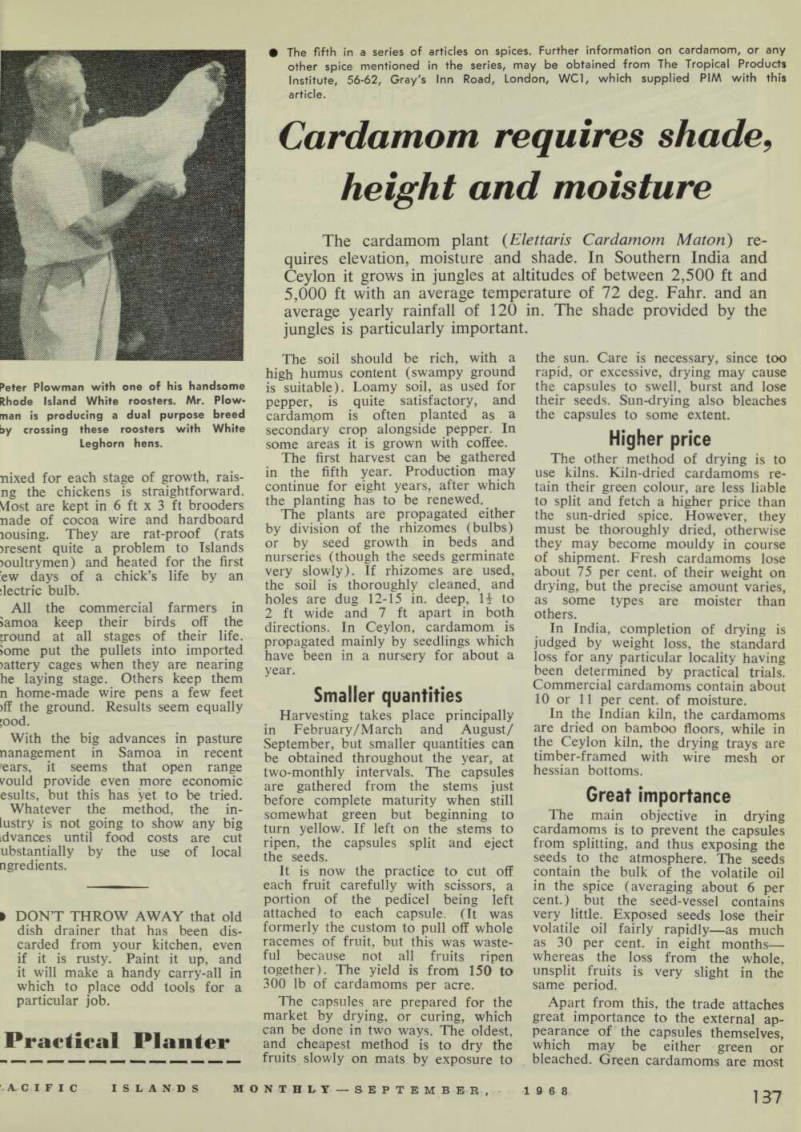
now hatching his own chicks and getting a successful dual purpose breed from a cross between Aus tralian Rhode Island White roosters and White Leghorn hens.
It does not seem to make much difference what breed is imported— all the breeds and their crosses seem to lay and thrive equally well.
With imported foodstuffs specially
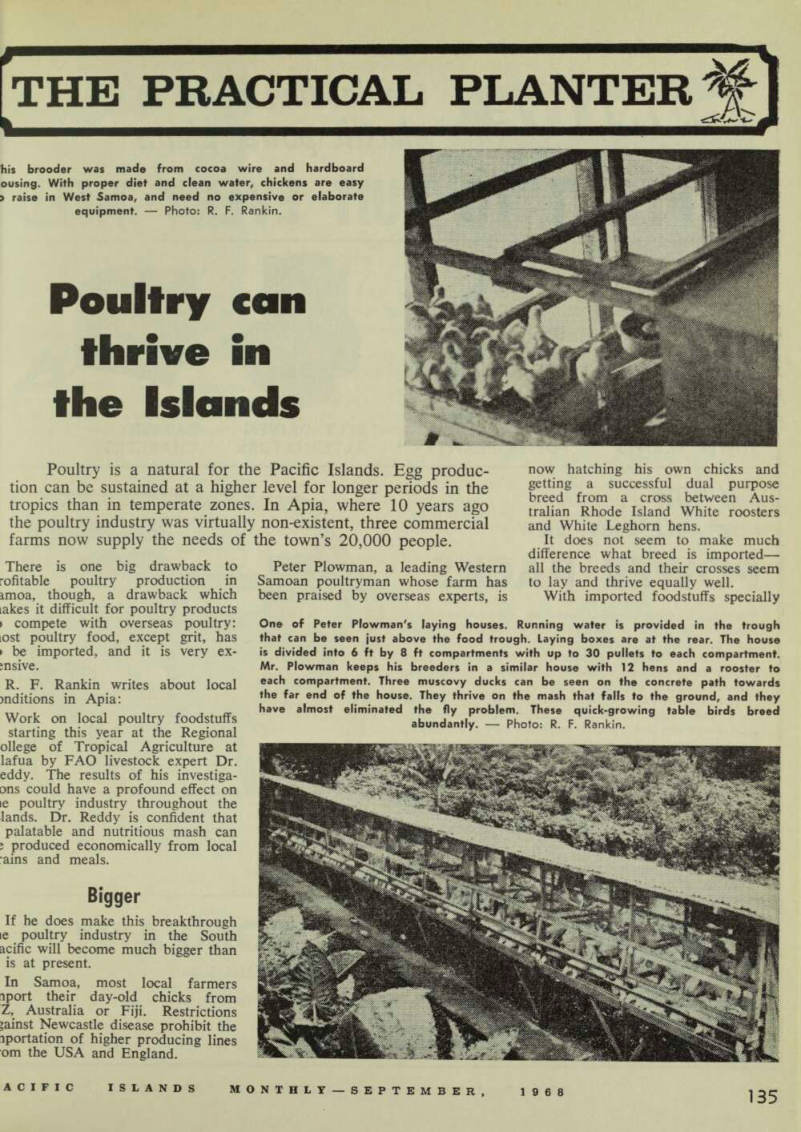
this brooder was made from cocoa wire and hardboard ousing. With proper diet and clean water, chickens are easy [?] raise in West Samoa, and need no expensive or elaborate equipment. -Photo: R. F. Rankin.
One of Peter Plowman's laying houses. Running water is provided in the trough that can be seen just above the food trough. Laying boxes are at the rear. The house is divided into 6 ft by 8 ft compartments with up to 30 pullets to each compartment.
Mr. Plowman keeps his breeders in a similar house with 12 hens and a rooster to each compartment. Three muscovy ducks can be seen on the concrete path towards the far end of the house. They thrive on the mash that falls to the ground, and they have almost eliminated the fly problem. These quick-growing table birds breed abundantly. -Photo: R. F. Rankin.
nixed for each stage of growth, rais ng the chickens is straightforward.
Vlost are kept in 6 ft x 3 ft brooders nade of cocoa wire and hardboard lousing. They are rat-proof (rats iresent quite a problem to Islands loultrymen) and heated for the first ew days of a chick’s life by an slectric bulb.
All the commercial farmers in >amoa keep their birds off the p-ound at all stages of their life.
Jome put the pullets into imported >attery cages when they are nearing he laying stage. Others keep them n home-made wire pens a few feet >ff the ground. Results seem equally 'ood.
With the big advances in pasture nanagement in Samoa in recent 'ears, it seems that open range yould provide even more economic esults, but this has yet to be tried.
Whatever the method, the in lustry is not going to show any big tdvances until food costs are cut übstantially by the use of local n gradients. » DON’T THROW AWAY that old dish drainer that has been dis carded from your kitchen, even if it is rusty. Paint it up, and it will make a handy carry-all in which to place odd tools for a particular job.
• The fifth in a series of articles on spices. Further information on cardamom, or any other spice mentioned in the series, may be obtained from The Tropical Products Institute, 56-62, Gray's Inn Road, London, WCI, which supplied PIM with this article.
Peter Plowman with one of his handsome Rhode Island White roosters. Mr. Plow man is producing a dual purpose breed by crossing these roosters with White Leghorn hens.