Development
pp. 123-150 · Read in the full issue
Business and
Pearls Could Bring Big
Money To P-Ng
From YVONNE BLAKENEY, in Port Moresby The pearl—of the “teardrop of the moon” to give it its legendary Japanese name—has provided P-NG with a new, million dollar industry. Next year, the first pearls produced by a farm in Fairfax Harbour, five miles across the bay from Port Moresby, will be sold on the Moresby market.
Set against a backdrop of barren 11s that characterise the Moresby ea, the farm is a 400-acre water ise operated by Pearls Pty. Ltd., □stralia.
Port Moresby managing agent for e company, Mr. Neville Barnes, id that the pearls would be sold as ms, not jewellery, and that the ice could vary from Sioo to $2OO ch.
He said: “Practically all our pro iction will be sold through the panese pearl market but a small lantity will be marketed through . E. Barnes Trading Company Pty. d., mainly to private local buyers io have expressed interest in Gaining some locally-grown pearls.
“If successful, we will examine the issibility of using other outlets.”
The pearls produced during three years of tests have been equal to the world’s best. They have soft warm colours and a very smooth surface.
They range in size from 11 to 15 millimetres.
The industry will give a big boost to the territory from overseas ex change earnings, taxation and employ ment. Forty New Guineans are now being trained in many aspects of the pearling industry and their number should increase to 60 within a year.
Six Japanese are now carrying out the more detailed and technical activities and are helping to train the indigenous workers.
General manager of Pearls Pty.
Ltd., Australia. Mr. H. Iwaki, surveyed the New Guinea waters early in 1965 and found conditions in Fairfax Harbour similiar to those
at Kuri Bay, Western Australia, where there is a large pearling station.
Temperatures, salinity, tidal move ments and the type of plankton were all tested with favourable results.
Conditions were also similiar to those in Burma where some of the world’s best pearls are produced.
Ideal
Therefore, Mr. Iwaki felt that Fairfax Harbour was an ideal place to extend pearling activities. A thousand oyster shells in which nuclei had been inserted were ship ped from Western Australia to New Guinea and tests were started.
Results from the first harvest verified Mr. Iwaki’s judgment in selection of a site, and a further 6,000 shells were imported in 1966.
Periodical tests showed good results and progress. Early in 1967 the company decided to go into full pro duction with a further consignment of 50,000 shells.
Setback
Then the first setback occurred.
There was a severe attack by the Polycheate worm which burrows into the shell and weakens the oyster.
The worm caused heavy losses before it was brought under control by early 1968. A further 70,000 shells were then installed in the farm.
The Administration was enthusiastic
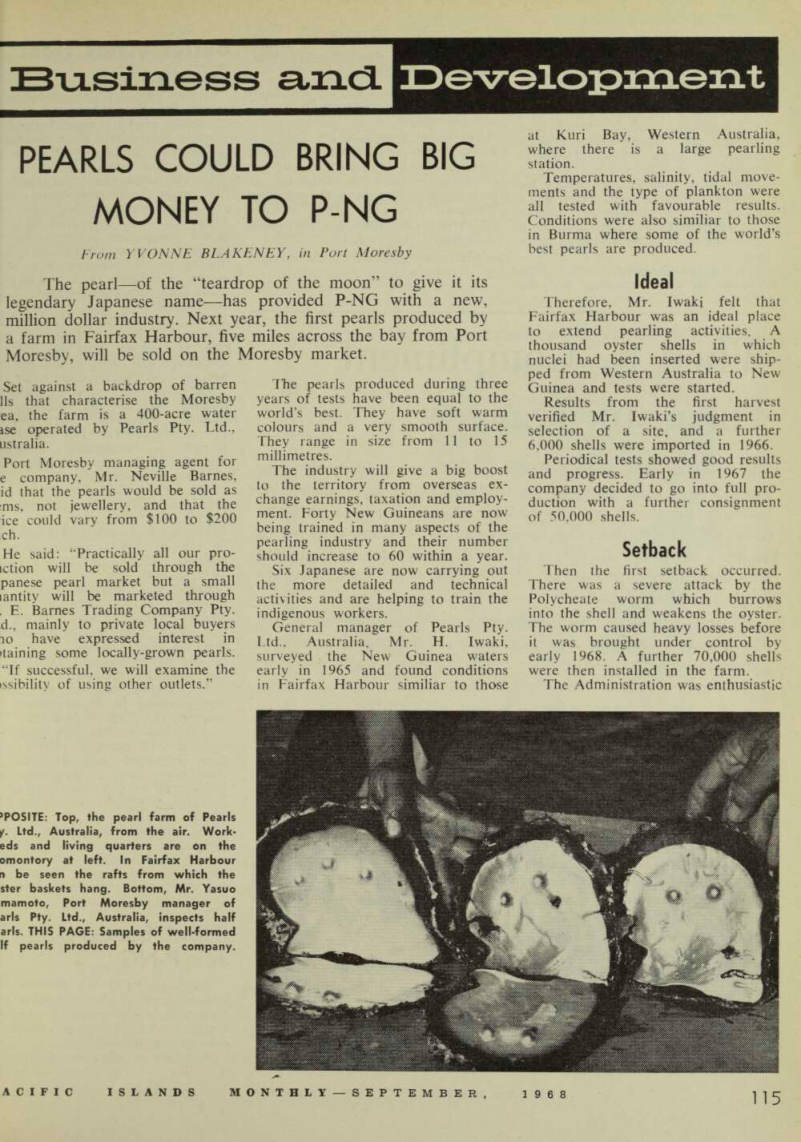
[?]PPOSITE: Top, the pearl farm of Pearls [?] Ltd., Australia, from the air. Work eds and living quarters are on the [?]omontory at left. In Fairfax Harbour [?]n be seen the rafts from which the ster baskets hang. Bottom, Mr. Yasuo mamoto, Port Moresby manager of [?]arls Pty. Ltd., Australia, inspects half arls. THIS PAGE; Samples of well-formed If pearls produced by the company.
about the new project, and gave much assistance m the initial stages.
The pearl farm consists of 12 long, grey teak rafts floating on drums in the protected waters. From these rafts, baskets containing the oysters are suspended. Made from teak saplings cut from New Guinea forests, the rafts are about 100 ft Jong by 50 ft wide.
Worksheds and living quarters for the workers have been built on a nearby barren promontory. Fresh water from Port Moresby is brought across the harbour by a pipe 4i miles . .
To the casual visitor, there is little to indicate great expense, but the
company has invested half a million dollars in equipment, reclamation, buildings, rafts and oysters , ' 1 he harvesting season for the round pearls is between November and December The oyster shells—which are about 9 in. wide—are placed in plastic covered wire baskets divided into ten compartments and are rested for six months after they have arrived from Western Australia. The baskets, attached to the rafts, are suspended at depths of between 15 to 20 ft.
After six months they are brought
(Continued on p. 142)
Better yields from
Fiji rice
August brought an encouragi report for those dedicated to t expansion of Fiji’s smaller rural i dustries, particularly the experiment rice-growing concerns—but it was report with a sting.
It was announced that yields Fiji’s main rice-growing areas—Re\ and Navua—were up to 50 per cei more this year, compared with U year’s production figures. A m variety known as FK 135 was yiel ing up to H tons an acre, wh grown on irrigated land, and fertilis trials were increasing yields by up 50 per cent.
On the Dravo Developme Scheme in Bau, a yield of mo than H tons per acre was obtaine compared with half a ton on lar not subjected to fertiliser trials.
But in the latest governme progress report, the Minister f Natural Resources, Mr. W, ] Brown, warned that Fiji would ha to pay a “staggering” price f imported rice unless local growii efforts were intensified.
Mr. Brown said rice imports h year cost £F766,000. The value local rice production was on £555,000. Fiji consumed 23,000 to of rice in 1967, was expected consume 25,000 in 1970 and 1 1975, 32,000 tons.
Local rice production has be< hampered by the uncertain rainfa which results in late planting aj low yields, but farmers are hopef that the situation will be improv< by the new high-yield varieties ai new irrigation methods.
Mr. Brown said the governme was planning to irrigate about 71 acres of rice land at Nausori.
A United Nations pilot project c another 250 acres at Nausori h been approved and a team w; also carry out a three-year pr investment study into irrigation ar drainage of 8,000 acres on the Rev Plains.
In addition, the government hi decided to employ a firm of overse; consultants to carry out a simils survey of the Navua Plains. Th two-year survey is expected to sta at the end of the year.
Third brewery
for P NG
Plans to build the P-NG’s thir brewery and to place a major terr tory vehicle distributor on an Aui tralian stock exchange were ar nounced in August.
Sponsors of the two projects ir
;nd to have residents of New Guinea nancing and owning most of each roject. This reflects current thinking y NG that local capital should be sed to develop secondary industries.
The brewery, to be built in Port loresby, will be financed by six jrritorians “representing the widest ossible interests”. Mr. Norman /hite, a Port Moresby solicitor and lokesman for the six men, said that le expected cost of the brewery is 750,000.
The money would come “wholly” *om New Guinea, Mr. White said, lowever, the brewery itself would be lanned by a Japanese firm, Asahi irewing Company, and its beer would possibly be of a Japanese style”.
A company, called Papua New iuinea United Brewery Ltd., would e formed to run operations and it muld be initially privately owned dth a public listing on Australian tock Exchanges an eventual goal.
NG’s two existing breweries are the outh Pacific Brewery Ltd., of Port loresby, and Guinea Brewery Ltd., f Lae. Both are controlled by a lajor Asian corporation, centred in ingapore.
*NG Motors to
jo public
There was more than a little public Nations in the announcement by a ydney stockbroker, Patrick and Company, that territorians would e offered 500,000 50 cent shares in ie vehicle distributor, PNG Motors ,td., of Port Moresby.
If PNG Motors can attract several jrritorian investors it will give tie firm a favourable local image.
Patrick and Company told PIM tiat PNG Motors would be floated ►n Sydney Stock Exchange in late leptember or early October with a •aid-up capital of $500,000 or 1600,000 in 50 cent shares.
Earnings would be 20 per cent, ind it was hoped to pay dividends of at least” 10 per cent., the brokers aid.
Since its foundation, under a dif erent name, in Port Moresby in 954, PNG Motors has prospered vith NG’s rapidly expanding car )Opulation. Today it has branches it Port Moresby, Lae, Rabaul and tfadang and plans to set up a Mt. -lagen branch.
The company is sole distributor or the British Motor Corporation ine of cars and trucks —such as the Vlorris, Nuffield and Riley range— md it also has the NG franchise for laguar and Daimler cars. Other
activities include selling petroleum products, running two fleets of taxis, panel-beating, car body making and maintaining Administration cars.
Director of operations in Port Moresby is businessman, Mr. Alan A. Morris, Chairman is Sir Donald Cleland, NG’s former Administrator.
Another setback
L .
for Fiji moot
Fiji’s embryonic meat exporting industry has suffered another setback through the tightening-up of meat regulations in American Samoa.
Initial consignments of Fiji meat
to Pago Pago were received with enthusiasm, but Burns Philp (South Sea) Co. has had to abandon tern porarily its beef exports to the terri tory because of the recent enforce ment of local import regulations.
A spokesman for Burns Philp in Fi jj Mr. Paul Best, explained that in order to export any more meat, the company would have to conform to US mainland requirements, which in volve inspection of slaughtering and processing facilities by an offical from the Department of Agriculture in Washington.
The company’s export activities are being kept on ice until after the publication of a report now being
prepared by an Australian beef expert who has studied the Fiji industry.
A ban is still in force on imports of Fiji-produced corned beef into Western Samoa. Western Samoan authorities say they cannot afford the imports, in terms of foreign exchange, and would prefer local people to buy Samoa meat and fish (see story in Tropicalities).
Bank of NSW
for Nauru?
Two senior officers of the Bank of New South Wales, visited Nauru in August to examine the prospects of establishing a branch of the bank which could supply full trading and savings bank facilities in the Re public. The only banking services at present available in Nauru are those of the Commonwealth Bank agency conducted by the post office.
This results in large sums of money having to be carried around by hand, and business often becomes a cumbersome process.
In recent months several over seas financial corporations, including American interests wishing to build a hotel, have taken close looks at Nauru.
Fiji will change
Customs system
Fiji will have more than decimal currency to confuse its business com munity next year. The government has announced that a new Customs tariff system—the internationally-used Brussels Nomenclature, already adopted by about 100 countries—will be introduced in January. The change over, a government release hinted, will not be easy.
“Although it is based on precision of definition and relative simplicity,” it said, “any system which aims to classify all goods in international trade must, of necessity, be some what complex.
“Nevertheless, it is considered that the system is the most simple method of doing what it sets out to do.”
Which, beneath the verbosity, seems to be one way of saying the new system is the best of a bad lot.
Vavau copra
progress
For the first time in seven years, Vavau has regained its position as the top copra-producing island group of Tonga, ahead of its two rivals, Tongatapu and Haapai.
Vavau was hit by a severe hurri cane in 1961 which in two years minimised copra production from 4.764 tons in 1960 to 150 tons in 1962. Latest figures, for 1967, reveal production of 2,704 tons—a good recovery.
By clearing allotments for Tonga’s coconut rehabilitation scheme, Vavau producers have been largely respon sible for the comeback. The early 1970’s should see 1960 figures equalled again.
With vanilla bean growers in creasing planting on Vavau—and re ceiving $4.20 f.o.b. per lb—Vavau could be heading for prosperous times.
Commerce briefs
• Australia’s 1968-69 government grant to New Guinea is $B7 million, $9.4 million, or 12 per cent, more than in the previous year. In addition, Australian departments, such as Commonwealth Works, Army and Aviation, will spend $23 million, making a total of nearly $llO million provided for the territory in the Aus tralian budget. ® “Indications” of copper and nickel have been located by the Aus tralian Bureau of Mineral Resources in the south-western area of New
Guinea’s Sepik River, on a tributary of the Frienda River, north of Tele fomin and about 56 miles east of the West Irian border. In a prospective area of about eight square miles, traces of porphyry copper were found by a bureau mapping team recently and during the same mapping opera tion, the team located 400 square miles of ultrabasic rocks which are usually associated with nickel. • Three separate lots totalling 1,374 crocodile skins from the Western District of Papua were re cently sold at Daru to two buyers, Mr. George Craig, of Daru, and the Horiushi Trading Company, of Japan, for over $25,000. The skins, mainly freshwater belly types, came from Lake Murray, Kiunga and Morehead. • In late August the Oil Search Ltd. and Esso Exploration’s first well on Ini Island, in the Gulf of Papua, had reached a depth of 6,401 feet and was testing a “gas flow” en countered at 6,380 feet. Drillers were hopeful because Ini is less than 13 miles from where huge gas flows were tapped earlier this year,
P-NG copra growers
will get more
New Guinea copra growers will re ceive an extra 5A29.69 for every ton of copra they delivered to the P-NG Copra Marketing Board during 1967 as a final price distribution payout.
With deliveries of copra to the board in 1967 totalling 108,114 tons, the extra payment will cost the board over $3,2 million.
The $29.69 does not include a bounty of $2 per ton paid by the board during the first half of 1967 and a similar $3 bounty per ton paid during the last half of the year.
Generally, NG growers seemed satisfied with this final $29 payment, which is greater than similar pay ments made by copra bodies in other Pacific Islands territories.
Since NG copra prices are not keyed so tightly to day-to-day changes in world prices as, for example, Fiji and the Cooks, the policy of the board has been to pay prices well below world ruling rates and build up its own reserves, making final payments from accumulated reserves.
This policy was strongly criticised early this year by Mr. J. W. Grose, president of the Planters’ Association of New Guinea, which represents the territory’s major copra producers.
Mr. Grose had argued that growers should receive 90 per cent, instead of 60 per cent, of current world prices.
The board is currently paying out about 75 per cent, of the world rates to growers.
up to be operated on. This consists of the insertion of artificial nuclei around which the cultured pearls grow.
When the oyster shells are taker from the baskets they open slightl> and a wooden wedge is placed inside the lip to prevent it from closing, They are then taken to the operation room, a high structure built out ovei the water.
The shell is placed in a clamp and the first process involves cutting a small portion of the nacre (mothei of pearl) producing mantle. Ar incision is then made over the top of the muscle and into the gonads.
A small piece of the nacre-produc ing mantle is placed into the incision where it grafts to the wound and forms a sac around the nucleus and covers it with nacre.
Then the delicate process of in serting the nuclei is carried out, aftei which the operated shells are returned to the baskets. Four months latei they are X-rayed to determine pro gress made. If the pearls are forming properly they are allowed to grow for a further 14 months before the} are harvested.
This year 70,000 shells were operated on.
Mr. Barnes said in August that about one to two per cent, of the harvest would be perfect pearls.
About 30 per cent, are usually very good medium size pearls.
“Our aim is to produce a warm, pink tinge in the pearls. So far this has been achieved with considerable success/ 4 Mr. Barnes said.
The only difference between a cultured pearl and a natural pearl is that the irritant, in the form of a nuclei, has been artificially inserted.
Half pearls
If the oyster shell vomits the nuclei, or if the pearl is not forming pro perly, half pearls are grown as an expense recovery. In this operation the mantle of the oyster is pushed back and four or five nuclei are glued on with contact cement. The mantle then folds back and the half pearl is formed in about nine months time. They are drilled off the shell at the farm, then shipped to Japan for full treatment. Half shells are harvested between May and June.
Three hundred shells can be opera ted on in a day by experts such as Port Moresby manager, Mr. Yasuo Yamamoto. By 1970, more than 100,000 shells will be operated on.