Cruising Yachts'
pp. 103-109 · Read in the full issue
Pacific Shipping And
Two years old and still in [?]irginal solation
Completed two years ago, the deep water wharf at Asau, Western Samoa, will continue to stand in virginal isolation for some time yet.
iy some incredible engineering .calculation, only after the Sim. arf was completed was it dis ered that the coral sea bed was tough for the dredge to dig out 3,600 ft channel through the oon to the open sea. The New dand Navy came to the rescue, after more than a year of blast hundreds of tons of war surplus ?edo heads, squid bombs and TNT, end is still not in sight, larly this year it was predicted t with the blasting, the wharf uld be opened this September, wever in August, Samoan Director Works L, McQuitty announced t it was unlikely that the wharf ild be opened this year. He said t Public Works had run into un ected difficulties but that good gress was being made in dredging blasted coral. He said over half channel had now been cleared the dredge was clearing about 20 ft daily of the 120 ft wide nnel.
Tie wharf plays a vital part in latch Forest plans for Savaii
timber development. Potlatch mana ger T. Shelton is now permanently in Samoa and the company is all set to start building its mill at Asau.
The only delay in this, according to Mr. Shelton, is the hold up in finalis ing a lease for the mill site. After the usual protracted argument and
negotiation, expected in things of this nature in Samoa, this will be finalised shortly and work on the mill and the S6m. timber project should be well under way by the end of the year.
The wharf should certainly be open by the time the mill is in opera tion some time next year. The two year delay however has not enhanced the value of expert advice in the eyes of Samoans.
Nauru To Register
Own Ship
On July 12 the Speaker of the Nauruan Parliament gave assent to the Registration of Ships Act, paving the way for Nauru to register its own ships. Members of Parliament wrestled with the complex bill over several sessions before accepting the inevitable conclusion that the tech nical requirements of such a measure just had to be accepted.
The new law is obviously intended to provide for the blue, gold and white flag of the Republic to fly over the 6,000 ton vessel that the Nauru
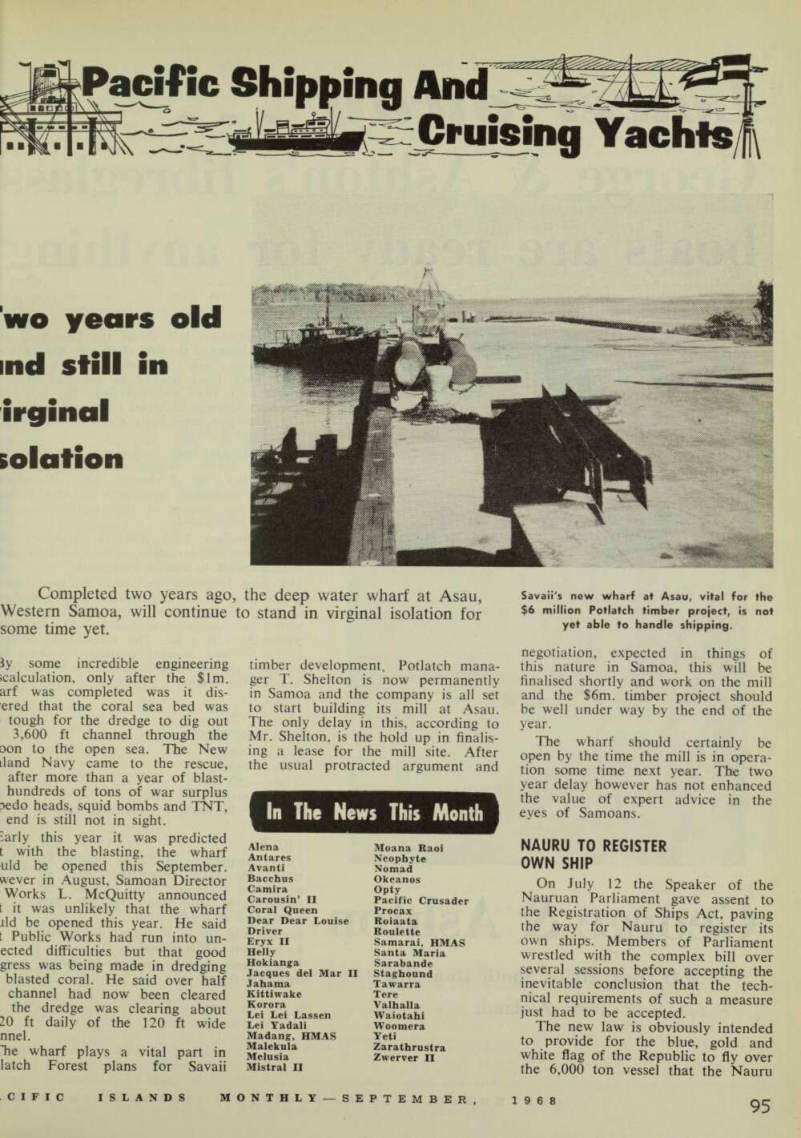
Savaii's new wharf at Asau, vital for the $6 million Potlatch timber project, is not yet able to handle shipping.
.ocal Government Council has under instruction in Scotland.
The ship is expected to go into ervice early in 1969, and will carry lassengers and freight between Aus ralia, Nauru and possibly other ports, fhe cargo one way will, of course, e Nauru’s only export, the phosphate hat has made the island rich.
Advertisements appeared recently q Nauru, seeking two young men as ipprentices and another as a writer, or the ship’s crew. This appears to »e the limit of Nauruan participation n the ship’s operations, at least at irst. It has not been officially stated vho will comprise the ship’s crew, >ut it is understood that there may >e jobs for other Pacific Islanders in he total complement.
Ownership of the vessel is one of he oddities of the Nauruan political tructure, since the Nauru Local jovernment Council comprises the line men who were also the elected nembers of the old Legislative Council, and who with nine more lew members, comprise the Nauru Parliament.
President Hammer Deßoburt is till also Head Chief of Nauru by Trtue of his still being leader of the Government Council, and iealth and Education Minister Austin Bemicke is the council’s ecretary. Presumably the Head Zhief and his Council will apply to he President and his Government br registration of the ship, and no loubt after due deliberation it will >e granted.
Ips Halt Bougainville
Zalls For Time Being
After over 40 years of regular ihipping services to Bougainville >orts, Burns Philp and Company Ltd. vill stop calling regularly at Bougain ville when the firm’s 16-year-old >assenger-cargo vessel Malekula eaves Kieta about August 29.
BP’s general shipping manager, Mr. “Monty” Stobo, told PIM that t was no longer economically worth vhile to call at the plantations of >oraken, Teopasino, Numa Numa or \rigua where cargoes of copra nave to be loaded by surfboats or ighters because no deepwater wharves ire available.
Mr. Stobo said it was possible BP vould resume calls at Kieta later.
ECieta’s new wharf can handle nedium-sized freighters of the Malekula class.
BP’s decision to eliminate several )f its less important NG calls is part ?f a reappraisal the company has )een making for several months now 3f all its shipping activities. Hopes ire to reduce massive shipping losses
of recent years and produce shipping profits by 1970.
The company made its first call at Bougainville in 1922 with its motor vessel Melusia. Since then the company has made regular calls to Bougainville—-except for a three-year break during World War 11. fiiAAMi daai/ DAvc ucd
Moana Raoi Pays Her
First Visit To Sydney
Tucked neatly at No. 7 berth, Sydney Cove, beside Sydney’s massive Harbour Bridge, the small interisland trader Moana Raoi went virtually unnoticed during her twoweek stay in Sydney in August. She
was behind the big passenger ter minal (which receives regular calls by 40,000-ton P and O liners)—and the white hull of her 700-ton body hardly filled the length of her wharf, Sydney Press, radio and television didn’t g j ve the ship, or her successful star t on a regular shipping service between Tarawa, GEIC, and Sydney, a WO rd of mention. But for those who cared, the Moana Raoi was a hit.
Everybody who went on board was impressed. Some said she was the best-kept and “cleanest” vessel in Sydney for many years. Others re marked at the friendliness and
ciency of her 24-man Gilbert and ice Island crew. lopra buyers praised her first con nment of 400 tons of sun-dried >ra as better than top New Guinea >ra, and shiplovers had only one ;stion for Captain Peter King: 0 you take passengers?”
Vtoana Raoi’s appearance in Syd r was the result of long negotia is between her owners, the govern nt-run GEIC Wholesale Society, 1 Australia for permission to sell :r 2,000 tons of copra a year in stralia to an agreed copra buyer, fhe service means that the GEIC ; an additional market for its Kiuce and is also able to import ae consumer goods itself, thereby ing overseas exchange, ronically, for her Sydney stay, >ana Raoi was berthed a few blocks ay from the headquarters of Burns ilp and Co. Ltd. which began its n shipping services to the Gilberts t on 70 years ago. Excluding the npany’s plantation interests on ming and Washington Islands, , of course, hasn’t operated in the TC since 1945. \s with its activities in the Scio ns, BP pulled out of these two ritories because the company n’t receive compensation from tain for equipment losses during Pacific War. 7 OOTNOTE: Moana Raoi does e passengers—two of them!
Itain Introduces Shipping
3Ulations For N. Hebrides
fhe New Hebrides—for long arded as the best spot in the South ls to register “any old tub” :cause shipping regulations were ;ually non-existent there) —is to inter this reputation, at least as as British-controlled vessels are icerned.
Dn July 20 the British Resident mmissioner, Mr. C. H. Allan, ned a new regulation to “provide the control and safety of British sels”.
Broadly, it means that certificates competence will be introduced for w requirements and conditions Jer which passengers and goods y be carried. Restrictions will be ced on unseaworthy vessels.
While not all parts of the regula a were in force in August, a RIM ■respondent in Vila said residents the New Hebrides hoped the ndards of safety and seamanship vessels throughout the condo lium would improve.
Britain will enforce the regulation dually, and after 12 months, safety tificates will be legal requirements ships registered by Britain and in the New Hebrides.
Commander F. W. Hunt has been appointed Licensing Officer.
French-controlled vessels and vessels owned by New Hebrideans are not covered by the British regulations.
A Second Life For
The 'Coral Queen'
After an absence from the Solomons of nearly three years, the supposedly irreparable Coral Queen recently berthed at Santa Cruz, Gaudalcanal her machinery and engines overhauled and her fittings and super-structure repaired. She had a new master, Captain Harry Moss, and a new crew of Solomon
Islanders and at last report she was looking for work in the Solomons.
Once the BSIP High Com missioner’s vessel, she went aground on Papari Reef, off Ysabel Island, on February 4, 1965, and was re floated with the help of dynamite, which severely damaged her hull. In late 1965 the government offered her for public tender because it was judged she was damaged so ex tensively she could not be repaired.
Mr. Lawrie Crowley, a New Guinea businessman, bought her and had Captain Moss carry out repair work at Tulagi and Taroaniara boat yards.
Now, with a second life, the future looks bright for the Coral Queen.
Pints" Roundup Of
Hipping News
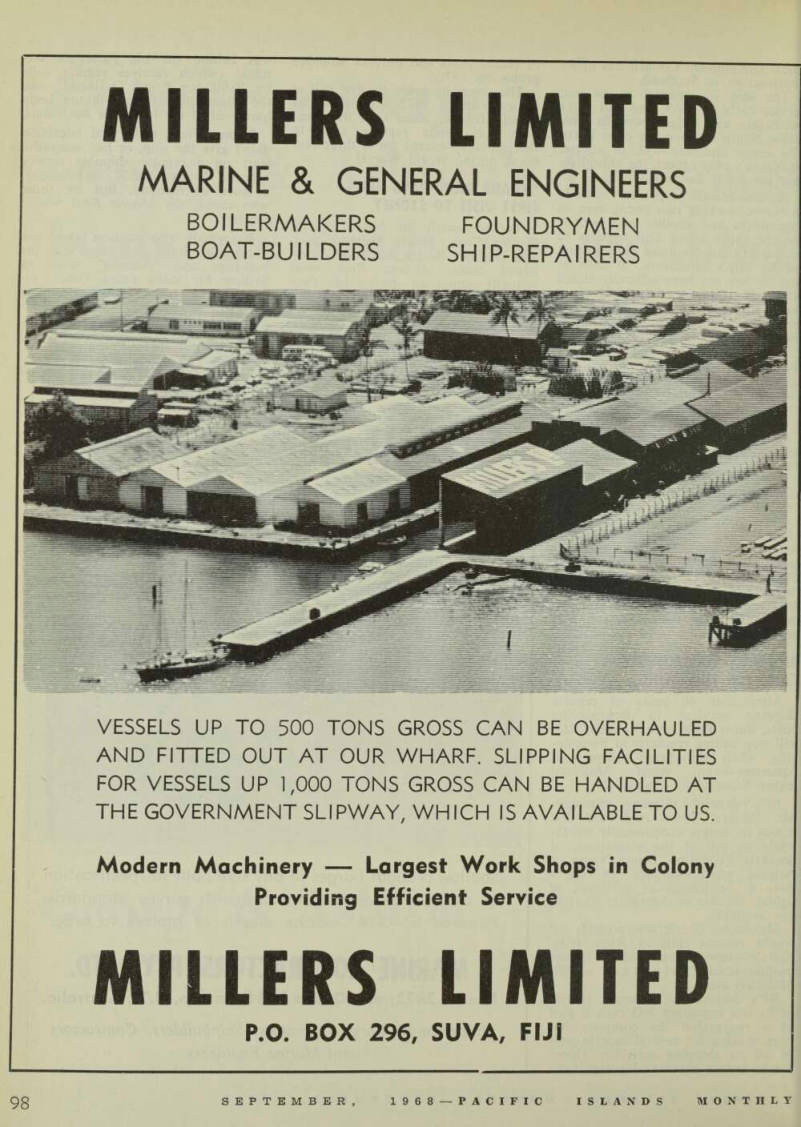
Among recent shipping develop lents in the Islands: • One of the newest inter-island aders plying Fiji waters is the 7-ft motor cutter Lei Yadali, bult ver seven years in a boatyard at /ainunu, Vanua Levu, by her wners, Charles Whippy, 29, and [enry Bhurra, 29. Named after the lountain on Vanua Levu, where her mber came from, Lei Yadali jgularly runs from Suva to Labasa, avusavu and Wainunu. • To start a deepsea commercial shing business, the Rabi Island Council is having four fishing vessels uilt at the Suva Shipyards of Millers ,td. Rabi, north of Taveuni, will ;ceive the first vessel—a 26-ft boat -about September. • A new $150,000 freight terminal 3r the Australia-West Pacific Line t Lae was opened by the P-NG Ldministrator, Mr. D. O. Hay, ecently. It is expected that the ter linal, which can handle up to ,000 tons of cargo at a time, will reatly speed up Lae’s cargo-hand ing facilities. AWPL’s decision to iuild the terminal at Lae reflects its tiinking—and the thinking of several »ther major firms—that Lae is NG’s astest-growing town. • Freight rates for Sydney to Lord €owe Island cargo on the French »wned Jacques del Mar II increased rom August 1, by up to 25 per cent, slew rates are $37.50 per ton for ;eneral cargo (old rate, $3O) and >5O per ton for freezer and cooler argo (old rate, $45 per ton), tydney shipping agents said it was it least 10 years since the charges vere changed. Increased operating md stevedoring charges in Australia lad caused the rises, they said. • A new small-ships wharf at Vasu, on the northern side of the Tuon Peninsula, New Guinea, was •ecently opened. The wharf, built vith the help of the local Kabwum jeople, will save many hours in load ng and off-loading coastal traders. [Previously the traders had to spend ip to a day loading by raft.) • Mrs. E. Feldt, widow of Com mander Eric Feldt, who organised ;he Coastwatchers during World War 11, launched a new Royal Australian Navy patrol boat, HMAS Madang, at Brisbane in August. Commander Feldt died earlier this year, aged 68, and his ashes were scattered at sea from another RAN patrol boat, HMAS Samarai, off Madang, NG, on May 20.
• Tonga is considering shipping some of its copra and bananas in its own vessels to New Zealand instead of using Union Steam Ship Company vessels. Tongan leaders recently pointed out that the USS has been making profits by hauling Tongan produce, while some of Tonga’s own vessels have been operating at a loss. The Tongan Government in August was considering a proposal to operate ships to NZ, but observers felt any decision to put Tongan ships into NZ would meet solid resistance from the USS, a wholly owned subsidiary of P and O. • An ultra-modern lighthouse on Vadua Island, off western Vanua
Levu, began operating in mid-August.
It is the third lighthouse built from special British grants to Fiji since May. The two other lighthouses are at Makogai and Vatu-i-ra. • Two former New Zealand coastal ships, the Waiotahi and the Hokianga were being fitted out recently for service in Papua and the Solomons. The Waiotahi, a 36-year old vessel of 208 tons, was being fitted out at Onehunga, and the Hokianga, a 30-year-old vessel of 169 tons, was being fitted out at Auckland. The Waiotahi will go to Honiara, and the Hokianga will sail for her new owner in Port Moresby.