The Future Of New Guinea
p. 95 · Read in the full issue
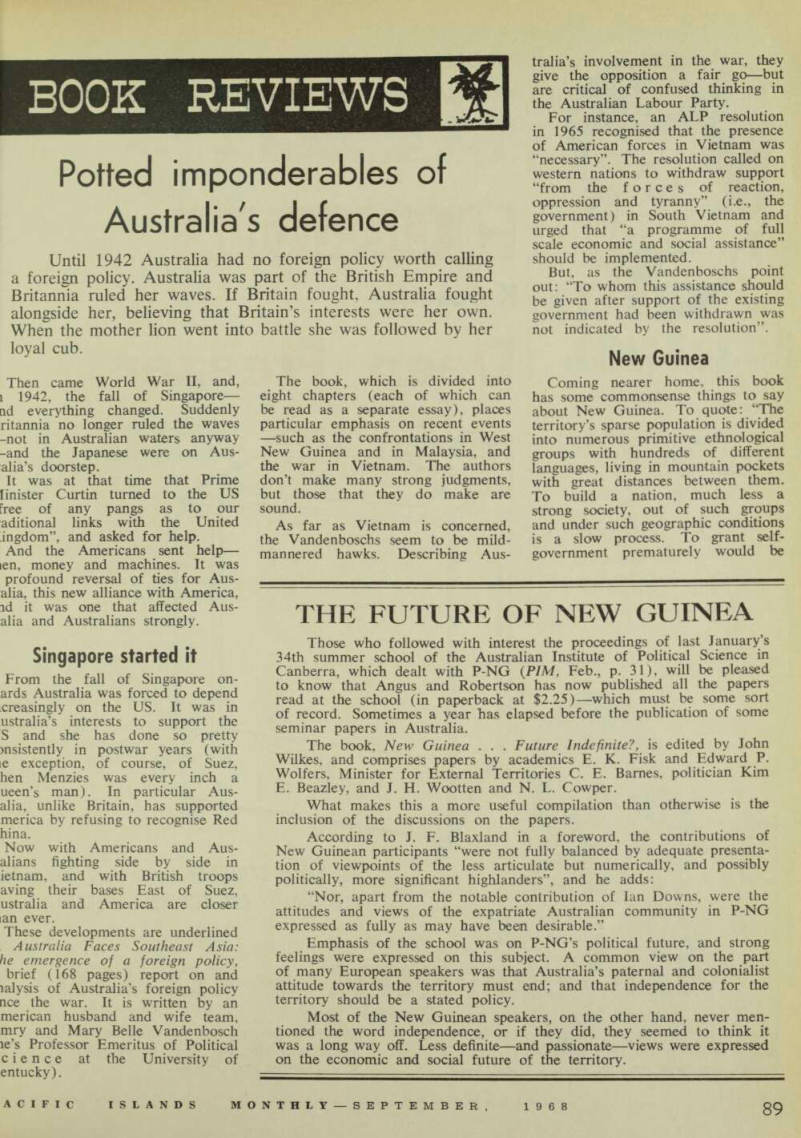
Those who followed with interest the proceedings of last January’s 34th summer school of the Australian Institute of Political Science in Canberra, which dealt with P-NG (P/M, Feb., p. 31), will be pleased to know that Angus and Robertson has now published all the papers read at the school (in paperback at $2.25) —which must be some sort of record. Sometimes a year has elapsed before the publication of some seminar papers in Australia.
The book, New Guinea . . . Future Indefinite?, is edited by John Wilkes, and comprises papers by academics E. K. Fisk and Edward P.
Wolfers, Minister for External Territories C. E. Bames, politician Kim E. Beazley, and J. H. Wootten and N. L. Cowper.
What makes this a more useful compilation than otherwise is the inclusion of the discussions on the papers.
According to J. F. Blaxland in a foreword, the contributions of New Guinean participants “were not fully balanced by adequate presenta tion of viewpoints of the less articulate but numerically, and possibly politically, more significant highlanders”, and he adds: “Nor, apart from the notable contribution of lan Downs, were the attitudes and views of the expatriate Australian community in P-NG expressed as fully as may have been desirable.”
Emphasis of the school was on P-NG’s political future, and strong feelings were expressed on this subject. A common view on the part of many European speakers was that Australia’s paternal and colonialist attitude towards the territory must end; and that independence for the territory should be a stated policy.
Most of the New Guinean speakers, on the other hand, never men tioned the word independence, or if they did, they seemed to think it was a long way off. Less definite—and passionate—views were expressed on the economic and social future of the territory.