yesterday
p. 93 · Read in the full issue
The big news in the South Pacific 20 years ago was the im pending arrival of the new London Missionary Society vessel “John Williams VI” in November. The 380-ton ship was offi cially named in a colourful ceremony at London on August 5 by Princess Margaret before a big gathering of society repre sentatives, members of associated churches and representatives of Pacific Islands governments. Princess Margaret was presented to a small boy, Anthony Robbins, said to be the great-great grandson of the original pioneer missionary, John Williams, murdered by New Hebrideans over 100 years ago.
OTHER items in PIM, for September, 1948, included: THE New Hebrides was “well catered for” with air con nections, PIM said. Two airlines, a Noumea-based French company, TRAPAS, from Noumea and Trans Oceanic Airways, from Sydney, were regularly servicing the Condominium, and the Aus tralian airline, Qantas, was talking about starting a fortnightly service between Sydney and Santo. Qantas had already carried out survey flights, but had had to make three postponements of its starting date.
WESTERN Samoan planters were being urged to produce more copra, cocoa and bananas and to further develop the re sources of the territory.
KOKOLA and Kokola Extended Plantations, near Namatanai, New Ireland, NG, were both up for sale. There were 1,500 acres with 32,000 coconut and 100 cocoa trees on the plantations, which at the time had 80 to 90 years of an original 104-year lease to run. Former owner was the late Mrs. E. B. Hertz.
THE Presbyterian Church of the New Hebrides was inaugura ted as an independent church with a separate constitution on July 1 at Tangoa, Santo. Representatives of the church throughout the New Hebrides, from Australia and New Zealand, attended the cele brations. New Hebrides’ new church would not break all its ties with its parent churches over seas and would still receive support from both Australia and NZ, said the report in PIM.
NEW Zealand had suddenly decided to lift the value of its pound from a par level with the Australian pound to a par
level with the British pound—a move which caused widespread change in the exchange rates of several Pacific territories. Most affected were NZ’s bigger trading partners Fiji, Western Samoa, Tonga, the Cook Islands and Norfolk Island. The Australian pound remained at 25 per cent, below both the British and the New Zealand pounds. Fiji’s traders wanted Fiji’s pound strengthened, but the Fiji Government an nounced in early September that there would be no alteration to its exchange rate.
A DECISION was expected in September on the site for the future international airport for Fiji—and both major rivals—Nadi and Nausori—were ardently press ing their claims. Nadi had every thing in its favour except one thing—its 130-road mile distance from Fiji’s capital, Suva. Never theless, it was the big tip.
THE oil search in Papua was to be stepped up and the Aus tralasian Petroleum Company Pty.
Ltd. was buying two additional drilling outfits for use on the company’s extensive drilling areas in Western Papua. Drilling sites had been selected. APC, then and now, was an associate company of Oil Search Ltd.
BURNS Philp and Co. Ltd. had received a new auxiliary ketch at Santo, New Hebrides, for trading throughout the New Hebrides. The ketch, 82-ton Koro, would be based at Vila and take the place of the motor vessel Muliama, recently diverted to trading in the Solomons. Koro’s master was Captain D. Anderson, who had experience on New Guinea runs.
SUVA’S trial bus service was under way. “The traffic authori ties, bubbling over with reason ableness, have altered and ex tended the timetables”, PIM said.
“The flat rate fare of sixpence, however, remains a major hurdle for short-distance travellers”.
LEVUKA, Fiji’s former capital on Ovalau, felt itself badly done by in the realm of public works, and on a visit by the Governor, Sir Brian Freeston, Levuka residents asked for ad ditional roads for the island and a small jetty to be built at Lodoni.
PIM said Lodoni was literally a “jumping-off place” ferry passengers had to take off their shoes and paddle across the mud flats to reach Levuka.
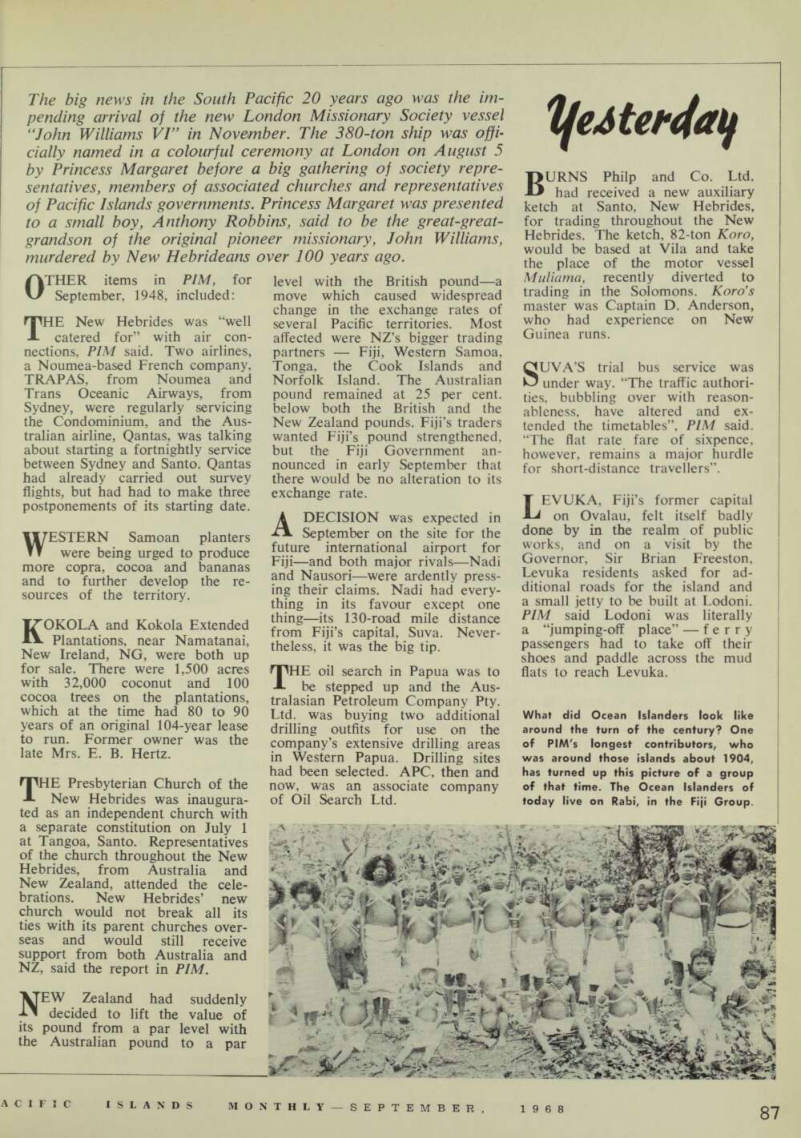
What did Ocean Islanders look like around the turn of the century? One of PlM's longest contributors, who was around those islands about 1904, has turned up this picture of a group of that time. The Ocean Islanders of today live on Rabi, in the Fiji Group.