The Relics Of "The German Times"
pp. 87-89 · Read in the full issue
Bougainville, Where They Treasure
By Kakata
Generally speaking the Bougainville Islanders are a communicative people who, at the slightest pretext, will down tools and enter into long and interesting conversations on any number of topics.
On many occasions I have spent hours listening to the rumblings of old men as they retold the past in their native tongue, waiting patiently for someone to translate their stories into Pidgin.
Often the conversations would ntre on “the German times”, often misleading term since the natives id to confuse the early days of the istralian Administration with the >t days of the German. (The srman Administration, of course, me to an end in 1914).
Bougainville Island is named after 5 French explorer, Louis de mgainville, who discovered it in 68. During the century following v Europeans set foot on the island, lose who did were sailors, from s occasional whaling or trading ssel, who went ashore in search of jsh water.
Towards the end of the 19 th ntury both England and Germany owed interest in acquiring vereignty over Bougainville. In 86 the Germans annexed it, and s was later ratified in the Anglo ;rman Settlement of 1898.
During the last two decades of j 19th century the first trading
posts were established on the island, and the first European settlers and missionaries arrived. Trade goods were the first articles of western origin to enter the island in quantity.
Still valued
The most common relics of the German era still in use are steel axe heads. Some of these were acquired from traders, and others were re ceived in payment for land sales.
These axes have a narrow blade and a hammer head. All of them are now burnished brown with age, and most have worn short after countless sharpenings on coarse river stones. Nonetheless, they are still valued for their balance and their ability to keep a sharp edge.
Many of them are mounted on black-palm handles, some of which are decorated with intricate geometric designs—an indication that these axes were regarded as treasures. (Bear in
mind that before the arrival of the European, the Bougainville native had used stone axes).
I once inquired in a village in the Siwai division of South Bougain ville if anyone had a stone axe-head.
The villagers replied that they had none, but they did show me two rusty iron adze-heads hanging from the rafters of the village drum house.
These had been unearthed near the village during the preparation of a new garden site. No one knew why they may have been buried in the bush, or where they had come from.
Judging from their antiquated shape, and the degree of corrosion, it appeared that they might well have dated back to the last century. They may even have come from Forsayth’s store which was looted and destroyed by Siwai natives near Mamagota village in 1897.
Traffic in firearms
During the last century a prolific traffic in firearms, introduced by traders and recruiters, existed in many parts of the Pacific. Although percussion lock muskets could be found in the nearby Solomon Islands in the 1920’5, I have not seem a Bougainville native with one. Perhaps some of these muskets did enter the island in the early days, but if they
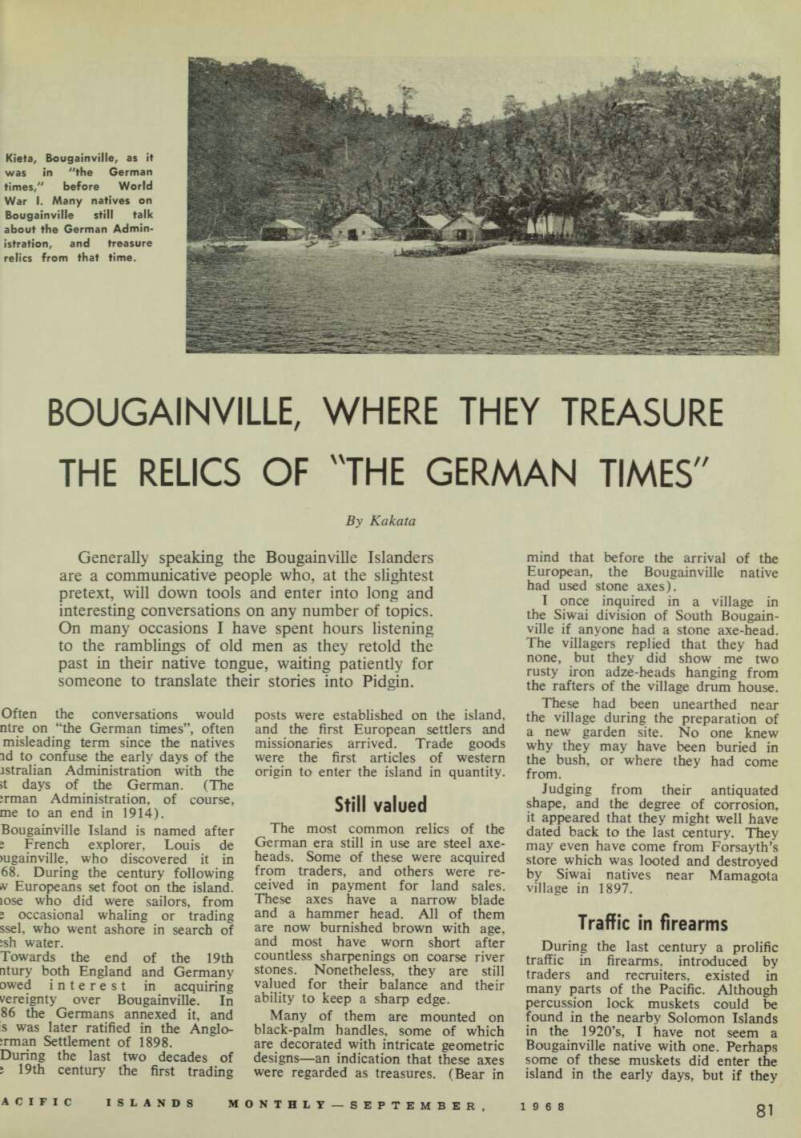
Kieta, Bougainville, as it was in "the German times," before World War I. Many natives on Bougainville still talk about the German Admin istration, and treasure relics from that time.
father to son
lid they must have been confiscated oon after the establishment of gov rnment control.
The early traders did bring with hem shotgun barrels which had been ut down and sharpened into chisels. k>me are still used to gouge out the ateriors of logs during the manu acture of the prized “garamut” slit ongs.
Most village men possess a long pear which they use when hunting igs. Most of these spears are carved rom a 5 ft length of black-palm, nd they are generally tipped with piece of sharpened steel bound into tie haft with either rattan cane or opper wire. In some instances these pears have been handed down from ather to son for three generations r more.
Some of the older spears are pped with triangular-bladed socket ayonets. There bayonets are thought a have been introduced by the Jermans. Found in a variety of mgths and sizes, many of them ear ordnance marks from some of Europe’s most famous arsenals, triangular bayonets were in common se by European armies during the ist century).
Golden sovereigns
Some of the old people keep olden sovereigns as curios. These re said to have been earned as wages n copra plantations in the Solomons nd elsewhere about the turn of the sntury. Probably they would be ven more common today if many ad not been used to pay tax during le mid-war years.
The oldest sovereign I have seen i the territory was dated 1854 which n old man cashed at the Bank of ISW in Rabaul. Coins such as lese are rare in Bougainville, but it ► their existence that occasionally ives rise to rumours that the natives ossess “golden dubloons” salvaged rom the wrecks of Spanish galleons.
German coins
Equally rare now are German oins —marks and pfennig. Most of lem passed out of circulation many ears ago. An occasional mark is eceived in change in coastal stores, hough, and I saw one cashed at You’s store at Buka Passage i 1961; it was dated 1908.
More common are coins intro uced by the Japanese during the for use in the islands they
conquered and placed under military administration. Much of Bougain ville was under Japanese control from 1942-45.
In 1962 a native, digging a garden near Buin, South Bougainville, un earthed a great hoard of copper and aluminium invasion coins. His delight quickly changed to anguish when they turned out to be valueless!
I was once asked by a Bougain ville Islander where he could buy a mine dectector. He had seen them used during the war, but he was not interested in finding bombs or scrap iron; he wished to search a nearby island for a wooden chest reputedly full of silver coins.
He had heard the village elders tell of an old man who lived on the island in “the German times”. He had sold a lot of copra to the traders, who once plied the coast, and over the years had received a considerable numbers of coins in payment. He kept these in a wooden chest which he carried with him wherever he went. When he died his kinsmen searched for the chest, but it could not be found. They deduced that he had buried it somewhere on the island.
Perhaps one of these days some body will dig it up and unearth with it yet another ailment introduced by expatriates—treasure fever!