Papuan Wonderland
pp. 76-154 · Read in the full issue



There are cannibals in the Papuan Wonderland
From a Port Moresby correspondent Something is being done to tame the last of the cannibals in P-NG. The Administration has set up a base camp at Sadado, some 350 miles north-west of Port Moresby, among the warring Biami cannibals.
Allan Johnson, 24, Assistant District Commissioner from the Nomad patrol post, 20 miles west of Sadado, has set up the camp with 10 policemen.
The Administration decided to establish the Sadado camp after an Unevangelized Fields Mission had gone into the area. Although the UFM patrol met with no violence, the Administration was worried that the presence of white men might stir up the Biami people.
Until recently little attention was paid to the Biami. They were virtually left alone until November, 1962, when Acting Assistant District Officer M. Lang, and Patrol Officer R. W. Henderson, took a patrol into the middle reaches of the Strickland River.
A member of the patrol, Constable Kasiga, 26, was hacked to death by four men who claimed Kasiga had assaulted one of their wives.
As a result of the killing, the Administration set up the Nomad patrol post in 1962.
The single patrol officer at Nomad began working around the fringes of the aggressive Supei, Kubor, Biami and Gubusi tribesmen, trying to halt the traditional killing and cannibalism.
Things began to look good. But the Nomad patrol officer was never quite sure what was happening out in the bush.
Slaughter
Then, in May, 1967, the Kubor cannibals broke their fast. They swept in at dawn with their bone tipped arrows, killing clubs and bamboo knives to slaughter four people in a longhouse only 12 miles from Nomad station. Two of the bodies were sliced up on the spot, carried off and eaten. The only evidence —a jawbone and one piece of a tibia—still hang on a nail today, in the Nomad Sub-district Office.
For the Administration, it was the worst cannibalism since the discovery of the Keba (Southern Highlands) cannibals in 1962, and one of the
most highly publicised since that Easter Monday in 1901, when the English LMS missionaries, Chalmers and Tomkins and 10 of their native adherents, were slaughtered and eaten on Goaribari Island, in the far west of the Gulf District.
Less than five years ago, many of the estimated 4,000 longhouse people in the Nomad Sub-district were cannibals. It’s the last big stronghold of cannibalism in P-NG.
There’s no social stigma in cannibalism near Nomad. Very little is known of the people so far, but it seems they seek human flesh as a suppplement to the colourless and monotonous sago.
Perhaps some of them, like the Kukukukus and more recently some of the Southern Highlanders, feel that by eating the slain enemy they acquire that man’s strength as a leader or warrior.
Many of the Gubusi and Biami people are afraid of the Administra tion, and repeatedly race into the bush when they sight a patrol.
Not long ago, one Fabe clan threatened to attack the next patrol it saw. “We want to be left alone . . . we don’t want the Administra tion” the Fabe leaders told the patrol, as they hovered on top of a sharp little hill, twanging their bow strings by way of warning.
The first journalist allowed into the Sadado area, the ABC’s John Ryan, said in Port Moresby: “The Biami cannibal people and their nervous neighbours live in carefully hidden, heavily-fortified longhouses with great logs which crash over the small doorway, the moment danger threatens.
“Loopholes in the blackpalm walls of the longhouses give the defenders a big advantage against an enemy in the open. The arrows, four feet long and delicately carved, are some times tipped with human bone.
“Tracks to the longhouses are often almost impossible to find. This is the first line of defence.”
Patrols with local guides often have great difficulty, because the guides don’t like approaching a long house community which almost in variably are at war with their own.
Occasionally, the nervous guides lead
(Continued on p. 144)
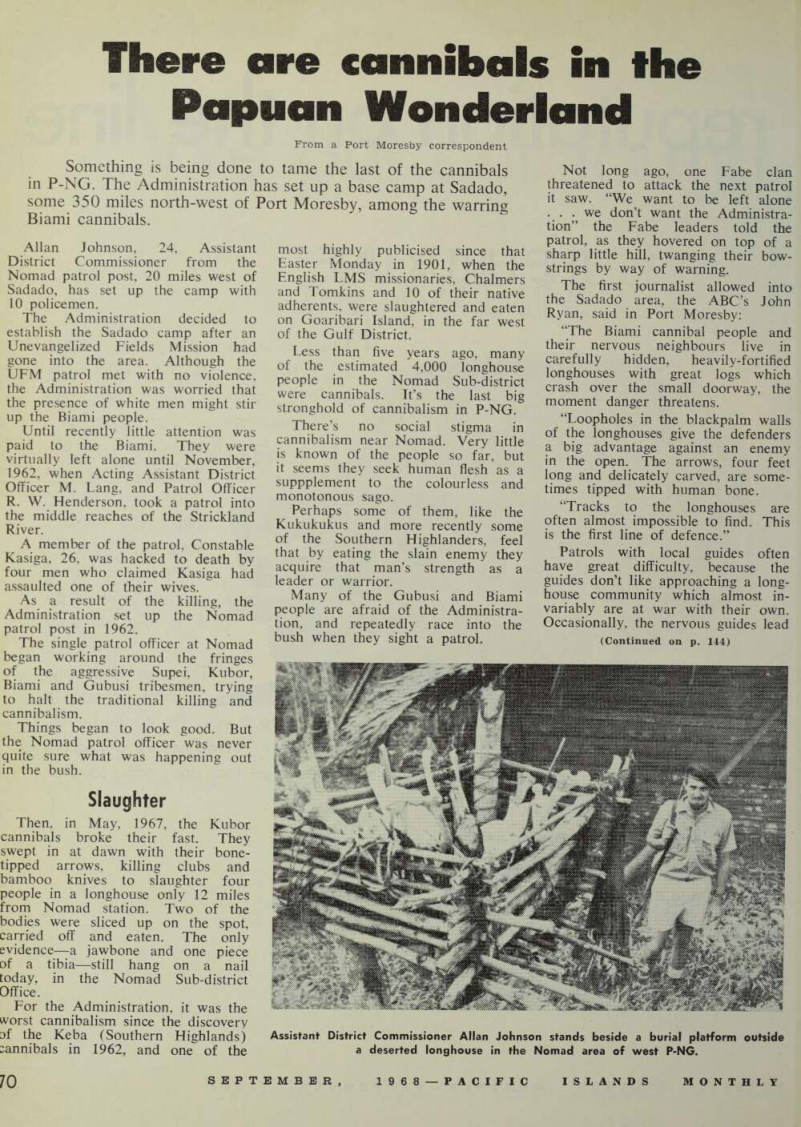
Assistant District Commissioner Allan Johnson stands beside a burial platform outside a deserted longhouse in the Nomad area of west P-NG.
the patrols away from longhouses known to be aggressive.
However, ADC Allan Johnson’s latest patrol among the Gubusi-Biami longhouses set out to call the bluff of the Fabe group which last year had threatened to attack, Johnson’s armed patrol crept for one mile along ravine-top paths, down sharp hills and through a stinking sago garden, and towards a longhouse he hoped to catch un awares.
The idea was to capture one or two Fabe people and to hold them long enough to convince them the Administation is friendly, and is trying to help them.
But a Fabe lookout spotted John son and also the five armed police men, and the Fabe fled, dropping a five-year-old native boy in their haste to reach the jungle. Johnson’s patrol interpreter, a former cannibal named Nogoi, grabbed the little boy.
The boy, Gosuma, aged five, was convinced Johnson and his men were cannibal raiders, and he was going to be killed. For 20 minutes, Nogoi, and the Karkar (Madang) policeman, Siebert, tried everything they knew to halt his wailing and screaming.
No use
Eventually, Gosuma seemed re assured, and was instructed to begin calling his father and friends from the jungle. It was just no use.
After 20 minutes, Johnson gave little Gosuma a brand-new Admini stration bushknife in the hope that this, in a community still using stone axes, would convince the Fabe community the Administration was friendly.
For little Gosuma, it had been a very rough day, psychologically.
Johnson and the patrol were the first white men he’d seen; and he’d also been spared from what be be lieved would be certain death.
Next day, Johnson’s patrol sur prised two haughty Biami warriors in a garden. Both quietly snuffed their fire, slowly reached for their bows and arrows, rose and headed in separate directions.
One climbed a pig-fence and came within five feet of Johnson’s patrol —then raced up a sharp hill and turned left into the jungle, with Johnson’s native policemen on his heels. But too late.
The Biami longhouse was further up the hill, and the police rushed it, hoping for a hostage.
The patrol was too late. All it found inside was an old woman
moaning with fear, and a smiling little girl too young to know wha was happening. The patrol sat dowi cautiously, and the interpreters begai calling into the jungle, hoping th( men would come.
Within half an hour, two mei appeared, but not those who’d beei in the garden. Tentative contact wai achieved, but nobody knows wha reception the next patrol will get.
A few days later, the patro cautiously examined three more long houses, and found one recentb evacuated. Johnson camped then two days, hoping they would return but they didn’t. Perhaps the nex patrol will have better luck.
Suspicious
The sullen and suspicious attitude of the Gubusi and Biami longhouse was hard to take. But there wa one welcome relief, on the soutl bank of the Rentoul River.
Tribesmen with bananas, coconu milk and water, came forward an< took Johnson to a brand-new res house.
Last year, many of the men o this community had been gaoled fo their part in an unsuccessful rai( on another longhouse. It was in gaol ironically, that the Administration’ message of friendship finally wen across.
Director of District Administra tion, Mr. T. W. Ellis, has only 52( staff. There are not enough to g( round, and forgotten little com munities like Nomad have to suffer The Administration is well awar< that the Biami people must hi brought under control. With the res of the nation developing rapidly forgotten pockets like the Nomac area could be political dynamite ii a few years.
In Port Moresby, an officia summed up the Administration’: attitude: “We want to help the Biam people, but the Administration doe; not have the money or the men. I the Biamis can be made to give ug their killing and cannibalism ant still remain happy with that way o life, then the Administration will b( happy. The Administration can dc nothing else.”
And what do the Biamis think?
Not long ago, one Biami lookec ADC Johnson in the eyes and tol< him in all sincerity: “When our children cry for nc apparent reason, we parents know that they are hungry for humar flesh.”