For 'Bush' Days
p. 73 · Read in the full issue
Spring In Niue
Is A Time
From J. Edward Brown, in Niue
August on Niue Island is the month when most of the hibiscus bushes start to sprout greenery again, and buds appear on the tips of the branches. And then the housegirls spend hours outside threading the blossoms on to cotton and appear with leis of hibiscus flowers around their necks.
With spring in the air, Mele, one of our housegirls, asked why we didn’t have a “bush” like some of the other Europeans living on the island.
A “bush” is a plot of land up on the central plateau where there is soil and where it is possible to grow vegetables such as taro and yams and tapioca, and fruit such as bananas.
“I’ve talked to my parents and you can have a piece of their bush,”
Mele told my wife.
A “bush” is a good idea if you are interested in gardening because it’s almost impossible to grow any thing in the grounds of our house, or any of the other houses on the lower plateau. The lower plateau is 70 feet or so above the sea, and it is rocky.
Sawdust for soil
We have big lawns but there’s no soil under the grass. The ground was originally built up with sawdust which has rotted into so-called soil, but it is very thin and has to be continually spread with fresh sawdust.
The lower plateau of the island is riddled with caves and caverns and there are small holes in our back lawn which go through to a cave which runs from the coast right under
our house. And when the tide and the wind are right, cold air is ex pelled through these small holes with a whoosh as the Pacific rollers break on the reef, and the cold air flattens the grass.
In a really heavy sea the house shudders slightly, and I sometimes wonder if it is safe.
The sawdust comes from the timber mill which processes timber from the extensive forest on the fertile central plateau, the only place
where food crops really grow well.
On the west side of the island all the villages are on the sterile lower plateau and all the villagers go up on to the central plateau to grow their food.
Thursday is a big “bush” day and half the staff of the government departments take the day off. Late in the day Niueans emerge with bicycles groaning under the weight of husked coconuts tied together, hands of bananas, plaited coconut leaf baskets of kumeras and yams, taro and tapioca and thick branches to be used as firewood.
“Bush” days are regular events in the subsistence economy of Niue, and the Niueans are actually forced by law to till the soil.
Forced by law
There is a law which says that Niueans must plant enough food for their familites, and crops are regularly inspected to ensure that enough is planted. Niueans who don’t plant enough food have to appear before the court.
Most Europeans eat imported food from New Zealand so there is no compelling reason for them to plant in the bush.
Some do, though. We have a friend, John, with a piece of “bush”.
He grows parsley. It’s delicious.
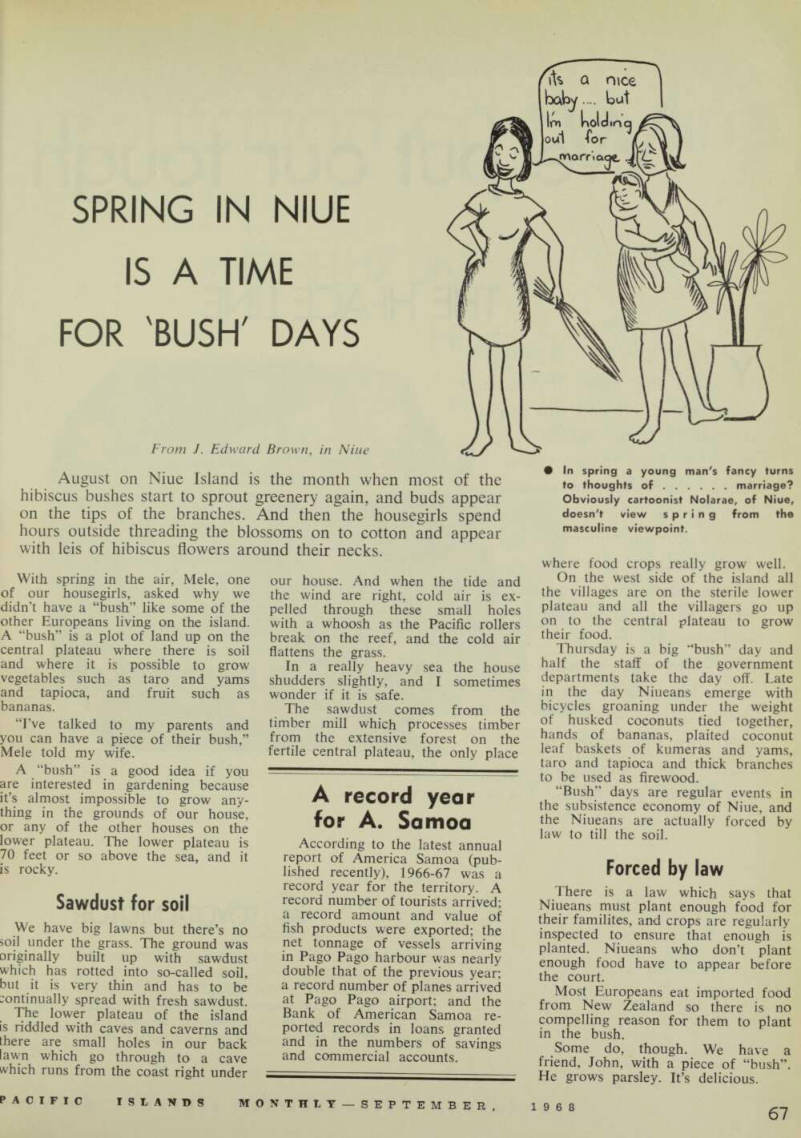
• In spring a young man's fancy turns to thoughts of marriage?
Obviously cartoonist Nolarae, of Niue, doesn't view spring from the masculine viewpoint.