colony's "big problems"
p. 39 · Read in the full issue
GEIC'S House examines colony's "big problems"
Drunkenness and the “crime wave” on Tarawa were two of the main topics discussed at the second meeting of the Gilbert and Ellice Islands Colony House of Representatives, held at Tarawa in late July and early August.
A six-man committee, including four islanders, was set up by the House to examine the colony’s liquor licence ordinance and the means of enforcing it.
Motions carried varied from calls for a basic wage and minimum hours to be set for domestic servants to possible government restriction on Bingo and card playing.
The GEIC’s top politician and chief elected member, 43-year-old Reuben K. Uatioa, took a big part in debates.
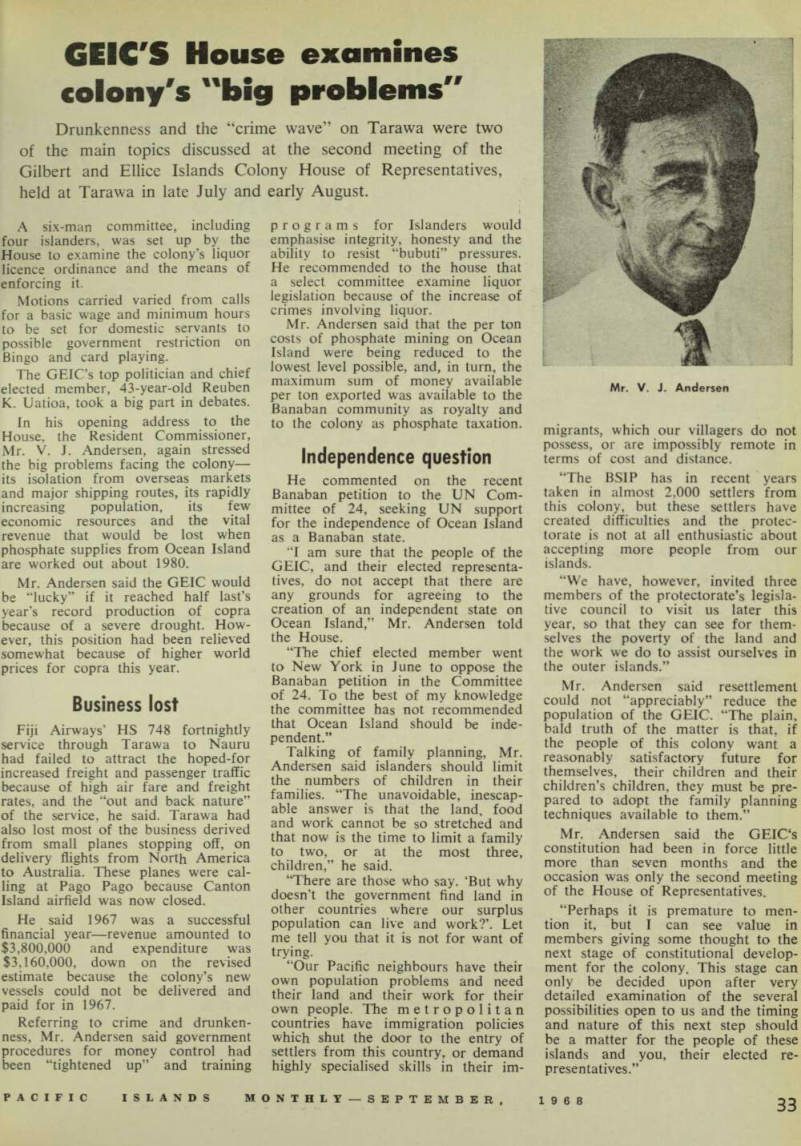
In his opening address to the House, the Resident Commissioner, Mr. V. J. Andersen, again stressed the big problems facing the colony— its isolation from overseas markets and major shipping routes, its rapidly increasing population, its few economic resources and the vital revenue that would be lost when phosphate supplies from Ocean Island are worked out about 1980.
Mr. Andersen said the GEIC would be “lucky” if it reached half last’s year’s record production of copra because of a severe drought. How ever, this position had been relieved somewhat because of higher world prices for copra this year.
Business lost
Fiji Airways’ HS 748 fortnightly service through Tarawa to Nauru had failed to attract the hoped-for increased freight and passenger traffic because of high air fare and freight rates, and the “out and back nature” of the service, he said. Tarawa had also lost most of the business derived from small planes stopping off, on delivery flights from North America to Australia. These planes were cal ling at Pago Pago because Canton Island airfield was now closed.
He said 1967 was a successful financial year—revenue amounted to $3,800,000 and expenditure was $3,160,000, down on the revised estimate because the colony’s new vessels could not be delivered and paid for in 1967, Referring to crime and drunken ness, Mr. Andersen said government procedures for money control had been “tightened up” and training
programs for Islanders would emphasise integrity, honesty and the ability to resist “bubuti” pressures.
He recommended to the house that a select committee examine liquor legislation because of the increase of crimes involving liquor, Mr. Andersen said that the per ton costs of phosphate mining on Ocean Island were being reduced to the lowest level possible, and, in turn, the maximum sum of money available per ton exported was available to the Banaban community as royalty and to the colony as phosphate taxation.
Independence question
He commented on the recent Banaban petition to the UN Com mittee of 24, seeking UN support for the independence of Ocean Island as a Banaban state.
“I am sure that the people of the GEIC, and their elected representa tives, do not accept that there are any grounds for agreeing to the creation of an independent state on Ocean Island,” Mr. Andersen told the House.
“The chief elected member went to New York in lune to oppose the Banaban petition in the Committee of 24. To the best of my knowledge the committee has not recommended that Ocean Island should be inde pendent.”
Talking of family planning, Mr.
Andersen said islanders should limit the numbers of children in their families. “The unavoidable, inescap able answer is that the land, food and work cannot be so stretched and that now is the time to limit a family to two, or at the most three, children,” he said.
“There are those who say. ‘But why doesn’t the government find land in other countries where our surplus population can live and work?’. Let me tell you that it is not for want of trying.
“Our Pacific neighbours have their own population problems and need their land and their work for their own people. The metropolitan countries have immigration policies which shut the door to the entry of settlers from this country, or demand highly specialised skills in their im-
migrants, which our villagers do not possess, or are impossibly remote in terms of cost and distance.
“The BSIP has in recent years taken in almost 2,000 settlers from this colony, but these settlers have created difficulties and the protec torate is not at all enthusiastic about accepting more people from our islands.
“We have, however, invited three members of the protectorate’s legisla tive council to visit us later this year, so that they can see for them selves the poverty of the land and the work we do to assist ourselves in the outer islands.”
Mr. Andersen said resettlement could not “appreciably” reduce the population of the GEIC. “The plain, bald truth of the matter is that, if the people of this colony want a reasonably satisfactory future for themselves, their children and their children’s children, they must be pre pared to adopt the family planning techniques available to them.”
Mr. Andersen said the GEICs constitution had been in force little more than seven months and the occasion was only the second meeting of the House of Representatives, “Perhaps it is premature to men tion it, but I can see value in members giving some thought to the next stage of constitutional develop ment for the colony. This stage can only be decided upon after very detailed examination of the several possibilities open to us and the timing and nature of this next step should be a matter for the people of these islands and you, their elected re presentatives.”
Mr. V. J. Andersen