Colombo Plan (but it's broke)
pp. 37-38 · Read in the full issue
Australia now has a South Pacific Colombo Plan (but it's broke)
By Stuart Inder
If we make an exception of Papua-New Guinea, for whose administration Australia is directly responsible, Australia’s friends and neighbours in the islands of the South Pacific don’t get any extra consideration from this year’s Australian Budget, brought down in Canberra in August.
P-NG gets $9,408 million more an last year, for a total Common :alth grant of $87,353 million, d she’ll need every cent, and more, r the big job of development that s yet to be done in that territory.
Norfolk Island, the only other istralian South Pacific territory now t since Nauru’s independence of it January (and Nauru paid its n way with phosphate profits any iy) gets the same Australian hand t as last year—s66,ooo for general ministration and an additional 0,000 for restoration and main lance of its tourist-attracting con t ruins (which it also got last ir).
Australia’s contribution to the uth Pacific Commission is down s year—s2s7,3oo compared with 59.000 last year. Only about 57.000 of last year’s contribution s spent.
They'll share what's left
Phe rest of the South Pacific will /e to share a mere $420,000 to be de available under Australia’s nth Pacific Aid Programme ictly the same as last year.
Phis is the first time since the icme was started in 1965 with )0,000 that there has been no rease.
But there is a gleam of hope. \t some time since the last Budget, hout any publicity at all, the aid igramme has dropped its insistence being a plan for distribution of hnical aid only, and the way is v clear for it to develop into a e South Pacific Colombo Plan.
Jntil this year the plan has been led ASPTAP—Australian South :ific Technical Aid Plan. Under it, South Pacific territory (not Aus lian) could ask for, say, machinery be installed in a technical college, ; it could not ask for money to Id the college itself. It could ask the provision of engineers to ign a new road, but could not for money to build the road.
Restricted as it was, this assistance was welcomed in the South Pacific, but there were hopes in the Pacific that the plan would in time be widened. There were signs last year that the men of Australia’s Depart ment of External Affairs responsible for administering the plan were beginning to be less fussy about how the money was used in the Islands.
Anxious
External Affairs has in fact been anxious to widen the scheme, but it has had Cabinet and Treasury to contend with. 1 understand that External Affairs budgeted for a much bigger increase in the South Pacific Plan this year, but despite an overall increase in Australian aid to developing countries
this year other commitments absorbed all the money. This isn’t good enough.
The South Pacific is in need too.
ASPAP (without the “T”) is a fine vision, but it would remain just a vision without the money.
Certainly Australia’s expenditure on external economic aid has in creased at a much faster rate than both national income and total government spending since 1958/9.
All told, Australia has provided, as outright gifts, more than $1,130 million in official economic aid to developing countries since the end of World War 11.
The total amount to be provided this year is $155 million—com prised of $l5 million in multilateral programmes, $4l million in bila teral programmes and $9B million for P NG.
Aid for P NG
The P-NG handouts do, of course, comprise a big percentage of total aid payments each year. Of the $1,000.5 million paid out since 1958/9 (including the 1968/9 estimate) $668 million has been allocated to
P-Ng.
According to a comparative table published with this year’s Federal Budget, Australia now ranks second only to France in the proportion of overseas aid it gives, when expressed as a percentage of national income.
The French figure (for 1967) is
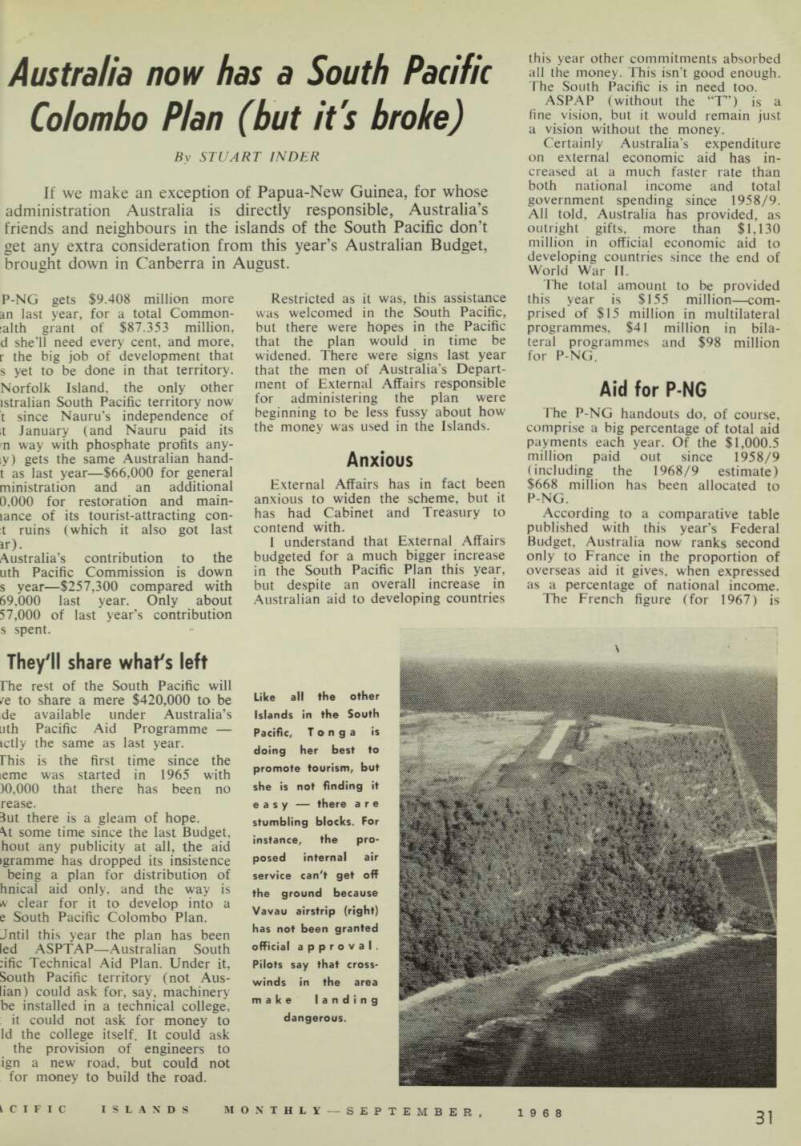
Like all the other Islands in the South Pacific, Tonga is doing her best to promote tourism, but she is not finding it easy there are stumbling blocks. For instance, the pro posed internal air service can't get off the ground because Vavau airstrip (right) has not been granted official approval.
Pilots say that cross winds in the area make landing dangerous.
0.98 per cent. Australia is 0.79, fol lowed by Belgium and the Nether lands each with 0.60, the US and Germany with 0.53 and Britain with 0.49.
It would be an interesting study to see how the aid figures were com piled in the various countries.
France, like Australia, gives a big proportion of its overseas aid to its own territories. But does the aid figure given for Britain take into consideration such British handouts as the grant to sugar-producing countries (Fiji is one) to offset the poor world prices for sugar? For Fiji this is a valuable consideration.
It could be that the aid table might take on a different appearance with closer examination.
But undoubtedly Australia has a good, and improving, record of external aid grants. What is needed is more attention to the needs of the South Pacific, in addition to such requirements as India’s Indus Waters Scheme and the Special Common wealth African Assistance Plan.
FOOTNOTE : To be found in the “other services” section of the Prime Minister’s Department 1968 Budget appropriation is a sum of 57,000, — the cost of the official visit recently of President Hammer Deßoburt of Nauru. It compares with $20,000 for the visit of the Emperor of Ethiopia.